
This week on Manhood Reimagined, I’m offering something a little different: the first lesson from my grief course, Time Doesn’t Heal All Wounds.
I’m doing that because the more men’s work I do, the more convinced I become that grief is one of the great unnamed forces in men’s lives. I see it in the Illuman community. I hear it in conversations with guys here on Substack. I notice it in men’s groups, coffee conversations, fitness-oriented gatherings, and in ordinary friendships with men who are trying to figure out how to live with more honesty, strength, tenderness, and integrity.
And the grief is not only death, though death matters deeply. It is layered. It is different for every man. It is often hidden beneath jokes, busyness, irritability, numbness, achievement, withdrawal, or the old reflex to say, “I’m fine,” when something in us is absolutely not fine.
Some men are grieving divorces they did not expect, or marriages that became lonelier than they knew how to name. Some are grieving years spent chasing the wrong scoreboard, only to realize the prize did not give them the life they wanted. Some are grieving childhood wounds they were never allowed to talk about because boys were taught to toughen up, move on, or turn pain into competence. Some are grieving friendships that never learned how to hold depth. Some are grieving bodies that are changing, fathers they could not reach, children they fear they failed, faith that no longer fits, work that consumed too much, tenderness they exiled, anger they do not know how to metabolize, or parts of themselves they were taught to hate.
A lot of men are not emotionless. They are carrying grief without a map.
Thanks for reading Manhood Reimagined! This post is public so feel free to share it.
That matters because ungrieved grief does not disappear. It often becomes something else. It becomes shutdown. It becomes cynicism. It becomes control. It becomes the quiet despair of realizing you built a life around expectations that never actually made you whole. It becomes the ache of wanting brotherhood, but not knowing how to ask for it without feeling weak. It becomes the instinct to fix, perform, advise, drink, train harder, work longer, disappear, or make a joke before the truth gets too close.
Grief work is not about becoming fragile. It is not about endlessly processing your feelings or making pain your identity. For men, grief work may be one of the most courageous forms of strength there is, because it asks us to stop outsourcing our pain to the people around us and start telling the truth about what we carry.
Masculinity is not performance. It is presence. And presence requires the capacity to feel what is real without being ruled by it.
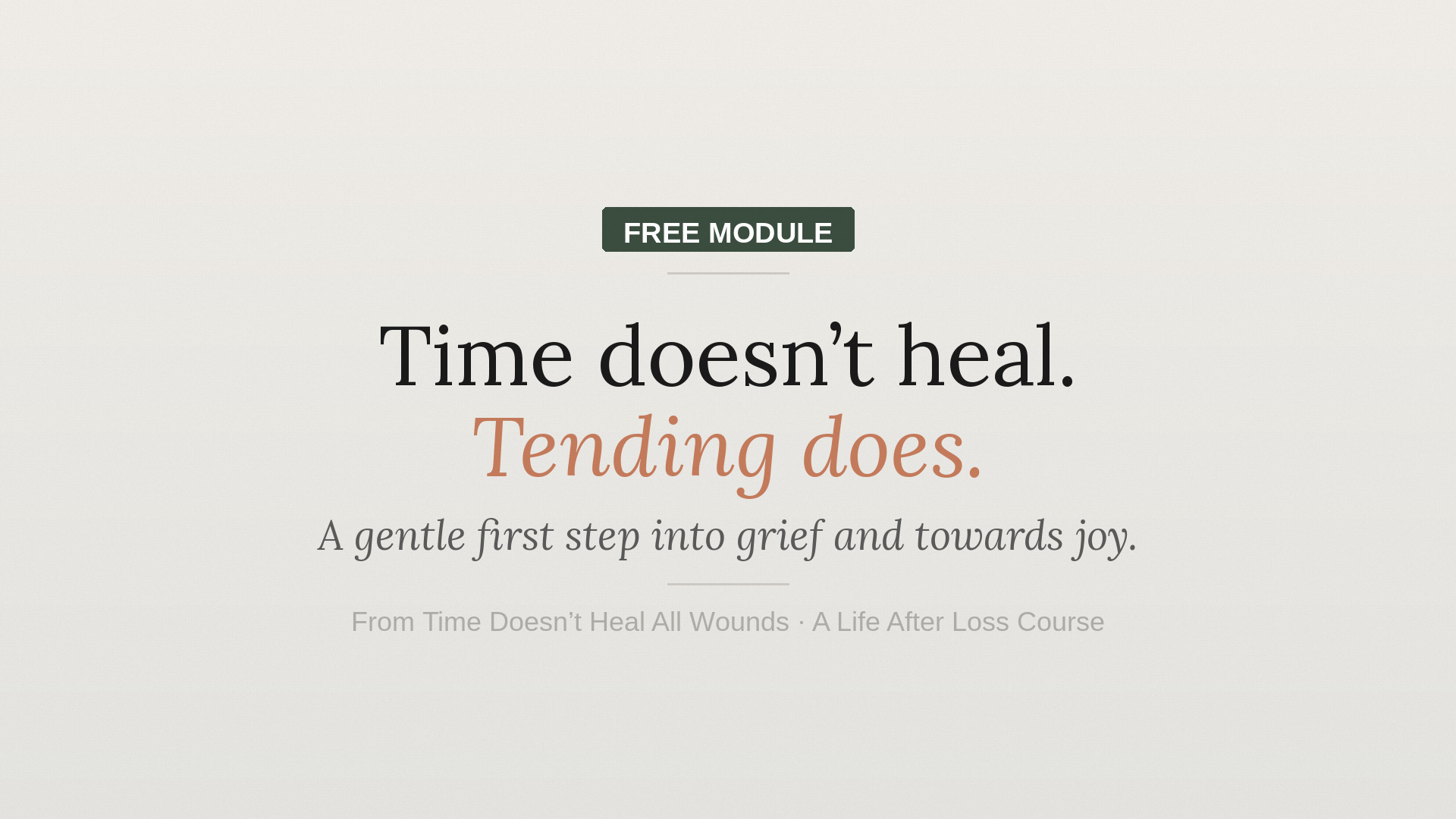
That is why the first lesson in this course begins with a simple idea: time does not heal all wounds. Tending does. Time can pass, and a man can still be carrying the same wound in his body, his marriage, his parenting, his friendships, his faith, and his choices. Time alone does not make us free. Time plus tending can begin to change the texture of grief.
This lesson is an introduction to that kind of tending. It is grief literacy and soul care, not therapy or medical advice. It offers a way to begin gently, honestly, and practically. Not with shame. Not with a demand to collapse. Not with some performance of vulnerability. Just with the invitation to notice what is true, name what has been lost, and begin giving grief somewhere to go.
If you are a man carrying more than you usually say out loud, this is for you. If you have lost someone, yes. But also if you are grieving a divorce, a childhood, a dream, a version of yourself, a faith, a friendship, a body, a father, a role, a future, or years spent trying to become the kind of man you thought you were supposed to be.
This week, I’m offering you the first lesson of Time Doesn’t Heal All Wounds.
And if it meets something real in you, I’m also offering 25% off the full course with the code MANHOOD (act quick, it’s only good for a week).
If you are indigenous or an American Descendent of Slavery, the course is available to you at no cost. Please reach out and I’ll send you a code.
If you’re curious why I’d do this, here’s my statement on reparations.
When I first began my own healing journey, I started to realize that a lot of what I was carrying wasn’t only pain. It was grief.
There were things in my history that were genuinely painful. Abuse. Neglect. Bullying. Moments that shaped me, named me, and taught me the wrong lessons about myself and the world. And when I finally reached a point where I was ready to face those stories and stop letting old wounds dictate present responses, the message I received from the most significant person in my life at the time was simple: “That’s in the past. Just get over it. Move on. Pretend it never happened.”
They were operating with a cultural assumption many of us have inherited: time heals all wounds.
But that message didn’t heal me. It shamed me. It taught me to treat my nervous system like an inconvenience. It taught me to abandon the younger part of me that was still holding what happened.
What I actually needed was different. I needed truth. I needed witness. I needed a way to feel what belonged to those years without getting overwhelmed or swallowed by it. Some of that support was clinical. Some of it was relational. Some of it was grief work and ritual, ways of telling the truth with my body, not only my thoughts.
And over time, something changed. Not because time magically erased what happened, but because time had help. Time plus tending began to change my relationship to the past. It didn’t rewrite the story, but it did soften the grip the story had on me and ultimately changed how I related to it.
I’m starting here because this course is not about fixing you. It is about helping you become more human. It is about learning the kind of tending that makes time able to do its work.
There is a phrase many of us have heard, and maybe even said to ourselves: “Time heals all wounds.” And yet so many people can tell you the truth. Time alone does not heal all wounds.
Francis Weller writes, “Time does not heal our wounds but becomes a product of them.” The longer we carry untended grief, the more it shapes our lives. Not because we are broken, but because grief is powerful, and the body keeps the score.
So why does this myth that time heals all wounds? Because many of us were raised in a grief-phobic culture. We treat discomfort as danger. We treat not feeling good as bad. We treat sadness as something to get rid of. Toxic positivity shows up here, not always as cruelty, but as avoidance. We rush to silver linings. We change the subject. We encourage people to be strong. We call grief a season that should end quickly.
So when grief stays, it is natural to assume something is wrong with you. But if a culture invites you to do something unhealthy, it does not become healthy just because everyone is doing it. And yes, that statement is the upscaled version of your parent’s asking you, “If your friends jumped off a cliff would you do that too? The point is, cultural habits can be common and still be harmful.
Untended grief does not just disappear. It becomes anxiety. It becomes numbing. It becomes irritability. It becomes isolation. It becomes overwork. It becomes addiction. It becomes the inability to be present. It becomes reactivity. On a larger scale, untended grief can feed how we approach war and violence, how we abandon one another, how we harden our hearts, how we pass pain forward.
This is why our carry-forward line matters: time doesn’t heal. Tending does.
All that means that this course is an introduction. We are learning grief literacy. We are naming what is happening in the body. We are learning that grief is not shameful. It is human. And we are stepping into simple grief-tending practices that fit real life.
In this module, you have three supports: the workbook, the ritual, and the guided audio. Each one has a different job.
The workbook is for clarity and language. It helps you name what you lost and what changed. It helps you tell the truth about what you did not get to say, and what you did not get to be. It also helps you detox the clichés you’ve been handed, so you can start replacing them with language that is honest and supportive.
If you only have the capacity for a little work, do this: choose one prompt that feels true, answer it simply, and stop. Small counts.
The Threshold walk is for your body. Grief is often a threshold experience. Something changed. Life before is not the same as life after.
This ritual is a gentle way of marking that truth in motion. It gives you a low-drama container to feel what is real, name what changed, and notice what you carry now. You are not trying to force a breakthrough. You are practicing honest contact.
The audio is for capacity. It helps you arrive in the present, orient to safety, and make contact with what is true without judgment.
If anything feels activating, pause the audio. Look around the room. Feel your feet. Return to breath. You are in charge of your pace.
As you move through this module, hold these questions:
Where have I been taught to treat my grief like a problem to solve instead of a truth to tend?
What part of my story has been shamed away or rushed past?
If time alone is not enough, what kind of tending might be needed?
And remember, you are not failing. You are being human. And you are learning to tend.
0:00
-7:36
If this lesson opens something in you, I want to invite you into the full course.
Time Doesn’t Heal All Wounds is built around a simple but demanding truth: grief does not heal by being ignored, rushed, managed, minimized, or turned into stoic silence. Grief heals through tending. Through witness, language, ritual, body awareness, meaning-making, and small practices that help us stay connected to life.
For men, this matters because so much of what gets called anger, distance, numbness, control, cynicism, or “just the way I am” may actually be grief that never had a safe place to land. And grief is bigger than death. We grieve lost futures, divorces, aging bodies, childhood wounds, estranged relationships, old identities, faith shifts, missed chances, and the parts of ourselves we learned to bury in order to be accepted.
The promise of this course is not that you will never hurt again. The promise is that grief can become less exiled. Despair can become less shameful. Your body can build capacity. Meaning can return without denial. And joy can become possible again, not as forced positivity, but as a deeper yes to life that has made room for the truth.
If you are ready for a guided path through that work, you can enroll in Time Doesn’t Heal All Wounds and use the code MANHOOD for 25% off. And if you are Indigenous or a Descendent of American Slavery, please reach out for the reparations rate.
Time alone does not heal all wounds. But time plus tending can change the texture of grief.
Comments
Nothing yet. Say the first thing.
Sign in to join the conversation.