
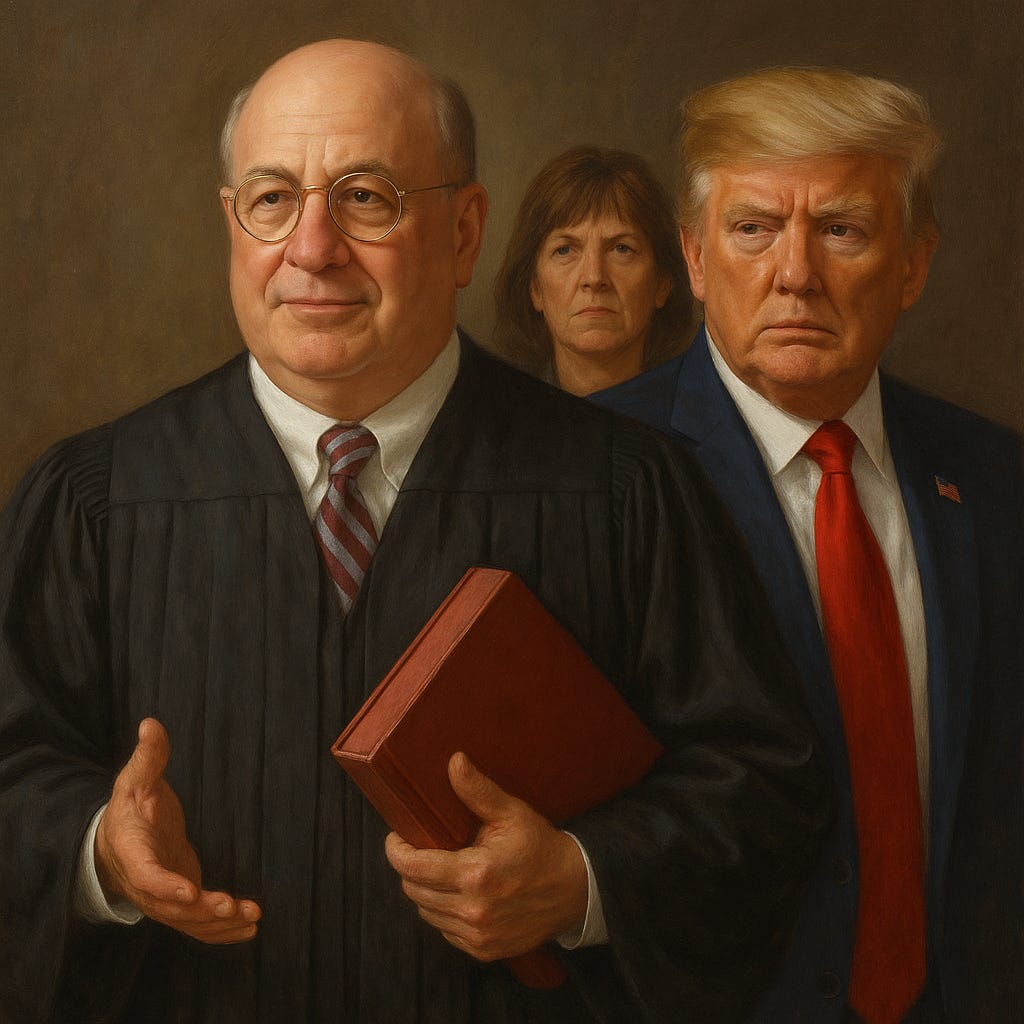
Judge Mark Wolf appointed by Ronald Reagan no less, recently resigned from the bench—not quietly, not for retirement’s ease—but in order to speak openly about what he describes as a serious threat to the rule of law. In his op-ed in The Atlantic, he declared that he “no longer can bear to be restrained by what judges can say publicly or do outside the courtroom.”
He specifically accused Donald J. Trump of using the law for partisan purposes: targeting political opponents, sparing allies, dismantling Justice Department units, issuing unlawful executive orders, and ignoring court rulings. He warned: “President Donald Trump is using the law for partisan purposes, targeting his adversaries while sparing his friends and donors from investigation, prosecution, and possible punishment.”
In his comparison to a darker era, Wolf said: “What Nixon did episodically and covertly, knowing it was illegal or improper, Trump now does routinely and overtly.”
At first glance, it’s a dramatic and urgent story. You might lean in and say: “Yes, we must heed his warning.” But stick with me. Because when you follow the breadcrumbs, you discover something deeper—and far more troubling.
What he and they claim
Trump weaponized the Justice Department to attack his enemies.
He punished law-firms and lawyers for representing opponents.
He ignored court rulings and crushed separation of powers.
He dismantled norms protecting independent institutions.
He targeted minorities and eroded civil rights.
Combined, these charges paint a cinematic villain: a president using the law to crush dissent, crown himself above the courts, and undermine democracy. Judge Wolf positions himself as the guardian stepping in to defend the republic.
The lady doth protest too much, methinks
But here’s where the plot turns. Judge Wolf served on the federal bench from 1985 until 2025 (senior status since 2013). During all those years of high drama—FISA abuses, IRS targeting of us Christians, politicised investigations—he was silent.
Despite many highly political, contentious and ethically fraught episodes, he never publicly sounded the alarm. He only now opts to “speak out” when the target is Trump and the narrative supports his side.
If one’s commitment to impartial justice is genuine and consistent, one would expect earlier and broader critique when law enforcement was used for political ends—not only when it serves one side’s narrative.
His public criticism is singularly focused on Trump’s purported “lawfare.” But where are his critiques of earlier administrations, or major investigations where law and politics intertwined (FISA surveillance, special-counsel probes etc.)? The timing suggests his “moral alarm” may be driven less by principle and more by partisanship.
True—sitting judges are constrained in political speech. Wolf claims his reason for stepping down was to speak freely. But that very constraint means that many critical moments passed without his intervention; when silence becomes a habit, excusing it as ethics feels hollow.
His earlier career shows commendable work in public corruption prosecutions. But commendation in one domain does not guarantee moral consistency in all. When public activism appears timed to a specific political context, one must ask: is the concern justice, or is it which side wins?
Putting the pieces together: Wolf stayed silent through many episodes where law and politics intertwined—and then emerged only to criticise Trump’s alleged abuses. That pattern resembles selective positioning, not a pure moral awakening.
Therefore the claim stands: this man is no saint in the sense of impartial moral authority. He is more plausibly a partisan actor—someone with prestige and legal power, who intervenes only when politically opportune.
What the DOJ complaints actually say they did wrong
Perkins Coie LLP (Executive Order March 6 2025): Accused of “dishonest and dangerous activity,” its prior association with Hillary Clinton’s 2016 campaign, its role in commissioning the Steele Dossier, and its DEI policies undermining national interests.
Wilmer Cutler Pickering Hale and Dorr LLP (March 27 2025): Accused of employing attorneys tied to the Mueller investigation and of “weaponizing prosecutorial power to upend the democratic process and distort justice.”
Jenner & Block (March 25 2025): Accused of representing clients opposed to the administration on gender transition, asylum rights, EPA funding; employing attorneys tied to Trump investigations; and being part of “legal-system weaponization.”
Skadden, Arps, Slate, Meagher & Flom LLP: Allegedly agreed to provide $100 million in pro-bono work and to abandon certain DEI practices to avoid an executive order—creating coercion, conditioning freedom of representation on avoiding disfavoured clients or views.
The Underlying concern is that these orders threaten First Amendment rights (free speech & association), Sixth Amendment rights (access to counsel), and due-process protections by conditioning government contracts, security clearances, or access on representation of certain clients or holding certain views.
Let’s be honest, there is no risk here except for shedding light on decades of corruption in the deep state and their lawfare
Weaponising the DOJ? No — Un-weaponising it.
The same legal class now clutching its pearls oversaw the greatest misuse of federal power in a generation: the FBI’s FISA abuse based on the fraudulent Steele Dossier funded by Perkins Coie. The Inspector General found major errors and fabrications. Trump’s later efforts to clean house—reviewing those same actors—were not “attacks on enemies,” but attempts to restore legality.Punishing law-firms? No — Confronting political operatives masquerading as counsel.
Perkins Coie was not targeted for defending unpopular clients; it was reprimanded for commissioning false intelligence that corrupted federal investigations. WilmerHale was not punished for advocacy; its attorneys ran the Mueller probe that bankrupted innocents without proving collusion. Accountability for abuse of prosecutorial power is not authoritarianism—it is long-overdue justice.Ignoring courts? The courts are functioning—and keep checking him.
Every time an order overreaches, judges enjoin it. That is how the Constitution works. A tyrant defies the rulings; Trump complies or appeals through lawful channels. The fact that these disputes are litigated proves the system remains intact.Breaking norms? Or exposing double standards.
“Norms” are what the permanent class invokes when its privilege is threatened. The Obama-era IRS targeted conservative nonprofits; the FBI spied on journalists. No grand resignations then. Only now, when their monopoly is challenged, do they rediscover reverence for tradition.Assault on civil rights? No — Return to constitutional equality.
The Supreme Court’s 2023 decision in Students for Fair Admissions v. Harvard struck down race-based admissions; DEI mandates allocating opportunity by skin color are now unlawful. Rolling them back is not bigotry—it is fidelity to equality.
The Real Picture
Judge Wolf’s outrage arrives decades late—and exactly on cue: when the entrenched legal order feels threatened. He ignored weaponisation when it came from his side—the dossier, the IRS, the selective prosecutions. Now he calls reform “dictatorship.”
Trump’s opponents say he’s tearing down democracy. In truth, he is challenging an aristocracy: an unelected class of lawyers, bureaucrats, and judges who believe accountability stops with them. Their fear isn’t of tyranny—it’s of exposure.
And Finally: Are We Even a Democracy?[1]
Wolf claims he is defending “democracy.” But the United States was never founded as one. The founders despised democracies for their volatility and “mobocracy.”
James Madison in Federalist No. 10 wrote: “Democracies have ever been spectacles of turbulence and contention.”
John Adams warned, “Democracy never lasts long. It soon wastes, exhausts, and murders itself.”
The founding fathers called democracies, mobocracies because the mob can get together and decide to take away your rights at the whim of the frenzied masses. Remember Robespierre and the French Revolution?
The founding fathers built a constitutional republic based on Exodus 18, not a democracy of shifting majorities and passions. “Our republic is a government where laws are created by representatives elected by the people and bound by the supreme rule of law—the Laws of Nature and of Nature’s God—and by an unchangeable moral constitution. I explain this in greater detail in my book (book.j3ip.com.)”
If a federal judge of forty years doesn’t understand that, then the real threat to the rule of law lies not in the White House—it lies within the ignorance or the duplicity of the judiciary itself.
Judge Wolf is not the savior of democracy. He is at best its confusion made flesh—a man mistaking the preservation of his class’s power for the preservation of liberty. He isn’t standing against tyranny. He’s standing against exposure.
And that, more than anything, reveals where the rot truly lies.
Objection 1: “You’re defending Trump, not the law.”
Rebuttal:
No. This is not a defense of Trump—it is a defense of consistency.
If Judge Wolf or the legal establishment had raised the same alarm when Democrats weaponized the FBI, spied on journalists, or funded a fabricated dossier, then perhaps his outrage now would be credible. But selective morality is no morality at all.
True justice must apply equally. When one side’s abuses are treated as “norms” and the other’s corrections as “tyranny,” the issue is hypocrisy, not law.
This isn’t about Trump’s virtue. It’s about the double standard that destroys trust in every American institution. It is also not an issue about punishing both equally, Trump is not violating the constitution. Biden and Obama did.
Objection 2: “But Trump punished law firms for their political views.”
Rebuttal:
No—he exposed firms that acted as partisan weapons under the guise of law. This SHOULD be punished.
Perkins Coie helped fabricate intelligence used to justify spying on a presidential campaign. WilmerHale’s Mueller team bankrupted private citizens over process crimes while proving nothing. Jenner & Block promoted unconstitutional racial quotas.
When a law firm ceases to practice law and starts to practice politics, it forfeits neutrality.
Accountability for corruption is not persecution; it is the restoration of integrity.
Objection 3: “These executive orders violate the First Amendment.”
Rebuttal:
The same critics who suddenly discover the First Amendment were silent when social-media giants, coordinated by government agencies, censored dissenting voices during COVID and the 2020 election.
They were silent when the IRS targeted conservative nonprofits, when DOJ labeled parents as domestic terrorists, when whistleblowers were silenced.
You cannot demand free speech for elites and suppression for everyone else. If constitutional rights matter, they must matter for all—not just the politically favored.
But most of all, remember the First Amendment does NOT give you the freedom to lie or violate anyone else’s’ liberties.
Objection 4: “He’s undermining democracy.”
Rebuttal:
First, the United States is not a democracy. It never was.
The Founders called democracies “mobocracies.” Madison wrote that they are “spectacles of turbulence and contention.” Adams said they “murder themselves.”
Our nation was built as a constitutional republic, designed to restrain passions, not feed them.
So when Wolf claims he’s defending democracy, he betrays his ignorance—or his allegiance to the mob.
The real threat isn’t that Trump undermines democracy; it’s that the ruling class mistakes democracy for license—the license to rule without accountability.
Objection 5: “He’s using the DOJ to target enemies.”
Rebuttal:
The record shows the opposite. Trump’s DOJ prosecutions have been overturned or enjoined by courts that remain fully functional. The judiciary checks every action, proving the system works.
Contrast that with the years 2016–2020: fabricated FISA warrants, secret surveillance of journalists, and leaked classified information used for political gain—all tolerated by the very same class now clutching its pearls.
Judge Wolf’s outrage isn’t about law enforcement being abused; it’s about control being lost.
The people who once controlled the levers of power cannot stand being investigated by the very machinery they built.
Objection 6: “He’s breaking norms and eroding institutions.”
Rebuttal:
Norms? Whose norms? The norms that allowed bureaucrats to target opponents without consequence? The norms that declared censorship “safety”? The norms that blessed illegal spying as “national security”?
Institutions don’t collapse when they are challenged—they collapse when corruption becomes institutionalized.
Reform is not erosion. It is the rescue of integrity from decay.
Objection 7: “This is authoritarian retaliation.”
Rebuttal:
Authoritarianism silences dissent. Yet the loudest voices against Trump are publishing daily, broadcasting nightly, and teaching in universities nationwide. No one is silenced—they’re amplified.
Meanwhile, ordinary Americans who question government narratives are censored, de-platformed, or fired.
So who is truly wielding authority to suppress speech?
The authoritarian impulse lives in those who claim to “save democracy” by silencing half the nation.
Objection 8: “Judge Wolf is a principled man defending institutions.”
Rebuttal:
Principled men act when principle demands it—not forty years later when their silence has already enabled corruption.
Wolf’s sudden emergence from decades of quiet isn’t courage—it’s coordination.
He didn’t speak when lawfare was first unleashed; he speaks now only because his class is losing its monopoly.
He may believe he’s saving the system, but in truth, he’s shielding the system from scrutiny.
Objection 9: “These actions chill the legal profession and threaten democracy.”
Rebuttal:
They threaten a comfortable class of lawyers who have grown used to power without accountability. That’s not a constitutional crisis—that’s justice finally reaching the unreachable.
The Founders didn’t design our government to protect elites; they designed it to restrain them.
The Republic is not collapsing—it’s waking up.
Objection 10: “You’re attacking a lifelong public servant.”
Rebuttal:
Public service is honorable only when paired with humility and consistency.
A man who swears to uphold the law yet speaks of “defending democracy” misunderstands both. The Constitution protects rights—it doesn’t grant them.
Wolf may see himself as a guardian, but he’s guarding a lie—the lie that unelected power can masquerade as virtue forever.
History is filled with judges who mistook moral theater for moral clarity. Wolf just joined their ranks.
Final Word
The louder the establishment cries “rule of law,” the more we should ask whose law they mean—and whose rule they fear losing.
The Founders warned us of the mob, the passion of democracy, and the tyranny of elites pretending to be its saviors.
Judge Wolf’s protest isn’t the voice of justice. It’s the sound of the old order cracking.
[1] https://www.thedailybeast.com/reagan-appointed-judge-steps-down-to-slam-trumps-assault-on-rule-of-law/
Comments
Nothing yet. Say the first thing.
Sign in to join the conversation.