
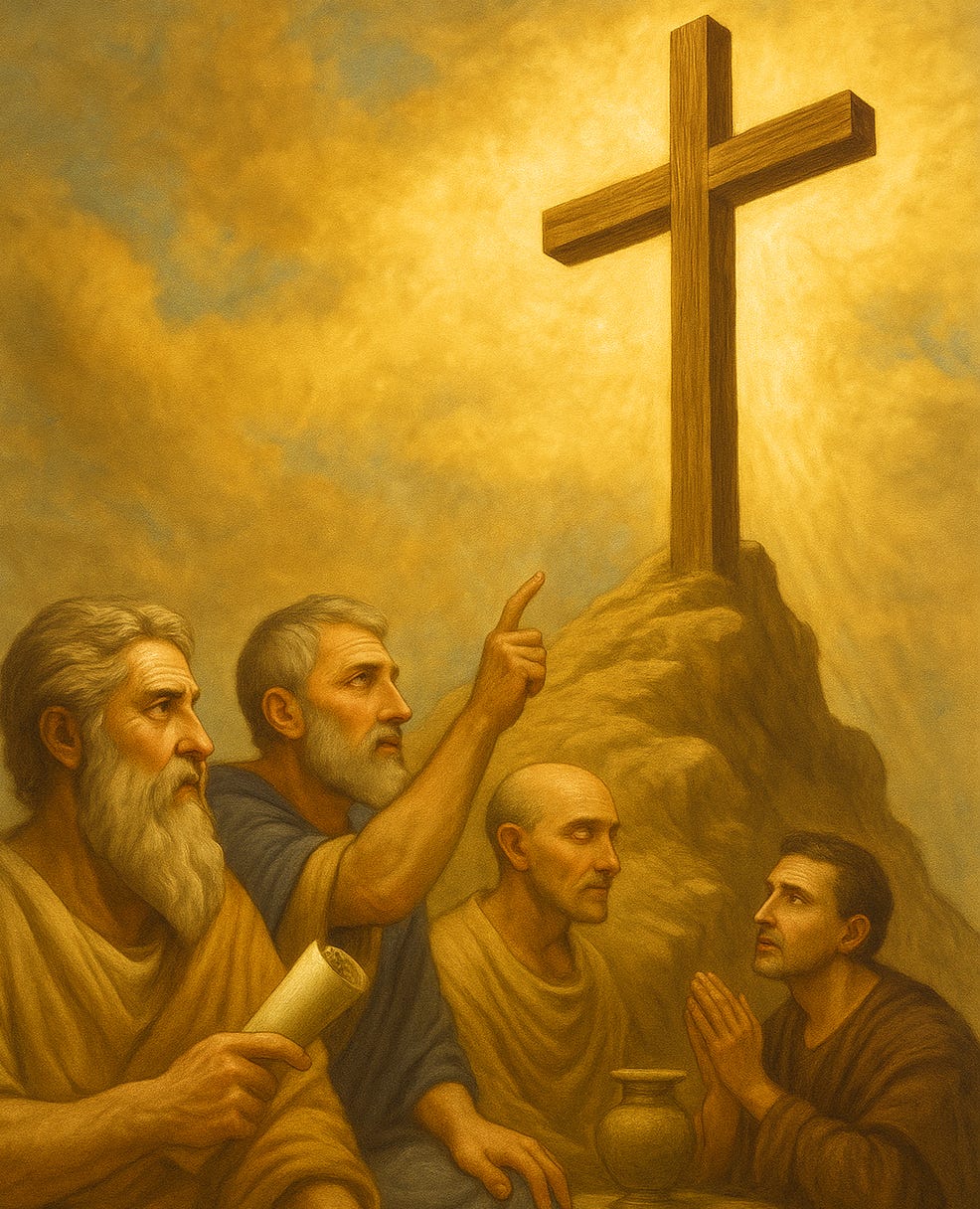
Neil Mammen,
NoBlindFaith.com
November 2025
Have you ever wondered if some things were written into the very fabric of the Universe—truths that could be discovered by reason and logic alone? Truths that can be discovered without the Bible?
Romans 1:20 says,
“For since the creation of the world God’s invisible qualities—His eternal power and divine nature—have been clearly seen, being understood from what has been made (that is the Universe), so that men are without excuse.”
Is God’s nature, salvation, repentance, and the death of Jesus logically derivable from the evidence of the Universe?
This question has bothered me for years. Why did Jesus have to die? Why all the blood and gore? Couldn’t God have figured out a different way to do this?
Yet if God is not capricious, it would seem the only reason Christ had to die is because there really was no other way. If that is true, then His death was not arbitrary but necessary.
If it was truly necessary, then we should be able to logically derive from reason itself that Christ had to die.
Romans 1:20 seems to indicate that we can arrive at God’s existence and His nature simply by observing the Universe.
But where does that verse stop? It says, “so men are without excuse.” That sounds like more than merely, “we can figure out from nature that there is a God.” It seems to imply something closer to, “repent and be saved.”
So the real question becomes this: can what we know about the Universe lead us all the way to the salvation message itself?
In other words, are there things God does not merely by choice, but because His very divine nature requires them?
And if so, these things should be logically inevitable— which would make them deducible from REASON itself.
I want you to note something very critical here. If the reasoning that follows is sound and reaches its full conclusion, then observation, logic, and reason alone necessarily rule out every other existing religion as incomplete or false, and collapse most attempted objections to Christianity. Why? Because as you will see, only Christianity satisfies all the logically concluded principles. I will address those implications in the appendix, because once the argument is complete, this conclusion follows inexorably.
But why would anyone NOT want to use the Bible?
As soon as I mentioned this, folks asked me “why?” Why not just use the Bible?
Here’s why.
When you spend most of your day with Muslims, Atheists and Hindu engineers (like I used to do), if you start your discussion with "the Bible says..," you are immediately hit with "The Koran says Jesus is not God." Or "The Vedas say we are all gods." Or don't be stupid the Bible is full of contradictions and fake stories."
And that’s where it often dies. If your first move is to refute the Koran, you have already lost the room, because many Muslims are more attached to the Koran than most Christians are to the Bible. Your opening volley will trigger defense, not reflection, and once their guard goes up, the Gospel never gets a fair hearing.
Why not start with "Anything that begins to exist needs a cause, yet anything that exists forever needs no cause. And if you disagree with this you are abandoning all scientific knowledge, inquiry and principles."
At that point, they are usually willing to stay in a rational conversation with you, philosophically and scientifically, because you are not attacking their holy book. You are starting from a shared rule of reasoning, and that keeps the door open for the Gospel.
The Ancient Philosophers
While researching for my novel, The Christ Commission—about a Roman Centurion sent by Emperor Trajan to disprove the Resurrection of Jesus—I studied several Greek philosophers: Aristotle, Plato, Plotinus, and Plutarch. Each, in their writings, reasoned up to the edge of divine truth. Plutarch, in particular, came closest to recognizing the need for a sacrifice. Each philosopher held a piece of the puzzle, but none assembled the full picture.
In the end, all four reached upward by reason and came close to revelation’s threshold. Each saw part of the truth:
Plato saw the Good,
Aristotle saw the Cause,
Plotinus saw the One,
Plutarch saw the Need for Atonement.
See the appendix for details on their reasoning.
But none could unite them into a single, coherent reality: a personal, moral, and loving Creator who must also act in justice to redeem. Their philosophies climbed toward God, but stopped short.
So this triggered a thought. What if reason itself, starting only from reality as we observe it, severely constrains all options and by doing so provides what a coherent solution to existence, morality, justice, and evil could look like, even before Scripture is consulted?
Note: I freely acknowledge that I know the Christian claim, but the argument below does not assume it as a premise. It tests whether the nature of reality and the demands of reason and logic alone allow any viable alternative. Nothing in the logical chain depends on Romans 1:20, nor does foreknowledge of the destination affect the validity of the reasoning itself.
The Transcendent Laws (or the Transcendent Arts, as I like to call them) are the laws that exist even if a Universe does not exist. For instance Logic is transcendent, Mathematics is too.
Why? Because 1+1 = 2 even if no Universe exists and there is no Universe where 1 + 1 = 3. On the other hand Physics, Biology, Botany etc. are all dependent on a Universe existing.
By necessity, anything transcendent must be atemporal i.e. it must have existed forever.
So, after much study and thought, I believe I may have resolved it. Here it is. It’s long, but let me know in the comments if you disagree or agree. What are the weaknesses?
Each point addresses an area of discoverable truth. I format it as a Question, Answer and Conclusion format. They all build to a final logical conclusion. Let me know what you think. Do note that some points proceed from the previous conclusions, while others originate as new threads.
Some notes:
I will use familiar theological terms for clarity, but the argument does not depend on Scripture. These terms merely name conclusions reached by reason and could be labeled differently without changing the logic.
To Lawrence Krauss fans, by “nothing,” I mean the absence of anything whatsoever: no space, no time, no energy, no matter, no fields, no laws, no vibrations and no potentialities.
We will use six different threads and study each of them, then bring them together to reveal an inevitable conclusion.
Cosmology. The origin of all things
Moral Philosophy. The nature of good and evil
Power. The source of all power
Love. The essence of relationship
Free Will and Creation. The gift of choice
Justice. The requirements of righteousness
Point 1
Question: Can something begin to exist from nothing?
Answer: No. Without something to start with, nothing could ever begin to exist.
Conclusion: Therefore, if anything begins to exist, it must have come from something.
Note: If something begins to exist, there must be a sufficient reason for its existence rather than nonexistence. This is not an appeal to blind faith, but to the basic intelligibility of reality itself. Denying this principle would undermine explanation, inquiry, and rational thought. In fact denying this would be denying the very philosophical foundation of Science and the scientific method.
Point 2
Question: Is there something?
Answer: Yes. The Universe (i.e. Time, Matter and Energy) and we ourselves exist.
Conclusion: So something exists now.
So let’s think about this: if something’s here, it had to come from somewhere. So now we ask—what started it all?
Characteristics so far: Source of all
Point 3
Question: Has everything existed forever?
Answer: No. Science clearly shows that most things begin and end. It shows the Universe (Time, Matter and Energy) had a beginning. All accepted theories today show that you can’t have Time without Matter, you can’t have Matter without Energy and you can’t have Energy without Time. Modern physics shows that time is not an independent backdrop but part of spacetime. Matter and energy exist within spacetime, and changes in energy and matter affect the structure of spacetime itself. While details are debated, contemporary physics treats time, space, matter, and energy as deeply interrelated rather than separable primitives. Additionally, the Borde–Guth–Vilenkin theorem shows that any spacetime which has, on average, been expanding cannot be extended infinitely into the past. This strongly indicates that the physical universe is past-incomplete and therefore requires an explanation beyond itself.
Conclusion: So not everything is eternal.
Point 4
Question: So where did everything not eternal come from?
Answer: It must have come from something eternal.
Conclusion: That eternal thing is the source of all things that began to exist. The eternal thing created Time, Matter and Energy. The Eternal thing is not composed of matter, does not need energy and is not constrained by time.
Extension: Since nothing comes from nothing, if anything exists, something (which made everything else exist) must have existed forever. “Anything that begins to exist needs a cause, anything that has existed forever needs no cause.” This was actually core concept in ancient Greek philosophy, particularly associated with Parmenides. An infinite regress of purely contingent causes cannot explain why anything exists at all, because each member would still depend on something else. Therefore, explanation must ultimately terminate in something that exists necessarily and does not depend on another. Note denying that everything that begins to exist needs a cause is to deny philosophy, science, logic and reason.
Characteristics so far: Source of all, Eternal
Point 5
Question: If something existed forever and is the origin of everything else. What do we call it?
Answer: The Creator.
Conclusion: There must be as least one eternal Creator behind everything. Because the Creator is eternal and necessary, His nature and character do not change, even though His actions and relations to creation freely occur in time. And because it is the source of all things, if anything exists it is necessary. It is a non-contingent Creator.
Now, if the Creator is necessary rather than contingent, then He cannot gain or lose properties. Any change would imply unrealized potential, which contradicts necessity. Therefore, immutability follows not merely from eternity, but from being necessary in nature.
Characteristics so far: Source of all, Eternal, Immutable, Necessary, Non-Contingent
Some at this point may argue that this thing that created everything could be some random accident, an amoral non sentient thing, some “think” like a quark. But the same principle we noted above, that nothing comes from nothing, also logically and philosophically and rationally indicate that you can’t get sentience from non-sentience, you can’t get intelligence from non-intelligence. This rules out all mere “objects.”
Okay, so we’ve got a Creator. But who is this Creator being? What kind of person—or power—would make a universe like ours? Are there any obvious characteristics of this Creator that we can get to from here?
Point 6
Q: Is evil something that exists on its own, like a rock or a tree?
A: No, evil depends on good to exist—it’s a corruption, twisting or privation of good, like a shadow depends on light.
If you need proof of this then define one thing that is evil, without referring to an uncorrupted core.
C: Evil is not its own thing; it is only the corruption of good.
Note: The shadow analogy is different from darkness. Darkness would be amorality—i.e. the total absence of the good light, not the blocking of it. Defining evil as suffering, betrayal, or injustice does not refute privation theory. Each of these presupposes an underlying good—life, trust, justice—that has been damaged or withheld.
In the appendix we quote multiple philosophers who came to this conclusion and the proof of this.
Point 7
Q: If evil isn’t truly something on its own, could it exist without good? Could it exist eternally on its own.
A: No, because a shadow disappears when the light is gone. So in the same way since evil can only exist as a corruption of that which is good, if the evil destroys all the good then the evil will cease to exist along with the good. So it can’t exist eternally.
C: Evil cannot be eternally existent and powerful; of the two, only good can be eternal.
Evil can’t last forever on its own, only goodness can. So the big question becomes—what about something that was half evil and half good. Like Ying and Yang or the Force in Star Wars? Can those coexist for all eternity past?
Point 8
Q: If something were partially good and partially evil, what would happen over eternity?
A: First as we’ve seen, evil is not a thing on its own. It’s a corruption of a pre-existing good. Which means evil cannot come into existence unless good already exists. Therefore, evil can never causally or atemporally precede good in existence, and it depends on good continuing to exist for it to exist.
From the beginning, then, if evil appeared at all, it would always be lesser than the good. It would always come after good has already existed. By its very nature, good would strive to heal and cleanse this minor evil and would eventually overcome it, becoming wholly good again. As we will see later the Good must be personal and knowledgeable thus it would know to never let Evil become equally as strong as it.
Thus, one could never logically arrive at an equal and opposite good and evil. If, in some unfathomable way, evil were to gain the upper hand, it would continue destroying the good until, over eternity past, both would be gone—and evil itself would have ceased to exist.
A being that is eternal—without beginning and without dependence—would, over infinite duration, eliminate any defect, since defect is a lack of some proper good. Persistent defect would imply either limitation or inability to perfect, contradicting necessity and fullness of being. Therefore, only what is wholly good can be eternal in this sense.
C: Therefore, only what is fully good can exist forever.
Characteristics so far: Source of all, Eternal, Immutable, Necessary, Non-Contingent, Good
OK what about multiple Eternal Creators of everything? Now that we’ve come this far, can we derive Monotheism from logic? If we can do so then Monotheism ceases to be a theological concept and becomes a necessary and logical concept.
Point 9
Q: How much power does the creator of all things have?
A: All the power. Power is the capacity to actualize states of affairs. If the Creator is the ultimate source of all contingent reality, then every instance of causal power derives from Him. Therefore, no power can exist independent of or greater than His, which entails maximal power.
C: So the creator of all things is all powerful.
Remember, from the last few points we have concluded: The creator of all things is eternal, all good and all powerful.
Note: this is different from a man creating dynamite which is more powerful than him. The power of dynamite and nuclear bombs are in the very materials themselves, i.e. in the atomic bonds or the pressure that was built up. All the man did was mix pre-existing molecules together, not create the very molecules with the energy contained in them. The Being who created all the molecules itself would be more powerful than the energy in the bonds, more powerful than the molecules, more powerful than the dynamite, more powerful than the nuclear bombs. If you follow the logic it would be clear that this Being would be unable to create anything more powerful than Himself. ( See this link to answer the question of: Can God Create a Stone bigger than He can move). Not to mention that this Being would also not desire to create anything more powerful than Himself.
Characteristics so far: Source of all, Eternal, Immutable, Necessary, Non-Contingent, Good, Omnipotent
Point 10
Q: Can you have more than one all-powerful being?
A: No. If there were two beings, each could limit the other’s power in some ways, which means neither would be truly all-powerful. If there were two beings and one being was less powerful than the other, the weaker would only exist at the pleasure of the more powerful which would mean the first was really the all-powerful being, not the lesser.
C: So the eternal good Creator can only be a single all-powerful being.
Characteristics so far: Source of all, Eternal, Immutable, Necessary, Non-Contingent, Good, Omnipotent, One
OK if there’s only one all-powerful Creator, then what is He like? Let’s find out if we can derive that He is loving. And in that process we may discover another characteristic of this Creator.
Point 11
Q: Is love good?
A: Yes, it is transcendent. That means it must have existed forever and not be contingent on anything.
C: Then perfect goodness must include perfect love. The best word for this kind of love is “Agape.”
Note: Philosophers before Paul already distinguished higher, virtue-oriented love from lower desire. Plato taught that the highest love seeks the good of the soul, Aristotle defined the best friendship as mutual pursuit of one another’s moral good, and the Stoics emphasized universal benevolence, rational goodwill, and self-controlled commitment to the good of all.
It’s easy to argue that Agape Love is good, because it objectively seeks the benefit of others. Remember destructive or selfish love is not Agape.
But is Agape transcendent?
First, love makes claims that go beyond biology.
Chemistry can explain why you feel attached.
It cannot explain why you ought to keep your vows when it hurts.
It cannot explain why you should forgive when you could get revenge.
It cannot explain why you should care for a dying spouse or parent or beggar when there is no future payoff.
“Ought” language does not come from molecules. Molecules describe what is, they do not command what should be. As Frank Turek would say: You can’t get an ought from an is.
Second, love points beyond time.
We do not just want pleasure now, we want permanence.
We do not say, “I love you until the feeling fades.”
We say, “forever.”
Even people who do not believe in eternity still talk like love deserves eternity. That is a clue that love is not merely a tool for survival. It feels fitted for something lasting. You cannot explain love in evolutionary terms, loving someone who can never benefit you, or an old person who is dying is contrary to the “selfish gene” concept. It violates the entire survival of the fittest.
There are many other transcendent characteristics you can derive about the perfectly good Creator in this manner. But we will limit this dialog to the minimum we need.
Characteristics so far: Source of all, Eternal, Immutable, Necessary, Non-Contingent, Good, Omnipotent, One, Loving, Relational
However, we hit a small dilemma here, it turns out if the Creator is love then there’s another necessary character that reason requires Him to be.
Point 12
Q: If love is good, how can the Creator be loving unless there is someone else to love?
A: Love requires relationship—someone to give and receive it.
C: For the Creator to be love eternally, love must have always existed within Him.
Point 13
Q: Was the Creator loving for all eternity?
A: Yes.
C: So agape love existed within God before anything was created.
Point 14
Q: If the Creator can only love contingently, i.e. after creating people, then He wouldn’t have been loving forever.
A: So there must be multiple persons in the Creator for Him to be love for all eternity.
C: the Creator is one being with eternal love shared between divine Persons.
Characteristics so far: Source of all, Eternal, Immutable, Necessary, Non-Contingent, Good, Omnipotent, One, Loving, Relational, Multipersonal
And thus we come to the Creator that consists of at least 2 persons. Can this further lead to the Trinity, it does, but we won’t study that path at this time. If you are interested, see Augustine’s and Richard of St. Victor’s writings. If there is enough interest I will do an article on it.
If love is eternal, then the Creator didn’t start loving when people showed up (His love is not contingent on creation). He already was agape love. But agape love always wants more people to share it with—and that’s where creation comes in.
Point 15
Q: The Universe has people. If the Creator is good and powerful, why would He create these people—out of need or out of love?
A: Out of love. If the Creator created out of need, He would not be all powerful or self-sufficient, because He would depend on something outside Himself and be lacking in some aspect.
C: Creation is an act of generosity, not necessity, proving God’s self-sufficiency and love. Creation also indicates that the Creator is a Creator with free will because he freely creates people whom He loves when He did not need to.
Characteristics so far: Source of all, Eternal, Immutable, Necessary, Non-Contingent, Good, Omnipotent, One, Loving, Relational, Multipersonal, Free-willed
Point 16
Q: The Universe has people. Would the Creator want to create these people to be able to freely love Him?
A: Yes, because real love is good and real love must be freely given.
C: The Creator creates free beings capable of real love. Note: That does not mean He only creates beings capable of real love, He may create other beings.
Characteristics so far: Source of all, Eternal, Immutable, Necessary, Non-Contingent, Good, Omnipotent, One, Loving, Relational, Multipersonal, Free-willed, Personal
As we see this also results in a personal Creator, personal to us who He wants to love and be loved.
Point 17
Q: If people can freely love, must they also be free not to love—or even to hate or rebel against the Creator?
A: Yes, true freedom must include both options.
C: The possibility of rebellion by doing evil is the cost of freedom. It is the cost of Free Will.
Point 18
Q: So what happens when people freely choose not to love or obey God?
A: They separate themselves from Him and do evil.
C: That separation and wrongdoing is what we call sin.
OK are you with me so far? We’ve derived a lot of logical and necessary characteristics of this Creator. Let’s see if we can discover a few more.
Freedom sounds amazing until we use it to hurt others—or the Creator. Once that happens, we’ve got a problem bigger than we can fix ourselves. That’s where justice comes in.
Point 19
Q: Are justice and mercy and forgiveness good?
A: Yes.
C: So the Creator must be just, merciful and provide forgiveness.
Characteristics so far: Source of all, Eternal, Immutable, Necessary, Non-Contingent, Good, Omnipotent, One, Loving, Relational, Multipersonal, Free-willed, Personal, Just, Merciful
Now, some skeptics might say, “Hold on—you’re just making up qualities for the Creator, throwing it at your logic and hoping something sticks.” Fair enough. In a way, they’re right to question that. But think about how science actually works. You start with what you can observe, you test ideas, and you keep what fits the evidence.
That’s what we’re doing here. We’re not inventing qualities for the Creator, we’re testing them. If something doesn’t fit reason, logic, or reality, it falls apart. It’s just like an experiment that fails.
Try saying, “Maybe God is evil,” or “Maybe there are ten equal gods fighting each other.” Run that through logic and it breaks instantly. It doesn’t match what we already know about cause, morality, and coherence. The false ideas don’t stick because truth has boundaries, it’s consistent.
So what we’re doing isn’t guesswork, it’s discovery. We’re following the evidence where it leads, even if that path happens to point toward a Creator who is eternal, good, powerful, and loving.
And there’s no “my logic” or “your logic.” Either you have logic or you have illogic. Logic is one of the Transcendent Arts.
Point 20
Q: To be perfect, the Creator must also be just and merciful and loving? If so, can He ignore evil and sin?
A: No. To remain perfect, He must punish sin.
C: The Creator must punish sin.
This concept is not unique to Christianity, we note multiple cultures and writings of this that preceded the New Testament.
Characteristics so far: Source of all, Eternal, Immutable, Necessary, Non-Contingent, Good, Omnipotent, One, Loving, Relational, Multipersonal, Free-willed, Personal, Just, Merciful, Righteous
Point 21
Q: If The Creator must punish sin, is He being merciful or forgiving?
A: No.
C: So the Creator has a dilemma: is He just or is He merciful & forgiving? It would seem that He has to pick one over the other.
Point 22
Q: How can justice be satisfied?
A: Justice is satisfied if a payment is made and a punishment is meted out.
C: So if someone else makes the payment and takes the punishment, the Creator may be able to be just.
Point 23
Q: Could an unwilling substitute take the punishment that justice demands so mercy can still be given?
A: No, an unwilling substitute would be unjust.
C: Justice and mercy can meet through a willing substitute, so we need to find a willing substitute. A Savior of mankind is needed.
Now the courtroom gets real. Someone has to pay, but no one can afford the price. So who steps up? Who can step up?
Point 24
Q: If the rebellion is against the infinite the Creator, how great is the punishment owed?
A: The punishment must be infinite, because the offense is against an infinite being.
C: Only something infinite could fully satisfy such a debt. That mean the debt can only be paid by the Divine.
Characteristics so far: Source of all, Eternal, Immutable, Necessary, Non-Contingent, Good, Omnipotent, One, Loving, Relational, Multipersonal, Free-willed, Personal, Just, Merciful, Righteous, Infinite
Note:
A finite human being could never pay an infinite debt. A sinner could only pay for their own sin, and even a perfect human could only substitute for one other person. But the moral debt of humanity is infinite, so only an infinite being could pay it in full.
By now, we know justice demands payment and mercy needs a substitute. But who could possibly step in? This is where reason itself hits a wall—and something remarkable appears on the other side.
Point 25
Q: If the crime of rebellion was committed by a human, could a non-human be the substitute?
A: No, because the same kind must pay the price.
Someone both human (to represent us) and divine (to bear the infinite cost).
C: The Savior must be fully divine and fully man. Yet distinct in person. He must be an incarnation (in the flesh)
Note:
Some might ask whether an angel, animal, or any other kind of freewill being could take humanity’s place. The answer is no.
1. Animals have no free will or moral awareness; they act by instinct, so they cannot sin or atone.
2. Objects or forces (like fire, wind, or stars) have no will at all.
3. Angels or other free beings, though possessing will, are not human. Justice requires that the same kind of being bear the punishment for its own kind’s rebellion. An angel could not represent humanity before perfect justice any more than a human could atone for angelic rebellion.
Only a human can pay for humanity’s rebellion—but since the debt is infinite, that human must also possess divine nature to bear it.
If the rebellion came from humans, then justice says a human must pay. But no normal person could survive an infinite sentence. So the only answer that works is shocking: someone who is both human and divine. The logic leaves no other option.
Think of it like math—you can’t divide by zero. Here, you can’t balance infinite guilt with finite goodness. It’s impossible… unless the infinite becomes one of us.
But even a perfect substitute doesn’t help if we refuse it. Picture a rescue helicopter hovering overhead while someone drowns—but they won’t grab the rope. Justice can be satisfied, mercy can be offered, but you still have to reach out.
Point 26
Q: If a human rejected the Mercy of God or refused to repent would Justice and Mercy apply to them.
A: No, because each person who wants mercy must accept it and transform their lives.
C: Repentance and the acceptance of the substitutionary punishment is a prerequisite.
So the Creator’s offer isn’t automatic. It’s personal. Love must be accepted freely, or it’s not love at all. That’s why repentance isn’t just saying “sorry”—it’s choosing to be rescued and transformed by the renewal of your mind.
Characteristics so far: Source of all, Eternal, Immutable, Necessary, Non-Contingent, Good, Omnipotent, One, Loving, Relational, Multipersonal, Free-willed, Personal, Just, Merciful, Righteous, Infinite
Point 27
Q: So if God chooses to create mankind with freewill, why do we need a Savior?
A: Because only one who is both God and man can restore us to God by satisfying justice and showing mercy. But we have to repent and accept it.
C: Reason, morality, and love all point to the necessity of a 2nd person of the God Being who comes as an incarnation, a man to become the Savior and sacrifices Himself to pay the price for Justice. And as we can prove separately Jesus alone fulfills it.
This is the Gospel. This is the Salvation message! Final Characteristics: Source of all, Eternal, Immutable, Necessary, Non-Contingent, Good, Omnipotent, One, Loving, Relational, Multipersonal, Free-willed, Personal, Just, Merciful, Righteous, Infinite,
And you’ll note we never needed to use the Bible to conclude any of this. We only used logic, reason, and observation of the Universe.
Let’s step back and review our journey. We started with “something exists” and ended with “someone saves.” All by reason alone. No miracles, no verses—just logic and observation.
The funny thing is that, now that you see this, you realize it’s always been obvious. We just hadn’t thought through it. Once you’ve seen it you can’t unsee it.
Note: This does NOT bring you to the Trinity or to the name Jesus as the one who is the Savior/Messiah/Christ, we STILL need the Revealed Truth (i.e. the Bible or the Gospel Witnesses of the Saints) for all the details. But that is not the purpose of this dialog. It’s to show that Logic and Reason itself, point to God and tell you that need a Savior, repentance and salvation; even if you don’t read or accept the Bible. In fact just given that knowledge you could repent to the Creator and ask to be saved by the sacrifice who is God. If you haven’t done so wouldn’t it be logical to do so now?
Getting to Jesus’ name and the Bible being true can be proven in other ways see https://www.youtube.com/@XBlindFaith/videos
If you have ANY objections, or see weaknesses or wish to refute this argument, please comment and I will address them.
Scroll down for Existing Objections and my Responses
If the moral and cosmological reasoning we’ve developed is true—if logic and observation themselves reveal the nature of a perfectly good, personal, and loving Creator who must act in justice and mercy—then this framework quietly but completely rules out every competing worldview that cannot account for these same logical necessities.
Atheism and Materialism:
These collapse at the first premise. “Something cannot come from nothing” eliminates materialistic naturalism. The moment we affirm the existence of a universe with laws, order, and moral reality, atheism loses coherence. While some may argue that this is begging the question the reality is that:Atheism cannot account for why anything exists, nor for why we have consciousness, reason, or moral awareness.
It fails the Principle of Sufficient Reason and offers no eternal, necessary cause. This is also a critical tenet of science. Deny this and you deny 1000’s or years of science. Good luck with that.
Pantheism and Eastern Dualism (Hinduism, Taoism, Yin-Yang, George Lucas’ Force, New Age, Animism, ancient myths, etc.):
The idea of equal, eternal good and evil self-destructs logically. Evil is a corruption of good; it cannot coexist as a co-eternal opposite. Over eternity, either good purifies evil or evil annihilates good and itself.Thus, the eternal balance of Yin and Yang is impossible.
Pantheism’s impersonal “oneness” cannot explain personal love or moral accountability.
Animism can’t explain creation or a personal God.
Polytheism (Greek, Roman, Norse, Hindu, Pagan, etc.):
Multiple “gods” imply limited beings, not all-powerful ones. By logical definition, only one can be truly omnipotent.Any worldview with rival deities contradicts the necessary unity of the eternal Creator.
Deism:
The God of pure intellect or power but without love fails reason’s test of moral goodness. A perfect being must be not only powerful but also relational and loving.The deistic god is logically incomplete—it explains causality but not morality, justice, or mercy.
Islam and other strict monotheisms without internal plurality:
If God is truly love in His essence, He must have had relational love within Himself eternally, before creation. A purely singular god could not love until He created others—making His love contingent, not eternal.Therefore, only a God with internal relationality (a Trinity) can be love itself.
Humanism and Moral Relativism:
The very claim “evil exists” or “injustice is wrong” invokes an absolute moral standard. Without an objective moral lawgiver, such claims are meaningless preferences.By acknowledging good and evil, humanism inadvertently affirms God.
This argument quietly dismantles most of the popular attempted refutations of Christianity:
“Jesus was just a moral teacher.”
Logic demands more: if God is both just and merciful, the only coherent way to satisfy both is through a voluntary, divine substitute—exactly what the Incarnation provides. While we don’t argue it here it was clear that if Jesus was just a moral teacher he would have been lying about the issue of atonement.“All religions lead to the same God.”
Impossible. The necessary characteristics of the true Creator—eternal, all-good, all-powerful, personal, relational, and self-sufficient—exclude all other systems that deny one or more of these traits, especially since the law of non-contradiction indicates that all contrary claims can’t be simultaneously true.
Where does it stop?
If reason, observation, and logic can reveal a Creator who is eternally good, relational, just, and merciful, then it necessarily leads to a God who provides atonement through a willing Savior.
And that means this:
Observation, logic, and reason alone eliminate every other religion and worldview as inconsistent with the necessary structure of reality.
It also means most modern disputes against Christianity—whether moral, philosophical, or scientific—collapse under their own assumptions.
Romans 1:20 then becomes not just a statement of theology, but a statement of logic:
“So men are without excuse.”
It implies not only that God exists, but that reason itself calls us to repentance and salvation.
Eternal: the first cause did not begin to exist.
Necessary: all contingent things depend on it.
Self existent: its being is in itself, not from another.
Uncaused cause: it explains all things that begin to exist.
Creator: the source of all non eternal reality.
Immutable: the ground of change is itself not changing in being.
Omnipotent: creator of all power, limited by nothing outside itself.
One: multiple all powerful beings cannot coexist, so monotheism follows.
Rational mind: laws and math describe, they do not cause, so the first cause is personal and intelligent.
Moral foundation: objective morality requires a moral source.
Good: evil is privation of good, only the wholly good can be eternal.
Omnibenevolent: perfect goodness without admixture of evil.
Truthful: a rational, moral source is aligned with truth, not deception.
Just: real moral law entails real accountability.
Merciful: goodness includes mercy and forgiveness rightly ordered.
Love, agape: perfect goodness includes perfect self giving love.
Relational: love requires giver and receiver.
Intra divine love: if love is eternal, love existed within the creator before creation.
Plurality of persons: eternal love within the one being implies multiple divine persons.
Free will: creation is by generosity, not by need.
Purposeful: creation is intentional, aimed at goods like life and relationship.
Personal toward us: creates persons capable of knowing and loving.
Grants creaturely freedom: love that is real must be chosen.
Allows the possibility of evil: freedom entails the option to rebel.
Sin defined: separation from the good by free moral rebellion.
Justice must punish: perfect justice cannot ignore real wrongs.
Mercy must save: perfect love seeks restoration, not mere condemnation.
Justice and mercy meet by substitution: a willing substitute satisfies justice and extends mercy.
Debt is infinite: offense against the infinite good has infinite weight.
Kind matched substitution: humanity sinned, a human must represent humanity.
Divine capacity required: only the infinite can bear infinite debt.
Incarnation required: the savior must be fully God and fully man.
Willingness required: the substitute must choose the payment, or justice is violated.
Repentance required: mercy is received by free acceptance and moral turning.
Savior necessary: given justice, mercy, and love, a savior is logically required to reconcile rebels to the good.
These conclusions arise from existence, causality, morality, and the nature of perfect love, using logic alone.
Christians, lest you think the Bible does not show these points, here are the same points but with the verses that support them listed.
1. Eternal
Psalm 90:1–2 (NASB 2020)
1 Lord, You have been our dwelling place in all generations.
2 Before the mountains were born or You gave birth to the earth and the world, even from everlasting to everlasting, You are God.
Other verses: Isaiah 57:15, Revelation 1:8.
2. Necessary
Colossians 1:16–17 (NASB 2020)
16 For by Him all things were created, both in the heavens and on earth, visible and invisible, whether thrones, or dominions, or rulers, or authorities— all things have been created through Him and for Him.
17 He is before all things, and in Him all things hold together.
Other verses: Hebrews 1:3.
3. Self existent
Exodus 3:14 (NASB 2020)
14 And God said to Moses, “I AM WHO I AM”; and He said, “This is what you shall say to the sons of Israel: ‘I AM has sent me to you.’”
Other verses: John 5:26, Psalm 36:9.
4. Uncaused cause
John 1:3 (NASB 2020)
3 All things came into being through Him, and apart from Him not even one thing came into being that has come into being.
Other verses: Genesis 1:1, Hebrews 3:4.
5. Creator
Revelation 4:11 (NASB 2020)
11 “Worthy are You, our Lord and our God, to receive glory and honor and power; for You created all things, and because of Your will they existed, and were created.”
Other verses: Genesis 1:1, Nehemiah 9:6.
6. Immutable
Malachi 3:6 (NASB 2020)
6 “For I, the Lord, do not change; therefore you, the sons of Jacob, have not come to an end.”
Other verses: James 1:17, Hebrews 13:8.
7. Omnipotent
Jeremiah 32:17 (NASB 2020)
17 ‘Oh, Lord God! Behold, You Yourself have made the heavens and the earth by Your great power and by Your outstretched arm! Nothing is too difficult for You.’
Other verses: Genesis 18:14, Matthew 19:26.
8. One
Isaiah 45:5 (NASB 2020)
5 “I am the Lord, and there is no one else; There is no God except Me.”
Other verses: Deuteronomy 4:35, James 2:19.
9. Rational mind
Psalm 147:5 (NASB 2020)
5 Great is our Lord and abundant in strength; His understanding is infinite.
Other verses: Isaiah 55:8–9, Romans 11:33.
10. Moral foundation
Psalm 119:137 (NASB 2020)
137 Righteous are You, Lord, And upright are Your judgments.
Other verses: Deuteronomy 32:4, Psalm 89:14.
11. Good
Psalm 34:8 (NASB 2020)
8 Taste and see that the Lord is good; How blessed is the man who takes refuge in Him!
Other verses: Psalm 145:9, Nahum 1:7.
12. Omnibenevolent
1 John 4:8–9 (NASB 2020)
8 The one who does not love does not know God, because God is love.
9 By this the love of God was revealed in us, that God has sent His only Son into the world…
Other verses: Psalm 136, John 3:16.
13. Truthful
Titus 1:2 (NASB 2020)
2 in the hope of eternal life, which God, who cannot lie, promised long ages ago,
Other verses: Hebrews 6:18, John 14:6.
14. Just
Psalm 9:7–8 (NASB 2020)
7 But the Lord sits as King forever; He has established His throne for judgment.
8 And He will judge the world in righteousness; He will execute judgment for the peoples fairly.
Other verses: Acts 17:31, Romans 2:5–6.
15. Merciful
Psalm 103:8 (NASB 2020)
8 The Lord is compassionate and gracious, Slow to anger and abounding in mercy.
Other verses: Exodus 34:6, Micah 7:18.
16. Love (agape)
1 John 4:16 (NASB 2020)
16 We have come to know and have believed the love which God has for us. God is love, and the one who remains in love remains in God, and God remains in him.
Other verses: Romans 5:8, John 17:26.
17. Relational
John 17:24 (NASB 2020)
24 Father, I desire that they also, whom You have given Me, be with Me where I am, so that they may see My glory…
Other verses: Exodus 33:11, Revelation 21:3.
18. Intra divine love
John 17:24 (NASB 2020)
…for You loved Me before the foundation of the world.
Other verses: John 1:1–2, John 17:5.
19. Plurality of persons
Matthew 3:16–17 (NASB 2020)
16 After He was baptized, Jesus…
17 …a voice from the heavens said, “This is My beloved Son, with whom I am well pleased.”
Other verses: Genesis 1:26, Matthew 28:19.
20. Free will (in God)
John 10:17–18 (NASB 2020)
17 …I lay down My life…
18 No one has taken it away from Me, but I lay it down on My own.
Other verses: Ephesians 1:11, Psalm 115:3.
21. Purposeful
Isaiah 46:9–10 (NASB 2020)
9 …I am God, and there is no one like Me,
10 Declaring the end from the beginning… I will accomplish all My good pleasure.
Other verses: Ephesians 1:9–10, Proverbs 16:4.
22. Personal toward us
Genesis 1:26–27 (NASB 2020)
26 Then God said, “Let Us make mankind in Our image…”
27 So God created man in His own image…
Other verses: Psalm 8, Acts 17:27–28.
23. Grants creaturely freedom
Joshua 24:15 (NASB 2020)
15 …choose for yourselves today whom you will serve…
Other verses: Deuteronomy 30:19, Isaiah 1:18–20.
24. Allows the possibility of evil
Genesis 2:16–17 (NASB 2020)
16 The Lord God commanded the man, saying, “From any tree of the garden you may freely eat;
17 but from the tree of the knowledge of good and evil you shall not eat…”
Other verses: Romans 1:21–25, James 1:13–15.
25. Sin defined
Isaiah 53:6 (NASB 2020)
6 All of us, like sheep, have gone astray, Each of us has turned to his own way…
Other verses: 1 John 3:4, Romans 3:23.
26. Justice must punish
Hebrews 9:27 (NASB 2020)
27 And just as it is destined for people to die once, and after this comes judgment,
Other verses: Romans 2:5–6, Nahum 1:3.
27. Mercy must save
Ephesians 2:4–5 (NASB 2020)
4 But God, being rich in mercy…
5 even when we were dead in our wrongdoings, made us alive together with Christ…
Other verses: Titus 3:5, Psalm 130:3–4.
28. Justice and mercy meet by substitution
Isaiah 53:5–6 (NASB 2020)
5 But He was pierced for our offenses…
6 …the Lord has caused the wrongdoing of us all to fall on Him.
Other verses: 2 Corinthians 5:21, 1 Peter 2:24.
29. Debt is infinite
Psalm 49:7–9 (NASB 2020)
7 No one can by any means redeem another Or give God a ransom for him—
8 For the redemption of his soul is priceless…
9 So that he will live on eternally…
James 2:10 (NASB 2020)
10 For whoever keeps the whole Law yet stumbles in one point has become guilty of all.
Other verses: Matthew 18:23–35, Romans 1:20.
30. Kind-matched substitution (human for humans)
Hebrews 2:14–17 (NASB 2020)
14 …He Himself likewise also partook of the same…
17 …to make propitiation for the sins of the people.
Other verses: Romans 5:12–19, 1 Corinthians 15:21–22.
31. Divine capacity required
Hebrews 7:24–25 (NASB 2020)
24 But Jesus, on the other hand, because He continues forever, holds His priesthood permanently.
25 Therefore He is also able to save forever those who come to God through Him…
Other verses: Acts 20:28, Colossians 2:9.
32. Incarnation required
Hebrews 10:4–7 (NASB 2020)
4 For it is impossible for the blood of bulls and goats to take away sins.
5 Therefore, when He comes into the world, He says…
7 “Behold, I have come… to do Your will, O God.”
Other verses: John 1:14, Philippians 2:6–8, Hebrews 2:14–17.
33. Willingness required
Exodus 25:2 (NASB 2020)
2 “Tell the sons of Israel to take a contribution for Me; from everyone whose heart moves him you shall take My contribution.”
34. Repentance required
Acts 17:30–31 (NASB 2020)
30 …God is now declaring to people that all everywhere are to repent,
31 because He has set a day…
Other verses: Luke 13:3, Acts 2:38.
35. Savior necessary
Acts 4:12 (NASB 2020)
12 And there is salvation in no one else; for there is no other name under heaven that has been given among mankind by which we must be saved.
Other verses: John 14:6, 1 Timothy 2:5.
This case forms a cosmological–moral bridge that moves step by step from existence to purpose, from cause to consequence, from morality to redemption. It begins with the undeniable reality that something exists, and since ‘nothing’ cannot create, there must be an eternal source—the Creator. From there, moral realism leads us to recognize that goodness, justice, and mercy are not opinions but objective truths. And if both justice and mercy are real, they can only meet through a willing substitute.
Thus, this framework holds:
· Cosmology leads to a necessary, eternal Creator.
· Morality reveals the Creator as good, just, and merciful.
· Justice and mercy demand a willing substitute.
Once these are granted, reason itself requires a Savior—and rejecting that conclusion means abandoning one’s own premises.
Now, if you’re thinking, “Wait, what about science?” or “That seems unfair,” good! Real truth can handle real questions. Let’s take them one by one.
Every serious objection to this framework collapses into one of two costly moves: either deny that anything needs an explanation (which destroys science by rejecting causality) or deny that moral truths are real (which destroys ethics by erasing “good” and “evil”).
Any serious and relevant objections and their responses will be added to this list.
Objection 1. “Quantum physics shows something can come from nothing.”
No, this is simply false. Physicists do not mean a real nothing. What they call a “quantum vacuum” still contains energy, fields, and mathematical laws. That is something, not nothing. Real nothing means no space, no time, no energy, and no laws at all. If energy and laws already exist, we still must ask why they exist. They need an origin. So the truth remains: from nothing, nothing comes. If you deny causality you destroy all science.
Objection 2. “The universe could be eternal.”
Modern science proves otherwise. The Big Bang Theory shows that space, time, and matter all began to exist. The universe is expanding, and the cosmic background radiation shows it had a hot, dense starting point. The second law of thermodynamics tells us everything is running down—like a clock losing energy. Anything that runs down had to be wound up. Even theories that suggest the universe “bounces” or cycles still need laws and material to start with. So the question of origin only gets pushed back—it never disappears. There must still be an eternal, self-existent cause beyond the universe.
Objection 3. “Evil disproves a good Creator.”
Actually, evil proves good exists. To call something evil, you must believe in a real standard of good that has been violated. If there is no objective good, then nothing is truly evil—only disliked.
Evil is not its own thing. It is the corruption of what is good, like rust on metal or a shadow blocking light. Even the critic who says evil disproves God knows that cruelty and injustice are wrong—he just lives as if moral standards are real.
If I hit him and stole his wallet, would he say I did something good? Of course not. He would say I did something wrong.
That reaction proves he already believes in a standard of good and evil that goes beyond human opinion. Evil depends on good to exist, not the other way around. That points directly to a perfectly good Creator.
See my talks on Evil and God available on Youtube.
Objection 4. “Love doesn’t need more than one person. God could just love Himself.”
Self-love is not the same as real love. True love gives itself away; it is other-centered.
Our argument is that God is Agape love—the kind of love that cares and gives for others. You cannot be caring and giving if you are alone.
If love existed eternally, then there must have been relationship eternally within the Creator. That is why Christians say God is one being in at least 2 persons (the requirement for a Trinity is not discussed here). Love has always existed in God Himself.
Objection 5. “Why give people freedom if they can use it to do evil?”
Because without freedom, there can be no love. A robot that only obeys is not good—it is programmed. Real love must be chosen. God gave humans the ability to love freely, which also means they can rebel. Freedom is the risk that makes real love possible.
Objection 6. “Compatibilism says you can be free even if everything is determined.”
Compatibilism means you are “free” if you act on your own desires, even if those desires were caused or manipulated by something else.
But that quietly changes what freedom means. If someone manipulates your mind so that you want to do evil, are you really free? No. You act voluntarily, but not freely in the moral sense, because your will is no longer your own. Note this does not include being exposed to temptation.
True freedom means you could have chosen otherwise—to love or to rebel—not just to follow preprogrammed desires.
So compatibilism keeps the word freedom but removes its meaning.
Objection 7. “A good God wouldn’t punish anyone. Justice is cruel.”
Justice is not cruelty—it is fairness. If a judge let murderers go free, we would call him corrupt, not merciful.
God’s laws protect the people He loves. Sin isn’t bad because it crosses arbitrary rules—it’s bad because it harms others. Every law in the second half of the Ten Commandments (the Love your Neighbor part) protects relationships—honor parents, do not steal, do not murder, do not lie.
If God never punished, He would be ignoring real pain and real victims. Punishment is love’s way of defending the good. Without justice, love would fail to protect.
Objection 8. “God could just forgive everyone without payment.”
If forgiveness ignores justice, justice ceases to exist. Imagine a society where every crime is simply excused. Chaos would follow. Real mercy pays the cost itself; it doesn’t erase moral debt by pretending it never existed.
For God to stay good, He must uphold justice and give mercy at the same time. That requires a voluntary, righteous substitute to bear the cost.
Clarifying Justice and Mercy
Justice must still mean accountability.
If “justice” only means “fixing the harm,” then it ignores the moral law itself. A criminal who never faces consequences may feel better, but the moral order stays broken. Justice is not vengeance, but neither is it therapy. It affirms that moral reality has weight—that some acts ought not be done, and wrongdoing incurs real moral debt.Human justice is not the same as divine justice.
Among humans, restorative justice can repair relationships. But rebellion against the Creator is not just harm to a person—it is a fracture in the foundation of all moral reality. You cannot “restore” God by therapy or reform. The violation must be addressed, or goodness becomes meaningless.Punishment as moral restoration.
Punishment is not payback—it restores moral balance. Justice and mercy are not opposites; mercy without justice is false. Only when moral debt is paid can restoration be genuine. Divine punishment restores the truth of goodness itself, so mercy becomes real, not make-believe.If justice never punishes, nothing is truly wrong.
If justice is only restorative, then no act is evil—only “unhelpful.” That collapses morality into mere convenience. Justice must punish in order to remain justice; restoration follows, but never replaces it.Justice flows from love.
Rebellion is wrong not because it breaks arbitrary rules, but because it violates the Creator’s love for His children. God’s laws protect people. Evil wounds those He loves. So when God punishes, it is not out of ego but love—defending victims, vindicating the harmed, and affirming their worth. To erase punishment would cheapen suffering and make evil trivial.
Summary:
Justice flows from love. The laws of God exist to protect what He loves—free, moral beings. Sin violates that love; punishment upholds it. Without just punishment, evil is excused, victims’ suffering is cheapened, and goodness loses meaning. Justice must punish because love must protect.
Objection 9. “Why can’t an angel or some higher being die for humans?”
Even if such beings exist, they are of another kind. Justice requires that the same kind of being pay for its own kind’s rebellion. An angel can’t die for a human any more than a human can pay an angel’s debt. Humanity sinned; humanity must pay. But since the debt is infinite, only someone both human and divine could bear it.
Objection 10. “If God is infinite, He could just erase the debt.”
He could—but then He’d deny His own justice. Ignoring wrong doesn’t make it right.
The only way for perfect goodness to forgive without ceasing to be just is to pay the cost personally.
That means the infinite Creator Himself enters the human story and bears the punishment.
That satisfies justice and shows mercy at the same time.
Objection 11. “Morality is subjective—there is no real sin.”
If morality is just opinion, then no one can ever say something is truly wrong—only unpopular. Yet everyone reacts when wronged.
Slap the atheist and take his money. Ask if that was morally neutral. He’ll say it’s wrong. Ask why. If he says society decided it, then ask if society could decide the opposite. If he says society would collapse, ask if that would be bad. The moment he says “yes,” he has admitted there is real good and evil.
So moral objectivity exists, and moral law requires a moral Lawgiver.
Objection 12. “Maybe the universe is just a brute fact.”
That’s like saying, “It just exists, no reason why.” But science itself depends on reasons and causes.
If some things have no reason, then anything could happen for no reason—knowledge and logic collapse.
The Principle of Sufficient Reason (PSR) says everything that begins or could have been otherwise must have a reason.
Without PSR, reasoning itself is meaningless. With it, the chain leads to a necessary being whose reason is in itself.
Objection 13. “Cause and effect don’t apply before spacetime.”
If time began, the cause of time cannot be inside time. That’s called atemporal causality—a timeless cause producing time.
Even if cause-and-effect work differently beyond time, the need for explanation remains. We know atemporal causality must exist if time began. Denying it would mean abandoning logic itself.
Objection 14. “Reason gives both ‘the world had a beginning’ and ‘the world is eternal.’”
Nonsense. The data settle it. The Big Bang shows the universe had a beginning, and the second law shows it is running down. The evidence proves the world had a start. The idea that reason produces both sides equally ignores the facts. Logic and observation both say time and matter began.
Objection 15. “Goodness is either above God or just whatever God wills.” (Euthyphro dilemma – is good good because God said so, or is God a slave to goodness)
This is a false choice and it fails.
We already proved that evil cannot be eternal because evil is corruption and corruption cannot exist forever. So any eternal being must be fully good.
This means goodness is not outside of God or invented by Him—it is His eternal nature. God is not ruled by good nor does He make it up; He is good. It’s his very nature. He can no less not be good than He can not be God. That destroys the Euthyphro dilemma.
Objection 16. “Infinite punishment for finite sin is unfair.”
The seriousness of sin depends on who it offends, not just what it is.
Rebelling against infinite goodness is an infinite offense.
If I multiply a finite number by an infinite one, the result is infinite. The logic is simple: finite creatures rebelling against an infinite being owe an infinite debt.
That is why only an infinite being can pay it—and why the God-man is necessary.
Objection 17. “Maybe laws or math made everything.”
Laws describe; they do not act. Math can’t cause anything. Equations explain what happens—they don’t make it happen.
To cause something requires power and choice—qualities only minds have. And since Personal Minds have to originate from something, whatever created personal minds must have a super all powerful, timeless eternal personal mind.
So the first cause must be a personal mind, not an impersonal rulebook.
Objection 18. “You just assume a personal Creator.”
No—we conclude it from evidence. We are moral, personal, rational beings. If the source had none of those qualities, then personality, morality, and reason came from nothing. That is impossible. The causer/creator must be moral and personal, or it could not produce moral, personal creatures like us.
Objection 19. “Your argument mixes theology and philosophy.”
Reason and theology aren’t enemies. We start with logic: something exists, and it can’t come from nothing. That leads to a moral, personal Creator. Logic and evidence alone lead to the conclusion that this Creator must be just, loving, and self-giving—and therefore must provide a Savior.
So what you’ve just seen is that Reason and Philosophy result in Theology.
We didn’t start with the Bible; we started with reason. And reason leads to the same end the Bible proclaims.
Objection 20. “Why must the Savior be both God and man?”
The debt is human, so the Savior must be human to represent us. The debt is infinite, so the Savior must be infinite to pay it.
Only a being who is both divine and human fits both sides.
That is why the Creator Himself entered humanity—Jesus Christ, the God-man.
Objection 21. “A moral debt requiring punishment from an almighty Creator is a Christian invention. You can’t conclude this from logic.”
The idea that moral wrongdoing creates a real debt or imbalance that must be corrected is not a Christian invention. It is found in multiple cultures, religions, and philosophies long before the time of Christ.
Plato argued that injustice creates a stain or pollution in the soul that must be corrected through punishment in order to restore harmony. Greek religion taught the concept of miasma, the belief that moral evil creates a kind of pollution that offends the divine and requires cleansing.
Aristotle described justice itself as a form of repayment that corrects moral imbalance.
The ancient Sumerians and Mesopotamians, over a thousand years before Christ, wrote penitential hymns that describe sin as an offense against the high god that demands expiation.
Romans believed in expiatio, the act of restoring the relationship with the gods after moral failure.
Stoic philosophers taught that the universe operates under a rational divine order and that violating this order brings consequences, because wrongdoing disrupts the moral structure of reality.
In every case, long before Christianity, cultures recognized that moral failure is not just a mistake but a real violation of divine or cosmic order that requires satisfaction or correction. Christianity did not invent the idea of moral debt. It clarified the universal human intuition that guilt must be addressed. Only the details differ. The framework is ancient.
Objection 22. A Christian objection: “But evil is eternal. Satan will be in the Lake of Fire forever.”
The objection confuses two different categories: the nature of evil and the existence of persons.
It is true that evil cannot be eternal in its own nature because evil is not a substance. It is only a corruption, twisting, or privation of what is good. Evil has no independent existence. In that sense only good can be eternal.
This matches Scripture, because only God is eternal. But the Bible never teaches that persons who commit evil or angels who have fallen cease to exist. Their existence does not depend on the continued presence of good within them. Their existence depends on God, the Creator, who sustains all things.
Evil as a metaphysical corruption is not eternal, but persons who chose evil remain conscious and accountable. Scripture teaches this directly when it says the devil is tormented forever and ever in Revelation 20:10 and that the wicked go into everlasting punishment in Matthew 25:46.
The eternity of their punishment does not make evil an eternal force like yin and yang. It simply means God does not annihilate conscious beings. Only God is eternal in His nature. Evil is not. But persons continue eternally under God’s justice.
Plato reasoned toward an eternal source of all goodness—the “Form of the Good.” Yet his Good was abstract, not living or personal. He saw moral perfection as real but never explained how humanity could be reconciled to it after doing wrong. His Good could inspire virtue but not forgive sin.
Aristotle reached the concept of a necessary, uncaused First Cause—the “Prime Mover.” But his god only contemplates himself. Aristotle’s deity is pure intellect without compassion—perfect but indifferent. It explains motion but not morality, cause but not conscience.
Plotinus came closer still, describing “The One” as the fountain of all being and goodness, with evil as a fading away from that Good. Yet his system was impersonal: the One radiates existence but does not choose, love, or redeem. Humanity returns to the divine through contemplation, not grace.
Plutarch sensed the moral tension most clearly. He saw that human souls are stained by wrongdoing and that guilt demands cleansing. He spoke of purification and reconciliation with the divine—but he never explained how it could actually be achieved. His sacrifices were symbolic gestures, not true payment for moral debt.
This appendix does not use the Bible.
It only uses reason, basic moral intuition, and simple logic.
Atheist rebuttal to this Argument
I can grant most of your starting points and still reject your final conclusion.
a. Causes and brute facts
You keep insisting that everything that begins must have a cause. That is just the Principle of Sufficient Reason in disguise. You never prove it. Maybe the universe or the physical reality behind it is simply a brute fact. It exists without explanation. Science does not need a cause of the whole, it only describes what happens inside the system.
b. Impersonal base
Even if I grant that there is some necessary reality behind everything, you leap from that to a personal God. That is not logic, that is theology. The base could be a necessary quantum field, or a timeless impersonal law, or a mathematical structure. None of these require a mind, a will, or a moral nature.
c. Morality is not objective
You talk as if good and evil are real features of the universe. That is not obvious. Moral instincts can come from natural selection. Cooperation helps species survive. Our sense of right and wrong might be useful biology, not some window into cosmic truth.
d. Justice and punishment
You treat justice as if it must punish and must be “satisfied.” That is just one theory of justice. There are others. Justice could be entirely restorative: heal people, correct behavior, and move on. Nothing in logic requires some cosmic ledger or moral debt that must be paid down.
e. Substitution and infinite debt
Your talk of infinite guilt and the need for a substitute looks like Christian theology dressed up as philosophy. A finite creature doing finite wrong cannot create an “infinite” obligation. Guilt is not a number that scales infinitely. You are using inflated language to smuggle in the need for a divine savior.
So from an atheist perspective, none of your steps force the existence of God or the need for a Savior. I can reject the Principle of Sufficient Reason, deny objective morality, or say the necessary base is impersonal. You began with neutral concepts and ended with Christian conclusions. That is not pure logic, it is importing theology.
Response to the atheist Rebuttal
On causes and brute facts
If something begins to exist, it is rational to ask why it exists rather than not. That is a modest form of the Principle of Sufficient Reason. You do not need the strongest possible version. You only need this: beginnings call for explanations.
If you say, “The universe just exists without any reason at all,” you have made a special exception exactly where the need for explanation is greatest. You keep explanation inside the universe, but refuse it at the origin of the universe. That is selective.
If you allow “brute fact with no explanation” at the foundation, there is no reason someone else cannot use the same move anywhere. They can say, “My belief just exists without reason.” At that point, rational inquiry has no binding force. You have not solved a problem. You have stepped away from it.
More than that, as I note in my book Who is Agent X, while doing the defense of my Master’s Thesis in Engineering, had one of the four professors and the smattering of students assembled there asked me a question like “why does this happen,” had I said, “It happens for no reason. Science doesn’t look for reasons.” They would not only have not given me my Master’s Degree but I’m willing to bet they would have done their best to rescind the Bachelor’s Degree they’d given me two years prior. Science exists because we want to know what causes what. In fact this is the only reason why any of the sciences have advanced. Are you suggesting we go back to the pre-science era of superstition? Thinking flies are created out of rubbish, diseases are caused by night airs and nothing else.
On an impersonal base
Suppose the base reality is only an impersonal law, field, or structure. From that base you must somehow get:
conscious minds,
rational insight into truth,
moral judgments that say “this ought not happen.”
Impersonal laws describe what happens. They do not care about truth or goodness. If your mind and your moral conscience are only the accidental result of blind processes, then your belief in an impersonal base is also just an accidental result. You have no reason to trust it as a discovery of truth.
A view that explains away mind and morality as accidents also explains away the trustworthiness of the very thinking used to build that view. That is self defeating.
If you want to keep reason and moral judgment as real and reliable, it is much more coherent to say that the foundation of reality is already rational and moral in its nature. That is what “personal” means in the minimal philosophical sense.
On morality as mere evolution
Yes, evolution can shape how we feel about things. But the key question is not “where did the feeling come from,” it is “is any moral claim actually true.”
Take one clear example: “torturing a small child for fun is wrong.”
If that is only a taste or instinct, then if a whole culture honestly enjoys it, they are not mistaken, they are simply different. Most people, including most atheists, find that unacceptable. They believe such torture would be wrong even if everyone approved of it.
If even one moral statement is objectively true, then morality is not only biology. It is a real feature of reality. If morality is real, there must be some standard beyond individuals and cultures. That points back to a moral structure in the foundation of reality, not just in our brains.
On justice and punishment versus pure restoration
Justice has at least three parts.
Truth: naming the act honestly as wrong.
Desert: acknowledging that wrongdoing deserves a serious, fitting response.
Restoration: repairing what can be repaired.
A purely restorative view keeps part 3 and weakens part 2 until it almost disappears. But then “wrong” becomes “unhealthy” or “socially unhelpful,” not “morally evil.”
If you really believe some actions ought never to be done, then justice cannot only fix damage. It must also affirm that the act itself deserves condemnation. That is what punishment expresses. It is not mere revenge. It is recognition that moral reality has weight.
On substitution and “infinite” debt
You do not need mystical arithmetic. You need two simple points.
The seriousness of a wrong depends partly on the worth of the one wronged.
No finite being by itself can fully repair a rupture with the highest possible good.
Even among humans, some harms cannot be paid back by the one who did them. No amount of effort can fully restore a murdered child. We still speak of “a debt that can never be repaid.” That is not math, it is moral proportion.
Similarly, the time it takes to commit a crime does not figure into the punishment that needs to be paid. A man can be murdered in a millisecond without forethought (e.g. while robbing a store), yet his murderer pays for that millisecond with life in prison. Had he not murdered the man, his robbery punishment would have been vastly shorter even though the robbery took much longer than the murder.
If the moral foundation of reality is personal and good, then a thorough rejection of that foundation has a depth and seriousness no creature can undo. If humanity caused the rupture, humanity must be part of the repair. If no ordinary human can bear the full moral cost, only a representative who is both human and has a capacity beyond the human level could do so.
That is not “Christian theology in disguise.” It is the natural conclusion of:
a real moral order,
a serious view of evil,
the demand that justice and mercy both be taken seriously.
You can escape this only by denying that moral evil is truly real or by treating the foundation of reality as morally indifferent. Both moves are very expensive for reason and for conscience.
Muslim rebuttal
I accept that God exists, that He is necessary, and that He is just. But your argument for a necessary sacrifice and a divine human mediator does not follow from reason alone.
a. God’s sovereignty
You speak as if God is bound by some higher rule of justice that even He must obey. That diminishes His sovereignty. God forgives whom He wills. He punishes whom He wills. His will itself defines justice. There is no need for an external standard that forces His hand.
b. Forgiveness without payment
You argue that God “must” punish sin for justice to be real. But forgiveness does not always require payment. God is merciful and can forgive directly. To say that He cannot forgive unless someone suffers implies He is weak or constrained.
c. Substitution is unjust
You say the guilty cannot pay, so the innocent must pay. But that is injustice by definition. Punishing the innocent, even willingly, does not restore justice. A truly just God does not punish someone else for another person’s wrongdoing.
d. God becoming man
You assume God can or would become human. But that collapses the Creator creature distinction. God does not take on limitations. He does not become weak, mortal, or dependent. Becoming a man contradicts His nature.
e. Infinite debt
You claim sins against an infinite Being create infinite guilt. That is philosophical exaggeration. God forgives large sins and small sins all the time without any sacrifice. Sin is not mathematical. It does not scale to infinity.
So from a Muslim standpoint, your argument does not logically require a divine mediator or a sacrifice. God can forgive freely, without violating reason or justice, and He does not need to incarnate to do so.
Response to the Muslim Rebuttal
On God’s sovereignty and God’s character
There is an important distinction:
God is not under any external law that is higher than Him.
God is still consistent with His own nature.
If “justice” is simply “whatever God decides today,” then the statement “God is just” adds nothing. It only means “God does what He does.”
For “God is good and just” to be meaningful, His actions must reflect a stable moral character, not shifting capricious whims. That means there are things a perfectly good being will not do, not because someone orders Him, but because they contradict who He is.
So the question is not “Is God free.” The question is “What sort of being is this God.” If His nature is truly just and loving, He cannot simply treat serious evil as if it is nothing.
On forgiveness with no cost
Picture a powerful ruler whose close friend’s son massacres a village of innocent people, including children. If the ruler simply declares, “I forgive you,” and there are no consequences, people do not call that mercy. They call it corruption.
Why. Because that response treats the suffering of the victims as insignificant. It declares that their pain can be brushed aside in an instant.
If evil is truly evil, forgiveness cannot be cost free in every sense. Someone must bear the cost somewhere, even if it is not the criminal. Otherwise, the moral seriousness of evil shrinks.
To say, “God simply forgives” is to suggest either that sin is not actually serious, or that His justice can be ignored. Neither fits a God who is both perfectly good and perfectly just.
On substitution and justice
You are right that punishing a random, unrelated, unwilling innocent would be unjust. Reason rejects that.
But that is not the only possible kind of substitution. There is also a substitution that is:
voluntary, and
deeply connected to the one who did wrong.
In human terms, you would not accept punishing a stranger for a crime he did not commit. But you might accept restitution from another member of the criminal’s family, if that person freely stepped in and took responsibility. The connection of identity matters. In the above example only a member of the perpetrator’s family could pay the price.
At the deepest level, if humanity as a whole has rebelled, then:
the representative must be truly human, one of us,
and must willingly take that role,
and must have a moral capacity no ordinary human could carry.
That is not unjust. It is the highest form of solidarity and self giving love.
On God becoming man
To say “God cannot become man in any way whatsoever” is a very strong claim. It must be based on a clear contradiction, not only on discomfort.
Some things are truly impossible, like a square circle or a married bachelor. That is a real contradiction. But God taking on a created human nature freely is not that kind of thing. It is not a logical impossibility. It is a free choice. A powerful, eternal being can choose to enter a lower level of created reality without stopping being what He has always been.
In the same way, the Muslim charge of “shirk” does not apply to Jesus. Jesus did not become the Son of God through some sexual act between God and a woman.
Jesus has always been the Son of God from all eternity. He did not become the Son only when He was conceived. Rather, at a point in history, that eternal Son took on human flesh and became incarnate through a supernatural conception.
Most people already accept that there are some things God “cannot” do, such as lie, be unjust, or cease to exist. Those are not limits on His power. They are expressions of His perfection. So the right form of the statement is: God can do anything that does not contradict His own nature or the basic laws of logic.
Becoming human in order to save humans is not obviously a contradiction of perfect goodness or power. It may offend some expectations, but it is not impossible in principle.
On “infinite” guilt
You can set aside the word “infinite” if it causes confusion. The essential claim is this:
The gravity of a wrong depends partly on the worth of the one wronged.
There is a moral fracture between finite creatures and the highest possible good.
No amount of finite effort can fully repair that fracture.
This fits what we already know from ordinary life. Some acts create a wound that no human effort can fully heal. Apology, change, and compensation help, but they do not erase the past. Multiply that to the level of our relation to the moral foundation of reality and the point becomes clear.
If humans cannot, by themselves, repair their deepest moral rupture, and if God will not simply ignore that rupture, the only coherent solution is that God Himself provides the repair in a way that involves humanity. That is where the logic points when you keep both perfect justice and perfect mercy at full strength.
Jewish rebuttal
I accept that God exists, that He is necessary, and that He is morally perfect. But the rest of your argument does not follow from those premises.
a. Covenant and relationship
You treat wrongdoing as if it always creates a transferable legal debt. But in Scripture and in reason, sin is relational. It damages the relationship between God and His people. That relationship can be repaired directly through repentance. No mediator is required.
b. God forgives without sacrifice
Throughout history, God has forgiven individuals and nations without any blood payment. Repentance, restitution, and turning from wrongdoing are sufficient. Sacrifice symbolizes repentance, it does not mechanically erase guilt.
c. No need for incarnation
You assume the mediator must be both divine and human. That has no basis in logic. God is fully capable of restoring His people without splitting His nature. The Creator does not become part of creation.
d. Justice without substitution
Punishing the innocent, even voluntarily, is unjust. You cannot fix injustice by committing more injustice. God does not need a human sacrifice or a divine sacrifice to forgive. He simply forgives when repentance is sincere.
e. No infinite moral gap
You speak as if sin creates a cosmic metaphysical gap that only a supernatural mediator can cross. But wrongdoing varies in severity. Repentance and restitution close the gap. God’s mercy completes the process.
So from a Jewish perspective, nothing in pure logic requires a divine incarnation, a substitutionary sacrifice, or a mediator who absorbs the world’s moral burden.
Response to the Jewish Rebuttal
On sin as relational
Sin is indeed relational. It damages the relationship between persons and God, and between persons and each other. The question is how a just God repairs that relationship without denying the seriousness of the wrong.
If a human judge forgives his friend’s crimes while punishing similar crimes in others, the relationship does not excuse the injustice. It exposes it. Likewise, if God forgives in a way that ignores the real moral weight of the act, His justice is not expressed, it is bypassed.
So yes, forgiveness is relational. But the relationship must still honor justice, or else it becomes favoritism.
On forgiveness without visible sacrifice
Forgiveness without a visible sacrifice does not prove forgiveness without any cost. The cost may be taken on by the offended party instead of the offender.
In everyday life, when someone forgives a serious wrong, they absorb the pain instead of demanding repayment. The wrong still mattered. It still hurt. The forgiver chooses to bear that cost internally rather than push it outward.
At the level of God and humanity, if God genuinely forgives, He must still treat the wrong as wrong. If He bears the cost Himself in some way instead of loading it on the offender, that is an act of deeper mercy, not a denial of moral structure.
On incarnation and the Creator creature distinction
Logic does not require incarnation. It asks whether incarnation is impossible in principle.
To be impossible in principle, it must be like a square circle, something that cannot exist in any reality. But a necessary being choosing to enter the created order in a particular way is not like that. It is surprising, but not self contradictory.
You can say, “I do not believe God would do that.” That is a theological judgment. But you cannot say, “Reason proves He could not do that,” unless you can show a genuine contradiction. Taking on a human nature in order to rescue humans is not an obvious contradiction of perfect goodness, power, or holiness. It is a free act of condescension.
On justice, substitution, and innocence
Again, punishing a random innocent is unjust. The key elements of just substitution are:
the substitute is willing, and
the substitute is deeply connected to those he represents.
This is not foreign to our experience. A parent may take responsibility for the damage a child has done and pay the financial cost. The parent is not guilty of the act, but is connected to the wrongdoer by identity and love. No one calls that unjust. They call it sacrificial.
On a cosmic level, if the representative is both:
truly part of the people who sinned, and
also morally capable of bearing what they cannot,
then His voluntary bearing of that cost can both honor justice and express love at the same time.
On the size of the moral gap
Yes, sins differ in severity. A careless word and a murder are not the same. But all sins share this feature: they fall short of the standard of the highest good. Cumulatively and deeply, human history shows a pattern of rebellion, injustice, and failure to love as we should.
Reason alone can see that humanity as a whole has not lived according to perfect goodness, and cannot, by its own power, repair its relationship to the moral foundation of reality.
Repentance is necessary, and restitution where possible is right. But neither can fully undo what has been done. The past remains. The wound remains. If God simply “moves on,” then the deepest wrongs are never fully answered.
So, if:
God is perfectly just and perfectly merciful,
evil is genuinely serious,
humans together cannot fully repair the damage,
then reason points toward a solution in which God Himself provides what His justice and mercy both require, in a way that involves a true human representative.
That is the shape of the logic. No Bible quote is needed to reach that outline.
Comments
Nothing yet. Say the first thing.
Sign in to join the conversation.