

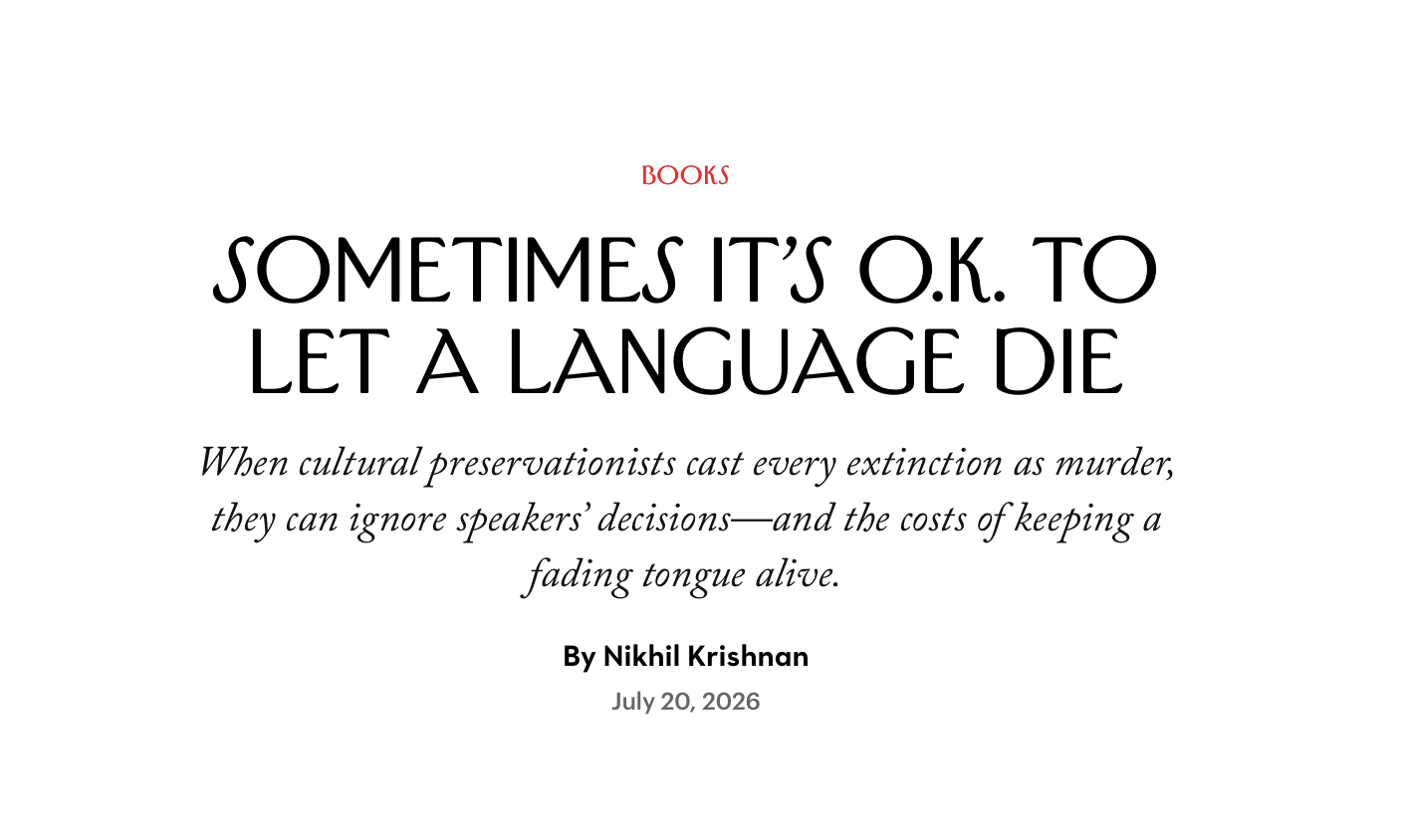
Apologies for the Portlandia skit but did you read the recent New Yorker article about linguicide titled, “Sometimes, It’s OK to Let a Language Die”? (“Mouth to Mouth” in the print edition.) Written by Nikhil Krishnan, the starting point for the article is a sort-of review of Sophia Smith Galer’s book How to Kill a Language. I say “sort of” because Krishnan does not review the book as much as responds to it with his own thoughts and feelings about language revitalisation and linguicide, the deliberate destruction or forced erasure of a language. So more of an op-ed. (Full disclosure: I have yet to read Smith Galer’s book although I am quoted in its pages and my work on raising multilingual children is referenced.)
Let’s start with the article title. It is clickbait and likely picked by an editor. I am well-versed in the art and science (a.k.a. clicks) of choosing headlines and here, I think the editor did a great disservice to Krishnan. Although there is a lot wrong with the article, the title undermines it further and misses some of the important points the writer makes. For example, resources in most communities are scarce and language revitalisation comes at a very high cost. It is incredibly challenging, time-consuming work that requires perseverance and passion. What it misses, along with a lot more, is that language loss also comes with an unimaginable cost and communities fighting to preserve a language should have autonomy on deciding what is best for them and how they use resources. (Policy and planning and prioritising language programmes also obviously comes into play.)
A different title that reflects the bigger story like, “Language Revitalisation is Costly, Time-Consuming, Challenging and Always Worth It (!) Even in a World Where Resources are Scarce” or even better, “Who Gets to Choose Which Languages Live On?” would unfortunately not get by a copy editor. On the other hand, after reading the article a few times, I wouldn’t be surprised if someone suggested, “The Case Against Multilingualism”!
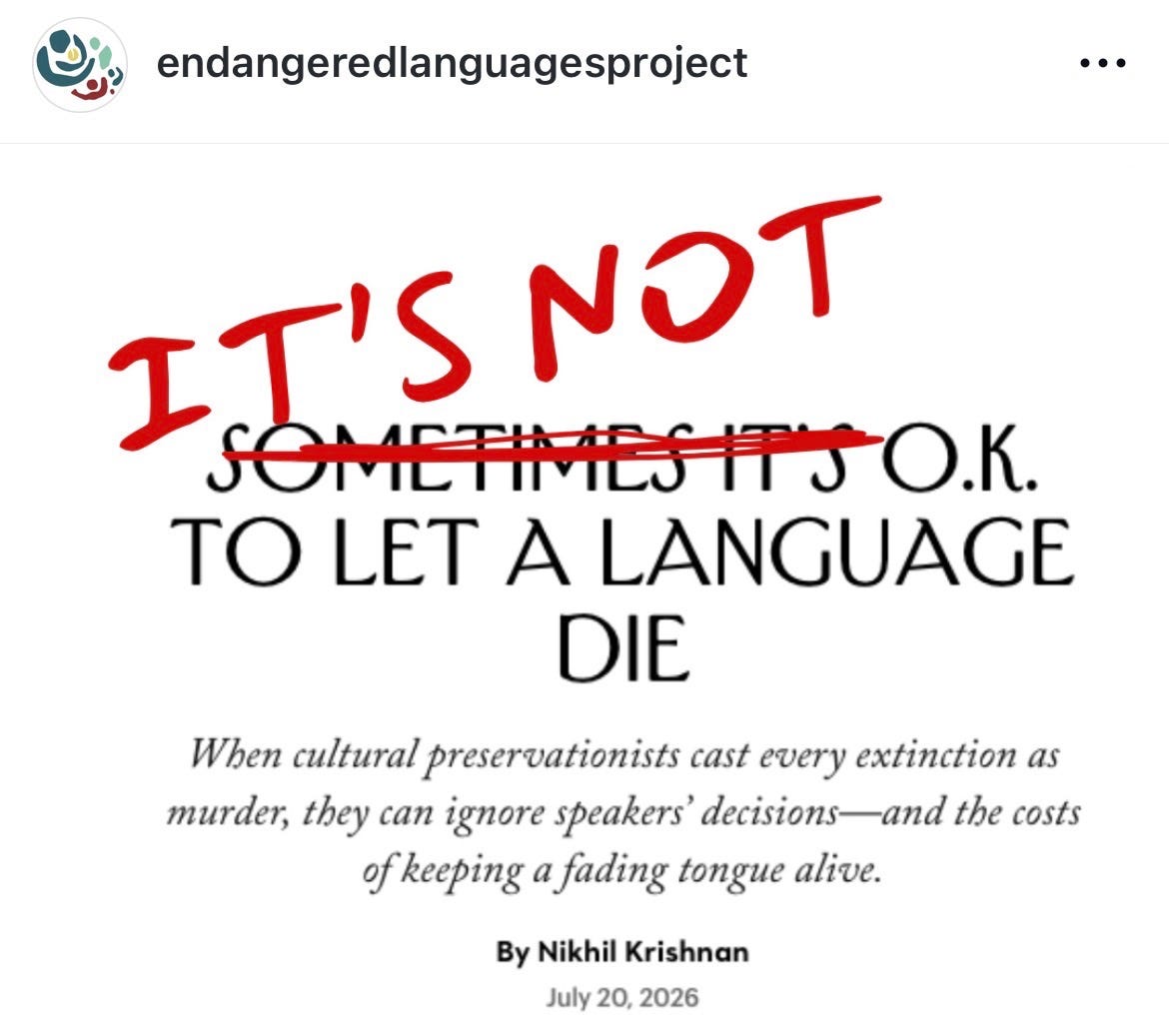
In response to the article, the Endangered Languages Project (ELP), a wonderful nonprofit organisation supporting the revitalisation of Indigenous and endangered languages around the world, led by a group of language practitioners, scholars, advocates, and allies, wrote a powerful and poignant response on how these types of colonising narratives are so very dangerous and do so much harm time and time again:
Discourses and narratives – the stories we tell about things, and the ways we tell them – are not harmless or abstract. They do things, and have concrete effects. For centuries, narratives about Indigenous Peoples and our languages have been shaped by those working to eliminate us, to eradicate our ways of knowing, being, living, and speaking. Dominant, hegemonic narratives about us have been crafted to support very real efforts to make us disappear: our cultures dismissed as “savage” or “primitive” to justify taking our children from us; our languages denigrated as “gibberish” incapable of holding “higher, rational thought,” and thus forbidden in courtrooms and classrooms – and violently beaten out of our children.
The response also makes a point I will get back to about who should be writing about endangered languages, linguicide and revitalisation, especially if they are not part of these communities. From the ELP response:
This is especially important when people with no connection to Indigenous or endangered languages, like writer Nikhil Krishnan, position themselves, or an unspecified audience of New Yorker readers and non-Indigenous policymakers, as having authority to speak for us and our choices.
The first time I read the article, I kept thinking three things, repeating them to myself like mantras:
A language does not have to be “useful” to be worthy.
Language is not merely a body, it is a soul.
Language and life are intrinsically connected.
The first one is self-explanatory and something I have repeatedly written about. “Usefulness” is not a valid marker for language learning because what is useful for me is never the same for someone else. More so, “usefulness” and “worthiness” are capitalist and colonialist. I urge you to read the full ELP response and anything you can get your hands on about the horrors, violence and dehumanisation of Indigenous peoples by colonisers and colonialism, especially in the guise of ideas around a “usefulness” of a language”. All languages and people are worthy of existence. When communities, people and even parents raising children in minoritised languages feel their languages are “worthy” in whatever way that may be, it makes them healthier in mind, and often body, because they feel seen, cared for, appreciated and that they, and in turn their languages, matter.
The second mantra is timely for me as I research a new project on bodies and language and how they are connected in various ways and in some, not at all. Krishnan compares language preservation and revitalisation to animal conservation. But as the ELP response echoes my own sentiment, languages are not biological, at least not in the way Krishnan exemplifies. Contrary to what he writes, language is not only about communication. He notes parts of Smith Galer’s book about languages being encyclopaedias, but I would venture further and remind us of the soul of a language, something that lives on long after a speaker or signer is gone.
This is not a new idea and there are many cultures and languages that refer to the soul-language connection. For example, the Irish proverb, "Tír gan teanga, tír gan anam" (A country without a language is a country without a soul) and the Malay expression “Bahasa jiwa bangs” (Language is the soul of the nation.) In Indigenous communities and languages, the connection between what is often referred to as a spirit or the Sacred and environmental and societal health is fundamental.
In Smith Galer’s book, there is a part I keep thinking about where I am quoted. It is a paragraph about my children, their Polish, and the emotional and physical labour I have put into their multilingualism and transmitting my heritage language.1 Smith Galer recounts part of a conversation we had (the ‘she’ is me) beginning with something she says:
‘At some point, it will be up to them to decide what to do with Polish, right?’ She sighed, unconvinced. ‘I don’t want it to end with me,’ she said. What does Malwina mean by ‘it’? Is it her Polishness she is worried about ending? Or is it how she has experienced the world, an experience that, for her is inextricable from the language she lived it in? Either way, ‘it’ is easily lost.
A few pages later, there is a note about my use of an “elusive ‘it’”. But it is not elusive at all.
Comments
Nothing yet. Say the first thing.
Sign in to join the conversation.