
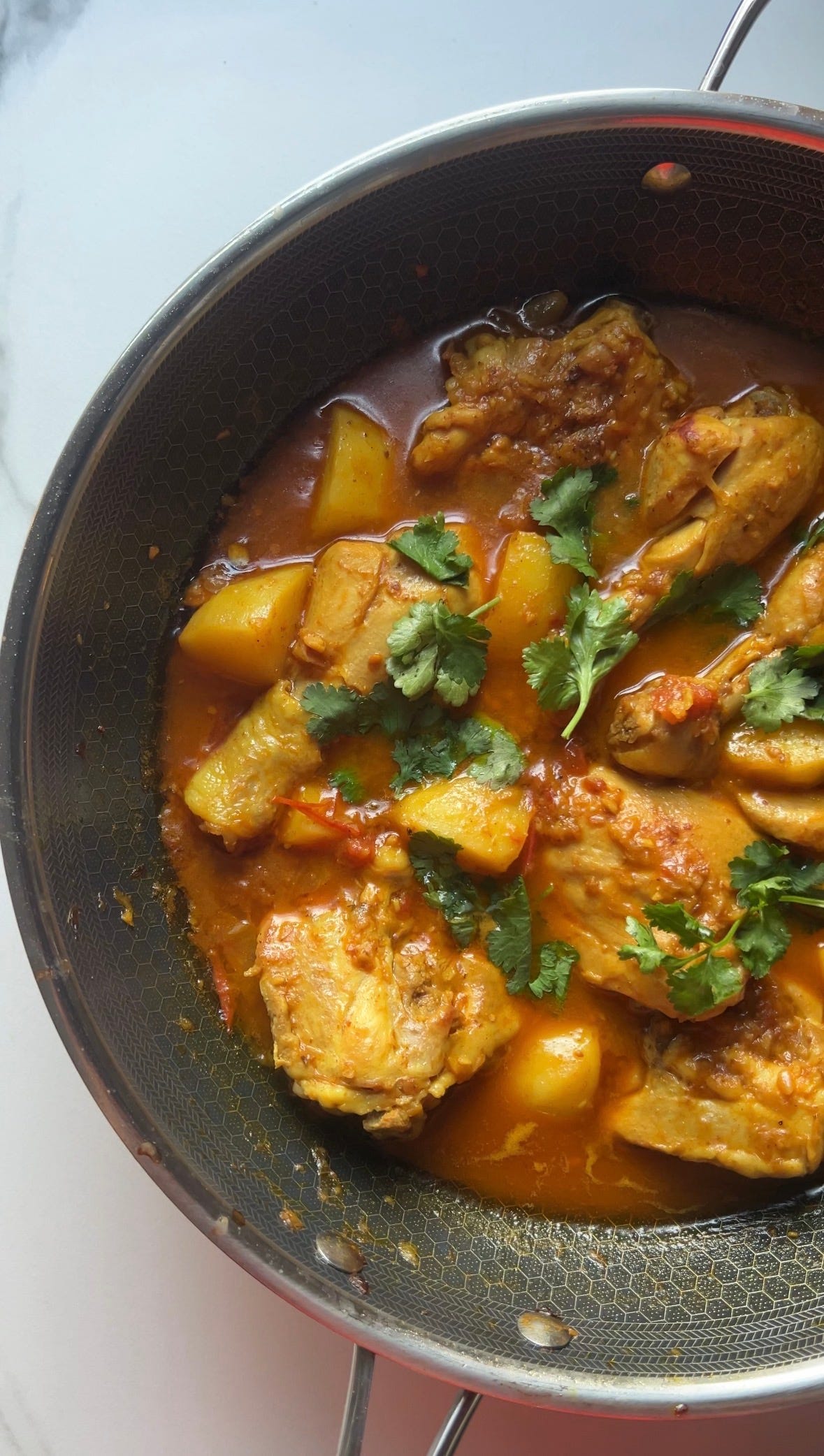
My children are finally back from what feels like an eternity away with their dad in Spain for summer. I couldn’t resist cooking a batch of homely Bengali chicken curry for the big return of the bundles. I knew they would have missed a taste of home, specifically the time-honoured tradition/trope that is mum’s cooking. And I was here for it, kitchen discomfort in heatwave be damned.
The recipe I picked is known lovingly as Robibarer Murgir Jhol, or Sunday chicken curry. Each step needs to be completed with precision before progression. A pinch of sugar in hot oil to stain the caramelising onions, the oil escaping the onion tomato masala before the addition of the meat. And the chicken on the bone needs to cook, seared first, then stewed. It is more meditative practice, than dinner-on-the-table-quick. But it also carries additional significance and the clue is in the name.
It is stirred slowly and enjoyed at the weekends. There was no boneless chicken at home when I was growing up. It was brown parts only and cooked with care. I turn to it again and again at home when comfort is needed. Or an affordable meat option with lots of delectable ways with it - a veritable sponge for the bold flavours we love.
Well, the kind we mostly buy doesn’t taste of very much. I’d also like to table my view that the most popular chicken breasts taste of polystyrene and are mostly impenetrable to flavour.
But we love the stuff. So much so that the average person now eats six times as much chicken as they did in 1961, according to a new report by the UN. It would be fair to say it’s been a summer of the chicken, with both chicken and eggs repeatedly making headlines.
So, what is the issue? Well, the chicken we eat is largely intensively farmed (some 95% of it) with birds bred to reach their slaughter weight extremely quickly. Animal welfare campaigners have dubbed these fast-growing breeds “Frankenchickens”. There are obvious welfare implications, which activists are keen to expose. You may have seen Slingshot campaign advertisements on the London Underground, featuring birds in various states of distress with alarming facts highlighted by celebrities.
There is another issue that flew under the radar in the news agenda this summer. researchers at the University of Oxford found that the huge global expansion of intensive chicken farming has created ideal conditions for Campylobacter to spread, mix and survive. Campylobacter is the world's most common bacterial cause of gastroenteritis and causes three and a half times as many cases of food poisoning in the UK as all other monitored food borne bacteria combined.
Let's not forget the impact that intensive poultry farming can reportedly have on the water we drink and swim in. The problem isn’t chicken poo per se, but the sheer concentration of waste and the nutrients it contains in areas with large numbers of poultry units, particularly around vulnerable waterways. The industry body refutes this. There are intensive chicken farms being proposed all over the UK, and being opposed by local residents and activists.
(I thought it was interesting that a skewed and dated study on the environmental impact, mostly carbon footprint, of organic eggs generated a lot more column inches than this Oxford study.)
Ironically, one factor behind the chicken boom may be decades of advice to eat less red meat. Chicken has become the apparently healthier alternative, with all the worrying effects of producing it at enormous scale.
A new Netflix documentary has attempted to lift the lid on Big Chicken - code for these industrial behemoths that raise, slaughter and process the chicken we eat. It covers a lot of important ground that we wouldn’t normally consider. Chris van Tulleken flags in his books and talks how little we engage with the quality or welfare of the chicken in our meals, particularly when it disappears into ready meals and convenience foods.
The comedian Mo Gilligan is an inspired choice as presenter in the documentary, which uses fried chicken to table some of the startling facts about the chicken we’re mostly eating today. In his immortal words: “they twanged the chicken”. I don’t want to give much away, but here’s a taster:
If human babies grew at the same rate as modern chickens, they’d be the size of an adult pig within two months
Where the documentary lets itself down is the return of the Super Size Me tactic of extreme eating. Mo eats only fried chicken for breakfast, lunch and dinner while filming. Unsurprisingly, he feels quite rubbish by the end of it all. But most of the chicken he was eating was junk food, loaded with ultra-processed ingredients, and the experiment itself was unusual and unnatural to the extreme.
I also thought the focus on vegan activism was a tad heavy. The issue here is that we the people are so disconnected from what’s on our plate and how it was reared that welfare can feel like water off a chicken’s back. Shock tactics may reach those already concerned about animal welfare. But what about everyone else? The bigger problem is the sheer quantity of chicken we're producing and eating, the system required to provide it so cheaply and its bigger costs.
It was also largely based in the US. While many of the issues apply more broadly, farming standards and regulation aren't identical in the UK, something worth bearing in mind while watching. The documentary manages to bring this back to a simple point that comes up time and time again: we need to eat less meat, especially the unethical, unsustainable kind.
Using fried chicken as the lens through which to work backwards down the supply chain was a genius tactic, because who doesn’t love fried chicken? Almost every culture has a version of it. I am a fan of the stuff and love the creativity and technique that comes with it, particularly as I don’t deep fry at home. On my list to try next is Papa Dak, the new Korean Fried Chicken concept from Woongchul Park, the chef-owner of Sollip.
Mo is from south London and this was close to home, quite literally. There are six fried chicken shops on my seven minute walk to the London underground. Down the road, where the teens live with their father, a host of big American chains have found high street homes - Wingstop and Popeyes have joined KFC, Shake Shack and Five Guys. Yep, it’s a junk food paradise.
And fried chicken is at the centre of it, a poster child for our troubled food system.
But it is also a culturally significant product.
Mo doesn’t shy away from this, tackling the cultural appropriation and subsequent weaponisation of fried chicken, and the racism and exclusion that came with it, head on. Its particular place in American food culture and much of the entrepreneurialism around it is deeply indebted to enslaved and subsequently emancipated Black Americans. This is covered in the documentary, but Melissa Thompson wrote about this in 2020 in a piece for the Guardian (a must read).
Many homegrown chicken shops are migrant success stories. Morley’s, for instance, was established in 1985 by Kannalingam Selvendran, who moved to London from Sri Lanka in the 1970s. They’re places where young people gather, and part of the identity of many high streets. Roosters Piri Piri started off as a “KFC rip-off”, in founder Khalid Mirza’s own words, before going on to emulate the success of Nando’s.
And therein lies another chicken conundrum. The cheapness that makes chicken so accessible, and has helped create livelihoods and businesses, is enabled by the very industrial system causing so much concern.
What can we actually do?
Chicken at home
I don’t think it will surprise you to learn that my household budget doesn’t normally extend to speciality-breed, organic chickens. If your wallet allows, please do buy them from your local butcher. If not, there is another way.
The Better Chicken Commitment (BCC) is a set of welfare standards that includes slower-growing breeds, more space, natural light and enrichment. Waitrose and M&S are currently the only UK supermarkets signed up to the full commitment. Other supermarkets offer some slower-reared, free-range and higher-welfare options too, so these are the words I look out for when my budget allows.
Our obsession with boneless chicken breast has always baffled me. We pay more money for less flavour and then work incredibly hard trying to put the flavour back in. As I said earlier, polystyrene. Chicken on the bone brings flavour to whatever you’re cooking
I also buy a whole bird where I can. This is a LOT of chicken for the teens and me, and that’s mostly the point. I roast or poach it, use the leftover meat and make stock from the carcass. Sometimes I do this half a carcass at a time. One chicken can travel surprisingly far, as this darling of social media content will attest.
Chicken out and about
Eating out is harder. Restaurants that talk proudly about provenance make that considerably easier. It gets more opaque with fast food, takeaways and convenience meals. KFC publishes that 35% of the chicken it buys in the UK and Ireland comes from British farms. The documentary notes that many hospitality groups withdrew their commitment to BCC and set up their own self-regulated standard.
If I’m at a music festival, surrounded by junk food, and there’s a Greek gyros stand selling grilled chicken wraps, I’m going to eat it. I’m not going to interrogate the person serving it about the breed and welfare standards first.
We make the best choices we can with the information, money and options available to us. Sometimes that means asking where the chicken came from. Sometimes it means doing the best you can.
Perhaps there is something in that old-fashioned Sunday approach. Chicken doesn’t have to disappear from our plates. But maybe it needs to become something we value again, rather than an anonymous, everyday protein we expect to be cheap and available everywhere and eat mindlessly.
I spoke to Rob Percival, the author of The Meat Paradox, for my podcast, if you fancy a 30-minute listen (also on YouTube and Apple podcasts):
And finally, if you fancy cooking this chicken curry, the recipe with detailed method is here. The recipe with potatoes will be on my Instagram.
I learnt a new term this summer: soft hermitting. It’s when you slow down and prioritise self-care without completely isolating yourself or stopping altogether. Turns out this is what I do every summer around work commitments.
To be honest, I needed it. The first half of the year involved 12 book promotion events, alongside writing, broadcasting, podcasting, advisory work and bedding into my role as Commercial and Marketing Lead at Hackney School of Food. I’ve loved catching my breath. But Autumn is incoming, and round two of In Good Taste book promotion is about to begin.
9 September, The Kitchen Table, Dorset
I’ll be kicking off The Kitchen Table bookshop’s Taste-themed season in conversation with my dear friend Philippa Davis, talking food, taste and In Good Taste.
12 September, Ludlow Food Festival
I’m returning to Ludlow, the home of the Slow Food Movement, for a cookery demo featuring Goan spices and wholesome, sustainable ingredients, a provocatively titled talk: What makes a true foodie?, and two book signings.
Hope to see you there!
21 September, From Field to Sea, The Conduit, London
I’ll be chairing a panel inspired by Jenny Jefferies’ book Islands In A Common Sea: Stories of Farming, Fishing and Food Around the World, exploring what we can learn from food production globally.
We’ll be joined by filmmaker Colin Ramsay of Dragonlight Films and John Cherry of Groundswell Agriculture, alongside three short films adapted from stories in Jenny’s book. It’s inspiring hopeful stuff and the event is open to members and non-members.
Event details here, and registration here.
That’s all from me this time. Thank you for reading, caring and sharing.


Comments
Nothing yet. Say the first thing.
Sign in to join the conversation.