
Over the past two episodes of the Making Therapy Better Podcast, the conversation has circled around an important question: What is actually helpful in psychotherapy—and how do we train ourselves to provide “good” therapy more consistently? What made these discussions particularly interesting was that they approached this question from different angles, almost like bookends, illuminating both the pitfalls of practice and the deeper conditions that allow therapy to be effective.

In the episode with Dr. Mick Cooper, the focus was deliberately uncomfortable. Rather than centering on techniques to emulate, the conversation explored what not to do in therapy. Through role plays and concrete examples, the emphasis was on moments where we can lose contact with the client’s experience. These were not caricatures of bad therapy, but recognizable missteps: moving too quickly toward solutions, privileging theory over the client’s meaning-making, filling silence out of anxiety, or subtly steering the work toward what feels clinically familiar rather than what feels alive for the person in the room.
Many of these missteps arise when we become more invested in “doing therapy” than in staying open and present within the unfolding interaction. Conversely, other missteps arise when we rely too heavily on our warmth and therapeutic skills alone, without a clear rationale for how our approach to each session is meant to target our client’s specific challenges and goals. The role plays made these patterns visible in a way theory alone often cannot. Watching how easily good intentions slide into disconnection served as a reminder that therapeutic skill is as much about restraint and attunement as it is about clear interventions in the service of a coherent treatment plan. If you missed this episode, make sure to watch two big names in the psychotherapy field doing role plays together here.
In the following episode, the conversation with Dr. Bruce Wampold picked up this thread from a different direction. Interviewed by a group of Brazilian psychologists, Wampold reflected on decades of psychotherapy research, returning again and again to the factors that consistently matter most across models and cultures. His emphasis was not on defending a particular approach, but on articulating a framework that makes sense out of how so many different therapies can be effective when they are delivered well. Central to his perspective is the idea that psychotherapy works primarily through relational and contextual processes: the client’s belief that the therapy makes sense, the therapist’s ability to offer a credible and compassionate explanation for distress, a treatment plan aligned with the client’s goals, and the collaborative effort to enact change within a trusting relationship.
What made this conversation especially compelling was Wampold’s willingness to situate these ideas historically. He spoke about how psychotherapy has repeatedly cycled through waves of certainty—periods where specific methods are elevated as solutions—followed by moments of recalibration, when the field is forced to reckon with complexity. From his vantage point, the present moment is one of both opportunity and risk: unprecedented access to data and tools on one hand, and a growing temptation to reduce therapy to protocols and outcomes on the other.
These two episodes form a kind of dialogue. Cooper’s focus on what can derail therapy at the micro level finds its counterpart in Wampold’s emphasis on the macro conditions that sustain change. One shows how therapy falters when we stop listening; the other explains why listening, meaning-making, and collaboration are not just ethical ideals, but empirically grounded foundations of effectiveness. Both conversations also carry an implicit invitation. They ask therapists to remain engaged in an ongoing process of reflection, anchored in science, and sensitive to the context in which the client lives. Learning what not to do, and understanding what tends to work across contexts, are not separate tasks. They are part of the same discipline: staying close to the client’s experience while holding our knowledge lightly.
As the podcast series continues, these tensions — between knowing and not-knowing, between structured treatment planning and spontaneity in the moment — remain central threads. As they should. After all, the path toward becoming a great therapist lies not in collecting new clever theories or treatment approaches, but in asking one simple, unresolvable question before every session: How can I be more effective than I was in my last session?
Therapy is, at heart, a human encounter — a conversation, a relationship, a mutual attempt to make sense of experience and suffering. Yet, paradoxically, one of the clearest ways therapists sometimes gain insight into their work is through numbers — not because digits are more “true” than dialogue, but because they can reveal patterns our best clinical instincts might overlook.
The idea behind measurement-based care (MBC) is simple: collect brief, validated measures at regular intervals and use those results to inform clinical decision-making. When clients’ symptoms, well-being, or experience of therapy change over time, those changes can serve as early indicators of whether the work is progressing, stalling, or diverging from shared goals. But what these measures mean — and how they should shape practice — is not as straightforward as it may first appear.
To understand this better, it helps to think of clinical evidence as lying on a kind of spectrum. At one end are large, population-level research findings — broad patterns that tell us, for example, that supportive relationships and client engagement are associated with better outcomes across many kinds of therapy. At the other end are moment-to-moment, individualized glimpses of a particular client’s experience. Somewhere between these extremes sits the routine outcome data we gather in MBC: patterns over time that are neither overly general nor idiosyncratic, but deeply proximal to our work with a specific person.
This way of thinking — that evidence varies in how close it is to the actual therapeutic encounter — helps illuminate both the promise and the limits of measurement-based care.
On its strongest days, MBC brings us closer to what is happening in therapy, rather than what we think is happening. Tracking a client’s scores over time can reveal subtle plateaus or inflections points, prompting conversations that might otherwise be delayed. It offers a bridge from the broader research literature — which tells us that some interventions tend to work on average — to the unique story of the person in front of us. In this way, measurement becomes a piece of individualized evidence that enriches, rather than displaces, clinical intuition.
Yet the very quality that gives MBC its value — its focus on measuring change over time — also points to its limitations. All measures are approximations. They capture some aspects of experience, but not all. A reduction in symptom scores might mask persistent distress in areas not captured by the chosen instrument; improvements in well-being might coexist with unresolved relational pain.
Moreover, what measurement reveals is shaped by what we choose to measure. Symptom scales like the PHQ-9 and GAD-7 tell us about distress (depression/anxiety), but they say less about meaning, identity, or relational context. Measures of well-being can expand the frame, and measures of client confidence in therapy invite explicit reflection on the therapeutic relationship. And even these are surface approximations of lived experience.
One therapist I know described working with a client whose depression scores showed steady improvement over several weeks. At first glance, symptom reduction suggested progress. But the client later revealed that their sense of agency had not shifted and that they felt increasingly disconnected from the goals they had named at intake. The numbers said “improving,” but the lived experience was more ambivalent. Without subsequent conversation, those numeric trends could have become a kind of false reassurance.
A second clinician offered a different example. Working with a client whose scores on a distress measure remained consistently severe, yet in session the client subjectively reported improvements across other life domains not captured by the measure. When the therapist brought those numerical trends into conversation, the client expressed surprise and hopefulness to notice their quality of life had substantially improved, even while many of their symptoms remained present. In this example, the measure served less as evidence of progress and more as a prompt for dialogue — an invitation to jointly revisit the client’s treatment goals and their fundamental beliefs about what it means to live a fulfilling life.
This is where measurement-based care can be most valuable: not as an objective arbiter of success, but as a relational instrument that surfaces topics ripe for discussion. When a client’s confidence in therapy dips, for example, a downturn in the corresponding measure could prompt a conversation that strengthens the therapeutic alliance rather than undermines it. In this view, measures are fuel for reflection, not verdicts.
Yet even as we appreciate what MBC can offer, we must guard against elevating it to an all-purpose solution. A measure is only as good as the questions it asks and the context in which it is interpreted. Used without nuance, it can create a false sense of certainty, privileging numeric trends over subjective experience and situational complexity.
This is especially salient in the context of clinical training and supervision. Trainees may be tempted to treat measurement feedback as definitive feedback on their competence or direction. But if supervision focuses solely on whether scores move in the “right” direction, we risk losing sight of the deeper inquiry that is the core of clinical education: Why is this change occurring, or not? What might these questions mean for this particular person in this particular context? In supervision, measurement data can be a shared object of inquiry, not a judgment. A supervisee and supervisor might look at the same trend line and ask different questions: What does this pattern reveal about the client’s evolving experience? Where do our theories and interpretations align or diverge? How might the client’s social context — factors that lie outside the therapy room — be shaping these numbers? Measurement-based care thus becomes part of a learning ecology in supervision: one among several forms of evidence, including clinical observation, case formulation, and relational attunement. When integrated in this broader context, numerical tracking does not supplant clinical judgment; it enhances it, prompting reflection rather than closure.
Therapy is not a science of certainties, and measurement will never capture the full richness of human change. But when we approach it with nuance — aware of both what it can reveal and what it cannot — MBC becomes a powerful ally in seeing what we otherwise might overlook. It is a reminder that the most meaningful evidence about the quality of our work is formed in the interplay between client experience, clinical judgement, and measurable change.
One of the enduring challenges of measurement-based care is not a shortage of tools, but a lack of coherence. Many systems offer an abundance of questionnaires, leaving clinicians to decide—often without guidance—what to use, how often to use it, and how to interpret the results. Over time, measurement becomes either burdensome or superficial, and both clients and clinicians often lose interest.
CarePaths takes a more thoughtful approach. Rather than attempting to measure everything, it focuses on a small set of instruments curated by some of the most preeminent psychotherapy researchers in the field. The select group of measures reflect different layers of the therapeutic process, designed specifically to capture the most reliable predictors of positive psychotherapy outcomes. The aim is to track signals that are close enough to the actual clinical work to genuinely support the provision of better care. Leveraging this approach benefits of everyone involved – from clinicians and clients, to clinical supervisors and trainees, to clinic directors and insurance providers.
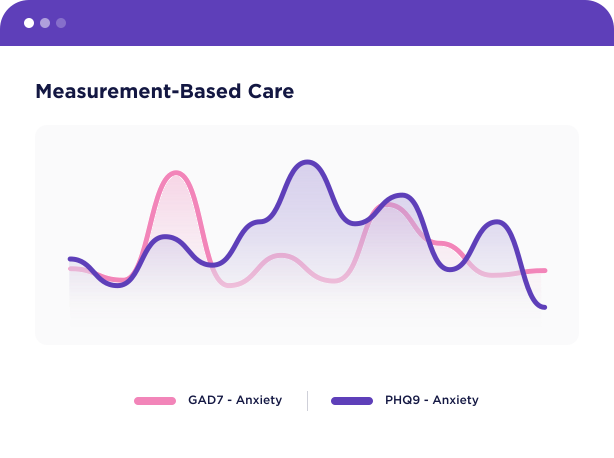
At the most familiar level, CarePaths includes validated symptom measures for symptoms of depression and anxiety. No measures are perfect, but these are highly practical, well-studied, and sensitive to change. Used repeatedly, they allow therapists to see patterns of distress as they shift (or remain unchanged) over time. The use of such repeated measures adds key information to support the therapeutic process, rather than relying solely on the therapist’s subjective assessment – which is of course critical but which research shows is not nearly as accurate or reliable as we often believe.
Symptom tracking is always paired with a brief measure of well-being. This reflects an understanding that symptom reduction and psychological well-being are not the same thing. Clients may report fewer symptoms while still feeling disengaged from their lives, or they may begin to flourish even while symptoms remain present. Including measures of well-being, and not just symptoms of distress, supports a broader, more humanistic definition of improvement.
CarePaths also incorporates brief measures of loneliness, which is increasingly recognized as a key contextual factor – not only in mental health, shaping symptom persistence and relapse, but even in physical health outcomes and life expectancy. Tracking loneliness brings relational and social dimensions of therapeutic progress into clearer focus, especially when symptom improvement occurs without a corresponding increase in social connection or belonging.
Perhaps most distinctive is the routine inclusion of measures that ask about the client’s experience of the therapy itself—often described as treatment confidence and acceptability. These brief check-ins assess whether the work feels helpful and whether the approach makes sense to the client. Although research consistently shows that these perceptions strongly predict outcome, they are rarely monitored systematically. When tracked over time, they offer early signals of misalignment, creating opportunities for conversation and course correction before disengagement becomes dropout.
What ultimately ties these measures together is not their content alone, but how they are used and their ease of integration into clinical work and supervision. In CarePaths, questionnaires are administered routinely and reviewed before sessions, allowing them to inform clinical thinking rather than sit passively in the record. The goal is not to provide answers, but to support better questions.
In this way, CarePaths’ measurement-based care framework forms a connective thread linking the immediacy of the therapeutic encounter with the broader scientific evidence from decades of psychotherapy research. It translates what we know about change at the population level into signals that are specific to an individual client’s trajectory, while still leaving room for clinical judgment, interpretation, and dialogue.
Used thoughtfully and collaboratively, the CarePaths’ approach does not narrow the focus of therapy; it widens it, offering multiple vantage points on the change process and reminding us that progress is nonlinear, multidimensional, and impossible to fully understand from any single perspective.
Check out the Carepaths free e-book on measurement-based care in mental health here.
Is there someone you would love to see on the show?
Is there a topic you’re eager for us to explore in depth?
If so, send us an email at: makingtherapybetter@carepaths.com.
We would be glad to consider your suggestions for future episodes.
Thank you for listening and for being part of our community.
Comments
Nothing yet. Say the first thing.
Sign in to join the conversation.