
There is something quietly destabilizing about sitting in a room where someone challenges the reliability of clinical intuition.
Bruce began his conversation with Dr. Natalia Mota by retelling the now-famous Daniel Kahneman story at Austin Riggs — a clinician asserting, with complete confidence, that he could predict a patient’s trajectory within the first thirty minutes, and Kahneman responding that he had won a Nobel Prize, demonstrating that confidence and accuracy are often inversely related. The tension in that anecdote is not merely historical trivia; it captures a fault line that has run through psychotherapy for decades. We trust our ears. We are trained to listen for fragmentation, derailment, coherence, and emotional tone. We sense when a narrative “hangs together” and when it does not. But sensing is not the same as measuring. And this is where Natalia’s work becomes both provocative and generative for our field.
Dr. Natalia Mota is a computational psychiatrist, which sounds more technological than it actually is. At its core, her work is deeply clinical. She takes something we already attend to — the structure of speech — and formalizes it mathematically. The methodological move is elegant in its simplicity. A patient is asked to speak, often about a recent dream or in response to emotionally evocative images. The speech is recorded and transcribed. Each word becomes a node in a network. Each time one word follows another, a directional? edge is drawn between them. When a word repeats, it forms a loop, creating a cycle in the graph. Over the course of a narrative, these nodes and edges accumulate into a structure that can be quantified: how many words are connected into a large component, how many short-range repetitions occur, how dense the network is, how fragmented the trajectory appears. What results is not an analysis of meaning but of structure — a topology of thought rendered visible.
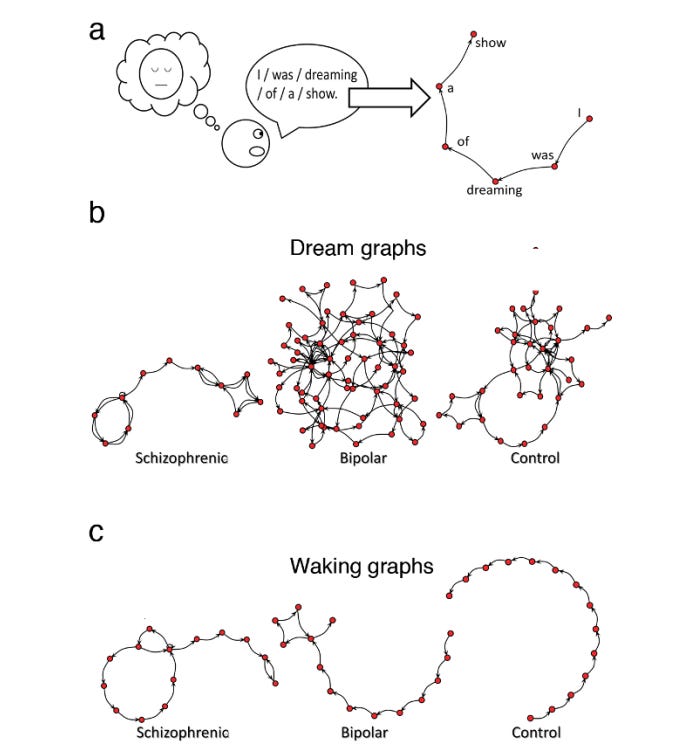
This distinction is crucial. In her early PLOS ONE study (2012), Dr. Mota and her colleagues applied this method to speech from hospitalized patients experiencing psychosis. They did not ask them to describe their delusions or hallucinations directly; instead, they asked for dream reports. Dreams, as Natalia explained, are less constrained by social scripts than daily narratives. When we recount a normal day, we follow culturally ingrained patterns: this happened, then that happened. Dreams are different: they are emotionally charged, associative, often nonlinear. In that looseness, structural differences emerge more clearly. What her team found was striking: patients later diagnosed with schizophrenia produced speech graphs with lower connectedness and greater fragmentation than patients later diagnosed with bipolar disorder, even when both groups were psychotic at the time of speech collection. The content of the dream was not the primary differentiator. The organization of the language was.
This finding becomes even more consequential in the context of early psychosis. In the 2017 Translational Psychiatry paper, Natalia extended this work prospectively. Speech samples were collected from young individuals presenting with first-episode psychotic symptoms, and participants were followed longitudinally. Six months later, some received diagnoses of schizophrenia-spectrum disorders and others bipolar disorder. The speech graph metrics derived from their initial emotional narratives predicted diagnostic trajectory with remarkably high accuracy. In practical terms, brief speech samples — structurally analyzed — contained predictive information about the course of illness before formal diagnosis could be established. For clinicians who understand how critical early intervention is in schizophrenia, the implications are profound. Duration of untreated psychosis is associated with functional decline, social withdrawal, and poorer outcomes. If language structure offers an earlier signal, it could refine our assessment processes in meaningful ways.
Yet Natalia’s work is careful in a way that many technological interventions are not. Language is not a static biomarker like a gene mutation or a blood protein. It develops. It is shaped by literacy, formal education, socioeconomic context, and culture. Recognizing this, Natalia conducted parallel research on cognitive development and narrative complexity. She demonstrated that speech graph connectedness increases significantly with formal education, particularly after literacy acquisition. Illiterate adults, on average, produce narrative structures that resemble those of preschool children in graph metrics — not because of pathology, but because literacy reorganizes semantic connectivity and long-range associations. Without accounting for educational context, a naïve machine-learning model could easily conflate social disadvantage with schizophrenia risk. This is where her insistence on interpretability matters deeply. Her approach is not a black-box AI system that classifies speech without theoretical grounding. It is a model designed to mirror psychopathology while controlling for developmental and cultural variables. For psychotherapy, which has historically wrestled with issues of bias and inequity, this nuance is not optional — it is foundational.
What makes this work particularly relevant for psychotherapy is that it does not stop at diagnosis. Natalia suggests that language structure may not merely reflect disorder; it may participate in maintaining or amplifying it. If an individual’s emotional speech is fragmented or incongruent, this can subtly disrupt social interactions. Others may struggle to follow the narrative, misunderstand intentions, or withdraw. Over time, this could contribute to isolation, reduced opportunities, and further deterioration in functioning. In this sense, speech structure becomes both marker and mechanism. Psychotherapy has long operated under the assumption that reorganizing narrative is therapeutic. We help clients connect affect to event, integrate disparate memories, and build coherent self-understandings. Natalia’s work invites a provocative question: could changes in narrative connectedness be measured over the course of treatment? Could increasing structural integration in speech correlate with clinical improvement or reduced relapse risk? These are hypotheses rather than established conclusions, but they open an avenue for bridging psychotherapy process research with computational methods in a way that enriches both.
The broader social context amplifies the urgency of these questions. Natalia noted the dramatic increase in adolescent mental health diagnoses over the past decade. Biological shifts do not explain such rapid changes. Social ecosystems do. Adolescents are developing emotional language in environments saturated with digital interaction, fragmented attention, and exposure to intense emotional content without relational containment. In Brazilian public health discourse, the term “mental suffering” is sometimes used to avoid prematurely pathologizing distress that may be rooted in environmental and social change. If language structure is sensitive to context, then large-scale shifts in how young people communicate and bond could influence narrative development in ways that intersect with vulnerability. Psychotherapy, situated at the crossroads of language and relationship, cannot ignore these ecological transformations.
Ultimately, speech graphs are not replacements for empathy, attunement, or relational depth. They are tools that make visible patterns we already sense, offering precision where intuition may falter. If we can measure the topology of suffering in language, perhaps we can also begin to measure the topology of recovery — not to reduce therapy to numbers, but to deepen our understanding of how change unfolds within narrative. In that integration of mathematics and meaning, the future of psychotherapy may become not less human, but more thoughtfully attuned to the structures that shape our shared stories.
Click here to listen to the full conversation with Dr. Natalia Mota and Dr. Bruce Wampold in the latest episode of our podcast.
From Screening to Safety: Building Suicide-Safer Systems
If language can reveal the early architecture of psychosis, then silence can conceal the architecture of suicide.
In the last episode of Making Therapy better, we explored how Natalia Mota’s work makes visible what clinicians often sense but cannot quantify — the structure of thought embedded in speech. Suicide prevention sits at a parallel crossroads. Here too, clinicians rely heavily on intuition. We “feel” when someone seems at risk. We ask, sometimes indirectly. We document what is said and what is left unsaid. And yet, the data are humbling.
A striking proportion of individuals who die by suicide had contact with the healthcare system in the months before their death. Some estimates suggest that the majority saw a primary care or medical provider within the year prior — many within weeks. And yet most were never directly asked about suicidal thoughts. The opportunity was there. The structure was not.
For years, depression screens were treated as sufficient proxies. If someone endorsed low mood or hopelessness, we would explore further. But research shows that depression screening alone misses a substantial proportion of individuals at risk. Many patients who later attempt or die by suicide do not endorse classic depressive symptoms at the moment of assessment. Suicide risk is not reducible to mood.
This is where structured suicide-specific tools enter the picture. The Ask Suicide-Screening Questions (ASQ) is a simple construct that can be easily integrated into any system. Four direct questions. About twenty seconds to administer. Validated across age groups and clinical settings, from emergency departments to outpatient care. A “yes” to any item signals the need for further evaluation. The simplicity is its power. It operationalizes something clinicians sometimes avoid: direct inquiry.
The Columbia-Suicide Severity Rating Scale (C-SSRS) moves from screening to differentiation. It does not collapse suicide risk into a binary. Instead, it distinguishes between passive death wishes, active ideation, specific planning, preparatory behaviors, and past attempts. It captures intensity — frequency, duration, and controllability of thoughts. These gradations matter clinically. Someone who fleetingly wishes they would not wake up requires a different response than someone who has rehearsed a plan.
Studies demonstrate that universal screening identifies individuals who would otherwise go unnoticed, particularly in medical settings where suicide risk is not the presenting complaint. Importantly, research also shows that asking directly about suicide does not increase suicidal thoughts — a myth that has lingered in clinical culture for too long.
But screening alone is not prevention.
The most compelling data emerge when screening is embedded within structured pathways. The Zero Suicide framework and other implementation studies show that when healthcare systems adopt systematic identification, structured assessment, safety planning, and proactive follow-up, suicide attempts and deaths decrease. In some health systems, implementation of comprehensive suicide care models has been associated with reductions in suicide rates of 30% or more over time. These effects are not the result of a single questionnaire; they arise from transforming suicide prevention into routine clinical practice rather than episodic crisis response.
This is the difference between detection and intervention.
Carepaths’ optional integration of suicide-safer functionality developed in collaboration with The Suicide Prevention & Integration via Electronic Records (SPiER) — embedding ASQ and C-SSRS directly into the electronic health record workflow — represents precisely this kind of structural shift. When screening tools live outside the clinical pathway, they become optional. When they are embedded into routine intake, follow-up, and monitoring processes, they become part of the architecture of care.
And architecture matters.
Consider a clinical example. A 23-year-old presents for anxiety and sleep disturbance. In an unstructured intake, suicide risk may not surface. The patient denies depression, reports stress, and leaves with coping strategies. In a system with integrated ASQ screening, a direct question reveals intermittent thoughts of not wanting to wake up. The C-SSRS then clarifies that these thoughts occur several times per week and sometimes include vague ideas of self-harm, though no plan. This triggers a structured safety planning intervention, documentation of protective factors, and scheduled follow-up within days rather than weeks. The therapeutic alliance deepens because the clinician addressed something real rather than peripheral.
We often speak in psychotherapy about holding space. Systems must hold it too. Electronic health records are not neutral repositories; they shape what is asked, what is tracked, and what is prioritized. When suicide monitoring is built into workflow — with clear prompts, structured documentation, and escalation pathways — the system supports the clinician rather than relying on memory or comfort.
Outcomes improve when risk identification is consistent, when safety planning is collaborative and documented, when follow-up is proactive rather than reactive. Research consistently shows that brief, structured interventions — such as safety planning combined with follow-up contact — significantly reduce subsequent suicide attempts compared to usual care.
In computational psychiatry, speech graphs make fragmentation visible. In suicide prevention, structured screening makes risk visible. In both cases, what was previously dependent on intuition becomes more reliable without eliminating clinical judgment.
Prevention is not only about identifying ideation; it is about restoring connection, increasing monitoring, and reducing access to lethal means. Tools like ASQ and C-SSRS are not ends in themselves. They are doorways into conversations that might otherwise never occur.
In psychotherapy, we often ask what works. Increasingly, the answer is not only technique but system. When clinicians are supported by structured, evidence-based pathways, outcomes improve. When screening is standardized, fewer individuals slip through cracks. When documentation aligns with best practice, risk management becomes proactive rather than defensive.
Carepaths’ suicide-safer integration is embedding evidence-based suicide prevention into everyday clinical flow. The future of mental health care lies not in replacing clinicians with technology, nor in ignoring data in favor of instinct, but in designing systems that make it easier to ask the right questions at the right time — and to respond meaningfully when the answers are difficult.
Is there someone you would love to see on the show?
Is there a topic you’re eager for us to explore in depth?
If so, send us an email at: makingtherapybetter@carepaths.com.
We would be glad to consider your suggestions for future episodes.
Thank you for listening and for being part of this community.
Warmly,
Geissy Araújo, Ph.D.
Producer and Director of Communication
Making Therapy Better
Comments
Nothing yet. Say the first thing.
Sign in to join the conversation.