
We have seen many all school projects garner the attention of a school community. Some are tied to big, seemingly one-off or startup initiatives (e.g., a new building or a commitment to project-based learning). Others are more routine (e.g., accreditation cycles and strategic planning itself).
Leaders often find it easier to frame startup initiatives because of their novelty and (ideally) the enthusiasm around them. The routine ones can be more slippery — literally harder to grasp and hold — even if their cadence is more predictable.
We know accreditation will happen regularly at schools. We expect strategic planning to follow. This expected, known, institutionally bone-deep cadence does not guarantee success; in fact, these initiatives are frequently hamstrung from the start because they show up with institutional-emotional cruft.
That is: people remember “the last time.” And they can easily reflect — in their own minds, offices, and lunch tables — on that last time. They remember the effort, and often wonder aloud: Was it worth it? What did the school do with those accreditation recommendations? How many of the strategic plan goals came to life? How much of my personal effort and voice was valued in the process?
Such questions almost seem like a case against our legacy planning systems. On the contrary, they are data that suggest we can do a better job with the institutional settings of such projects.
Think of institutional settings as you would the control panel on your computer or phone. Things like brightness, display, haptics, etc. control how you interact with the device. Institutional planning settings are much the same — they dictate how folks are expected to interact with a school’s biggest decisions. As such, adjusting settings at the start of an initiative is both a short game and a long game.
The short game is simple: you want to launch the project well in order to give it a chance to succeed. How you message the initiative matters. How you keep people informed matters. How you invite feedback matters. The short game here is about establishing the conditions for the kinds of quick learning milestones that are important for any project to authentically take root in a community.
The long game is murkier and harder to track. Each all-school project helps or hinders the institution in building habits that can be called on as a school’s always unpredictable future unfolds. The long game here is about adaptation with the net result that the institution gains both capacity and confidence.
Settings, and the questions that help to establish them, are about pacing, people, meeting schedules, deadlines, and reporting structure. Knowing that you can flex them helps you to accomplish things now . . . and, later, to be able to point back to the thing accomplished, in the manner accomplished, and say, we did it that way once so we can do it that way again.
By calibrating the settings around an all-school project — thinking about what you hope your institution will both do and learn — you expand your institution’s operational latitude. You can also help it to avoid some of the inefficiencies (at best) and ineptitudes (at worst) that emerge from using default settings to approach default planning.
Most modern businesses these days are operating on much shorter strategic cycles than independent schools are. Many startups have no choice but to operate in annual — or even semi-annual or quarterly — strategic bursts because that is what the market dictates. Such quickness also helps to produce data, allowing for reflection and iteration at a faster cycle.
It makes sense to think about the pace of change in your institution. It also makes sense to decouple the desire for change from the typical instrument of change, i.e., school accreditation. From an accreditation standpoint, the 5-10 year cadence works. From a school innovation standpoint, that same cadence is too long for most meaningful work. Let the accreditation validate to a third party that your school is doing what it says it does. Look elsewhere, for other models, when seeking to provoke iteration at a faster cycle.
When launching an initiative, there is a timeliness factor for inviting in external processes and people to examine how your school reflects, identifies challenges and opportunities, and designs and implements plans for such work. How do you get the most out of the time that you have the attention of and access to talented volunteer partners — whether a subcommittee of the board of trustees, a parent association cohort, alumni, or current students?
If your school is already in a rhythm of reflection and improvement, bringing in the outside perspective will help it to see blindspots and to bring in ideas from other industries and even world views (e.g., a 16 year old engages with the world differently than a 36 year old).
Conversely, if the outside expertise is merely brought in to identify challenges or opportunities (or, in the case of a self-study, to affirm/confirm such things), then you may not be able to leverage the entirety of the expertise for a concentrated amount of time. Problem seeing vs. problem solving vs. innovation: all require different approaches.
One of the worst settings a school can choose (or simply continue, by default) is to use strategic planning or an accreditation as an excuse to move forward something it has wanted to do but can’t figure out how to do on its own, through its own natural systems. Saying, “we’ll include scheduling or performance evaluation as a focus area of a self-study,” then having a 3rd party (or your board) approve it as a focus area, and then beginning a cycle of planning for such initiative-related work can be tough going. It’s not impossible, and it’s not always a bad route, but this kind of change often begins without motivation or excitement in the community, creating the conditions for a classic cold start problem. Prepare accordingly.
Ideally, your school has ongoing ways to explore or experiment with new models without putting the status quo at risk.
Measure the ROI of all school projects in terms of near term (in the next 1-2 years) and longer term (3 or more years). Having such a chart should not be dependent on some big, all-school project. Instead, you might make note of when such projects overlap with your 5-year outlook so you know how to leverage the opportunity. Often the near term items end up serving as prerequisites to longer term ones, but they should not be vaguely nested into some larger initiative. Create targets and timelines for all work.
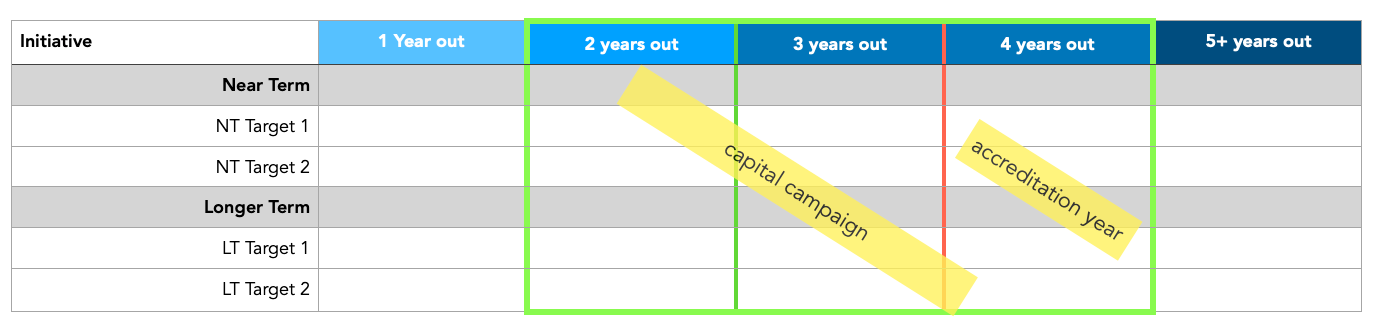
Your leadership and your community will see the returns on effort for contributing to the work by having clear and connected goals
Continuously reflect on your work to ensure that near and longer term projects are correctly mapped. These prompts may aid such thinking:
What’s the task in front of us and how quickly do we plan to accomplish it? With what core group?
What institutional muscle are we building deliberately by completing the task in the way we plan to?
Will we use this project as an opportunity for institution wide reflection, or are we just going to check the boxes to get it done?
What long term message will this send about how we work, how we can work, and how we might work?
Will the project benefit from the input of many voices (the perspectives of many users), or is there a clear rationale to keep the deciding group small, select, expert only?
How does this decision correlate with the school’s arc of progress?
How does it correlate with internal trust, the ever present negotiation between “us” and “them”?
A school’s typical mode is the ultimate ceiling for progress when pursuing opportunities, whether one-off or tied to routine planning exercises. Accreditation and even strategic planning can have a lulling effect if they are overly focused on examining systems and processes that get work/school/learning done. Such systems should already be in place and always be reflected upon and improving. We’re not so much asserting that culture eats strategy for breakfast, as many leaders do. We’re much more interested in suggesting that you take a close look at the culture of strategy at your school, ensuring that it is what you want it to be — whether or not you’re in a formal planning phase.
No posts
Comments
Nothing yet. Say the first thing.
Sign in to join the conversation.