
A friend is part of a community of entrepreneurs.
A few months in, they started building something new in an adjacent direction. Nothing copied. Nothing stolen. Just a new thing in a related space.
The community organizer reached out.
“Just making sure you’re not going to compete with me. Could you confirm?”
The correct answer, the one most people are too polite to give, is: that’s none of your business.
But most people don’t say that. They apologize. They shrink. They accept a frame that was never legitimate to begin with. And the moment they do, the tactic has worked.

The threat in that message isn’t legal.
No IP was stolen. No agreement was broken. No rule was violated.
The threat was simpler: someone might enter the same category.
What that reveals is a structural problem with the business being “protected.” A model this fragile, one where a single new entrant triggers alarm before they’ve launched anything, was never built on solid ground.
People who rely on being the only option in their space will feel threatened by the smallest move toward their territory.
They don’t want competitors. They want a monopoly they never had to declare.
The unspoken rule being enforced is this: I was here first, therefore this category is mine.
That rule exists nowhere. No market, no court, no economic framework recognizes arrival time as ownership.
Free markets work precisely because anyone can enter any category they want. That’s the feature, not the bug. More entries force better products, lower prices, better service. Consumers win every time.
Protecting a business is legitimate. Building a better product is legitimate.
Threatening potential competitors before they’ve shipped a single thing is a signal: the moat isn’t deep enough to survive contact with actual competition. The answer to that problem is to dig deeper, not to make the threats louder.

The person policing your originality didn’t invent their category either.
Whatever they built, someone built something adjacent before them. They found a better angle, better execution, better timing, and called that originality.
Health apps. Newsletter businesses. Community platforms. Every one of them entered a category that already existed. The “original” founders of those spaces felt the same threat when these people arrived.
Good XP is a weight loss app. There are thousands of weight loss apps.
The category wasn’t invented by me, but I had the problem and decided to create a product to solve it. Looked for a keyword nobody else was targeting, tried a positioning nobody had nailed for a specific type of user. It’s not original in the romantic sense, which forces me to be good at executing the vision.
And that’s how it should be.
If someone builds something better tomorrow, that’s the game. Nobody’s coming for permission. Nobody should be asked to give it.
The originality claim is always selective. It applies to everyone arriving after, never to the ones who came before. It’s a moving wall that only blocks people standing behind it.
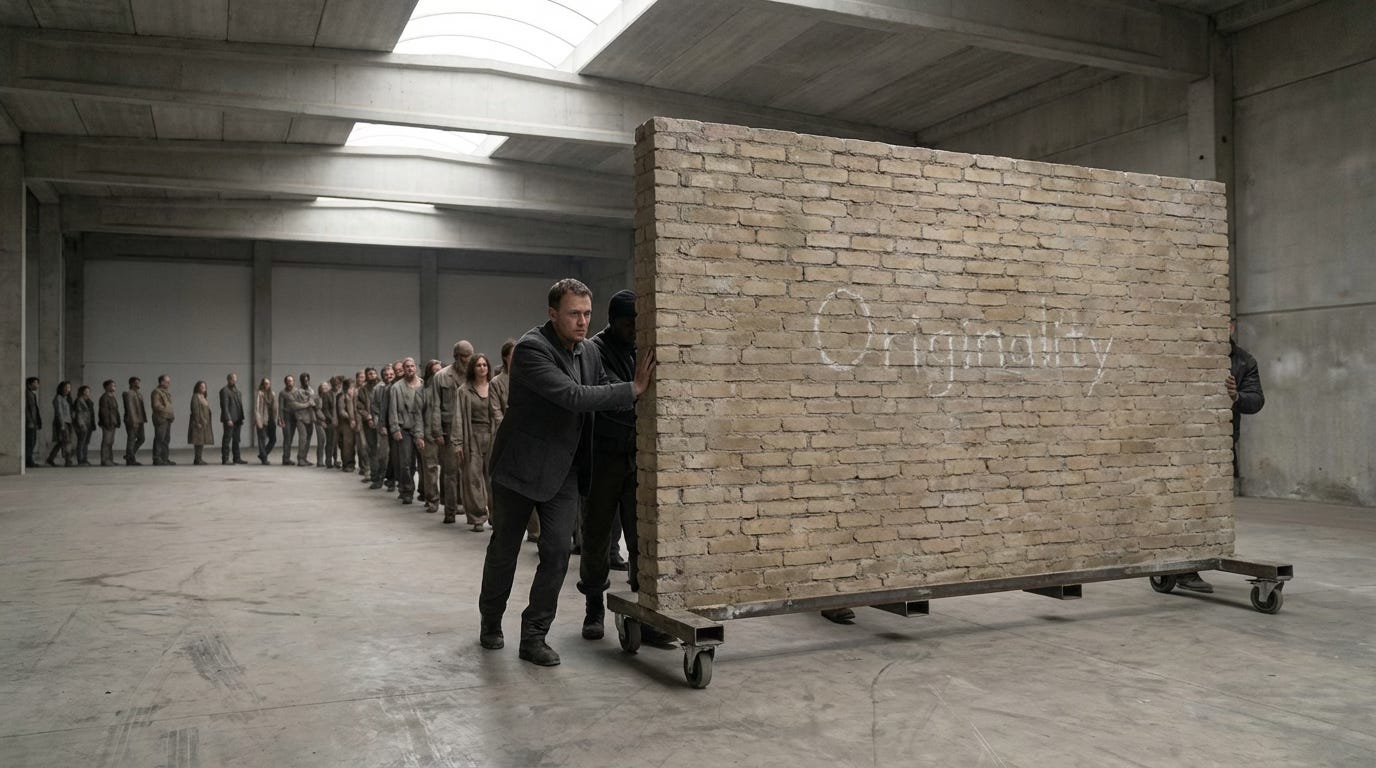
What the organizer did has a name: imaginary rule enforcement.
Create a rule. Act like everyone knows it. Pressure someone into compliance before they realize the rule doesn’t exist.
This works more often than it should. People who are just starting feel guilty. They apologize. They scale back.
They accept the frame because the person delivering it sounds certain.
The moment you recognize the tactic, it dissolves.
No rule was broken. No agreement was violated. Someone with a head start got uncomfortable watching someone else move. That’s all that happened.
The tell is in the framing.
The complaint is never “they’re worse than me and confusing my customers.” The complaint is always “they’re copying me.”
Fear of inferior competition isn’t the concern. Fear of better competition is.
A business that depends on preventing others from entering its category to survive has one real problem: the product isn’t good enough to hold customers on its own merit.
The solution to that problem is a better product, not a smaller competitive field.

Two responses to the same threat. Keep them side by side.
iFood held more than 80% of Brazil’s food delivery market. Then two well-funded competitors entered at the same time. Keeta, backed by Meituan with $1 billion committed. And 99Food.
iFood’s response: a 25% investment increase, from R$13.6 billion to R$17 billion. Better technology, better driver pay, lower fees. They got harder to beat.
99Food took the other road.
Exclusivity contracts with major restaurant chains, designed to block Keeta from the table entirely. A São Paulo court ruled it anti-competitive. The tactic failed in public, on the record, at considerable cost.
One player treated competition as pressure to improve. The other treated it as a violation to be stopped. The market rewarded one and corrected the other.
The detail worth holding: competition didn’t shrink the market. Delivery driver pay rose 50% across all platforms. Consumers ordered more because prices dropped.
A market that felt settled got better for everyone in it the moment more players entered.
That’s how markets are supposed to work.

Stardew Valley is a farming and life simulation game.
Harvest Moon had owned that category for decades. A devoted fanbase. No serious competition. The kind of franchise that felt settled.
One independent developer entered it anyway. No team. No budget. No permission asked.
20 million copies sold, against roughly 1 million for the franchise it was compared to at launch.
The category wasn’t new. The execution was better. That was enough.
There will be people who try to shame others out of entering their space.
They’ll call it unoriginal.
They’ll imply it’s disrespectful.
They’ll reach out to ask for confirmation that you won’t compete with them.
When this happens, read it correctly.
Nobody contacts competitors they aren’t worried about. Nobody polices territory that feels unthreatened. The message is a signal, not an accusation.
The correct reading of someone trying to stop you before you’ve started is this: they’ve already calculated what happens if you don’t stop.
The response isn’t to fight or justify or explain.
The response is to keep building. Build something good enough that the person who tried to stop you eventually wants to sit at the same table. Markets work that way.
The product that earns customers earns the room, including the respect of people who tried to keep it out.

Nobody owns a customer who hasn’t chosen to stay.
The only question worth asking is whether the product is good enough to make people stay, and good enough to make the people who tried to stop you want to sit at the same table eventually.
Don’t ask for permission. Don’t apologize for competing.
Build something better. Serve the people in front of you.
That’s business.
— Thiago Ricieri
X.com @makingofamaker
Instagram @thgvr or @makingofamaker
Threads @thgvr or @makingofamaker
LinkedIn @thiagoricieri
Substack Making of a Maker written by @thgvr
No posts
Comments
Nothing yet. Say the first thing.
Sign in to join the conversation.