
Reports of my demise have been greatly exaggerated:
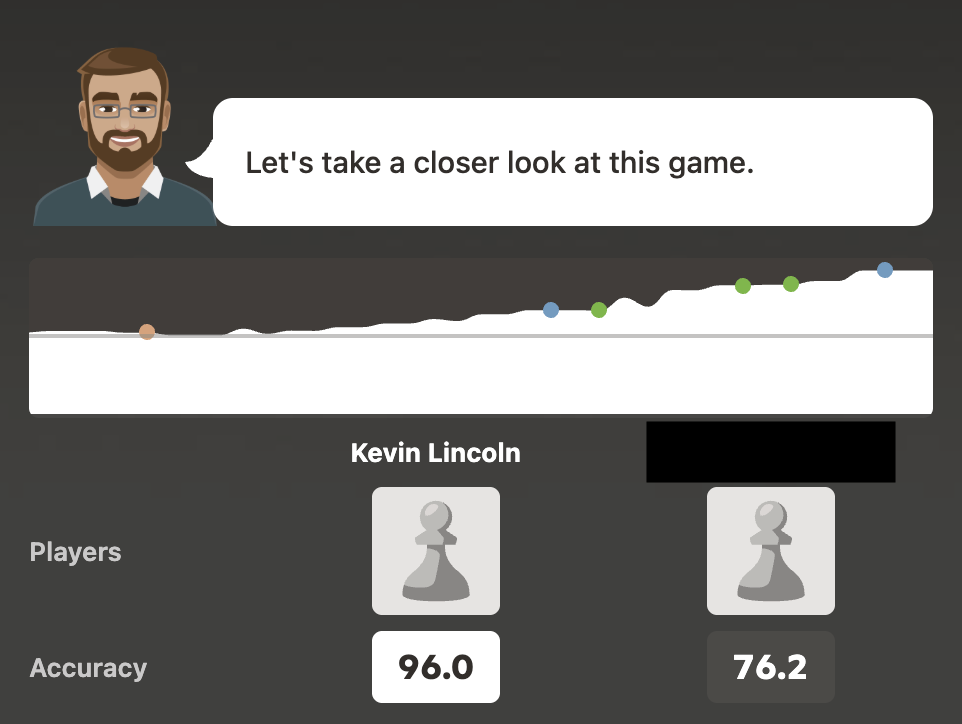
Now, when I say “reports of my demise,” let me be clear that these are all taking place in my own head. No one else in the world cares about the outcome of my chess games.
But last week, I capped off my three recent losses to kids with a fourth in which I straight-up blundered a whole piece in what was otherwise a winning position. It was one of those moves that’s so bad your opponent can’t help but react to it when you play it. As soon as I picked up the knight to move it to the over-defended square, I SAW that I’d lose the knight, but my brain forgot the details of the touch rule and didn’t remember that I could’ve just moved it elsewhere. I put the knight down, and the angels cried.
Anyway: that game kind of felt like hitting rock-bottom. I’d gotten the yips. It felt like the chess equivalent of this:
So I went into my game this week a little addled but confident that, no matter what I did over the board, it wasn’t likely to be worse than blundering a whole piece. And to my surprise, the angels, having finally stopped crying, gave me a gift: an adult opponent. He was an adult opponent who was rated 1500, much higher than the kids I’d been playing, AND was 2/2 in our current tournament, so on paper, he should’ve been tougher than the previous four kids. But you can look at the accuracy chart above for the results of that. I played lights out, one of the best games of my life.
What’s going on here, then? Am I truly just a headcase against kids? Or did I do something different in this particular game? The former might be true, but I think the answer is really the latter — for once, I learned from my previous mistakes.
Let’s dig in.
Before we get to the particular mistake I rectified, let’s touch on one other main difference between this game and my previous four losses: the opening. In those other games, the opening quickly veered into structures that I found unfamiliar, and, intimidated by my unfamiliarity, I played like a doofus.
This game was very different. Opening study is one of the great debates of chess improvement — I’m sure I’ve said this before — and ONE DAY, I will write a proper post about my feelings re: openings. But, BUT: what I feel confident in saying is that, when a game ends up aligning with positions I’ve studied, I play much, much better, not only in the opening but in the middlegame as well, and particularly when my opponent doesn’t know the structure well themselves.
In this game, the opening happened to be a Caro-Kann in which I played the Fantasy, a response characterized by 3.f3. If you play the Caro-Kann, you should have a response prepared against the Fantasy. According to my Lichess database settings, which account for all games played at my rating and higher, it only appears four percent of the time, so it might not feel that necessary to prepare against — but it can lead to very different-feeling positions than your typical Caro-Kann, and if you don’t know what you’re doing, things can go south fast.
In this case, that’s what happened. Unsure of what to do, my opponent ended up transposing into the French. If you’re a Caro-Kann player, you probably don’t play the French, since they’re both responses to e4 — and I’m confident he didn’t play the French, because he chose 5…b6, a weird move in that system, since it prevents the queen from going to b6, where it can put pressure on the d4 pawn.
However, I do play the French: any 1.e4 player needs a response to it. All of a sudden, I had a great French position. I knew the plans. He did not. That meant I could play moves quickly and confidently, and he needed to think hard about basically everything, since he had no natural options.
This led to a tactic that I’m familiar with from my French study:
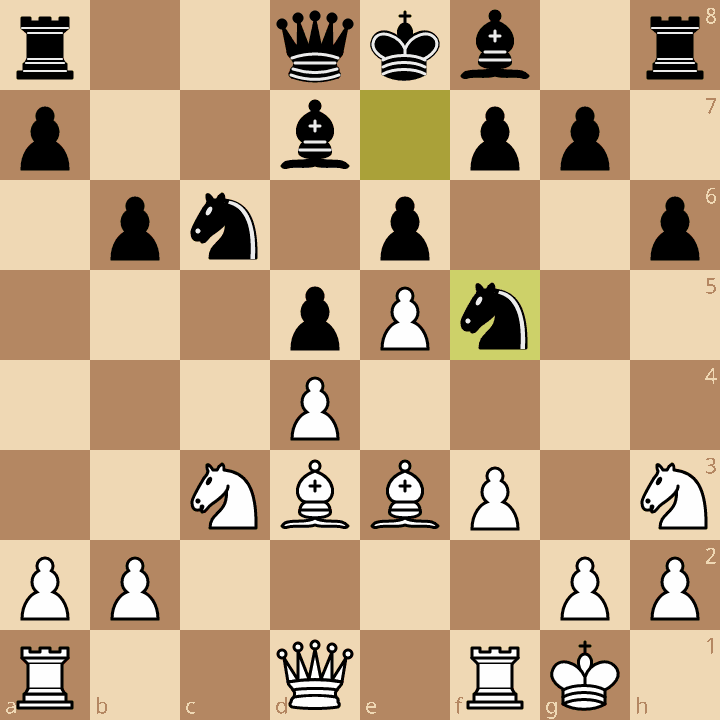
Nf5 drops the d-pawn after Bxf5. There are lines in the French where this is more playable, but this is not one of them. Afterward, I’m up a pawn and the engine gives me a two-pawn advantage because the rest of the position is so rough for Black.
So all of that was nice, and it made the early part of the middlegame much easier for me to play. But I’d lost some of these previous games after leading in the middlegame. What changed this time?
Winston Churchill did not say this, as is often believed; George Santayana did. But it’s true, and it’s kind of the whole point of why I write this newsletter. Other than being an attempt to entertain YOU, dear reader, Good Moves serves as a way for me to narrativize my own chess performance in the hopes of making it more memorable, more comprehensible, stickier.
I have found, across most aspects of my life, that telling stories about my experiences helps me to process and learn from them. That can be as deep and fundamental as therapy, or it can be as superficial and inconsequential as chess. But it holds true regardless: I am far more likely to remember the story of a past mistake than I am to remember the raw event or moment without that additional context.
It’s also fun to do this. It gives meaning and redemptive potential to the parts of our lives that might otherwise feel like mere errors or negatives. If I go out every Monday night and lose to children at a board game, it risks seeming like a waste of time. If I can tell stories about those losses, stories that end up teasing out some greater lesson that might come back around in the future, then they feel not only productive, but somewhat magical. There’s an alchemical quality to it: take your losses and transmute them into growth.
That’s what I’m trying to convey here: when you really learn from your mistakes, it feels GREAT. It feels like you’ve evolved as a human. It feels like the things you are doing are making a difference. We all need to experience this feeling in our pursuits, whether it’s work or art or play.
Yeah, right — so what mistake did I learn from, and how?
I wrote about the mistake in my last newsletter. Instead of using a crucial tempo to attack an un-castled king, I castled myself and let my opponent retreat to safety, from which point he managed to equalize the game.
A similar situation arose here:
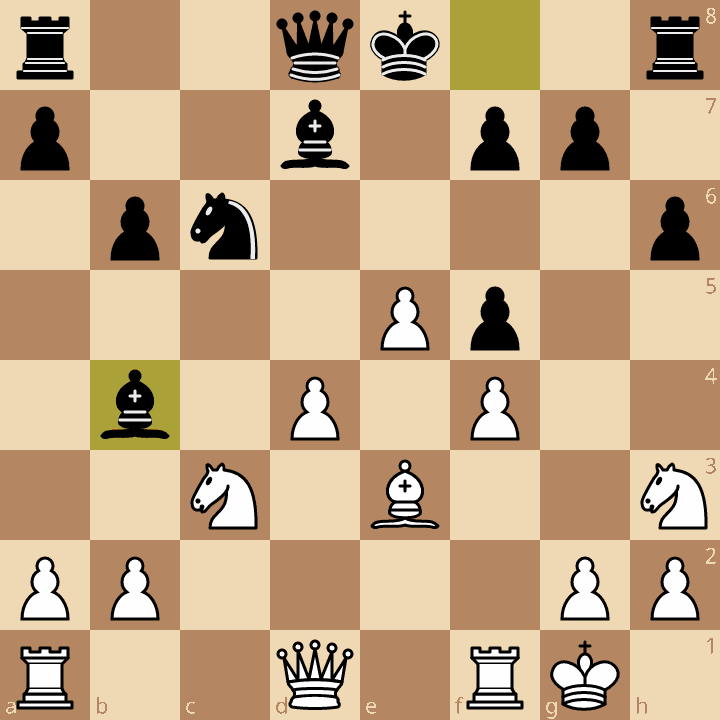
As you can see, Black has finally finished developing their kingside and is one move away from castling. Bb4 isn’t threatening much, since there’s no pin and, being up a pawn, I would welcome trades, particularly a bishop for a knight.
a3 would make sense in that context, as it encourages the trade. I’d also been wanting to play Rc1 for a while. But these moves would be making the same mistake twice. They’d let the moment slip away, allowing Black to castle before I could deliver the coup de grâce.
The best move to find in this position really isn’t that hard. d5 deflects the knight, which has to go somewhere awkward. I saw this, and I assumed my opponent did as well. It’s a good move, but it doesn’t win the game on its own. It doesn’t finish the job in the way I’m hoping to.
That’s when I see a6 as the follow-up to d5. a6 is like throwing a hand grenade into the middle of Black’s position. It’s exactly the kind of move I’ve failed to play in the past. If Black castles, then I get a free bishop. If Black doesn’t castle, choosing instead to exchange on a6, then I blow up their kingside pawns, keep the king in the center, AND get a free bishop thanks to the Qa5+ tactic.
Now, I might’ve seen a6 without having played my previous game. It isn’t that hard to find if you have the positional and tactical awareness that a player at my level (or at least the level I perceive myself to be at) should have. But because of the previous game, this move screamed out at me from the board. I knew exactly what the value of it would be. I understood the meaning.
I played d5. Sure enough, my opponent had seen it coming, and he snapped off Na5. And then I played a6, which he had not seen coming. He thought for a while. (It didn’t hurt that by this point, I had 20 minutes more on the clock than he did.) …fxe6 dxe6 followed. And then, in a desperate bid to preserve the bishop, he played Bc6, keeping the diagonal closed.
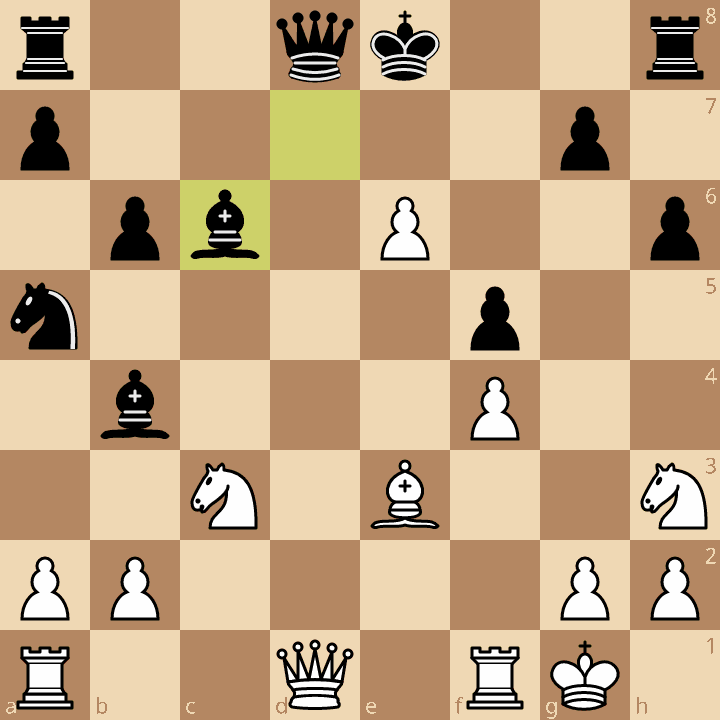
You know you’re in bad shape when your best option is to give up a piece. Bc6 is a fatal error, and the reason why has everything to do with the advantages of keeping your opponent’s king in the center of the board. This move allows Qh5+, which wins the game instantly. No matter what Black does, they’re losing insane amounts of material.
President George W. Bush was right: you can’t get fooled again. Of course, you CAN — but it is imperative that you prevent it from happening. You can’t if you want to improve.
This is the value of narrativizing your mistakes. If you tell stories about them, then you make it easier to learn from them, and if you learn from them, you remember them, and if you remember them, you’re less likely to make them again. This is true in chess, but it’s true in everything else as well.
So when you screw up, talk about it, think about it, understand it better. Trust me: when you actually do manage to learn from it, and you avoid making the same mistake again, it will be more than worth the effort.
No posts
Comments
Nothing yet. Say the first thing.
Sign in to join the conversation.