

Before you read any further, do this.
Write down your organization’s strategy in one sentence. Not what it should be. Not the version you would present to the board. What it actually is — based on the decisions you observe being made, the priorities that actually get funded, and the trade-offs that are actually being accepted.
Write it down.
Most people find this harder than it should be. Some find it impossible. And in 24 years of working with senior leadership teams — at companies including BMW, HSBC, Deloitte, and De Beers — I have found that the difficulty is almost never a failure of intelligence or commitment. It is a failure of definition.
When I ask leadership teams to describe their strategy, I hear some version of the following:
”We want to be the leading provider of X in our region.”
”Our priorities are growth, operational excellence, and customer experience.”
”We’re focused on digital transformation, expanding into two new markets, and improving margins.”
These answers are real. They represent genuine work and genuine intent.
They are also not strategy.
The first is an aspiration. The second is a list of management priorities. The third is a portfolio of initiatives. None of them explain how the organization intends to win — what it will do differently from competitors, what trade-offs it will accept, and why that particular approach will work given the specific challenges the organization faces.
The confusion between strategy and goals, plans, and initiatives is not a communication problem. It is a definition problem. And it has consequences. When there is no shared definition of what strategy actually is, every strategy conversation produces noise. People discuss strategy and mean different things. Decisions get made without a shared logic. The organization executes with effort and without direction.
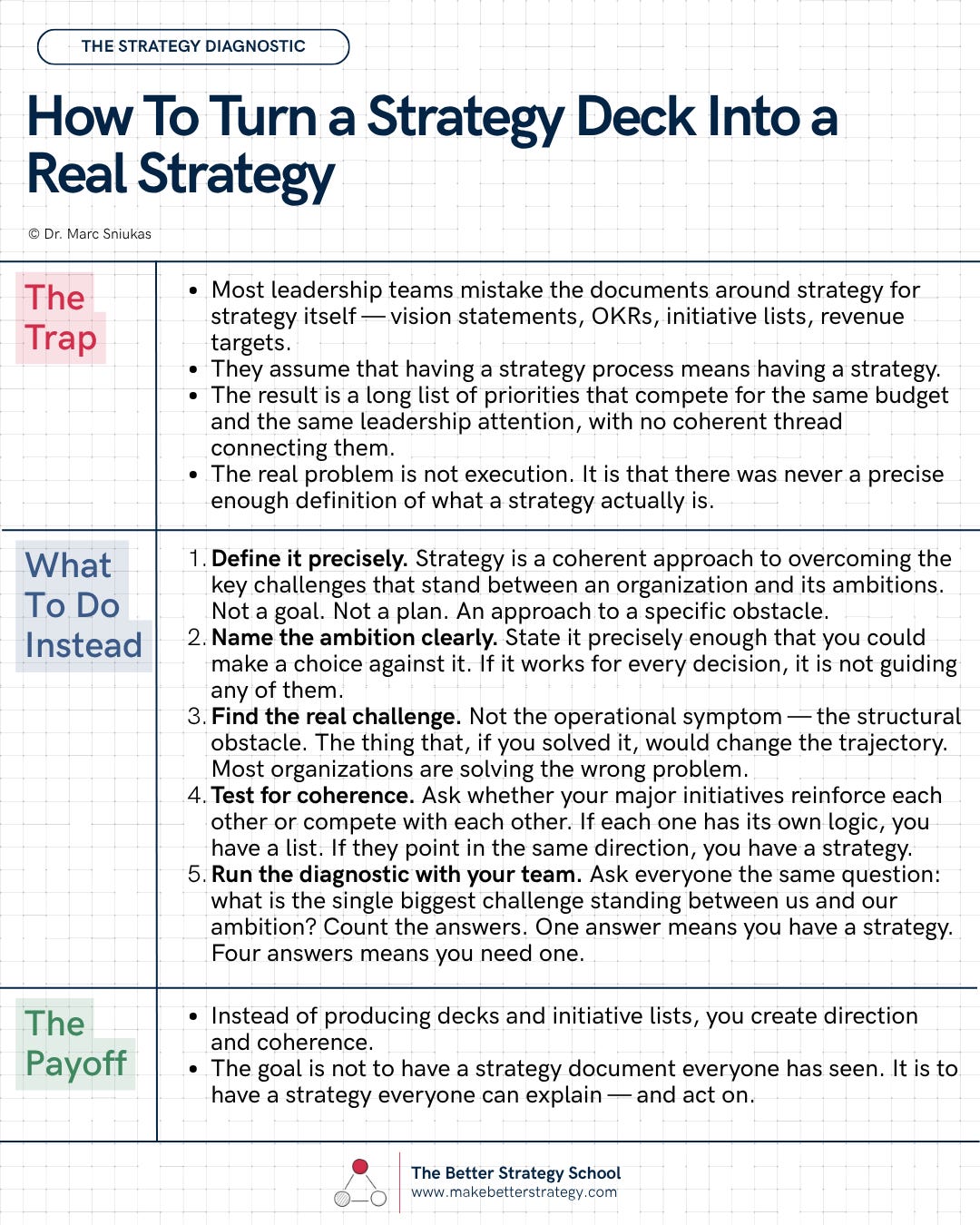
Strategy is a coherent approach to overcoming the key challenges that stand between an organization and its ambitions.
Three elements. Each one carries weight.
Ambition is what the organization ultimately wants to achieve — stated specifically enough to make trade-offs possible. Not a vague aspiration, but a meaningful direction that allows you to say yes to some choices and no to others. Without ambition, there is nothing to strategize toward.
Challenge is the real obstacle standing between the organization and that ambition. This is the most underused element in strategy. Most organizations skip it entirely and jump straight from ambition to solutions. But without a clearly identified challenge — the actual problem the strategy must solve — there is no way to evaluate whether a strategy is addressing the right problem. Most strategic confusion begins here: solutions in search of a problem.
Coherent approach is the integrated set of choices that resolves the challenge. Not a list of initiatives. Not a plan. Coherent means the choices reinforce each other — they hang together as a system. Remove one element and the rest weaken. If your strategic choices can be pursued independently without affecting each other, you probably have a list of priorities, not a strategy.
Run your organization through these three questions. Be honest — not aspirational.
On ambition: Can you state what your organization ultimately wants to achieve in a way that is specific enough to rule things out? If your ambition is compatible with almost any set of choices, it is not yet precise enough to drive strategy.
On challenge: Have you named the key obstacle — not the symptom, the root cause — that stands between you and that ambition? Not “we need to grow revenue” (that is the ambition) or “our sales team needs to perform better” (that is a symptom). The challenge is the structural problem the strategy must overcome. If your leadership team cannot agree on what that is, you do not yet have a strategy problem — you have a diagnosis problem.
On coherent approach: Do your major strategic initiatives reinforce each other, or do they compete for the same resources and attention? If you removed one initiative from the list, would the rest of the strategy weaken — or would it simply continue unchanged? If the latter, you have a portfolio of activities, not a coherent approach.
Most leadership teams find, when they run this honestly, that they have clarity on one element and significant gaps in the other two. The most common: a clear aspiration, an unexamined or disputed challenge, and a set of initiatives that were assembled more through consensus than through strategic logic.
The absence of each element has a predictable consequence.
Without a clearly named challenge, the organization solves the wrong problem — or solves the right problem too late, after significant resources have been deployed in the wrong direction. Leaders describe this as ”we’re treating the symptom, not the disease” or ”we can’t tell if we’re failing at execution or if the strategy itself is flawed.” Usually, it is both — because the strategy was never fully designed to address the real obstacle.
Without a coherent approach, the organization diffuses its effort. Every function pursues its own interpretation of the strategic direction. Budget allocation does not reflect strategic priorities. ”We keep adding to the plate instead of getting ruthless about what matters.” The strategy exists on a slide. The organization continues working as it always has.
Without a precise ambition, the organization cannot make trade-offs. Every decision becomes a negotiation between competing priorities. Strategy becomes whatever satisfies the most stakeholders — which means it satisfies no one’s definition of strategic clarity.
If you found the diagnostic uncomfortable, that discomfort is information.
Not about your intelligence. Not about how hard your team has worked. The leaders I have worked with who struggle most with this question are often the most capable and most committed people in their organizations. The problem is not effort or ambition. It is that strategic thinking — the ability to diagnose situations clearly, define the real problem, and design a coherent approach to resolving it — is a capability that is almost never taught explicitly.
Most leaders develop it, if they develop it at all, through years of trial and error. Through strategies that failed and were eventually understood to have failed for reasons that were knowable in advance. Through situations that exposed the gap between having a strategic direction and having a strategy.
That is an expensive way to build a capability that can be built more deliberately.
A capability gap is different from an effort gap. Effort gaps close with more effort. Capability gaps close with structured practice — the kind that builds a repeatable way of thinking, not just knowledge of frameworks.
The Better Strategy OS is built around exactly the kind of practice that closes this gap.
→ Join a free live executive masterclass to learn more about the Better Strategy OS
PS: Richard Rumelt popularized the challenge-based definition of strategy. But trace the literature, and you will find it in almost every serious thinker's work. The idea is not new. The gap between knowing it and applying it is.
No posts
Comments
Nothing yet. Say the first thing.
Sign in to join the conversation.