
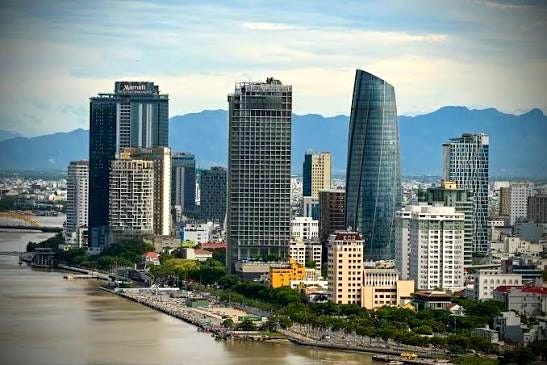
Between the shores of the East Sea and the gentle arc of the Hàn River lies a district at once richly endowed and curiously under‑developed. The ward known as Hải Châu, the urban heart of Đà Nẵng, presents a rare convergence: universities and museums, a river‑front grid of mature trees, premium hotels and residences, and an international airport just minutes away. Yet the kind of dense, walkable luxury corridor found in metropolises elsewhere — flagship boutiques, high‑end dining, creative design studios, and refined cafés building off each other in close proximity — has yet to take hold.
The urban core of Hải Châu is arguably the most functional city center in Vietnam, and one of the foremost in Southeast Asia, in terms of walkable scale, manageable traffic, and a relative absence of pollution and noise. Its proximity to the Hàn River, with pedestrianized riverwalks and scenic views, enhances both utility and appeal. While the area is the historic heart of Đà Nẵng, its architectural legacy has suffered: once‑lovely French colonial and Vietnamese modernist structures were largely razed over recent decades, most replaced with uninspired boxes. But even without adequate preservation, it remains a remarkably attractive and navigable urban space, offering infrastructure and environmental quality that few other central cities in the region can match.
Luxury cars queue at the entrances of private schools, signaling affluence in unmistakable form. But within that same radius, the high‑end dining and boutique retail that should logically follow are shockingly hard to find. While there are numerous Michelin-recommended restaurants, most of them serve street food; there is surprisingly little that could be characterized as fine dining.
Across the entirety of Hải Châu, there are virtually no high-end fashion boutiques, designer apparel stores, or lifestyle flagships. The retail landscape offers nothing beyond mid-tier chains and cheap imitations; there is hardly a venue anywhere in the district that satisfies the standards of global luxury consumption. This is a striking and scarcely believable contrast to the visible affluence of the city: the capital exists, international tourist flow is growing, infrastructure is present, yet the ecosystem of luxury goods and services—the very lifeblood of a sophisticated urban core—is almost completely missing.
Globally, it is rare to find a city center so fully equipped with urban assets yet so commercially underdeveloped. Most metropolitan cores with walkability, scenic appeal, affluence, and accessible infrastructure — from Singapore’s Orchard Road to Bangkok’s Sukhumvit and Shanghai’s Bund before the 1990s — quickly self-organize into luxury and cultural clusters. Hải Châu, by contrast, possesses both physical and financial prerequisites, yet the ecosystem of high-end dining, design boutiques, and experiential commerce remains largely absent. This unusual disjunction — wealth and infrastructure without the accompanying luxury-consumption culture — marks the district as a rare “sleeping giant” in urban development, full of latent potential for those willing and able to navigate the first-mover risk.
A persuasive reason lies in the profound cultural‑consumer gap. Wealth is most often expressed here through durable, visible assets — vehicles, real estate — but less through experiential purchases: fine dining, creative retail, high‑design cafés. Without the local habit of consumption that luxury venues require, investors perceive risk. The first‑mover entry cost is high, and without the critical mass of neighboring upscale venues, the feedback loop for demand remains weak.
The future of the district may depend less on high-end tourists and more on domestic migration trends: Vietnamese seeking livability outside the toxic smog‑bound corridors of Hanoi or the frenetic sprawl of Ho Chi Minh City. Their arrival brings capital, but more importantly, a cultural predisposition for refined consumption and entrepreneurial impetus. As that wave builds, Hải Châu’s urban core could be transformed: the neighborhood once defined by a few premium restaurants and cocktail bars may evolve into a full-fledged luxury lifestyle quarter — a synergy of creative boutiques, destination cafés, galleries, and high‑end retail.
A further catalyst in the transformation of Hải Châu lies in the Lang Vân development, a vast new project stretching beneath the slopes of the majestic Hải Vân Pass, one of the world’s most scenic roadways. Covering 512 hectares and backed by an investment of nearly 44,000 billion VND (~1.7 billion USD), this is not merely a collection of residences and resort accomodations, but a comprehensive urban presence, combining living, commerce, healthcare, and other amenities at a scale the city has never seen.
The sheer size and ambition of the project create a gravitational pull, drawing attention, activity, and investment northward. In doing so, Lang Vân has the potential to counterbalance decades of southward urban drift, returning vitality and prominence to Hải Châu, and offering the possibility of a district re-centered as the city’s true heart — alive with luxury commerce and cultural life in forms the city has long awaited.
That transformation is unlikely to happen quickly. Rather, it will unfold in stages over several years: first the drip‑feed of premium F&B and design outlets; next, the establishment of luxury brand flagships; eventually, recognition of Hải Châu as a lifestyle and global shopping destination in itself.
For now, the paradox remains: a city center with all the structural advantages, yet awaiting the clustering, commercial confidence, and cultural shift to become a genuinely cosmopolitan, luxury-lived space rather than mostly unrealized potential.
No posts
Comments
Nothing yet. Say the first thing.
Sign in to join the conversation.