

A program officer lands on your website. A philanthropy advisor reads an article by your chief executive. Neither contacts you, but each contemplates whether it’s worth learning more about your organization.
This is prospect research for major grants. Your agency is the prospect.
Funders increasingly initiate their own inquiries rather than rely on nonprofit staff to find them. They request a proposal or simply deliver checks to candidates who had no idea they were in the running.
When it comes to new philanthropy, grant seekers no longer own the first step in the process. Funders do.
When Grant Seekers Controlled Discovery
Nearly all the largest awards I’ve helped secure began when nonprofit staff sought out and then engaged someone on the philanthropy side. Organizations chased foundations through a wooing process that rivaled the most infatuated crush. They spent months, even years, identifying the most promising investors before dedicating themselves to the pursuit of a conversation.
In one recurring scenario, a client’s CEO met a program officer and turned ten minutes into cascading conversations and eventually, an investment. Old-fashioned research enabled those meetings, whether they took place in an office, online, or at an event. The brief encounters moved forward when personal synergy built trust.
The wave of breakthrough funding already arriving at many organizations offers little chance for a chief executive to engage in this relational dance. Our field has yet to acknowledge how many of the most meaningful opportunities now materialize in a completely different way.
Why Funders Seized Research
Candid reports that 71% of foundations do not accept unsolicited requests, a figure that has held steady for years. While that closed-door behavior takes a range of forms among foundations, it’s at its most extreme within a growing class of giving vehicles. The donor advised funds and philanthropic LLCs that don’t appear in Candid’s data make themselves impossible to identify, no matter how diligent the research.
Rather than invite applicants, new philanthropists set up stealth giving vehicles that rely on wealth advisors, philanthropy consultants, and increasingly, AI, to narrow the field. Even traditional foundation program officers seek out grantees. Whether motivated by efficiency, privacy, or aversion to public scrutiny, funders are forcing hopeful grantees to reimagine a generation of grant seeking practices.
Consider the most public example in modern philanthropy, MacKenzie Scott’s Yield Giving. Her team locates and studies candidates while conferring with others in the funding and consulting ecosystem. They open a narrow window for rapport when they request information from potential grantees. Visibility and reputation open the door. Relationships close the deal, if they happen at all.
The Discovery Sequence Has Flipped
Few things hold true across major grant seeking. Yet for decades, the sequence of early events has remained consistent. Relationships came first. Reputation reinforced them. A grantee’s visibility confirmed them. Those elements remain, but their order has reversed.
Increasingly, funders’ first impressions of grantees emerge without any prompting from the latter.
They see a video of your CEO’s keynote.
They visit your website.
They learn about a recent achievement.
They ask AI to select organizations working in your industry.
The relationships that have powered major grants now justify an investment decision rather than drive one.
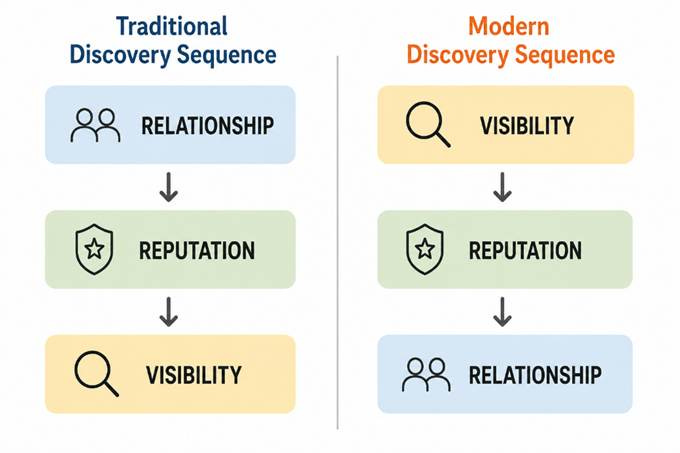
Great opportunity exists for teams that rethink how they engage with philanthropies in line with this shift.
Modern Major Grants Discovery
Visibility increasingly seeds major grants, and a decreasing share happens in person.
Modern funders are less likely to attend industry conferences or seek meetings, so potential grantees’ digital presence is key. The new gatekeepers might consult a charity aggregator, such as Candid Search, GiveWell, or Charity Navigator. They might start with a Google search or an AI prompt. They might see who is featured in an industry publication or on listed on an existing roster of grantees. The organizations that surface may not be the strongest. They are the easiest to find.
Reputation builds credibility.
Funders lean on their peers to bring their solitary research into a peer-influenced space. Grant makers have called me to ask what I think of a prospective grantee. These third-party endorsements build confidence when a funding advocate approaches the boss or board. If visibility surfaces an organization, reputation qualifies it.
Relationships still matter.
New philanthropists are building some of the largest giving vehicles in history. These tech-adjacent donors come from a culture of speed, and relationships don’t scale. So they demote rapport to a late-stage step in the discovery process. Over time, many create openings for grantee interaction, making relationships core to the renewals that feed long-term investment.
Thanks for reading Major Grants! Do you know someone who might benefit from this content? If so, feel free to share it.
The Cost of Invisibility
Teams that pride themselves on a mission-first ethic might shrug at visibility. Their leaders stay heads down in the work. A frugal marketing budget feels on brand.
Many clients confide in me, “We’re the best kept secret.”
I admire that modesty, but it costs organizations financial support. Organizations that anchor their thinking only in the old, relationships-first discovery sequence limit their revenue to the shrinking open-application market and the modest awards it typically yields.
Marketing departments define their audiences as volunteers, clients, and individual donors. They have another audience that few yet acknowledge: private funding institutions.
The old discovery model rewards you for who you know.
The new one rewards you for who knows of you.
Comments
Nothing yet. Say the first thing.
Sign in to join the conversation.