
On November 30, 1948, Bradley Dewey privately urged Secretary of Defense James Forrestal to protect America’s vital industrial centers with an extraordinary weapon:
“If we are to spend money on protection of our congested areas, I would like to see it take the form of very powerful radar jamming stations. Perhaps this is because I know nothing about the subject and can, therefore, speak freely.”
Those sentences carry the entire letter into another level of intrigue. For context, Bradley Dewey operated within the broader Bush-Forrestal military-industrial-scientific network1 going back to World War II.2 He was a “leading industrialist” who served as chairman of the JCS Guided Missile Committee (GMC), in addition to his membership as one of three civilian scientists on the JCS Evaluation Board at Operation Crossroads (aka the “Bikini Board”). Dewey often personally briefed Dr. Bush regarding the guided-missile program.
Considering Dewey’s eminent status in the scientific community, one must take his claim that he knew “nothing about the subject” with a lot of salt.
In his November 30 letter to Forrestal, Dewey introduced an extraordinarily specific civil defense proposal while distancing himself from its source. He recommended that the Secretary of Defense protect cities and vital installations with “very powerful radar jamming stations,” before adding that “[p]erhaps this is because I know nothing about the subject and can, therefore, speak freely” (emphasis added).
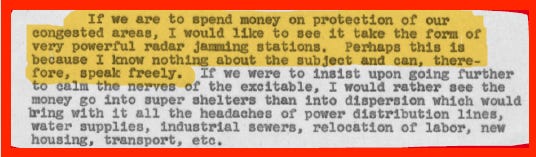
If Dewey’s disclaimer reads like compartmentation language, that’s because he was writing in compartmentation language to someone who understood the compartmented facts underlying the suggestion. This enabled Dewey to describe, in writing, the proposed weapon system—and its various implications—without implicating any sources who previously briefed him on microwave radar’s intriguing potential here.
The second page provides more intrigue, particularly within the second paragraph.
“As I understand it, a plane coming over the top of the world can reach Pittsburgh almost as easily as it can Minneapolis, Milwaukee, Chicago, Detroit, Toledo, Cleveland, Buffalo or Boston. Perhaps what we need most is a cooperative arrangement with Canada to spot incoming planes and get our interceptors up before it is too late.”
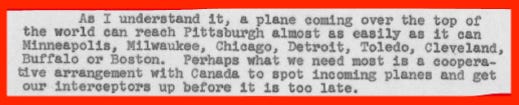
The second paragraph of page two (along with the last paragraph on page one) suggests Dewey envisioned two primary components to this aircraft warning system. First, the proposed Canadian-American radar net, which would (1) identify the “plane[s] coming over the top of the world,” and (2) escalate potentially hostile threats to the Air Force’s continental defense “interceptor” planes. Second, Dewey advocated installing “very powerful radar jamming stations” positioned around America’s congested population and strategic centers as an active defense against an imminent aerial threat.
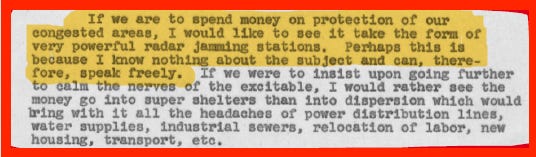
Dewey’s recommendation for additional “very powerful radar jamming” installations makes more sense within the context of the UFO crash retrievals in Corona and Socorro, New Mexico, in July 1947. If nothing else, Roswell demonstrated that powerful radar—which the Signal Corps already operated at White Sands Proving Ground and Fort Bliss—could interfere with the flying saucers’ control systems. Regardless of whether the discovery arrived purely by accident or through some as-yet unacknowledged clandestine project, Roswell evidently demonstrated to the US military-scientific elite that these seemingly invincible otherworldly vehicles possessed at least one technological vulnerability: Our radar jamming stations could track the UFOs mid-flight and, under the right conditions, possibly bring them down.
That discovery had numerous military research implications. For example, scientists could study the frequencies, power levels, range, and interaction between microwave energy and the recovered craft’s control system. Six months after MJ-12’s creation, the Aztec crash of March 25, 1948 raised the continental defense issues of early warning, identification, interception, and civilian defense. Eight months after Aztec, Brad Dewey urged James Forrestal to install “very powerful radar jamming stations” around America’s population centers and defense installations.
Sixteen months after Dewey’s November 30, 1948 letter to Forrestal, the same mechanism appeared in an entirely unrelated document, which is coincidentally the “most popular file in the FBI Vault” ever declassified: the Guy Hottel Memo.
On March 22, 1950, Guy Hottel, the Special Agent in Charge (SAC) of the FBI’s Washington Field Office, sent J. Edgar Hoover an official memorandum titled “Flying Saucers.” The memo recorded information an Air Force investigator provided concerning three previously recovered craft in New Mexico.3
The Hottel Memo also explained why the craft had come down:
“According to Mr. [redacted] informant, the saucers were found in New Mexico due to the fact that the Government has a very high-powered radar set-up in that area and it is believed the radar interferes with the controlling mechanism of the saucers.”

Comments
Nothing yet. Say the first thing.
Sign in to join the conversation.