
Returning to The Military Tattoo, I come back to the moment — and to what sits beneath it.
First, a reflection on endurance, memory, and the cost of staying upright.
Then, a note on the craft — how pressure builds, and what is deliberately withheld.
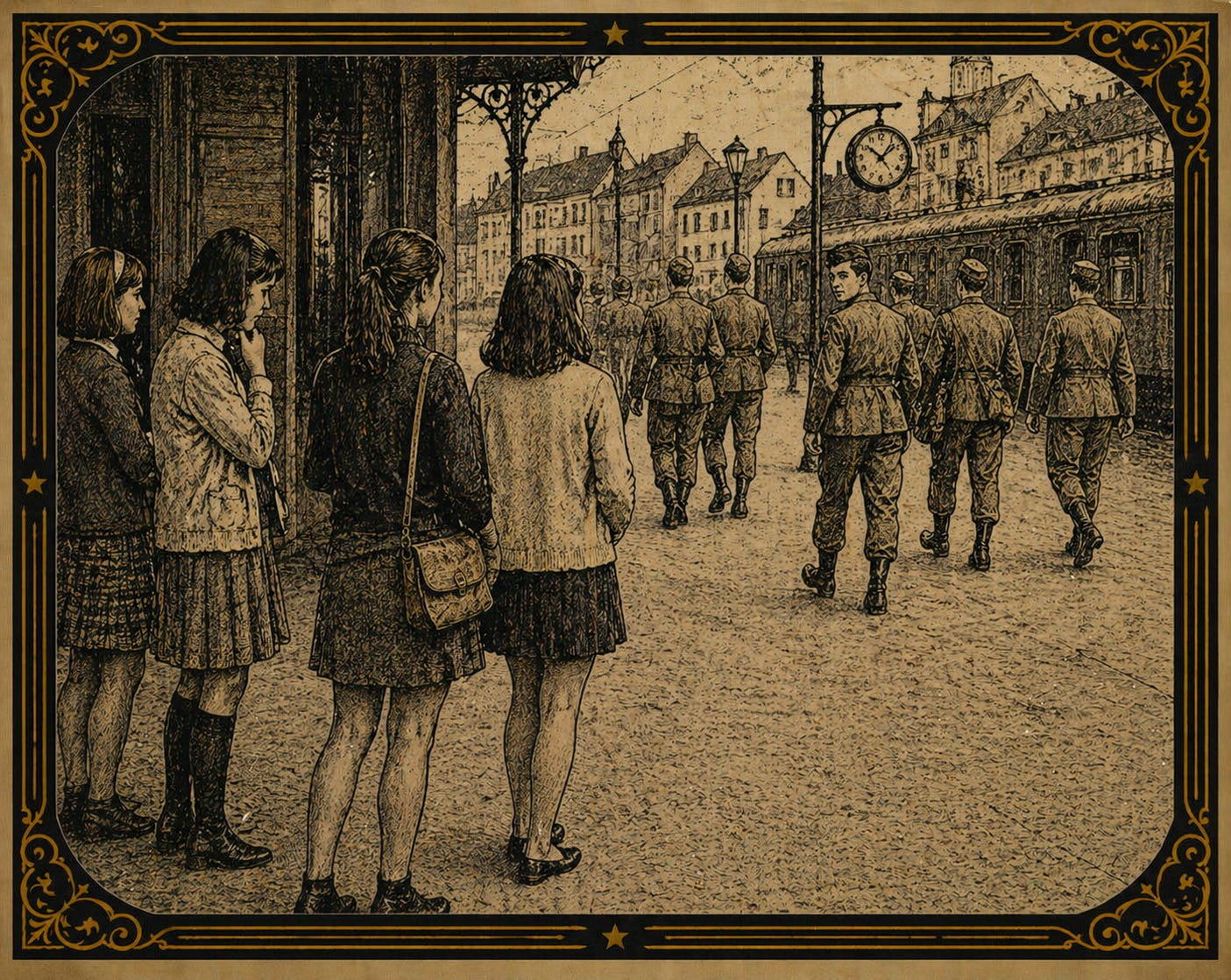
There is something mesmerising about young soldiers.
The uniforms.
The symmetry.
The discipline.
The contained strength.
At a distance, it can look like beauty.
In The Military Tattoo, the girls see the surface — smooth skin, rolled sleeves, a hint of danger. They giggle. They ask for photos. It feels harmless. Exciting.
But the narrator has seen more.
She has watched boys become soldiers.
She has watched softness harden.
She has watched vulnerability sealed behind armour.
In real life. On military bases.
What the girls feel is attraction.
What the narrator experiences is memory.
And something else — a quiet grief.
Because the transformation is not neutral.
These boys will not remain boys for long.
Institutions are efficient at remaking them.
The Army will suppress the boys they were, and impose on them another purpose, another identity — and belonging to another sort of family.
It will also take something away.
We do not always see what is taken until much later.
In the story, the moment at Strasbourg station is fleeting — a photograph, a small exchange.
Yet behind it stand Verdun, ossuaries, white crosses stretching across fields.
History hums beneath the present.
What does it mean to look at young men and see both beauty and future loss?
What does it mean to stand between generations — remembering what the girls cannot yet imagine?
Perhaps this is another kind of persistence.
Not endurance in the face of danger.
But the persistence of history.
Of patterns.
Of the ways nations shape bodies long before those bodies understand what is being asked of them.
The girls will go home with a photograph.
The soldiers will remain at their posts.
And the narrator carries the weight of knowing that desire, pride, grief and danger can exist in the same frame.
I placed The Military Tattoo in the section I call ‘Persisting’.
On the surface, it appears to belong in ‘Emerging’. The girls are emerging into desire. The soldier-boys are emerging into uniformed adulthood. There is laughter, blushes, bravado.
But something else is persisting beneath the surface.
History.
The narrator stands slightly apart from the moment. She has been one of those girls. She has stood on parade grounds. She has felt the pull of young male beauty and the pride of belonging to military culture. But she has also seen what comes next.
That layered perspective shaped the structure.
The story begins lightly — almost playfully — because that is how young girls experience it. I wanted the reader to enter through the doorway of youth.
Attraction first.
Giggles.
Photographs.
Only gradually does the deeper register emerge.
Verdun.
White crosses.
The ossuary.
Institutional machinery.
The juxtaposition is deliberate.
I did not want to analyse the system overtly. Nor did I want to indict it. Instead, I chose to let the image do the work — smooth arms, rolled sleeves, rifles upright — and allow history to hum quietly in the background.
The tension in the story comes from that double perspective.
The girls see possibility.
The narrator sees trajectory.
And the reader is asked, gently: where does this path lead?
Not through argument.
But through contrast.
For this, restraint was essential.
If I had leaned too hard into commentary, the story would have flattened into thesis.
Instead, I allowed pathos to carry it: the sadness of beauty moving toward risk and of innocence framed by institutions. Institutions that will shape it beyond recognition.
Sometimes craft lies not in what is added, but in what is withheld.
Comments
Nothing yet. Say the first thing.
Sign in to join the conversation.