
Returning to A Babe in the Woods, I look at the moment from two angles — what it set in motion, and how it was written.
First, a reflection on early awakenings and the quiet beginnings of vigilance.
Then, a brief note on the craft behind the story.
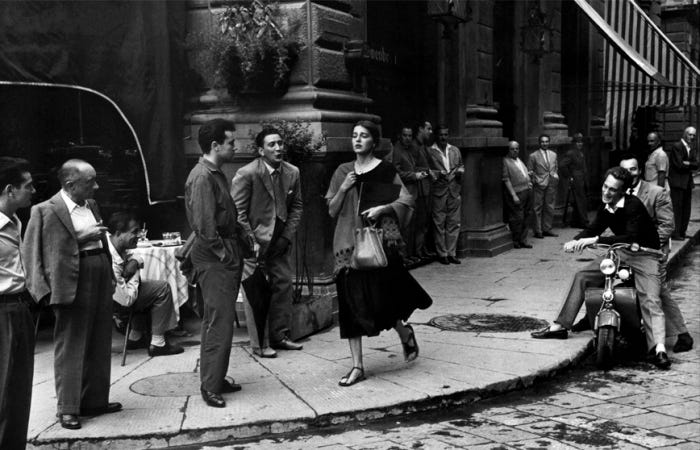
When I return to ‘A Babe in the Woods’, I’m struck less by the incident itself than by the shift it sets in motion.
Not the grabbing of an arm.
Not the humiliation.
Not even the fear.
But the moment a girl realises the world is not neutral – or safe.
That someone else may be watching her – testing, measuring – and that she must begin, quietly, to measure back.
Most girls do not remember the precise day they learned vigilance. It rarely arrives as a dramatic revelation. It arrives disguised as play. As teasing. As ‘nothing really’. A boy blocking a path. A laugh that feels slightly wrong. A body standing just a fraction too close.
Nothing catastrophic.
Nothing reportable.
But something registers.
The body senses it before the mind understands it.
What complicates it – at least it did for me — is that many of us were also taught to smooth things over. To be polite. To avoid making a fuss. To ‘play nice’. To believe we might be overreacting.
So when that first tightening happens in the chest or throat, we don’t always trust it. We search for another explanation. We tell ourselves it’s probably nothing.
And sometimes, in doing so, we cede a small piece of ground.
The damage is rarely dramatic.
We carry that message in our bodies into the next encounter. And we gradually learn to suppress it. To accept it.
It accumulates quietly over years – in moments where we override what we sensed because we lacked the words for it.
Language matters.
Without language, discomfort feels like confusion.
With language, it becomes information – something we can act on.
In the story, the child has no vocabulary for what is happening. She only knows her mouth goes dry. Her knees lock. Her breath rasps in her ears.
Later, she learns something else.
Protection exists.
But it does not always arrive immediately.
And eventually, she must discover her own agency – and name what she is experiencing.
That awakening is rarely loud.
It is almost always private.
Where did you first sense that shift?
Was it dramatic?
Or almost forgettable?
Were you encouraged to trust that instinct?
Or to ignore it?
Was there someone there to guide and support you at that pivotal moment?
And when did you first find the words for it?
I placed ‘A Babe in the Woods’ at the beginning of FAIR GAME very deliberately.
It is not the most dramatic story in the collection. There are no courtrooms, no headlines, no catastrophic fallout. It is small. Domestic. Almost forgettable.
And that is precisely why it belongs first.
Many awakenings do not announce themselves. They arrive quietly, disguised as play or coincidence. A path blocked. A hand held too tightly. A laugh that feels slightly wrong.
I wanted the season to begin not with outrage, but with recognition.
Craft-wise, that meant resisting the temptation to amplify the event. The story had to remain proportionate to the child’s understanding. If I over-interpreted it, the reader would feel instructed rather than invited into a child’s world.
So I stayed close to her body. Dry mouth. Locked knees. The rasp of breath in the ears.
Children often experience fear before they have language for it. The prose mirrors that sequence. Sensation first. Meaning later.
I also chose to write the story in third person.
That distance was important. Writing in first person would have intensified the autobiographical charge and possibly narrowed the lens. Third person allowed me to protect the child slightly – to observe her without overwhelming her – and to let the reader step alongside her rather than inside her.
The structure is simple: an initial encounter, a second escalation, and finally a restoration of balance.
But even that restoration is modest.
The father intervenes, quietly. The sister retaliates. The girl learns something about solidarity and about her own capacity to act.
I was careful not to make the boy monstrous. Nor did I want the father to become heroic. The power of the story lies in its scale. This is not a morality tale. It is an origin story – the beginning of vigilance, and the beginning of agency.
Understatement was the craft decision.
If the story feels contained, that containment is deliberate.
Awakenings often are.
Comments
Nothing yet. Say the first thing.
Sign in to join the conversation.