
Hi, Friend.
As promised, here’s a behind-the-scenes look at a poem from my new book, A Suit or a Suitcase, and the poem itself deals with scenes and looking. Today I’m sharing a handwritten annotation of “In Geologic Time, It Happened Just Seconds Ago.” It was first published in The Southern Review (many thanks to editor Jessica Faust!) and this month was featured on Poetry Daily. Here’s how it appears there, so you have a clean version:
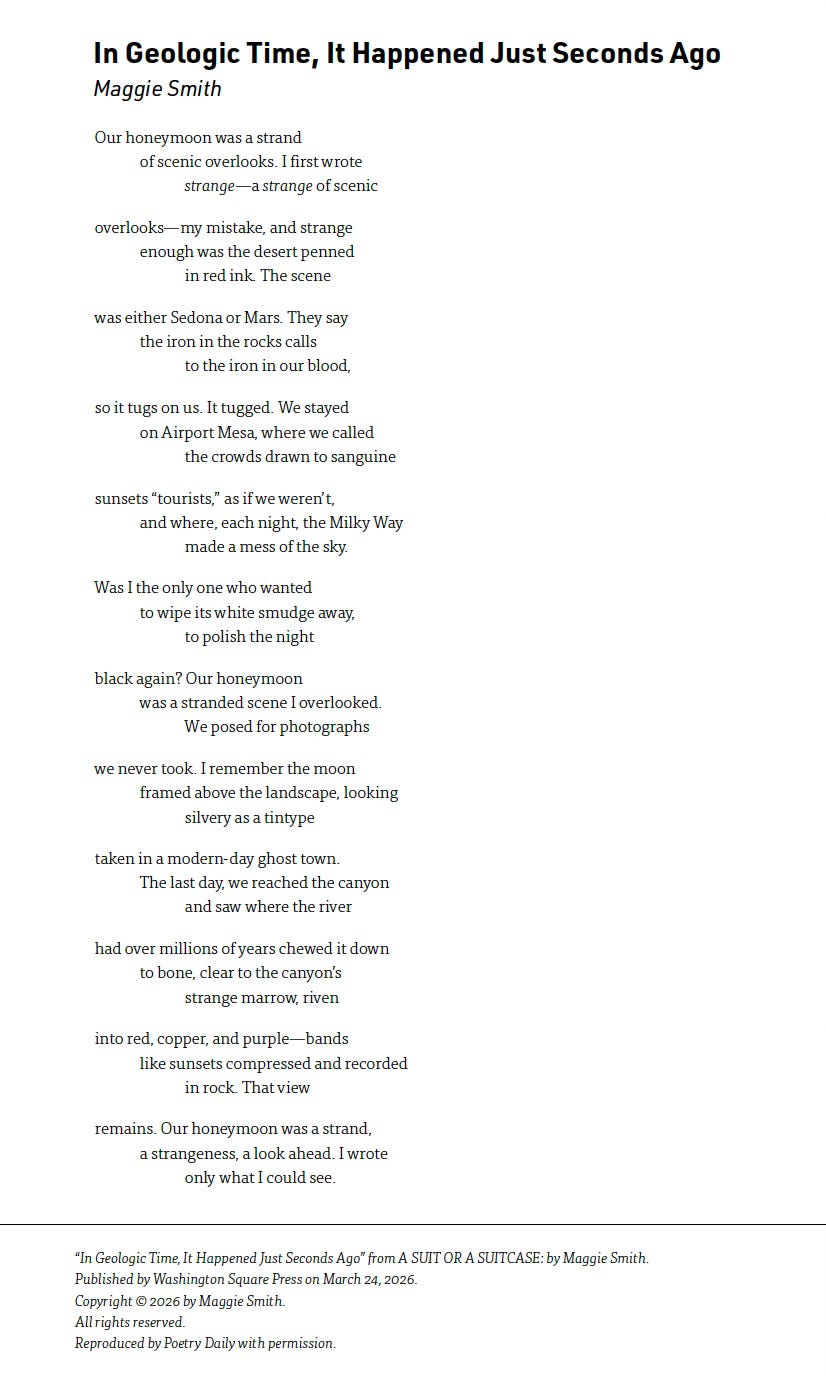
“In Geologic Time, It Happened Just Seconds Ago” is a poem that came together over many years. In 2005 I first jotted down notes about the canyon, the view from Airport Mesa, and the Milky Way while on my honeymoon in Sedona, Arizona. Over the next twenty years or so, I returned to that material now and then, but never had the poem in my grasp, just images. After my divorce, I went back to those old, failed drafts to see what I could find. That excavation led me to a poem that is, in its own way, about excavation, and about seeing things later through a different lens.

What helped me find and shape the poem was seeing an opportunity to play with repetition and variation. Like jazz musicians, we writers can improvise and riff! I’ve noted some of that riffing in the handwritten annotation below.
As I note here, I saw the opening—“Our honeymoon was a strand of scenic overlooks”—as an opportunity to play with variations on that sentence. Mid poem it becomes “Our honeymoon was a stranded scene I overlooked,” and in the end it becomes “Our honeymoon was a strand, a strangeness, a look ahead.” Riffing on the words in those sentences inspired me to play with other words and to find possible variations. Ultimately I built the form of the poem around those variations and revisions/distortions, with the end words in lines 1-3 (strand, wrote, scenic) corresponding to the end words in lines 4-6 (strange, penned, scene), and so on.
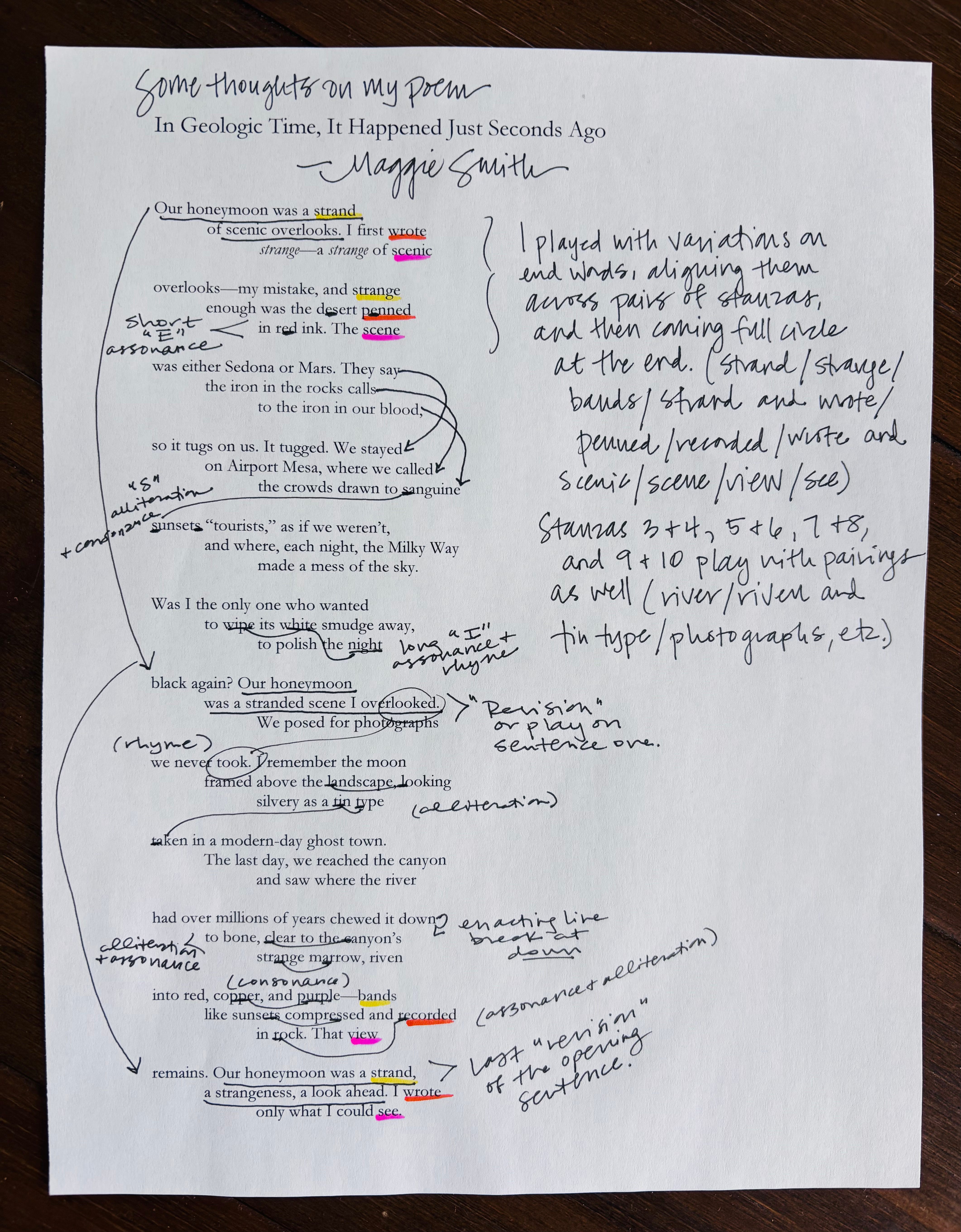
If you quickly scan the poem, you’ll see that the end words in each odd tercet (1, 3, 5, 7, 9, 11) are somewhat mirrored in the following even tercet (2, 4, 6, 8, 10, 12). The last two stanzas also circle back to the beginning. Is it a little fussy? Yes! But I’m grateful to the weird jazz of this poem, and all of those links, because it’s what helped some notes that languished for more than two decades finally become a poem! The form made it possible.
That said, is the weird jazz detectable—in that it’s hearable—but also mostly invisible to readers? I suspect yes, but you tell me! Did you notice this when you first read the poem? As I was revising, I didn’t see a way to call attention to the “matching” end words without hooting the reader over the head. I mean, I wasn’t going to bold them! So at least this annotation gives me the opportunity to share something about the poem’s architecture that might not be apparent on first or second read.
In the annotation, you’ll see I’ve noted some of the sound play in this poem. I’ve noted rhyme (white/night in stanza 6, overlooked/took in stanzas 7-8), alliteration, assonance, and consonance, including places where the sound play is downplayed because of the form. For example, both the sanguine/sunsets and the recorded/rock alliteration are toned down by the line breaks, as the words are given some distance from one another. This can be especially helpful with alliteration, which can slip into tongue twister territory (case in point!) if we’re not careful.
Generally speaking, enjambment allows for suspense—a kind of floating—at the ends of lines, so that the reader needs to keep reading to know where the sentence is going. Most of the lines in this poem are enjambed; only eight are end-stopped, with punctuation (comma, period), which I think adds to the sense of improvisation and re-seeing: the reader, like the speaker, is a little off-kilter, trying to make sense of the memory. Memory, perception, and revision are themes that come up again and again in A Suit or a Suitcase, and they all live in this poem.
I think of my poem “Wife for Scale” from Goldenrod (2021), also featured on Verse Daily, as a sister poem to this one. Read them both and see if you agree? (Fun fact: I have two geologists in my family, my youngest sister and her husband. If I ever need a rock identified, I know who to ask!)
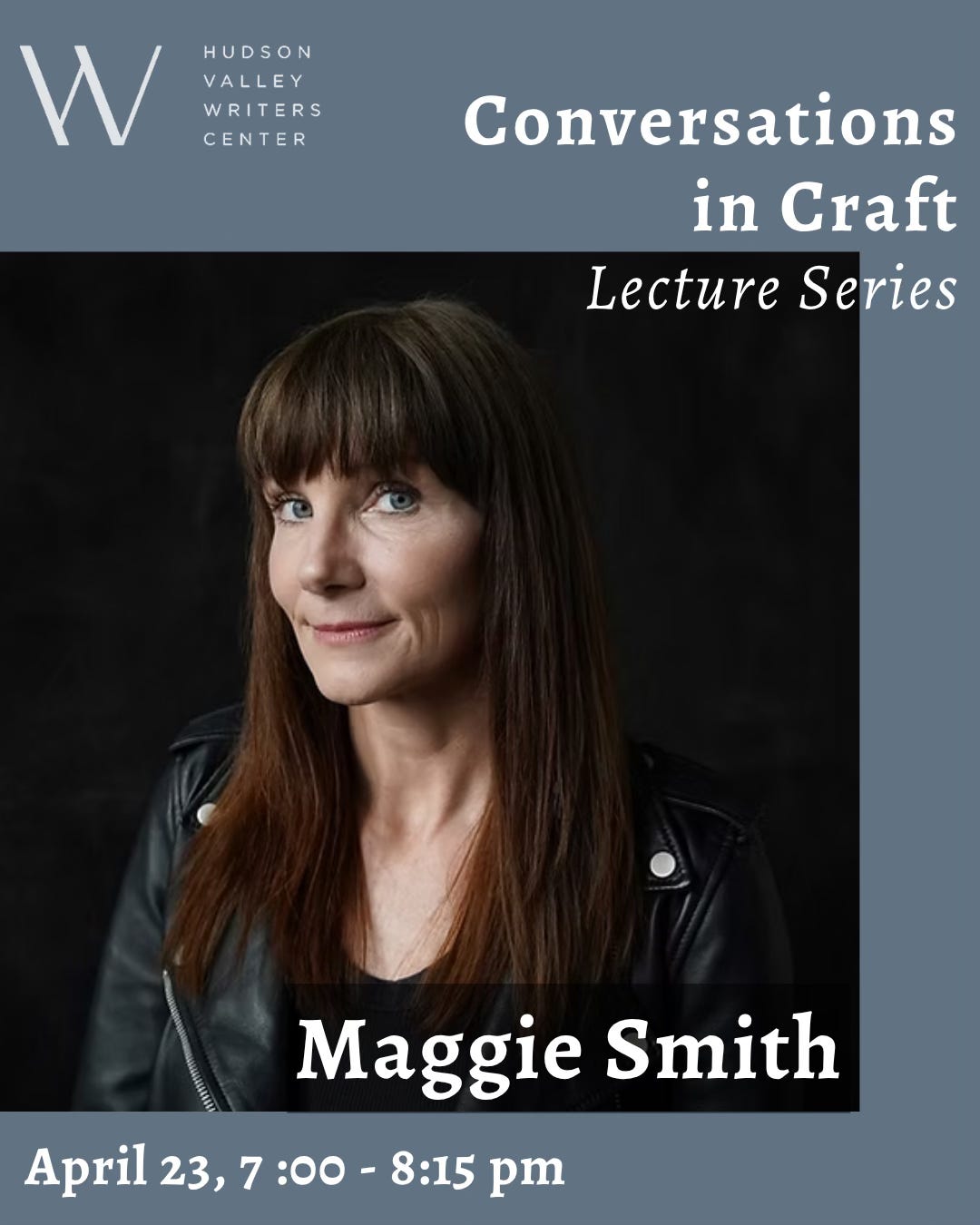
I’m giving a craft talk on Thursday evening, hosted by the Hudson Valley Writers Center. I won’t be talking about “In Geologic Time, It Happened Just Seconds Ago” specifically, but I will be talking about something that happens in the first two stanzas of the poem: an admission of a mistake. The talk is called “The Golden Repair: Embracing Imperfection in Our Poems.” I think it’ll be fun!
What else? We’re celebrating National Poetry Month on The Slowdown, so I hope you’ll join our newsletter and consider donating if you’re able. I don’t have to tell you that public media has taken quite a hit over the past year.
Thanks for being here at For Dear Life. It means a lot. I hope that experimenting with some “weird jazz”—repetition and variation—will help a draft of yours finally find its form. Here’s to that!
Take good care—
Maggie
Thanks for reading For Dear Life! This post is public, so feel free to share it. Word of mouth is still the best way for people to find books, writers, and creative spaces.
No posts
Comments
Nothing yet. Say the first thing.
Sign in to join the conversation.