
Welcome to My So-Called Feminist Life: Essays, interviews, and book reviews that wrestle with what it means to be a feminist today. This week, I’m reviewing my favorite book of the year, and thinking about womanhood, desirability, and being alone. Also letting you know where to find more of my work in the new year.
I’m a freelance journalist and if you’d like to support my work financially, you can subscribe here. Sharing, liking, and commenting are also wonderful ways to support my work.
About a year ago I stopped shaving my legs and armpits. My easily-irritated skin never seemed to like shaving. Plus, I wanted to see what might happen — what did my leg hair look like anyway? It seemed kind of ludicrous that in my late thirties I didn’t really know myself in this way. I also just hated the double standard of it all. I thought maybe I’d start to shave again come spring or summer, for shorts and tanktop season, or when I got too hairy to be comfortable swimming laps in my swimsuit (why women’s bathing suits force us to consider the hair at our “bikini line” is another subject of my rage), or when dressed up for a wedding or event — but I just … never did.
I know this is sounding very 1990’s Lilith fair attendee feminist awakening right now. But even as a self-identified feminist, women’s college alumna, and deep skeptic of gender roles, I had never spent an extended period of time with body hair before. And even though I personally have never thought anything beyond “cool” when I’ve noticed a woman who doesn’t shave, I worried about how others would perceive my body hair, a lot. Did they notice? How could they not? Were they embarrassed for me? Am I an extremely hairy woman? Maybe I saved some time in the shower not shaving, but I certainly spent more time than ever trying to figure out why I was so worried about body hair. Was it the male gaze? The need to feel desirable? Simply wanting to fit in?
In any case, this was the kind of mindset I brought with me to reading Melissa Febos’s The Dry Season a few months ago. I was hesitant to get into this book, only because I bristle a bit at any memoir that feels like a marketing ploy — I spent a year doing XYZ, here’s what happened!! — and the subtitle of the book worried me: A Memoir of Pleasure in a Year Without Sex. “Self-imposed celibacy? Really?” I thought, “How revolutionary!” But Febos addresses this skepticism early on in the book and it reminded me immediately of exactly how I’d been thinking about my body hair situation.
After Febos’s mother, a therapist, tells her to be careful who she tells about her initial period of three-months celibacy, since for many people this is not a big deal, she writes: “The problem with making a radical personal decision is that it pales in comparison to most things one might consider radical, like political revolution, religious conversion, suicide, or even divorce. A personal revolution is entirely subjective … A shift can be radical and ordinary at the same time.”
This is the lens that drew me in headfirst. As someone who has been through a two-year MFA Program in Creative Nonfiction, and taken numerous writing classes throughout my life, I’ve read my fair share of navel-gazing memoir. I would not even consider reading a book on this topic by a lesser writer. But Febos is a student and teacher of the craft, and somehow she writes books that not only delve deeply into her own thought processes and experiences, but somehow her personal stories also become wormholes through which a reader gets steeped in stories of ancient human history, culture, biography, philosophy and religion. She is a thinker on the page in a way that I envy, and though she and I have almost nothing in common on paper — besides being writers, women, and feminists I suppose — I found myself identifying deeply with her mental journey as she worked through her own former dependence on partnerships, sex, the male gaze (even as a queer woman), and her relationship to herself, her work, joy and pleasure. I saw my own weirdness about body hair as part of the same itchiness (metaphorical) that Febos starts to feel as a partner, and I have increasingly felt about being perceived as a wife, mother, and woman, in my midlife.
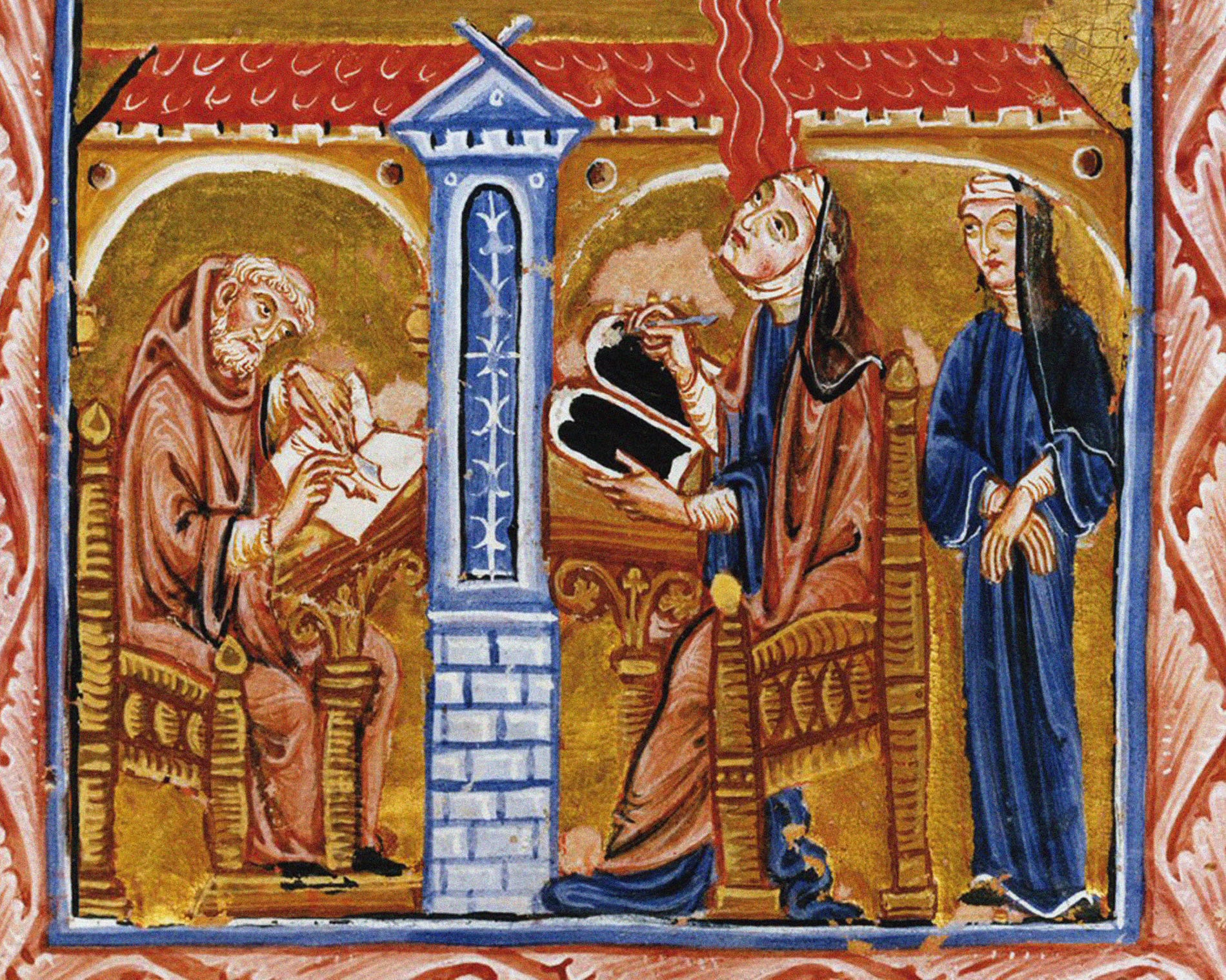
The Dry Season circles around several different touch points outside of her own story, including Belgian beguines, ancient female mystics, Virginia Woolf, and other women of yore who chose celibacy as a form of taking hold of their own societal power. After all, what are the traditions of marriage and motherhood about but giving up power, autonomy, selfhood? “Sharing a life always sounded horrible to me. I didn’t want to share. I wanted a whole life for myself,” Febos writes.
Unlike Febos, as a child, I’d fallen headfirst for the Disney-dream of sharing a life, and was a pretty hardcore serial monogamist throughout my young adulthood. It wasn’t until after I’d been partnered for nearly two decades and had multiple children that I realized sharing a life meant exactly that: sharing. Sharing implies a positive, of course, but there’s also a loss of independence that’s nonnegotiable. Because whether you, like Febos, have experienced a controlling partner, or are just dependent on finding the next thrill of the high of the cycle of flirtation to hookup to relationship, or, like me, you have small children and a spouse, it’s highly likely that as a woman, you may realize one day that you have lost the ability to wake up in the morning and do exactly what you want to do, if you ever had it to begin with.
The book fascinated me with the central question of how a person learns to see themselves as important enough to cater to, spend time with, and invest in, whether or not someone else does, too. This is a truly radical concept for those of us who are millennial women, fed the idea of “GIRL POWER” as harnessing your own body and sexuality to have as many men as possible find you attractive — as Febos puts it “Helen Gurley Brown feminism,” AKA 100 Ways to Please Your Man as a means to self-empowerment.
Febos deeply excavates this type of power — that shaving our legs and making sure we look good in our jeans, and wearing heels in order to be seen as desirable, is part of the belief system that controls women to see this as our only power. She is scared, she writes, of setting this kind of power down. She worries: “I might become something unrecognizable and even pitied by heterosexual society. I might stay invisible to men and recognizable to myself for good. Then, I thought, Oh. What a savvy trick, to convince women that we should not want all of this.”
Because what do we get from male-gaze type attention anyway? Or any unwanted romantic attention for that matter? Is it truly powerful to play into the same gendered hierarchy that promises if we win, we’ll always have to share? When we give up some opportunity to know ourselves in subservience to others’ needs and desires, what have we lost? Everything? Not just in a room of one’s own kind of way, either, but in the way that if we don’t truly know ourselves, how do we ever truly connect and care and love others?
I’ve been wrestling in my own work for so many years to try to untangle the mess of women’s power. It’s part of why sports and physical capability has always intrigued me. Because it is so obvious to me that we all have this other kind of power, strength, and brute capability — not just men. Yet, women often cling to this particular sense of power, beauty standards, and feminine wiles, and even — yes, still, yes, again — frailty and tininess, because it seems somehow safer, more reachable, than wanting true physical power of our own. What happens when we relinquish this power? Well, anything we want.
For Febos, this relinquishment has to do with giving up sex, dating, and romantic relationships. Within this choice, she doesn’t become an isolated nun or a hermetic writer — instead, she’s able to see others as fully formed individuals, not just conquests. As she dives further into herself, her former patterns with others become more and more clear. By giving herself over to romantic partners — which many women are primed to do — she was unable to truly share a life with anyone. While she pokes fun at herself throughout the book, that she is merely doing what 1970’s consciousness-raising feminists were doing before her, and others before them, Febos doesn’t oversimplify. Feminism, she writes, is about going back and seeing what we can do better the next time.
So, yes, not shaving my armpits is silly in a way. A lesson many women before me have discovered, and yet, perhaps, one we all need to learn in our own ways.
It is so difficult to write books like Febos does. Personal and universal and complex and weird and erudite all at once, I found The Dry Season an accessible and intellectual twist on the now-popular divorce memoir: A look at female independence and love and sexuality and partnership in our current era of, well who the hell knows what era we’re really living through when it comes to gender politics. And as I look toward the end of a difficult year — for all the obvious reasons, plus the personal journey reasons of hitting my (very) late 30s and having young kids and a career in a dying industry — I think this is the book I read this year that made me think the hardest, that will stick with me, and that I truly appreciated as I consider what I want next year (and honestly, the rest of my life) to look like.
EASY BEAUTY by Chloe Cooper Jones
HAPPY LAND by Dolen Perkins-Valdez
NERVOUS by Jen Soriano
FEEDING GHOSTS by Tessa Hulls
RING OF SALT by Betsy Cornwell
THE THIRD GILMORE GIRL by Kelly Bishop (listen to it on audio! Also, FYI Megan Burbank and I have been reviewing Holiday RomComs over at Gilmore Women)
ALL SYSTEMS RED And the rest of The Murderbot Diaries by Martha Wells
BEAR by Julia Phillips
OUTLAWED by Anna North
Speaking of next year, I have some exciting projects I will be launching in 2026. Keep your eyes here! For the next few months though I do have some fun things happening in Seattle. More on those below.
My author series at Pitch the Baby (Seattle’s newest women’s sports bar) is going so well! There’s one more this year, with Georgia Cloepfil. Come buy holiday gifts AKA books, for the women’s sports lover in your life!
This Friday, Dec. 12 at 5:00 PM with Georgia Cloepfil, author of THE STRIKER AND THE CLOCK: ON BEING IN THE GAME.
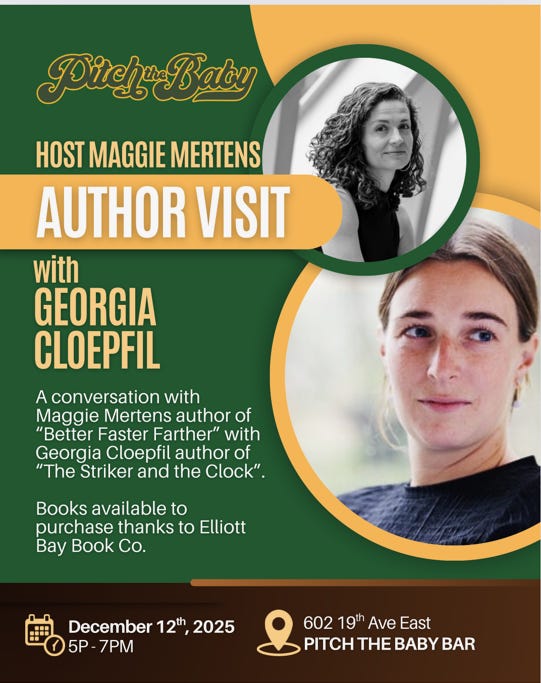
And Save the Date for January 26, when I’ll be in conversation with THE Angela Garbes! This has been so fun. If you have a suggestion for a local author or have a book coming out that’s a good fit for a women’s sports fan audience, let me know!
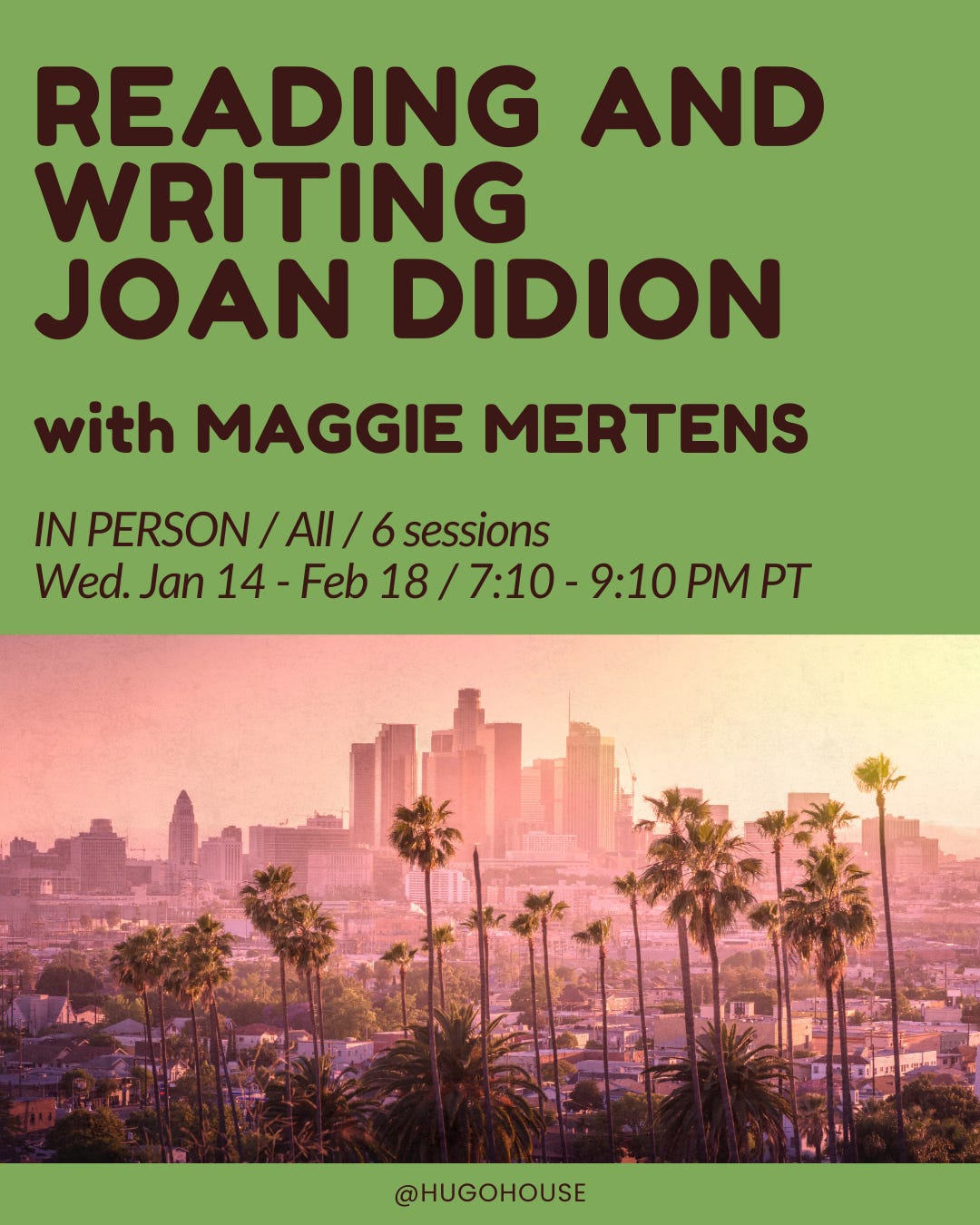
I’m teaching again at Hugo House, here in Seattle, in January and February. This time a 6-week course reading essays and reporting by Joan Didion (Controversial? Yes! Iconic? Also yes!). We’re going to read, discuss, and write with some Didion-esque observational skills. If you’re looking for some deep reading practice to influence your writing and are a Didion fan, Didion hater, or Didion curious, sign up! It will be fun!!!
I had a piece come out in the Smith Quarterly (the Smith College alumnae magazine) about women chasing the 4 minute mile mark.
Do you know Diana Flores? She’s the captain of the Mexican women’s flag football team and I got to profile her for Sports Illustrated as the winner of the Women’s Sports Foundation’s Game Changer Award.
I had a great time on the Active Moms Podcast with Dr. Carrie Pagliano talking about my book, and my own journey in running, activity, and motherhood.
After my last newsletter went out, I was asked to chat about the state of the media with Marcus Harrison Greene and Nora Kenworthy on In the Meanwhile, a local show about surviving the current apocalypse (lolsob).
Last but certainly not least, I was so glad to finally get to speak with Brendan O'Meara on The Creative Nonfiction Podcast to talk about my work life, writing about running (Brendan wrote THE FRONTRUNNER, an excellent biography of Steve Prefontaine that came out this year), and what the year after your book comes out is like. Also nbd, but his next guest was John McPhee, so… hoping that means something good?
I’m joining the Humanities Washington Speaker’s Bureau for 2026-2027 with my talk: HOW WOMEN WON THE MARATHON AND CHANGED OUR VIEW OF GENDER. If you’re interested in booking me to bring my interactive talk about how women marathoners shaped and changed society’s view of gender -- and how we can continue to learn from their work, please do reach out.
Nonprofits can apply to have the honorarium and travel fees funded by Humanities Washington. But any organization can book this talk at an accessible fee. More info here.
Thanks for reading! My So-Called Feminist Life is a newsletter wrestling with feminism in today’s world. I encourage conversation in the comments if you wish to share your own thoughts, feelings, memories, opinions. If you’d like to support this project financially, you can become a paid subscriber.
You can find me on Instagram: @maggiejmertens and on BlueSky @maggiemertens.bsky.social
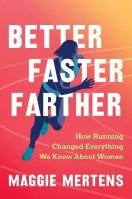
You can order my book Better, Faster, Farther: How Running Changed Everything We Know About Women (Algonquin Books) from your favorite local bookstore, request it from your local library, or push this quick order button from Bookshop.org. If you’ve read it, I’d love if you’d leave it a glowing review at Amaz*n or Go*dReads.
Comments
Nothing yet. Say the first thing.
Sign in to join the conversation.