
Welcome to My So-Called Feminist Life: Essays, interviews, and book reviews that wrestle with what it means to be a feminist today.
As evidenced by the below newsletter, I could write and talk about women’s sports forever. Which is why I’m really excited to let you all know about a new project of mine: The Forecast: Seattle’s Weekly Women’s Sports Show. It’s airing on KVRU 105.7FM in South Seattle or online at kvru.org. (The back catalog will be up soon, but for now we’re on live Tuesdays at 4PM PT and Wednesdays at 9AM PT). Tune in. Follow the show here. Or get in touch if you would like to support!
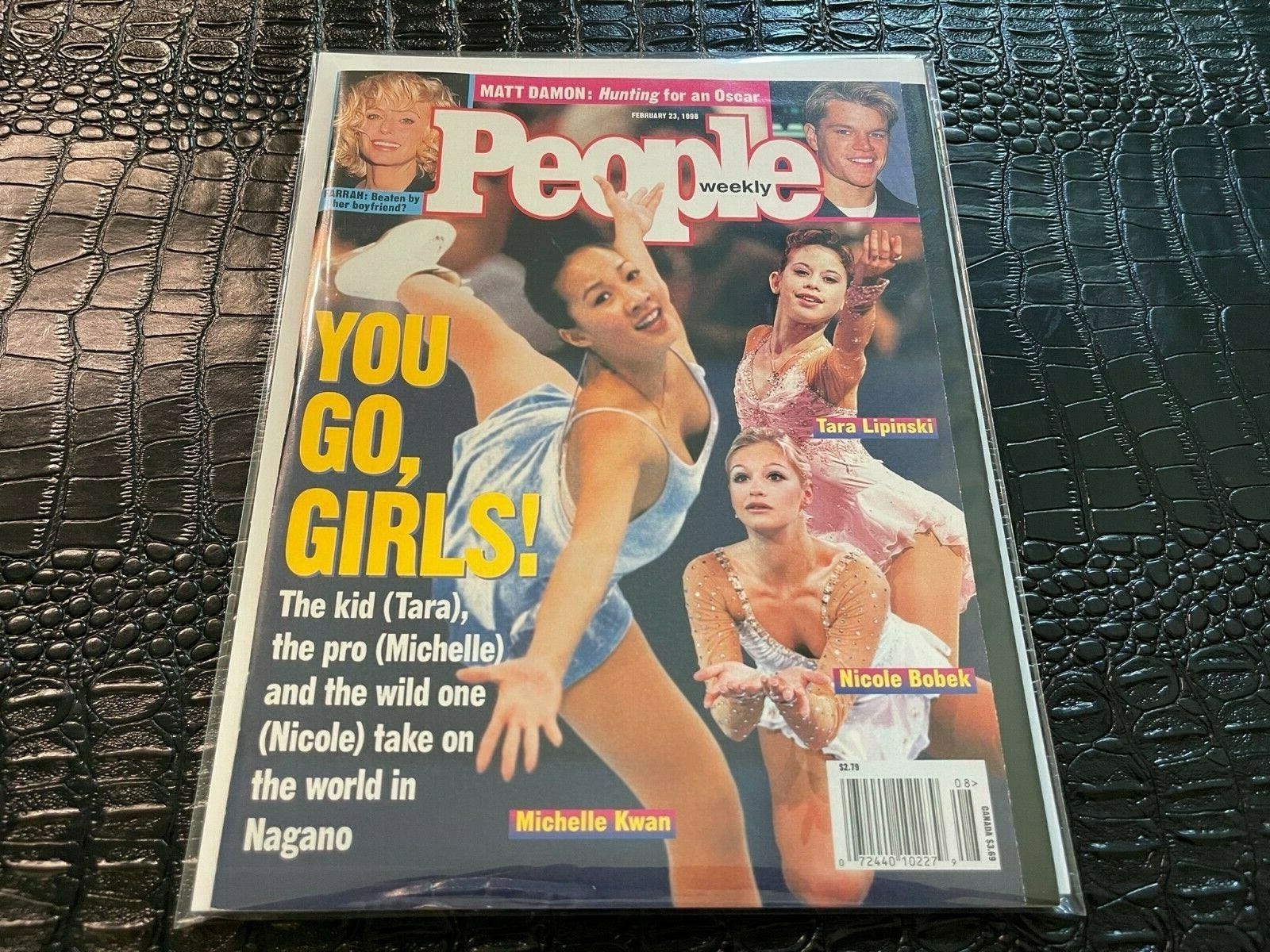
The Winter Olympics have always had a grasp on me. I remember poring over a PEOPLE magazine with the three women who would be attending the 1998 games in Nagano for the United States figure skating team on the cover: Tara Lipinski, Michelle Kwan, and Nicole Bobek — complete with very 1990’s framing, the headline called them, “The kid (Tara), the pro (Michelle), and the wild one (Nicole)”. Kwan’s crushed velvet baby blue skating costume was the height of late ‘90s fashion. (I was devastated when “the kid” beat her with a more technical routine and held an unfair grudge against Lipinski for years — I have since come to respect Lipinski and her commentating and her vivacity VERY much).
Even though I had never learned to ice skate, and really had no desire to, I was slightly obsessed with figure skating and that obsession has continued well into my adult life. Generally, yes, I still only watch the sport once every four years (like most of the world), but during the Winter Olympics it’s as though an invisible force is out there, pulling me toward my television, pumping me full of serotonin. Listen, I know that the Olympics are terrible for many many reasons. I know that the founder of the Olympics was a racist, misogynist who really really loved masculinity (in fact, I wrote a book that was very much about this!). I know that the IOC is corrupt and the economic, environmental, and political impact is often very very bad. But there’s something about watching athletes from all over the world come together to compete in sports that usually no one gives a crap about that actually just gives me so much faith in humanity.
When I lived in New York during the 2014 games, without cable and before streaming services, I tried to get bunny ears to work on my TV to get NBC so I could watch the Olympics. I pulled those bunny ears all over the living room inside my thick-walled brick building, but NBC only came in if they were placed nearly outside the one window in the trapezoidal room, and it still wasn’t entirely clear. Still I sat there, perched in that corner, watching Bob Costas and his conjunctivitis-laden eye walk me through the events of the day over in Sochi each evening.
On the phone with an editor this week, she mentioned that a lot of women our age seem to have this Winter Olympics obsession. “I think it’s because it was our only opportunity to watch women athletes as children,” she mused. And, a light bulb went of for me. Of course this explains my figure skating obsession. That PEOPLE magazine cover might have been the first time I’d ever seen women athletes on a magazine cover at all! It was pre-1999 women’s national soccer team winning the world cup. Pre-any professional sports leagues for women at all. Sitting in front of those evening broadcasts were likely the first time I ever saw women athletes on broadcast television. And not only on television, but they were the stars. Women’s figure skating was the highlight of the Winter Olympics. Always.
Which is all to say that while many people here in Seattle spent the past couple of weeks watching and celebrating a Super Bowl win, I have been plugged into my own Super Bowl. Pretty much the only thing I think that has been improved in our lives thanks to streaming services is the ability to watch the Olympics without having to see the terrible Primetime NBC packaging and watching these interminable winter sports the way they are meant to be enjoyed: from start to finish. If all that is on is curling, I will watch curling. If there are certain speed skaters I wanted to see, I will find those races and watch the stream. A friend mentioned this week that I seemed really happy, and I thought, that’s because I am. I am watching elite athletes, mostly women, do insanely difficult things and actually get massive attention and celebration for it.
This Thursday, in particular brought me such joy. The USA Women’s Hockey team winning gold in the absolute nail-biter win over Canada at a time when professional women’s hockey is finally taking off in the U.S. was one of those turning point moments I think we’ll look back on, like the 2015 Women’s World Cup, or the undefeated Olympic run of the 1996 Team USA Basketball team that presaged the formation of the WNBA.
But it was something about turning immediately from the women’s hockey gold medal match, over to the women’s figure skating free program (which I rewound to avoid spoilers) only to see 20-year-old Alysa Liu skate a routine the likes of which I have actually never seen before. Every moment of that skate was laced in the joy and freedom of her own movement. (ICYMI, the short version of her story is this: She from skating at 16. She was burned out. At 16. Because the way we’ve treated sports — especially demanding and extreme sports like figure skating — as though the only way to succeed is to be a champion or an Olympic gold medalist or the skinniest or the prettiest, etc. etc. etc. is exactly the wrong way to treat sports if we want to actually allow kids to learn things and actually get good without burning out! But she came back because she missed the fun of skating. The joy of skating. The art of skating. And somehow, as a 20 year old, she has been able to actually skate with only those things as goals. She said in all her media interviews during the Olympics she truly did not care about winning a medal. She wanted to just skate for the art and joy of it on this big stage.)
I have seen other skaters skate with joy, (Lipinski in ‘98 is a great example), and moments, perhaps, of total freedom. But, the thing about the Olympics is that since these athletes only get this type of attention every four years, the pressure we see them under is immense. And that so often leads to heartbreak. The skater who is just too stiff and can’t hit the full rotation, or worse, hits the ice. The speedskater who feels the need to apologize to everyone she’s ever known because she fell during a qualifying heat — even though she’s a world champion — and falling during a race is just part of the sport. But to see Liu show every single person that you do not have to fit the cookie cutter mold anymore, even in a sport like figure skating, and that you will do your absolutely best work, your most joyful and beautiful art, when you fully give up judging yourself through other’s eyes, well, to quote Liu, herself, “That’s what I’m fucking talkin’ about!”
I wish this joy on every athlete, every human, will be carrying this lesson from a woman 20 years my junior with me. When women athletes still have so much pressure to be perfect, and to prove their worth to the world, I see Liu’s victory as a huge advancement for women’s sports everywhere to quit feeling like they have to do everything the way they’re told, and forge something better instead.
OK, I know not everyone is fully plugged into the Olympic Games (because it is basically a full-time job) so I wanted to use this space to share a few of my favorite, most joy-bringing parts of what I’m thinking of as, the “Redemption Olympics.” Please enjoy some serotonin while it lasts!
Meyers Taylor has long been an athlete I’ve deeply admired. She went from a collegiate softball career to bobsledder in 2007, winning a bronze medal in the 2-woman bobsled event at the 2010 games. Since then she has been an advocate for the sport, helping to encourage other women to join bobsled, pushing to expand the offerings (several years ago the IOC added the “monobob” event to the Olympics’ women’s program instead of the 4-man sled… a move Meyers Taylor told me at the time she wasn’t super pleased with), and raising two children who both have disabilities. She has simply never given up. And for her to win the gold in monobob this year, at 41 years old, after doing so much for her sport. I just couldn’t be happier.
I was introduced to Mikaela Shiffrin, like many people were, as a wunderkind of the alpine ski racing world. She won her first gold medal in slalom in 2014 when she was just 18 years old. In 2022 I felt for Shiffrin as she had a very poor showing just two years after her father (and ski coach’s) sudden, tragic death. To see her come back mentally strong and win the slalom gold again is so heartwarming. Get this, she now holds the record as both the youngest and the oldest woman to win Olympic gold in slalom. How is that for dominance?
I have been obsessively watching the Instagram videos of Team USA hockey player Haley Winn’s three older brothers as they supported her part in the team’s gold medal run. First, these three remind me of exactly how my brother’s have always showed up for me: Enthusiastically, and often in matching outfits. I truly believe the power of sibling love and support can change worlds. And I’m sorry but if they’re final video didn’t make you sob, are you even human?
Look. This did not get nearly enough (any?) publicity, but this was the FIRST EVER year that women ski jumpers also competed in the Large Hill. (There are two hills, the women used to only be allowed off the smaller one, while the men have two separate events). Now, women’s ski jumping in general has only been in the Olympics since 2014, but I am so happy for the women who have been pushing for this for YEARS to have finally had the opportunity to jump off of a hill the same height as the men do. Because, it is quite honestly the LEAST that could be done. (Now, please let them compete in Nordic Combined, too. Thanks!)
Come see me in real life!! I will be giving my Humanities Washington talk at several different libraries in Washington in March (Happy Women’s History Month!) Dates, times, and locations, below. I would love to see you there!
(Want to book me? More info here! Humanities Washington: How Women Won the Marathon and Changed Our View of Gender)
March 5 | 5:00 PM, Lakewood Library, Lakewood, WA. Free and open to the public! More information/register here.
March 7 | 2:00 PM, Vashon Library, Vashon Island. Free and open to the public! More information/register here.
March 26 | 6:00 PM, Online, hosted by NCW Libraries. Free and open to the public! Register here.
March 28 | 2:00 PM, University Place Library. Free and open to the public! More information/register here.
My author series at Pitch the Baby (Seattle’s newest women’s sports bar) will return in April with scholar Justin Eckstein, who is going to talk with us about his newest book, Sound Tactics: Auditory Power in Political Protest.
Monday, April 13, 5:00 - 7:00 PM.
More dates to come, soon! Watch this space for updates!
Thanks for reading! My So-Called Feminist Life is a newsletter wrestling with feminism in today’s world. I encourage conversation in the comments if you wish to share your own thoughts, feelings, memories, opinions. If you’d like to support this project financially, you can become a paid subscriber.
You can find me on Instagram: @maggiejmertens and on BlueSky @maggiemertens.bsky.social
You can order my book Better, Faster, Farther: How Running Changed Everything We Know About Women (Algonquin Books) from your favorite local bookstore, request it from your local library, or push this quick order button from Bookshop.org. If you’ve read it, I’d love if you’d leave it a glowing review at Amaz*n or Go*dReads.
Comments
Nothing yet. Say the first thing.
Sign in to join the conversation.