
Several Saturday nights ago, I gently elbowed through a throng of tourists on Hollywood Boulevard who were staring with their mouths agape at the iconic, slightly dilapidated TCL Chinese Theatre, as I had an IMAX 70MM screening of Christopher Nolan’s The Odyssey to get to.
Under normal circumstances, the TCL Chinese Theatre wouldn’t be my first pick to see a movie, nestled in the heart of Los Angeles’ equivalent to Times Square. But these weren’t normal circumstances: every other IMAX screening of The Odyssey in Los Angeles County was sold out, including 3 AM screenings at Universal CityWalk. So, there I went, stepping over Marilyn Monroe’s handprints, through the crimson pillars, far less ceremoniously than the countless movie stars who had walked the route before me.
It ended up feeling fitting to experience such a big cultural movie in such an iconic Hollywood venue. Aloof to the particulars of Homer’s original epic, I loved The Odyssey. I was so enthralled, I barely noticed how stale and tasteless my popcorn was, that it had likely been sitting in the paper bag I was eating it out of since Star Wars premiered at the Chinese Theatre in 1977. Sitting in that particular theater, eating that particular popcorn, and seeing these particular sparkly movie stars complete a three-hour, decade-long Hero’s Journey was so satisfying, vintage, and LA. I felt like I was in Entourage or something.
I have steered clear of much of The Odyssey discourse, not wanting to tinge my delightful experience of it. But I do understand that Emily Wilson, the first woman to publish a complete English translation of Homer’s The Odyssey in 2017, was largely displeased by the adaptation, which she’s in her right to feel, given how much she’s labored over the text and given that Nolan primarily relied on her translation as inspiration for his film. For The Guardian, Charlotte Higgins writes that the film was too imbued with modern moral sensibilities, turning a post-war poem into an anti-war poem in the process, while also acknowledging that it’s nearly impossible to adapt a classic text completely faithfully, whatever “faithfully” means.
But the only enduring thought I’ve personally had about The Odyssey (2026) is how uncannily perfect the casting was. This isn’t to say the casting was “good,” per se, but that it was satisfying.
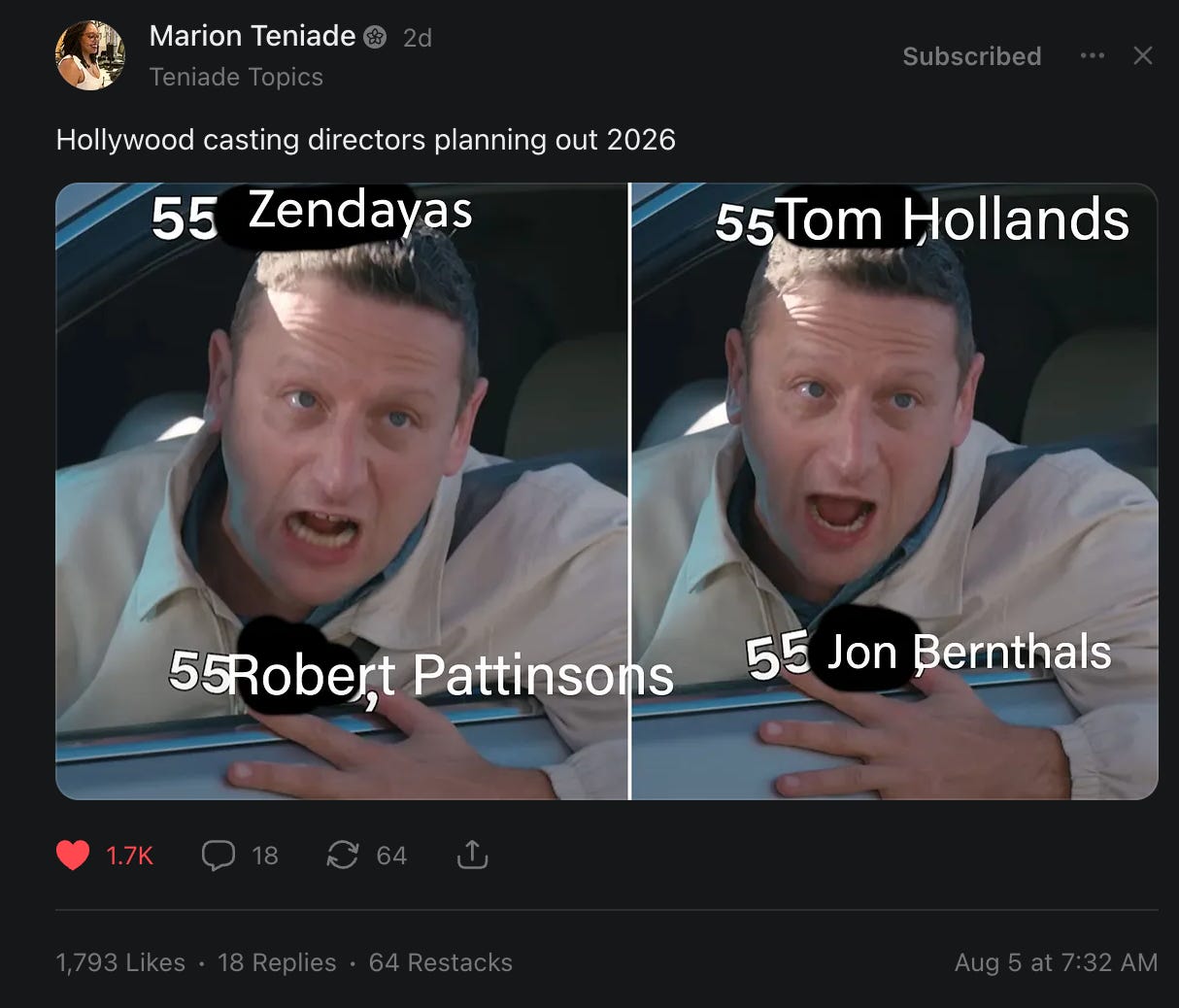
True to Christopher Nolan’s style, the cast was a perfect blend of decorated heavy-hitters, hot new things, and non-actor wild cards. To the chagrin of a few, the film opens with Travis Scott as the bard Phemius, introducing the Trojan Horse trick used to breach Troy in a rhythmic, poetic tempo. His delivery is just rap-like enough for us to understand Nolan’s cleverness, to highlight the parallels drawn between ancient Greek bards and modern hip hop artists, almost too much of a wink to modern-day viewers, but not quite.
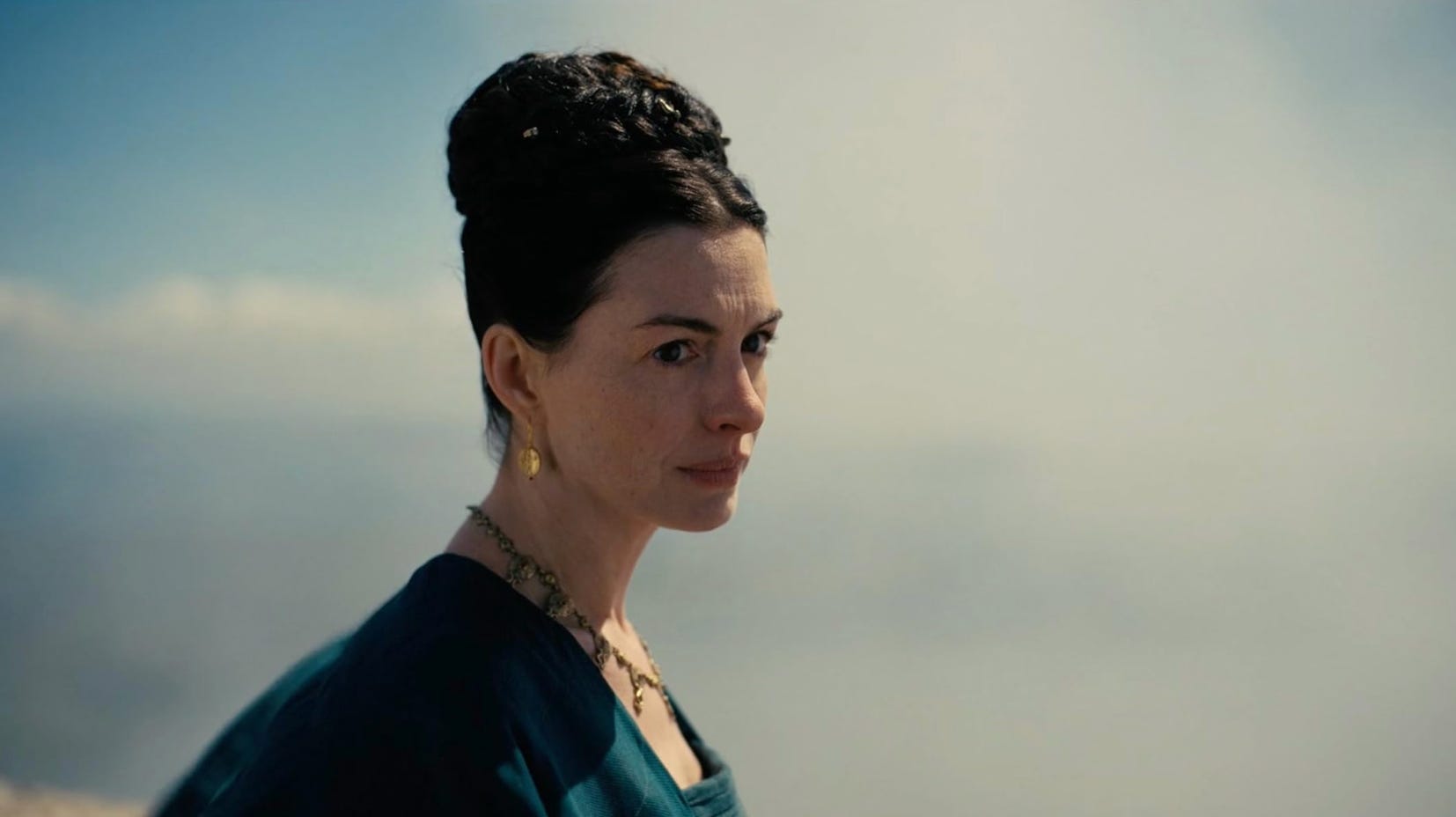
We’re then introduced to the seasoned and bright-eyed ensemble cast, each actor perfectly embodying the archetype that the blend of their personal movie star identity and filmography has slotted them into. Odysseus is played by famous Bostonian Matt Damon, who has the flexible ruggedness of a military captain or scoundrel, and the soft underbelly of a family man, all contributing to his complicated hero identity. American sweetheart Anne Hathaway plays Odysseus’ wife Penelope with emotional vigor and immediate likeability. Hathaway is beautiful, strong, and has enough movement in her face (she’s become known for her “graceful aging”) for us to see the full range of her character’s emotional spectrum, endearing her to viewers.
Everyone else is fulfilling their usual roles, all boxes checked. Thirty-year-old Tom Holland is a confused teenager with a complicated relationship to a father figure. Robert Pattinson is an evil weirdo with a silly voice. Jon Bernthal is a brash, ethically complex, but ultimately likeable dude. Zendaya is a goddess. Charlize Theron is a beautiful woman with a frigid, clandestine edge. And even Mia Goth plays a disloyal, unnerving servant harboring a secret affair with Pattinson’s Antinous, which fits in with her typical, unholy slew of characters neatly.
Each actor being perfect, or imperfectly perfect, for each role made the casting feel almost too cogent, like seeing an ultra-high-definition photograph, all the details in such sharp view that the subject doesn’t even look human anymore, alien without the automatic smoothing effect of an iPhone camera. Or perhaps it’s not that the film was truly, objectively, “perfectly” cast, but that it felt like a cast that Film Twitter would have hand-selected. Fan service, in a sense. And sometimes being served exactly what you want isn’t actually what you want. Like a teenager finally being granted a night out with friends after a week of being grounded, it can feel unusual to have nothing to complain about anymore.
Consuming discourse about art, in short-form video clips and medium-form articles, has taken up as much of my media diet as consuming art itself. And with that, the two media formats, at times, merge. It’s challenging for me to watch a movie or listen to an album without letting outside chatter, or what I imagine the outside chatter will be, color my perception of the art itself. As I’m watching Antinous try to kill Telemachus and seize control of Ithaca, I’m imagining the fan edits that will be made out of clips from this scene. I’m seeing Robert Pattinson smirking as Antinous at the dinner table compiled with clips of him as Edward Cullen and Bruce Wayne and his character in Good Time, all spliced together over A$AP Rocky’s “Fashion Killa.” I’m seeing a bumbling Tom Holland as Telemachus compiled with clips of Tom Holland as a bumbling Peter Parker, kitten whiskers and pink hearts sketched on his cheeks and a K-pop song playing over top.
In some ways, this feels related to typecasting, which is as old as movie-making itself. The Old Hollywood star machine thrived off reproducing pictures that featured actors playing the same types of characters, and merging actor-character identities in the process. Christopher Nolan is clearly no stranger to typecasting, as he usually hires the same half-dozen actors in all his films. In a recent interview, Nolan’s long-time casting director John Papsidera says that Nolan is “never wondering what might fit the mold; he already knows the shape.”
But typecasting isn’t the whole issue. The other part of the issue with watching movies these days is the unavoidable discourse creep. It’s always been challenging to engage with mainstream media in a vacuum, with the celebrity news marketplace being as prosperous as it’s always been. But with social media being as waterlogged with lay media critique and entertainment “news” as it presently is, and with social media being the default fumes we breathe in our spare time, the place our attention lies when it’s not supposed to be somewhere else, the discourse creep feels especially particular to these times.
Virtually every twenty- and thirty-something I know has some degree of awareness and knowledge about what’s happening in the world of movies and pop music, regardless of their profession or personal interests, or if they even care about pop culture. And I think it has something to do with the fact that we’re constantly being entertained by our phones, and much of that entertainment is just reproductions and remixes of traditional media. Movies, TV shows, and pop tours whittled down to interview clips and screen recordings and fan edits, served and ingested without seeking them out directly, until all we breathe is “entertainment,” whether we want to or not. Without our directly knowing it, we absorb entertainment trade knowledge and celebrity news through a kind of osmosis, by simply being on the internet all the time, until suddenly we know when certain “projects” are in production, and where they’re filming and who’s involved, knowing all this information about an industry we’re not even directly involved in, and maybe not even that interested in.
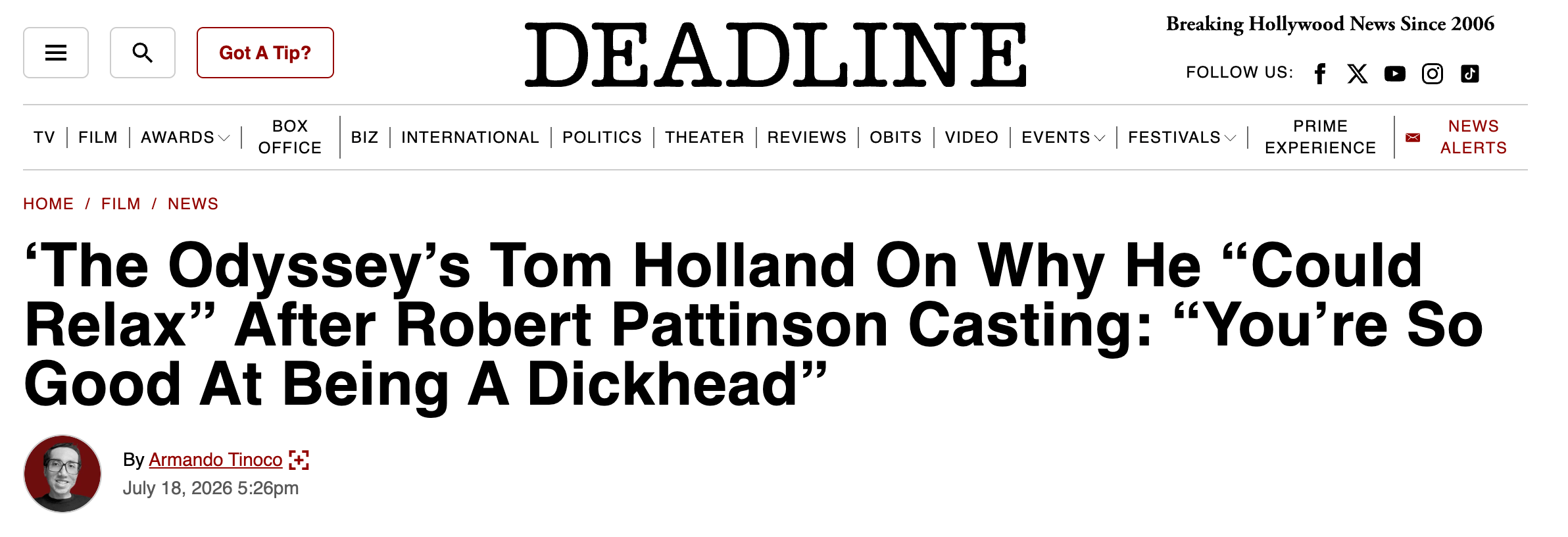
For example, if you fit within a certain young, educated, vaguely artistic, chronically online demographic, and you use Twitter, you’ll be categorized as a Film Twitter person and begin getting served the latest Deadline casting news via @FilmUpdates. You’ll start seeing clips from press junket interviews on TikTok, and theories about those clips, and perhaps even fan edits of the actors in those clips. As a result of simply seeing these headlines and seeing people talk about them, you’ll begin to care about them too. You watch other people’s talking head videos about the entertainment industry and the celebrities that inhabit it, and begin to silently, mentally bookmark the opinions that you agree with, the ones you could put forth at a dinner party if the topic was breached. You’ve become an “expert” at entertainment.
Even when we’re not outright being entertained by “traditional” forms of entertainment, so much of our entertainment is a critique or reproduction of that entertainment. And as a result, we talk about the critique as we would talk about the work itself, growing increasingly removed from the source material with each level of discourse. Discourse about discourse about discourse, all the way down, until it’s hard to even engage with the source material without thinking about the outside world.
When entertainment and entertainment discourse dwells at the center and periphery of our attention span, it’s nearly impossible to digest art in a vacuum. Just take Ariana Grande’s latest album, petal, for example, which is a fine work in isolation, but impractical to enjoy or disenjoy without thinking about the implications of liking it or not, due to her perceived illness, or lack of illness, depending on where you stand. In so many cases, the discourse about the discourse about the work has eclipsed the work itself.
But I guess this is the business of pop culture: perhaps the spectacle surrounding the work is impossible to detangle from the work itself, perhaps it’s meant to be this way. I love talking about entertainment, but even I find it a bit nauseating that all anyone ever seems to want to talk about is entertainment, and meta-entertainment, that it’s the commonest common denominator, the basement level of every watercooler. If we weren’t constantly being entertained all the time, perhaps it would seem more novel. I, for instance, love hearing opinions about entertainment from people who are largely detached from social media. But hearing the chronically online and chronically enthused divulge their entertainment opinions is like hearing an alcoholic boast about their bottle, or the Stockholm syndrome’d gush about their abductor. Obvious, noisy, and honestly a bit sad at times.
I’m trying to engage with more media in as airtight a container as I can before letting the chatter in. I will still probably always love knowing and speculating over the latest entertainment news, but I can’t let it replace meaningful engagement with the source work itself. With enough restraint, we don’t always have to dwell on the tertiary tier, but can confront ideas directly, closer to their core.
No posts
Comments
Nothing yet. Say the first thing.
Sign in to join the conversation.