

This month features two macros (with a bonus third) that simplify cleaning up the tracking in a document. Also, there are only a few more days to register for the FRedit workshop through SD/PEN.
When cleaning up tracked edits, pressing the Accept and Reject buttons on the Review tab allows you to review each edit independently, accepting or rejecting it before moving to the next one. However, if you want to keep your focus on the text you are reviewing rather than the Review tab, try TrackAcceptMoveOn and TrackRejectMoveOn. They give you the same functionality—accepting or rejecting the next tracked change—without having to shift your attention.
I also find TrackRejectMoveOn useful when I have changed my mind about an edit I’ve made. It rejects the change in the background while I focus on whether to take a different approach or leave the text as is.
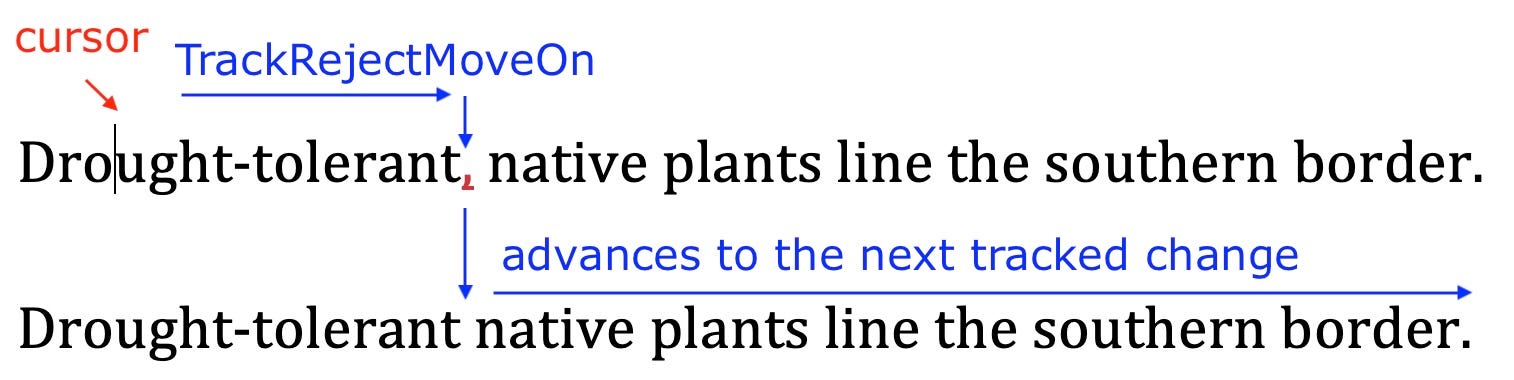
TrackAcceptMoveOn accepts a tracked change; TrackRejectMoveOn rejects it. Otherwise, both macros work the same way:
If the cursor is inside a tracked change, the macro accepts or rejects it and jumps to the next instance.
If the cursor is not inside a tracked change, the macro jumps to the next instance of tracking to the right, accepts or rejects it, and then moves to the next instance.
If the document is set to Simple Markup, running either macro switches it to All Markup so you can see what you’re accepting or rejecting.
Assign similar shortcuts to each macro. For instance, I use Ctrl+Shift+A for TrackAcceptMoveOn and Ctrl+Shift+Z for TrackRejectMoveOn. That way, only one finger needs to shift position to toggle between the two.
What if while accepting and rejecting edits, you want to leave an instance of tracking intact? You could use the mouse or arrow key to advance the cursor. Or use the bonus third macro, TrackJustMoveOn, assigning it a similar shortcut to the other two. I use Ctrl+Shift+Q.
TrackAcceptMoveOn: wordmacrotools.com/macros/T/TrackAcceptMoveOn
TrackRejectMoveOn: wordmacrotools.com/macros/T/TrackRejectMoveOn
TrackJustMoveOn: wordmacrotools.com/macros/T/TrackJustMoveOn
Have you heard editors talking about what a time-saver FRedit is? It’s earned that reputation. Making repetitive corrections—such as applying curly quotes, fixing double spaces, and standardizing dashes—eats up time that could be better spent on deeper editorial work. FRedit automates these fixes, and many other global corrections, before you even begin editing.
If you’ve been curious about FRedit but haven’t known where to start, or if it’s seemed too complicated to be worth the effort, this workshop is for you. Join Paul Beverley and me for a two-hour introduction to FRedit hosted by the San Diego Professional Editors Network (SD/PEN). You will learn what it is, how it fits into your editing workflow, and how to set up its find-and-replace list to support your projects.
While FRedit is an intermediate macro, the session is designed to be accessible whether you’re an experienced macro user or have never used one. Please note that the workshop will not cover how to install macros.
Meet FRedit: The Essential Pre-Editing Macro
Date/Time: Saturday, August 8, 2026, 9:45 a.m. PT
Information and registration here.
Have a question or want to suggest a macro for a future newsletter, or just want to say hi? Reply to this email.
Happy macroing,
Jennifer
ps: When was the last time you backed up your macros and keyboard shortcuts? If you can’t remember, now is a good time.
Thank you for reading Macro of the Month. If you found this post useful, please share it with other editors.
Comments
Nothing yet. Say the first thing.
Sign in to join the conversation.