
A few months ago I published a thesis on Macro Notes that came with a date attached to it.
The argument was simple. I was — and still am — convinced by SpaceX and by the wider space economy behind it. Morgan Stanley puts that market at roughly $630 billion in 2024 and $1.8 trillion by 2035.
But I argued that waiting for the IPO to get exposure was the wrong trade. I wrote several editions on it. Different angles each time, always the same question: how do you get positioned before the listing, instead of queueing up with everyone else on day one?
The $800 Billion SpaceX IPO Nobody’s Ready For — December 2025
The listing has now happened. SpaceX priced at $135 on June 11, opened at $150 on June 12, and closed its first session just above $161. In the days that followed, SPCX peaked at $225.64.
Six weeks later it trades around $115 — below the offer price. A CFRA analyst published a sell rating on debut day with a 12-month target of $115. The stock got there in six weeks.
So this is a good moment to settle accounts — not because the thesis is finished, but because the first phase of it is, and the second phase looks nothing like the first.
Four ways to have expressed conviction in the same company over the last sixteen months:
  ENTRY                              ENTRY POINT              POSITION TODAY
  ─────────────────────────────────────────────────────────────────────────
  Waited for the IPO, got            $135  (11 Jun 2026)             -15%
  an allocation
  Bought the first public print      $150  (12 Jun 2026)             -23%
  Chased the post-IPO peak        $225.64  (Jun 2026)                -49%
  Positioned in the proxies          Mar 2025 onward               +61.8%
  ahead of the listing
That last line is the thesis. It is documented, trade by trade, with prices locked at the moment each position was recorded — not reconstructed after the fact.
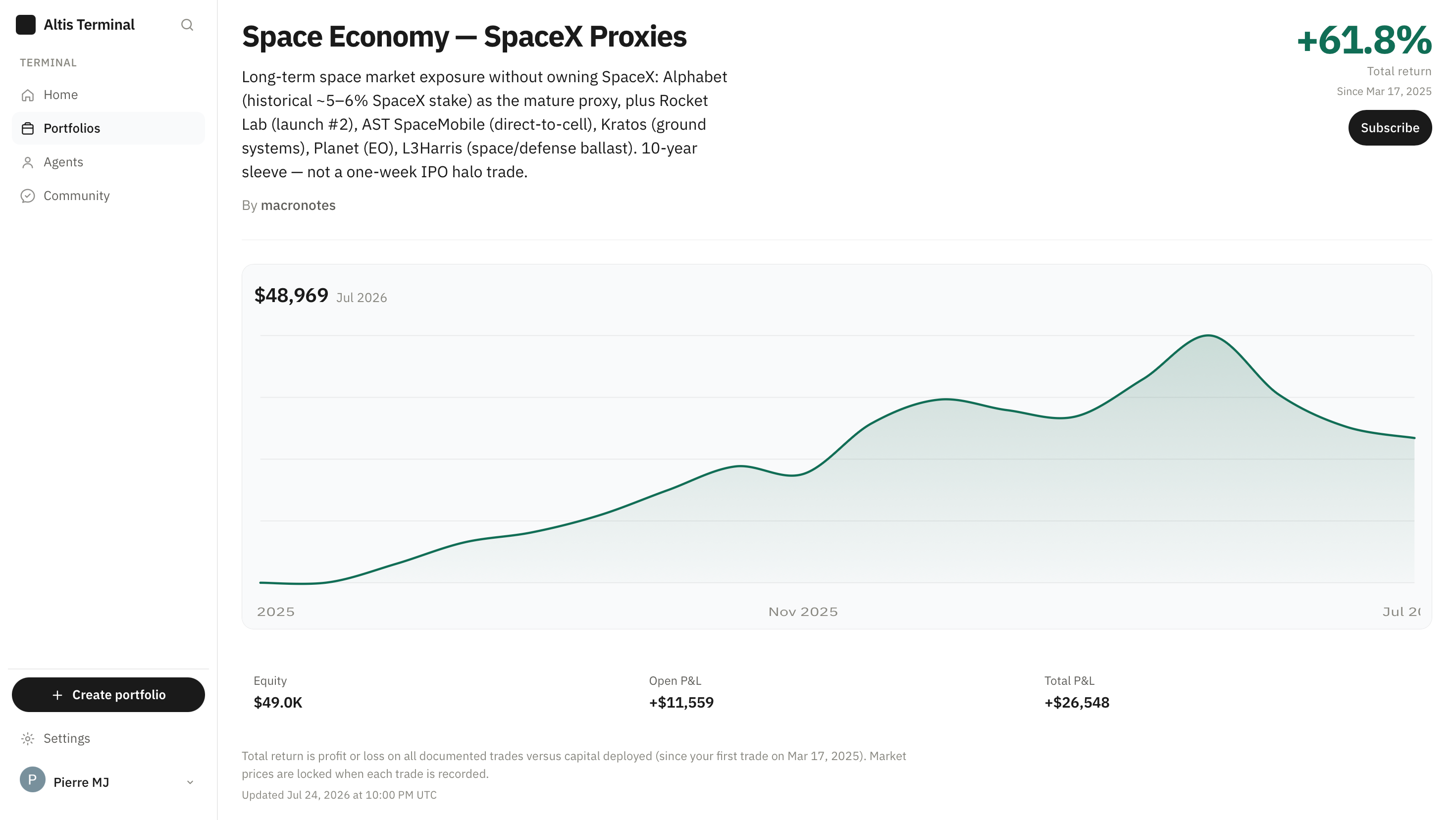
That’s the thesis live on Altis Terminal: the full write-up, real-time performance, the news flow that actually matters to it, and every trade we’ve taken since March 2025. Alongside a few hundred other published theses.
It matters to be precise about why this worked, because the honest answer determines whether it keeps working.
Two things paid.
The balance-sheet arbitrage closed. The core idea was that Alphabet was carrying an enormous, invisible SpaceX position at a conservative private mark, and that the IPO would force it into daylight. On July 23, Alphabet’s 10-Q did exactly that: $94.1 billion of SpaceX shares on the balance sheet, from a $900 million cheque written in 2015. That’s roughly a 100x on the original investment, and it is no longer a guess — it’s a disclosed line item. $80 billion of it sits under short-term sale restrictions, another $14.1 billion under longer restrictions running through Q3 2027.
That part of the thesis didn’t just work. It resolved.
The scarcity premium inflated, then popped. For years, the only way for public-market money to buy “SpaceX-shaped” risk was to buy the listed names that rhymed with it. That created a premium that had nothing to do with the underlying businesses — and it was never going to survive the arrival of the real thing.
It didn’t. Look at what June 12 did to the sector:
  PROXY                     2026 PEAK      NOW        FROM PEAK
  ────────────────────────────────────────────────────────────────
  Rocket Lab      RKLB      $151.00      ~$67          -56%
                            (27 May)
  AST SpaceMobile ASTS      $133.86      ~$57          -57%
                            (28 May)
  Kratos          KTOS       ~$61        ~$50          -18%
                            (Jun)
  Roundhill Space ETF        —             —           -23%
  (sector proxy)                                    (past month)
The Roundhill Space & Technology ETF fell 8% on the day SpaceX listed and is down roughly 23% over the past month. Rocket Lab joined the Nasdaq-100 on June 22 and is down more than half from its May high anyway. AST closed a $1.15 billion convertible and announced that BlueBirds 8, 9 and 10 are fully deployed — and the stock kept falling.
If you look at the equity curve on the terminal, this is exactly what you see: the peak is pre-IPO. The anticipation was the trade. That phase is over, and pretending otherwise would be dishonest.
Here is the part that most people are getting wrong, though.
The de-rating is a repricing of scarcity, not of the space economy. Rocket Lab’s backlog didn’t shrink. Planet’s Defense & Intelligence revenue grew more than 65% year-over-year with a backlog north of $900 million. Kratos took a $100 million sole-source space-domain-awareness award on July 13 and a $156 million counter-drone award on July 21. None of that changed on June 12. What changed is that the market no longer pays a premium for the privilege of being adjacentto SpaceX.
Which is, if you’re building a ten-year position, roughly the best news available.
It also helps to know what you’re being asked to pay for on the other side. SpaceX’s prospectus shows 2025 revenue of $18.67 billion, up 33%, against a net loss of $4.94 billion — and a further $4.28 billion loss in Q1 2026 with growth decelerating to 15%. At the offer price that was roughly 95x trailing sales on a business burning cash at scale, with Musk holding over 82% of the voting power. That isn’t a verdict on the company; it’s a statement about which instrument carries the better risk/reward from here.
Three structural shifts have happened in the last six weeks. Each one is more important than the drawdown.
This is the one almost nobody has priced.
A private SpaceX could afford to be the industry’s cheap, generous plumbing. Falcon 9 rideshare launched everybody’s satellites, including its competitors’, at prices that made the entire small-satellite economy possible. A public SpaceX answers to a share price, a quarterly report, and a lockup calendar.
The behaviour changed almost immediately. SpaceX has stopped accepting new dedicated Falcon 9 bookings for missions beyond 2028, has closed reservations on the Falcon 9 rideshare programme, and has reportedly halted production of some expendable Falcon hardware — all of it to force the transition to Starship.
Read that as a satellite operator rather than as a trader. The world’s default launch provider just told the market it is closing its order book. Every constellation that needs to be in orbit in 2029 and beyond now has to find capacity somewhere else.
Very few companies can absorb that demand. Blue Origin, Stoke and Relativity are all building toward reusable vehicles, but only one Western operator combines a flight-proven orbital launch record, a reusable medium-lift vehicle in late-stage testing, and a manifest that isn’t its own constellation. It completed a full-duration test of Neutron’s second-stage engine this month, with first flight still guided to late 2026. Its stock is down 56% from its May high.
That is the cleanest structural gift the launch sector has been handed in a decade, and it arrived during a sector-wide sell-off.
Not all of that drawdown is sentiment, and I won’t pretend otherwise. Rocket Lab is in the middle of acquiring Iridium, backed by commitments for a $3.6 billion bridge facility — roughly 2.4x its March cash and marketable securities. The stock has been trading around the deal’s collar, which means a chunk of the move is investors treating it as merger currency rather than as a launch company. That’s a real financing question, and it’s one of the things I’m watching most closely.
The flip side, and I want to be equally clear about it: the same logic cuts against anyone who depends on SpaceX for orbit while competing with Starlink on the ground. Direct-to-cell is the obvious case. SpaceX has launched most of AST’s fleet, and Starlink competes with AST for the same customer. That is a genuinely uncomfortable position, and it is now a shareholder-accountable relationship rather than a founder-goodwill one.
On February 2, SpaceX absorbed xAI in an all-stock deal valuing the combined entity at $1.25 trillion — $1 trillion for SpaceX, $250 billion for xAI — the largest private merger ever done. Three days before that, on January 30, SpaceX filed with the FCC for up to one million orbital data-centre satellites, at 500–2,000 km altitude. The filing’s claim: once Starship is operational and reusable, launching a million tonnes of satellites a year at 100kW of compute per tonne would add roughly 100 gigawatts of AI compute capacity annually. Its own framing — “within a few years the lowest cost to generate AI compute will be space.”
That is no longer a rocket company. It’s an energy-and-compute company that happens to own the cheapest ride to orbit.
Now follow where that leads. Google’s own orbital compute programme, Project Suncatcher, plans to fly TPUs in low Earth orbit — prototype satellites targeted for early 2027, with Google in launch-services talks with SpaceX. The satellite manufacturer for that programme is Planet Labs. Starcloud has filed for an 88,000-satellite compute constellation. Another entrant filed in June for up to 100,000.
The point isn’t that orbital data centres are certain to work. The economics are still genuinely contested — the sceptics’ numbers put orbital compute at a multiple of terrestrial cost per watt once you include launch and hardware, and they may well be right for years.
The point is that the two largest counterparties in the biggest orbital compute project outside SpaceX are already in this basket. Alphabet writes the cheque and designs the chips. Planet builds the spacecraft. That was not the reason either position was originally sized — it is a second, unpriced option that the thesis picked up along the way.
The space economy spent twenty years looking for a demand driver big enough to justify launch cadence. It just found one, and it’s the same one funding every data centre on Earth.
The reason this basket is down far less than its most exciting components is that a meaningful part of it is funded by government budgets that do not read SPCX’s share price.
Golden Dome is the anchor. Kratos won the roughly $450 million ground-system contract inside it and sits as the neutral control layer across satellites — on Wedbush’s read, effectively the only company delivering software-defined virtualised ground systems at scale, which would be a monopoly on the least glamorous, most necessary layer in the stack. Its hypersonics business is guided from roughly $200 million in 2025 toward $700 million in 2027 against an underlying programme worth over $8 billion.
Planet is the same story from the data side: a €240 million German agreement, a nine-figure Swedish contract, an NGA maritime-surveillance extension, prime status on a Missile Defense Agency IDIQ, and three consecutive quarters hitting Rule of 40. And L3Harris remains the boring, profitable, propulsion-and-payloads ballast that keeps the whole sleeve from trading like a single beta.
Appropriated money is slower and less exciting than narrative money. It is also considerably harder to take away.
Starship’s Flight 13 on July 24 was a real step forward — all 33 engines lit, the first-ever deployment of next-generation Starlink V3 satellites, an in-space engine relight, and the softest upper-stage splashdown yet. Worth reading the fine print, though: the 20 V3 satellites were functional but never intended to stay up, and burned up in the atmosphere about twenty minutes after release. The booster was lost to a failed landing burn. And after thirteen flights and three years, Starship still has not completed a full orbit. NASA wants it landing astronauts on the Moon as soon as 2028.
The bigger near-term variable isn’t operational, though — it’s supply. SpaceX’s post-IPO lockup structure releases an enormous quantity of stock in stages, and the first release lands within days of its first quarterly report as a public company. If you think the sector’s correlation to SPCX has already broken, the next few weeks are going to test it. The exact dates, sizes and how I’m positioned into them are in the premium section.
Worth stepping back for a second, because this edition is a good illustration of how Macro Notes actually works.
Nobody arrives at Rocket Lab or Kratos by screening for stocks. This position started three levels above the tickers, with a macro observation: the cost of putting one kilogram into orbit fell by roughly 95% in fifteen years — from $50,000–60,000 in 2010 to $2,500–3,000 on Falcon 9 today, with Starship aiming at another order of magnitude below that. That’s it. That’s the whole origin of the thesis.
From there the reasoning runs downhill, in that order:
Macro. A fundamental input cost in an entire industry collapses by two orders of magnitude. Historically, that doesn’t produce a better version of the old industry — it produces industries that were previously impossible. Satellite broadband. Daily global imagery. Direct-to-cell. Orbital compute.
Structure. Where does the value actually accrue as that cost curve falls? Who owns a bottleneck, who owns a commodity, who gets disintermediated, and who is funded by budgets rather than by sentiment.
Only then, equities. Which listed instruments express that structure, at what price, with what asymmetry — and what would have to happen for the whole idea to be wrong.
That sequence is the entire method, and we run it top-down every time. It’s the difference between owning Alphabet because a screener flagged it cheap, and owning Alphabet because you worked out that a $900 million cheque from 2015 was sitting on a public balance sheet at a private mark ahead of the largest listing in history.
Our conviction — and it’s the reason this publication exists in the form it does — is that macro-first, top-down work compounds far better over a decade than stock picking does. Individual names get lucky. Cost curves, capital flows and appropriated budgets don’t. Get the direction of the world right and you get several years of tailwind on every position you take inside it; get it wrong and no amount of security selection saves you.
The problem with that claim is that it’s easy to make and hard to prove. Every newsletter on the internet says its framework works. Almost none of them let you check.
Which is why the research is only half of what we’re building. The other half is the platform — Altis Terminal — where every macro thesis we publish is tracked in public: the original reasoning, the positions that express it, the trades with prices locked at the moment they were recorded, and the performance that follows. Including the theses that go wrong, which stay visible.
That’s the part we’re investing most heavily in right now. A thesis that can’t be audited against the market is just an opinion with charts. The point of the terminal is to make every claim we make falsifiable, in real time, in one place — so you can see not only what we think, but whether the method is actually working.
The +61.8% above is one line of that. There are a few hundred others.
Everything above is the shape of the thesis. Below is how it’s actually being run.
Before that, one thing worth knowing if you’re on the free list:
Altis Terminal is included at no extra cost with a Macro Notes subscription. Not an upsell, not a separate product. That gets you:
This thesis live — full write-up, real-time performance, position-level detail, and the complete trade history with prices locked at the moment each trade was recorded
Every other thesis published by Macro Notes and Altis Research, plus 10+ other Substack publishers on the network — a few hundred documented theses in total
The long-term macro strategy the whole book is built on, and how each thesis fits inside it
In the premium section of this edition:
The re-underwriting. What the six positions look like after the de-rating, which ones I’m adding to at these levels, which one I’ve cut exposure to, and the specific reasoning behind each — including the position where the original thesis has genuinely broken and I’m treating the drawdown as information rather than an opportunity.
The launch-capacity trade in detail. The Falcon 9 order-book closure is the single most actionable development of the last quarter. Who inherits that demand, what has to be true for it to convert to revenue rather than press releases, and the milestone I’m using as the go/no-go.
The August calendar. The full lockup release schedule with dates and share counts, the first SPCX earnings print, and the proxy earnings dates falling in the same window — mapped against how I’m positioned into them, and what I’m deliberately not doing.
The falsification rule. The specific conditions under which I close this sleeve. A thesis with no exit condition isn’t a thesis, it’s a hope. Mine is written down, with numbers.
Comments
Nothing yet. Say the first thing.
Sign in to join the conversation.