
Every churn prevention article tells you the same thing: make better content, deliver more value, justify the price.
That advice is correct. And it will not save your paid subscribers.
Because subscribers almost never leave because the content wasn’t good enough. They leave because something broke in the relationship before the cancellation email arrived, and by the time you see the notification, the decision was made weeks ago.
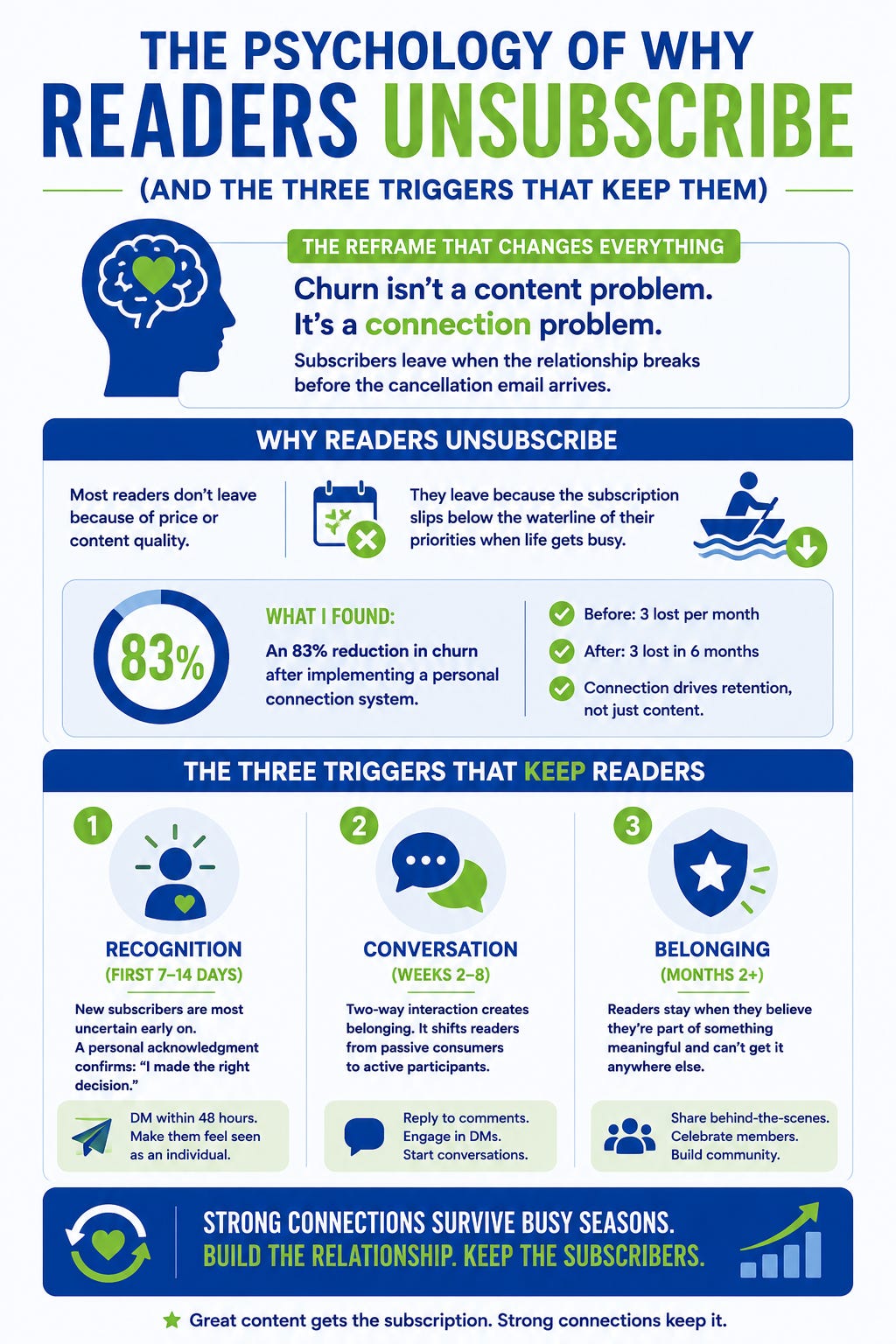
Here’s the reframe that changes everything: churn isn’t a content problem. It’s a connection problem. And once you see it that way, the entire toolkit changes.
You know the moment. You open your dashboard and there it is: a cancellation notification. And almost immediately, before you’ve had time to think, a story forms.
It was probably the price. Or maybe that last post didn’t land. Or they just couldn’t afford it anymore.
You tell yourself one of those things because they’re easier than the alternative. The alternative is that something broke between you and that subscriber, something invisible, something that happened in a window so small most writers never think about it, and you didn’t catch it in time.
Most writers who lose paid subscribers have concluded it was a content or value problem. They respond by writing better content. Their churn rate stays flat.
The diagnosis is wrong. And the wrong diagnosis sends you working harder on the wrong thing.
Here’s the reframe that changes everything: churn isn’t a content problem. It’s a connection problem.
In December of last year, three of my monthly paid subscribers cancelled.
Then in January, three more.
Six paid subscribers lost in two months. At my size, that’s significant. So I did what I always do when something breaks, I went back and looked at the data.
The pattern was immediate and uncomfortable.
Every single one of the six subscribers who churned had one thing in common: I hadn’t personally engaged with any of them before they left. No DM. No comment on their work. No acknowledgment that they existed beyond the welcome email they received when they upgraded.
They had paid to be part of something. And then nothing happened. No one showed up. The relationship they thought they were buying never materialized.
So they left.
This wasn’t a content problem. I hadn’t published worse posts in December than November. It wasn’t a price problem, the price hadn’t changed. It was a connection problem. Specifically, it was the absence of connection in the window that matters most.
I built a system to address it; a Monday and Friday review of every paid subscriber’s profile, with personal engagement built into the routine. Since January I’ve lost three paid subscribers total across six months. Before the system I was losing three a month. That’s an 83% reduction in churn, sustained across half a year.
But the reduction didn’t happen because the system is efficient. It happened because the system activates the psychology that keeps subscribers connected when life is pulling them in other directions.
Here’s that psychology.
When I’ve reached out to disengaged paid subscribers, the ones who have gone quiet, stopped commenting, stopped opening emails, and they respond, the answer is almost always the same: they’re busy. Real life. Full-time job. Things got in the way.
That answer sounds like an excuse. It isn’t. It’s a diagnosis.
What “I got busy” actually means is: this subscription slipped below the waterline of my daily priorities. Not because the content was bad. Because the connection wasn’t strong enough to keep it above the surface when life got busy.
The writers who retain paid subscribers at high rates aren’t simply the ones with the best content. They’re the ones who built connections strong enough to survive a busy month.
Those connections are built through three specific psychological triggers. And the writers who lose subscribers at high rates are almost always failing to activate at least one of them.
The most vulnerable window in any paid subscriber relationship is the first seven to fourteen days after upgrade.
This is when the subscriber is most uncertain about whether they made the right decision. The excitement of upgrading has faded. The content they’ve seen so far may be good, but good content alone doesn’t create belonging. They’re waiting, consciously or not, for a signal that they were noticed. That someone knows they’re here.
If that signal doesn’t come, a thought starts forming. Not “I should cancel”, something more passive and more dangerous: this isn’t really different from being a free subscriber. And once that thought forms, the monthly renewal shifts mentally from being an investment, to being an ongoing expense that has to be justified.
Recognition is the trigger that prevents this. Not content. Not features. Not even price. The specific, personal acknowledgment that you see this subscriber as an individual rather than a number.
This is why the personal DM within 48 hours of upgrade is the highest-leverage retention action available to you. Not because of what it says, a simple welcome and an offer to help is enough. Because of what it signals: I know you’re here. You matter to me specifically. This relationship is already real.
The six subscribers I lost in December and January never received that signal. I didn’t send it. And without it, the connection never formed strongly enough to survive the first moment of friction.
Once the initial connection is established, the next retention challenge is keeping the subscriber engaged between posts. Life gets busy. Inboxes fill up. A subscriber who felt connected in week one can drift in week three simply because nothing pulled them back.
The Open Loop trigger addresses this directly. Psychologist Bluma Zeigarnik established in 1927 that the brain retains incomplete patterns with significantly more persistence than completed ones. An unresolved question, a promised reveal, an ongoing story, these create a cognitive pull that keeps the reader returning even when life is competing for their attention.
For paid subscribers specifically, the Open Loop works best when it’s tied to the ongoing narrative of your Substack rather than individual posts. If a paid subscriber feels like they’re following a story in progress, your CVR journey, your path to the Bestseller Badge, the experiment you’re running this month, missing a post feels like falling behind in a narrative they’re invested in. That feeling is more powerful than any reminder email.
Think about what your paid subscribers are following beyond your content. Are they following you? Your journey? Your results in real time? If the answer is no, if each post is self-contained and disconnected from an ongoing story, the Open Loop trigger is not firing. And without it, every busy week is a week where the subscription quietly deprioritizes itself.
The writers who retain paid subscribers at high rates aren’t simply the ones with the best content. They’re the ones who built connections strong enough to survive a busy month.
The third retention trigger is the most durable and the hardest to manufacture.
Identity Signal is the psychological mechanism by which a person incorporates membership in a group into their sense of self. Henri Tajfel’s Social Identity Theory established that humans derive significant self-concept from the groups they belong to, and that this belonging creates loyalty that survives friction, inconvenience, and even extended periods of low engagement.
For paid subscribers, the Identity Signal fires when being a member of your community feels like a reflection of who they are, not just a service they subscribe to. The subscriber who thinks of themselves as a Backstage Pass member rather than someone who pays for a newsletter is infinitely more retentive than the subscriber who sees the charge on their credit card and wonders if it’s still worth it.
You activate the Identity Signal through the language you use about your community, the way you spotlight members publicly, and the sense of shared mission you create. When I write “we are all growing together” rather than “I teach you how to grow,” I’m firing the Identity Signal. When I publicly welcome a new paid subscriber by name, I’m firing it. When I highlight a paid subscriber’s win in a Note, I’m firing it.
Every time a paid subscriber sees evidence that belonging to this community is part of who they are as a Substack creator, not just something they pay for, the Identity Signal deepens. And a deep Identity Signal is what keeps a subscriber renewing when life gets busy and the budget gets tight.
What the three triggers have in common is timing. Recognition has to fire in the first two weeks or the window closes. The Open Loop has to be running continuously or engagement drifts. The Identity Signal has to be reinforced regularly or it fades. All three require consistent, deliberate activation, not occasional bursts of effort.
This is what the Monday and Friday review schedule provides. It’s not just a process for staying current on what paid subscribers are doing. It’s a delivery mechanism for all three triggers simultaneously.
Engaging with a paid subscriber’s content fires Recognition, they see that I noticed their work specifically. Commenting on their progress and referencing what I know about their journey fires the Open Loop, I’m part of an ongoing story they’re telling. And showing up consistently, week after week, reinforces the Identity Signal, this community is real, active, and worth belonging to.
The system doesn’t work because it’s efficient. It works because it activates the psychology that keeps subscribers connected when life is pulling them in other directions.
Before you move on, consider what a churned paid subscriber actually represents.
Think about what a paid subscriber is worth to you annually. Now think about how many you’ve lost in the last six months without fully understanding why. That’s not just lost revenue, it’s lost relationships, lost advocates, lost people who would have promoted you to their own audiences if they’d stayed long enough to feel genuine belonging.
The month you lose three paid subscribers isn’t just a bad month. It’s a compounding problem. Every subscriber who leaves is a relationship that never had the chance to deepen into advocacy. Every subscriber who stays becomes more likely to promote you, engage with your work, and renew without hesitation.
You already know the subscribers you’ve lost weren’t lost because your writing got worse. You know something broke in the relationship before the cancellation email arrived. And you know the writers who retain subscribers at high rates are doing something systematically different, not accidentally, not through luck, but through consistent activation of the connection that makes a paid subscription feel worth keeping.
The question is which trigger you’re missing.
Think about the paid subscribers you’ve lost in the last six months. Not the ones who told you why they left, the ones who just cancelled without saying why.
How many of them did you personally engage with in their first two weeks? How many felt like they were following an ongoing story rather than consuming individual posts? How many would have described themselves as members of your community rather than subscribers to your newsletter?
The answers will tell you which of the three triggers was missing.
Six months from now, you could open your dashboard on a Monday morning and see your paid subscriber count higher than it was in January, not because you acquired more, but because you stopped losing the ones you had. The same intentional presence that moved them to upgrade is what keeps them. The system is the same. The intention just has to be consistent.
The trigger that was missing is the one to build first.
Build it this week.
Inside Backstage Pass we work through exactly this, how to activate all three retention triggers systematically, and how to build the kind of community where subscribers stay not because they remember to renew but because leaving would feel like stepping away from something that matters to them.
The upgrade isn’t the end of our relationship. It’s the start.
Comments
Nothing yet. Say the first thing.
Sign in to join the conversation.