

We’re fast approaching a world where productivity is no longer the metric of human worth. Machines will do more, faster, and more precisely than we ever could. The question is no longer can we build a society of abundance—but what happens to us once we do?
AI is set to automate not just physical labor but intellectual labor as well. As economic scarcity dissolves, universal basic income (UBI) may become a necessity rather than a fringe idea. At first glance, this sounds utopian: no more drudgery, no more survival panic. But we forget that struggle, challenge, and responsibility give structure to the human soul.
Without purpose, people fall apart. Suicide studies reveal that many men don’t take their lives due to poverty, but because they feel unneeded. A life without contribution is a life without meaning.
We don’t need to invent new activities to make life meaningful. They’re already here.
Meaning doesn’t depend on wages. It depends on engagement. People find fulfillment when they’re immersed in pursuits that align with who they are:
High-achievers thrive by building, optimizing, and reaching goals.
Caregivers find joy in tending to others’ needs, especially the vulnerable.
Creatives give form to what others only feel.
Managers organize chaos into harmony.
Explorers venture into the unknown, whether physically, intellectually, or spiritually.
Athletes and gamers push themselves within structured challenges.
All of these people already exist. Their gifts are evident. But for many, economic necessity blocks the path. A post-productivity world would finally give them the time and energy to pursue what was always most meaningful.
Even those less skilled or motivated have vital roles: tending community gardens, beautifying public spaces, assisting the elderly. Robots could do these tasks. But if we elevate the value of human connection above the value of efficiency, we restore purpose to all layers of society.
Yet there is a shadow.
Heather Heying and Brett Weinstein warn of “hypernovelty”—a rate of change that far exceeds our capacity to adapt. We’re already sick from this—overwhelmed by options, numbed by stimulation, paralyzed by instability.
The rise of AI risks compounding this. When all your needs are met instantly—food delivered, entertainment streamed, dopamine hits that are tailor-made for your character flaws—the discipline required to build real relationships and meaningful work starts to vanish.
Relationships are hard. So is parenthood. So is making friends. But these are the very crucibles of meaning. Already, people are choosing loneliness over struggle. Birth rates are falling. Attention spans are fracturing. And behind it all is a quiet grief—the world is accelerating, and we no longer recognize ourselves in it.
What if we restructured society (ourselves) to value giving over getting?
Not as an economic imperative—but as a spiritual choice.
When the pressure to survive fades, the call to serve can finally be heard. People will naturally turn to contribution if the path is opened to them. What might this look like?
Neighborhoods that organize beautification contests and community meals.
Mentorship programs that connect elders with youth.
Competitive sports leagues that focus on excellence and cooperation.
Public rituals and festivals that celebrate service and creativity.
Even the so-called “malcontents” among us could be rechanneled: martial arts dojos, intensive wilderness programs, and spiritual rites of passage could help them rebuild their fractured sense of self.
And most importantly: a reawakening of the sacred.
Once freed from labor for survival, many will feel drawn to deeper work: the work of the soul.
We may see a resurgence of:
Meditation communities and monasteries
Modern mystery schools
Consciousness-expanding arts and practices
Urban sanctuaries for contemplation and prayer
A civilization that has tamed material scarcity must not lose itself to indulgence. It must remember who it is. That remembering happens in silence, in devotion, in spiritual discipline.
AI may not need us to wake at dawn for work. But the Light of Life will always need us to show up.
AI may solve the problem of scarcity. But it cannot tell us what a meaningful life is.
That’s up to us.
If we rise to this challenge, we may finally be free to do what we came here to do—not to toil endlessly for our keep, but to give ourselves fully to what is most real:
To care.
To build.
To create.
To contemplate.
To love.
The question isn’t whether we’ll find meaning after productivity—it’s whether we’ll be brave enough to build a world where meaning matters more.
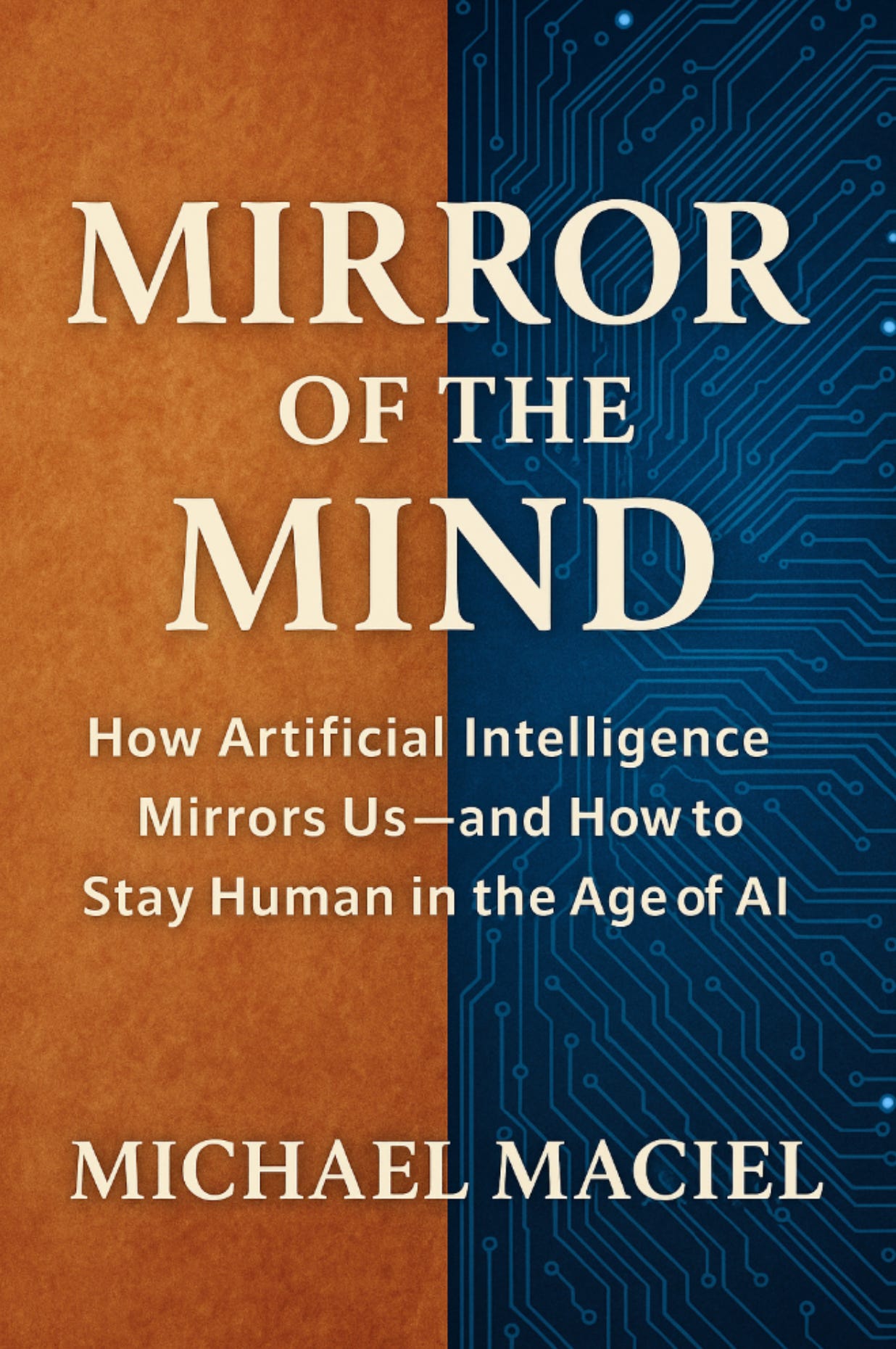
Mirror of the Mind
How Artificial Intelligence Mirrors Us—and How to Stay Human in the Age of AI
Artificial Intelligence doesn’t just process information—it mirrors us. Every prompt, every question, every word we feed it reflects back with uncanny precision. In that reflection we see not only our creativity, but also our illusions, our fears, and our blind spots.
But mirrors don’t only reflect—they shape how we see ourselves. The more we rely on AI, the more it influences what we notice, what we value, and even what we believe.
This book is a guide to navigating that tension. It offers a spiritual and psychological compass for staying human in the age of machines, showing how to use AI without losing soul. You’ll discover how to engage AI as a tool for clarity, growth, and dialogue—while resisting the temptation to outsource the very things that make us most human.
No posts
Comments
Nothing yet. Say the first thing.
Sign in to join the conversation.