
April 3, 2025
I spent the first half of my career working with major brands, Apple, Microsoft, Kellogg, to name but a few, who understood the value of building familiarity, building equity, building "Brand.” For part of that period, at least, Google didn’t exist, and Zuckerberg had fewer than a few hundred accounts on The Facebook. However, since stepping outside the comfort zone of those wonderful brands, it’s abundantly obvious that the fundamentals of good advertising have become diluted. This is not an observation unique to me, of that I’m aware. But now I find myself more often in conversations that start with the same loaded question:
“So, if I invest in Brand/TOFU, there might be some return in six months, you say… but what about the gaping hole left in my revenue today?”
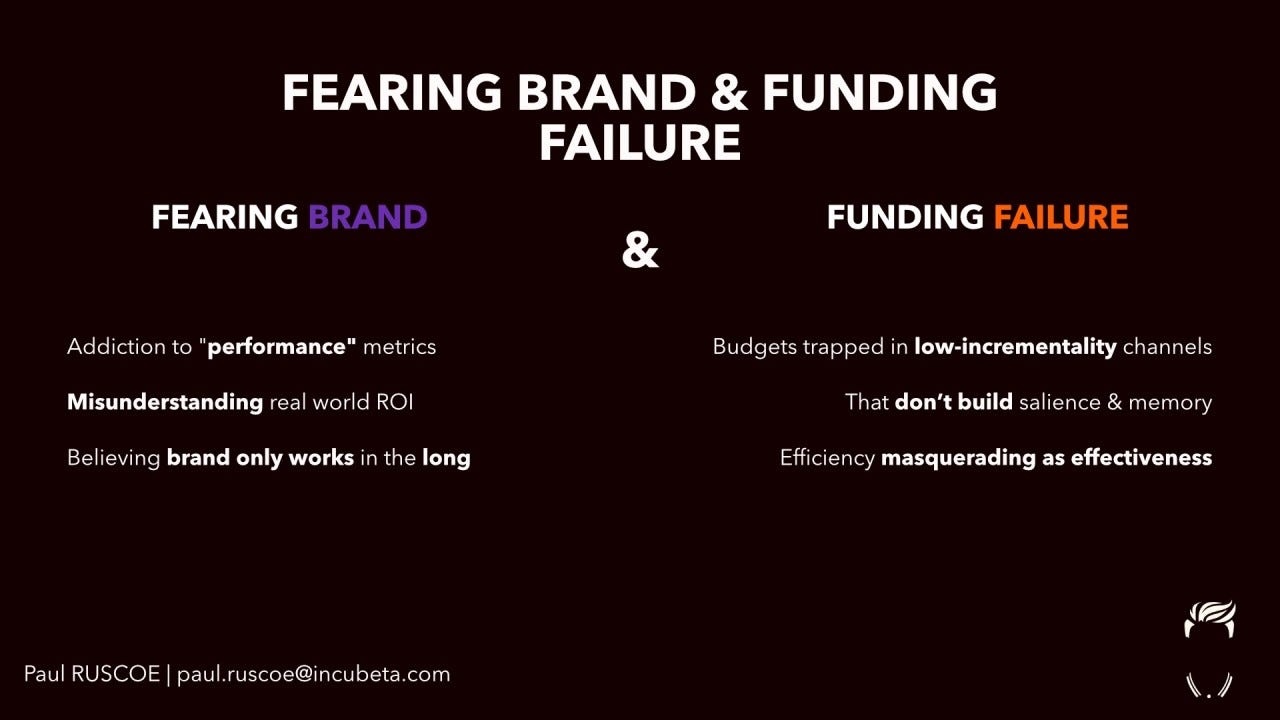
It’s not an unfair question, especially when, as marketers, you’re under pressure to deliver results instantly and justify every dollar to your stakeholders. But the question reveals the real problem: we’ve allowed ourselves to become wary of “Brand” investment, while blindly shoveling money into activities that fail to move the needle in any meaningful way. Are CFOs and financial controllers to blame for the move toward demonstrating clear and immediate returns? I don’t believe so, because if anyone should appreciate the value of capital investment, it’s the CFO. And that is exactly what “Brand” is: a capital investment. Except we marketers continue to do a poor job of expressing that, and so brand has become a byword for “risk.”
If we define “Brand,” or investments in “top of funnel” (a phrase, if you know me, you know I despise), as a risk, then how would one describe investment into “Performance/BOFU”? Because where advertisers are underinvested in brand and heavily overinvested in sales activation, it's likely that those latter activities are rife with inefficiency, wastage, sales that are incidental, not incremental. If they’re incidental, they’re eroding, not strengthening your profit margin.
“Brand”, some might say, is too slow, too vague, too hard to prove. And yet, those cynics happily overinvest in performance channels without understanding their true incremental effects. If “Brand” is “risky,” then investing in tech without understanding the incremental value, under the guise that it brings short term riches, is foolish.
If you haven’t pressure-tested the actual value of your performance media, particularly the contributions of branded search, PMAX, retargeting, and you’re still spending the majority of your budget on them, you’re likely funding failure. Or, at best, you’re protecting an activity that makes your team feel better while your competitors chip away at your market share.
That’s not to say you shouldn’t invest in performance media or in being what I refer to as “Easy to Find”. But we certainly shouldn’t view “Brand,” or the things that make you “Quick to Mind”, as risky. They are anything but.
While it may appear in certain LinkedIn circles that the dynamic has shifted, and “Brand” is enjoying a renaissance, in reality, we’re still in a place where the “Brand” is seen as soft and performance as “hard.” I personally dislike both of these terms and would reframe them (with a heavy dose of inspiration from the advertising intelligentsia, Binet, Field, Sharp et al.) as:
Quick to Mind – the things you do to make yourself more familiar, build a lasting flow of customers now and into the future, creating company value, pricing power, and profit.
Easy to Find – helping in-market buyers navigate to your point of sale, whether in the real world or the digital one.
But either way, brand (or “Quick to Mind”) does the one thing performance (“Easy to Find”) cannot: it compounds. It builds memory, primes future decisions, and improves the efficiency of everything that comes after.
Not only that, WARC’s The Multiplier Effect report, published in February of this year, couldn’t be clearer: “Brand” (“Quick to Mind”) has a multiplicative effect on performance (“Easy to Find”), and so they must work together. “Brand” isn’t an indulgent luxury or a risk, it’s what makes you come “Quick to Mind” and ensures more people realise just how “Easy to Find” you are.
A common refrain is that “Brand” only pays off in the long term. That’s only half true, if at all. A good brand execution, built with all the ingredients of effective communication, emotional cues, distinctive assets, and associated with a need state, absolutely can stimulate short-term effects.
But like your performance media, it will always be limited by the fact that only a small portion of your category is ever likely to be in-market. (Refer to John Dawes of the Ehrenberg-Bass Institute, whose work on the 95:5 rule is a must-read.)
The difference is, with “Brand”, it’s not the sole intent to sweat that small number of in-market buyers, and by virtue of trying to drive penetration and expand your coverage, the chances of reaching a significant number of those in the market with that brand execution over a short time frame are modest at best (the media KPI should be to reach as many people within the category as possible, after all).
That doesn’t mean the in-market buyers that are exposed, however, can’t be "nudged" by a “Brand” execution. They absolutely can, and there is not a single piece of evidence that I have seen that would suggest otherwise.
Remember: the buyer is in complete control of the buying journey. No amount of investment in “Brand” or “Activation” can force someone who isn’t in-market to buy now (unless incentivized). Yes, a well-constructed performance asset might be slightly better at converting the small number who are ready to buy. But that same execution does very little for the rest, the ones who will enter the category in weeks or months, and choose based on memory, familiarity, and fluency, leaning on the brain’s shortcuts and heuristics. In essence, brands that are more familiar are more likely to win over time.
And so that’s where “brand” pays back, in full. It’s not slower. It can start paying back now, and does so long into the future.
So no, your revenue isn’t going to fall through the floor as you start to optimize your balance between brand and activation. If anything, it may make your activation work harder, today and tomorrow.
Imagine a scenario where there are 30 million buyers in your category each year. If each buyer makes one purchase annually, and the decision window is five days, that means at any given moment, only 1.4% of the market is actively buying. That’s 420,000 people.
Now let’s say your market share is 0.5%, and you’re investing in your first “Brand” campaign with a modest but reasonable budget for a small brand. In a highly optimistic scenario, the campaign not only reaches a good proportion of the 98.6% of future buyers, but also manages to reach half of those currently in-market. That’s 210,000 people.
Because you’ve never read The Long and the Short of It, or watched any of Mark Ritson’s sweary videos, you evaluate that campaign solely on its short-term sales impact. You’re disappointed to see that the campaign generated no more than 1,050 sales. The ROI looks poor, and you decide never to run a brand campaign again.
But the failure here isn’t with the “Brand” campaign. It’s with the marketer, failing to recognize how unrealistic it is to expect a short-term deviation from your market share. A metric we know, moves slowly. The campaign contributed to 1,050 short-term sales, exactly in line with expectations.
The real blind spot is in the future sales the advertiser could have generated if the activity had been sustained. That’s where the compounding return starts to reveal itself.
So “Brand” works in the short term, but like all sales, it’s bound by the volume of active buyers in the category at any one time, and constrained by an advertiser's existing share of market.
The more I put my quill to work, the more I find it somewhat ludicrous that “Brand” is still perceived to be a risk, while wasting money on media that has little to no incremental effect is somehow a place of comfort for marketers. It shouldn’t be.
And so, here’s the challenge: if you’re genuinely worried about risk, start by running incrementality tests on your brand search campaigns, your PMAX investment, your display and retargeting activity. You don’t need an econometric model to tell you what’s working. Even a crude experiment will give you a steer on the likely incremental effects of your short-term activations.
This isn’t to say they aren’t valuable. But understanding where spend isn’t demonstrating an incremental effect gives you reason to reallocate that budget away from underperforming vehicles and start testing and experimenting with new ones.
What you’ll usually find is this: some channels reach diminishing returns fairly quickly, there are only so many people in-market at any one time, after all. So even mid-market advertisers, many of whom are investing significantly yet haven’t yet found the right balance between “Quick to Mind” and “Easy to Find,” will often be overspending in areas that are delivering little to no incremental value.
Once you’ve found those pockets of inefficiency, you’ve just bought yourself the freedom to reinvest, ideally into media and messaging that builds salience and memory over time. And in doing so, you've de-risked that part of your budget, because it wasn’t paying back anyway.
The irony is, the thing we treat as “high risk” is investing in “Brand”. Yet it is often the most critical lever to safeguard future sales, grow market share, drive pricing power, and improve profitability.
Meanwhile, over-investing in tactics that offer limited incremental return and no compounding effect is somehow seen as the safe option.
If that is your prevailing view, your competitors are likely sitting comfortably.
Advertising has always worked in two ways, you need to be both:
Quick to Mind – Building mental availability for when buyers eventually enter the market, increasing the likelihood they think of you.
Easy to Find – Removing friction for those who are ready to act today.
When you stop investing in the former, the latter becomes less efficient. You work harder. Spend more. But eventually, the model breaks and you have a choice. Find balance, or embrace the Doom Loop (refer to WARC’s Multiplier Effect here)
Thou hast been warned.
Aside from the usual suspects—Les Binet, Byron Sharp, Mark Ritson, et al.—I thoroughly recommend following Dale W. Harrison on LinkedIn. He offers a rational and scientific perspective on the topics above, presented in a clear and insightful manner.
I am also impressed by Liam Moroney’s contributions to these discussions. He has clearly developed a mastery in explaining complex theories in a highly digestible way.
No posts
Comments
Nothing yet. Say the first thing.
Sign in to join the conversation.