

The reigning assumption in artificial intelligence is that the game is now settled in its essentials, and that all that remains is to play it at scale. Whoever owns the most chips, draws the most power and signs the largest cheques will win, because the architecture is fixed: autoregressive models, trained on banks of identical Nvidia processors, getting larger until they get cleverer. On this view the only question left for a country like Britain is how much of the existing machine it can afford to buy.
It is worth remembering that every technological era has believed something like this, and every era has been wrong. Science does not stop at the prevailing paradigm. The crushing compute requirements of today are a bottleneck, not a property of the universe, and bottlenecks are precisely the thing that clever people are paid to remove. The interesting question is not who can amass the most of the current resource. It is who will need less of it.
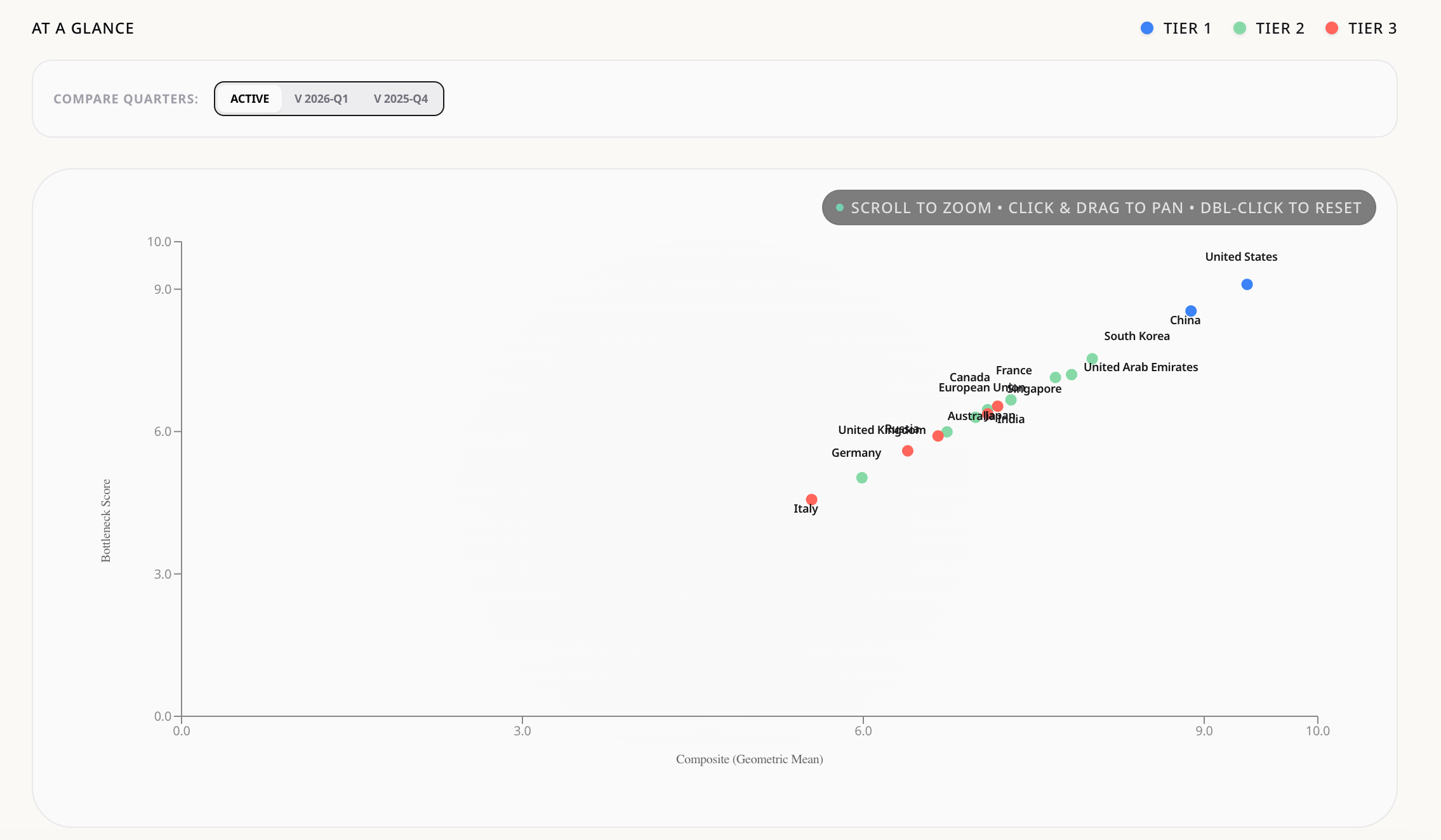
Let us speak the obvious. Today it is a two-horse race: America and China out front, and everyone else, Britain and Europe included, eating their dust. A report out last week gives the continent until summer to avoid “AI irrelevance.” The head of the European Patent Office says Europe has “more or less lost.” On today’s scoreboard, they are right.
The catch is that scoreboards get torn up. In 1906 the Royal Navy launched HMS Dreadnought, a single ship so far ahead of anything afloat that it made every other battleship on earth, most of Britain’s own included, obsolete in an afternoon. The race did not narrow. It reset to zero. And the awkward lesson, learned slowly by the people with the most invested in the old way, was this: the more of yesterday’s hardware you have stockpiled, the more a single leap has to destroy. America is sitting on the largest hoard of graphics chips ever assembled. That is a commanding lead in exactly the way a vast pre-dreadnought fleet was a commanding lead. Right up until it wasn’t.
![r/WarshipPorn - England's monster battleship [HMS Dreadnought] compared with our giant Connecticut (BB-18), The World newspaper Feb 1906 [3645x2675]](https://substackcdn.com/image/fetch/$s_!3zF0!,f_auto,q_auto:good,fl_progressive:steep/https%3A%2F%2Fsubstack-post-media.s3.amazonaws.com%2Fpublic%2Fimages%2Fc332b90b-1105-4f63-b7ec-f87e9da656c2_640x469.jpeg "r/WarshipPorn - England's monster battleship [HMS Dreadnought] compared with our giant Connecticut (BB-18), The World newspaper Feb 1906 [3645x2675]")
In 2017 a team at Google published a paper with the faintly insolent title “Attention Is All You Need.” They had built a better machine-translation model. They had not, by most accounts, glimpsed ChatGPT inside it. It took other people, the ones willing to bet that scaling this architecture would produce something like general capability, to extract the prize that was sitting in eight pages everyone in the field had read and almost no one had fully understood. Nobody missed the transformer; it was seized within months. What was missed was the size of what it contained.
Here is the part that should give the GPU maximalists pause, and the part their story leaves out. When that prize finally arrived, it happened to reward scale. The transformer made raw compute the kingmaker, which is exactly why the assumption then hardened into a supposed law: more chips, more intelligence, forever. But that is a description of one paradigm. It is not a guarantee about the next. The breakthrough that reset the field last time could just as easily, next time, reset it in the opposite direction, toward architectures that do more with less. DeepSeek already provided the first crack, training a frontier reasoning model for a sum that embarrassed Silicon Valley.
And a cluster of British firms has spent the last few months and years betting against the current regime at the level of physics.
Take Fractile, the Oxford-born startup that has raised more than two hundred million dollars to build inference chips that fuse memory and compute on a single die, killing the data-movement tax that throttles every GPU. It claims its hardware can run large models a hundred times faster at a fraction of the running cost. Its engineers were poached in part from Graphcore; its early backers include Hermann Hauser, who co-founded Arm. Anthropic, the company that just locked Britain out of its best models, has reportedly been in talks to buy Fractile’s chips. Proof that the dependence can run in both directions.
Or take Lumai, the Oxford spinout doing its arithmetic in beams of light rather than silicon, which has just begun shipping the first optical system capable of running billion-parameter models in real time, at up to ninety per cent less energy than a conventional GPU.
Or OLIX, a photonic-chip company founded by a twenty-five-year-old and valued within a year at a billion dollars, whose own manifesto describes its mission as building accelerators “free from the architectural and supply chain constraints of the current regime.”
Or Oriole Networks, the University College London spinout replacing the power-hungry electrical switches inside data centres with photonics, and claiming an eighty-one per cent cut in core network power, now deployed with AMD inside one of the government’s own research labs.
Or Callosum, built by two Cambridge neuroscientists on the observation that the brain does not achieve intelligence by copying one kind of neuron a billion times, but by orchestrating many specialised parts, and whose software shares workloads across whatever chips happen to be best.
Notice the common thread. Every one of these companies is trying to wring more intelligence out of less power. That is not only a commercial bet on cost. For Britain it is the same escape as the one I argued for earlier this week, when the binding constraint on our AI ambitions turned out to be the grid. A technology that needs a tenth of the electricity routes neatly around a country that cannot build the electricity. The energy problem and the compute problem are, in the end, the same problem, and the firms above are attacking both at once. This is the lane that rewards research and design as much as raw capital.
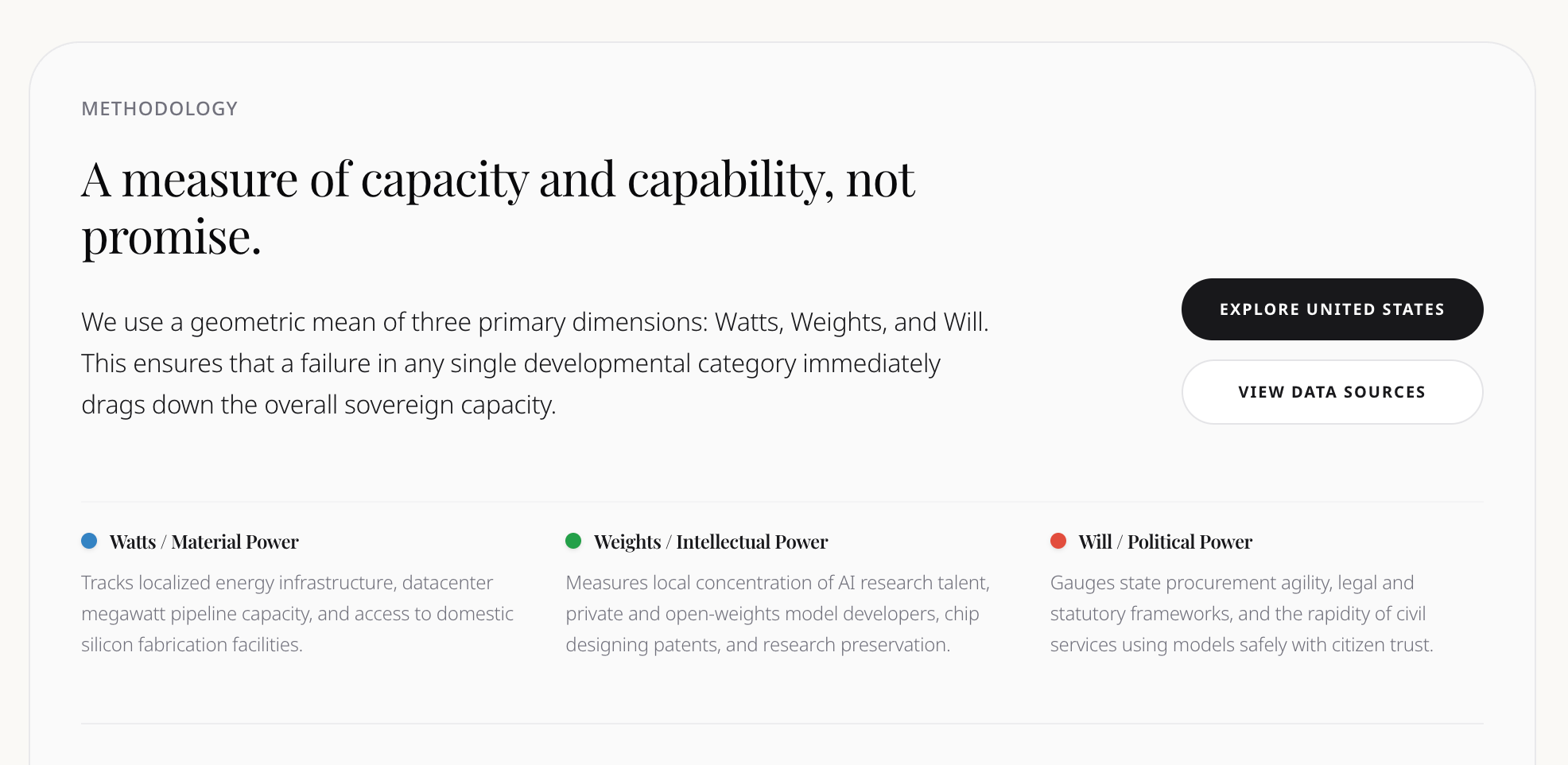
Admittedly, none of this yet shows up on my own Machinepower Index, which still marks Britain down. It scores national power as the present paradigm does, weighting watts heavily alongside research and will. But an index reads the facts rather than fixing them, and it moves when they do. Reweight those axes for a world that runs on a fraction of the compute, and a country rich in research and starved of power is repriced overnight.
There is of course another caveat to this ‘cope’. Invention has never been Britain’s problem; keeping what it invents is. Arm is run from Tokyo, Graphcore was sold to SoftBank, DeepMind went to Google, and Peter Thiel’s Founders Fund co-led Fractile’s last raise. From all of which the doubters will conclude that the moat is permanent and the race already run. In this, they may be right, it is time for us to stop selling the silverware.
Regardless, a contest can be decided by an idea as much as brute force. Time and the forward motion of science have rarely been on the naysayer's side. AI is not a closed book.
No posts
Comments
Nothing yet. Say the first thing.
Sign in to join the conversation.