
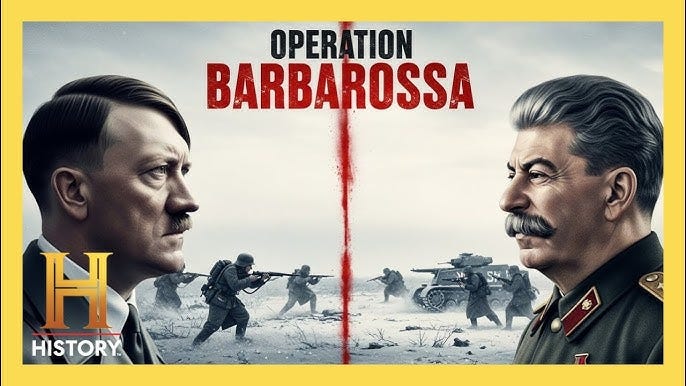
Shortly before four in the morning on June 22, 1941, Adolf Hitler opened the largest military front humanity had ever seen and, at the same time, made the mistake that would begin to destroy his empire. From the Baltic to the Black Sea, thousands of guns opened fire, the ground shook beneath tank tracks, and hundreds of German aircraft crossed into Soviet territory.
Hitler did not believe he was beginning a long war. He thought he was launching another rapid campaign. In his view, the Soviet Union was an enormous but fragile structure that would collapse once it received the first powerful blow. Four years later, the Red Army would be in Berlin, but on that June morning, almost nothing seemed to point toward such an ending.
In the summer of 1941, Hitler had every reason to believe he was unbeatable. In less than two years, Nazi Germany had conquered or subdued Poland, Norway, Denmark, Belgium, the Netherlands, Luxembourg, France and much of southeastern Europe.
Britain continued to resist, but it stood largely alone against a Germany that had turned blitzkrieg into something close to a doctrine of inevitable victory. Each new campaign seemed to prove that the Wehrmacht could move faster than its enemies could react, and in Berlin the prevailing mood was that final victory was only a matter of time.
There was, however, still the Soviet Union.
Although Moscow and Berlin had signed the Molotov–Ribbentrop non-aggression pact in 1939, Hitler had never regarded it as permanent. The conquest of territory in the East had been central to his ideology and geopolitical ambitions long before the war began.
The invasion was given the name Operation Barbarossa, after the medieval emperor Frederick I Barbarossa. The scale of the plan matched the arrogance behind it.
More than three million German soldiers, together with hundreds of thousands of troops from allied countries, were deployed along a front stretching almost 3,000 kilometres.
Around 3,500 tanks, thousands of artillery pieces and nearly 3,000 aircraft took part in the opening assault. Nothing comparable had ever been attempted on such a scale.
The entire plan depended on speed. Three vast German army groups would advance simultaneously toward the north, centre and south, with Leningrad, Moscow and Ukraine among their principal strategic objectives.
The central assumption was simple: the Red Army would be destroyed close to the frontier, the Soviet state would begin to disintegrate, and the war would be over before Russia had time to become truly Russian, before the distances, the mud and the cold could begin to fight their own war.
Many German officers expected the campaign to last only a few months. Some believed it might require even less.
During the first days, almost everything seemed to prove them right.
The German advance was devastating. Entire Soviet formations were surrounded and shattered, hundreds of thousands of soldiers were captured, and large parts of the Soviet air force were destroyed on the ground or during the first air battles.
The shock in Moscow was enormous. Stalin had received repeated warnings that a German attack was coming, yet until the final moment he struggled to believe Hitler would open another vast front while Britain was still fighting.
When the invasion finally came, the destruction of the opening weeks exceeded even the darkest expectations. But the Soviet Union did not behave the way the German plan said it should.
It did not collapse.
The Germans captured enormous territories, but behind every new line lay hundreds more kilometres. New Soviet units appeared. Factories were dismantled and transported east, beyond the immediate reach of the German advance, together with industrial equipment, workers and production capacity.
A war designed as a short, violent blow began to change shape. Every additional week increasingly favoured the side with more space, more people and a greater ability to replace what it had lost.
By the autumn of 1941, German forces were approaching Moscow. The distance to the Soviet capital had shrunk dramatically, and in some sectors the city seemed almost within reach.
But the Wehrmacht arriving there was no longer the same force that had crossed the frontier in June.
Its tanks had travelled immense distances. Vehicles were worn down. Supply lines stretched for hundreds of kilometres. Roads dissolved into mud, and the different Soviet railway gauge created yet another logistical obstacle.
Then came the opponent that history would remember as “General Winter.”
Temperatures plunged. Lubricants froze, engines struggled to function, weapons malfunctioned, and soldiers prepared for a short campaign found themselves without adequate winter clothing or equipment.
The Russian winter did not defeat Germany by itself. That explanation is too convenient.
What the winter did was expose every weakness in a campaign built on the assumption that no German army would still be fighting under those conditions.
If the Soviet Union had collapsed within the first weeks, as Hitler expected, winter would have been a detail. Because it did not, the cold found the Wehrmacht exhausted, its equipment worn, its supply system stretched across immense distances, and its enemy still capable of bringing fresh forces into the fight.
General Winter did not create the mistake.
He made it impossible to hide.
The failure of Operation Barbarossa cannot be explained by one cause alone. It was not simply winter, nor only distance, nor only Soviet resistance.
It was the collision between an enormous military operation and a fundamentally false understanding of reality.
Hitler had underestimated the Soviet Union’s industrial capacity, its population, its ability to move factories eastward and raise new armies, and the fact that the invasion itself would transform the war for millions of Soviet citizens into a struggle for survival.
He had also overestimated Germany’s ability to sustain mechanised warfare across such vast distances.
The Wehrmacht could win enormous battles. It could not make geography smaller, and it could not force an enemy to collapse simply because German planning had decided that collapse was inevitable.
Once the short campaign became a war of attrition, the balance slowly began to move in the other direction.
June 22, 1941 was not the day Germany lost the Second World War. Moscow, Stalingrad and Kursk still lay ahead, along with millions more deaths and almost four more years of war in the East.
But it was the day Hitler committed Germany to a kind of war it could not win in the way it had learned to win.
That summer, he stood at the height of his power. Europe seemed to lie at his feet, and the Wehrmacht still carried the aura of invincibility.
Four years later, Berlin was in ruins, Hitler was dead in his bunker, and Soviet soldiers stood in the heart of the German capital.
Operation Barbarossa destroyed millions of lives and opened the bloodiest front of an already monstrous war. It also destroyed something else: Hitler’s certainty that every opponent would behave exactly as he had decided they should.
On June 22, 1941, Germany invaded the Soviet Union believing the war would be over before winter arrived.
Winter arrived, and the Soviet Union was still there.
The Third Reich had begun to discover just how expensive an illusion could become.
Comments
Nothing yet. Say the first thing.
Sign in to join the conversation.