
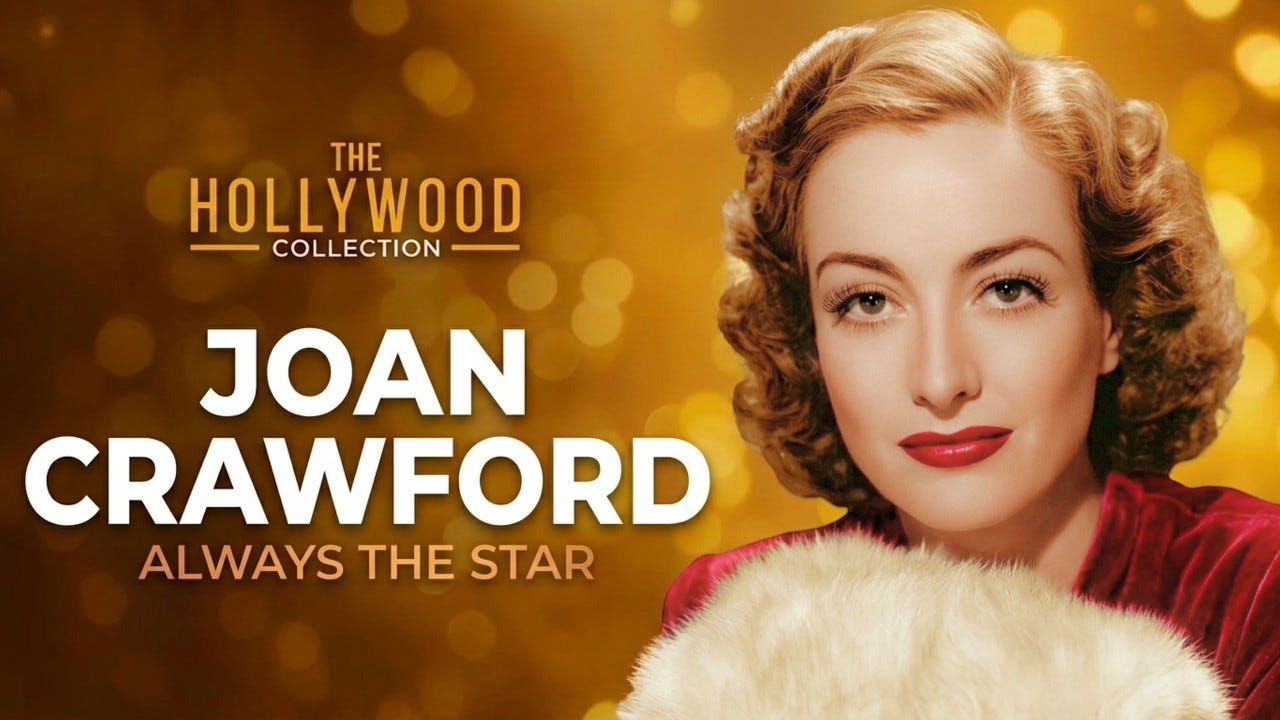
Joan Crawford spent almost her entire life fighting: first to escape where she came from, then to reach Hollywood, then to remain there, and finally even to control the way she would be remembered. She was not simply one of the great femmes fatales of the screen. She was a personality who inspired fear, anger, gossip and admiration in almost equal measure.
She had those enormous expressive eyes, the sharp angles of her face and a mouth that could move from seduction to contempt in seconds. People who worked with her remembered stories of aggression, impossible demands and ruthless ambition. Yet many of those same people, often in the same breath, admitted that something happened when the camera turned toward her that was impossible to ignore.
Crawford survived something that destroyed dozens of stars of her generation: the transition from silent films to sound. She survived the collapse of her box-office power, returned when many considered her finished, won an Academy Award and created some of the most formidable female characters in American cinema.
At the same time, she built around herself a second filmography that was never shot in a studio: four marriages, lovers, enemies, public insults, rumours, family battles and a rivalry with Bette Davis that eventually became almost as famous as either woman’s films.
When Crawford died, Davis was credited with one of the coldest epitaphs in Hollywood history, saying that one should never speak badly of the dead and adding, in effect, that Joan Crawford was dead and that was good.
It was the kind of feud that could not even end politely with death.
Before Joan Crawford existed, there was Lucille Fay LeSueur. She was born in San Antonio, Texas, the youngest of three children of Anna Bell and Thomas LeSueur. Her father left the family before she was born.
Her mother later married Henry Cassin, and the family moved to Oklahoma. Cassin worked in entertainment and managed the Ramsey Opera House, giving young Lucille her first glimpse of a world of stages, backstage corridors and theatrical lights.
But proximity to glamour did not mean safety.
Later accounts of Crawford’s childhood included allegations that she had been sexually abused by her stepfather from a very young age. Family instability, financial insecurity and the absence of a dependable father figure created an environment in which she learned early that nothing could be assumed to last.
It is easy to imagine her behind the curtains of a provincial theatre, watching women in costume walk into the light and seeing more than entertainment. She may have been looking at a possible exit.
She wanted to dance. A serious injury to her foot nearly destroyed that ambition, but she recovered and continued. It would become a pattern throughout her life: circumstances told her no, and Crawford treated the answer as a temporary administrative error.
Cassin was later accused of embezzlement, and his marriage to her mother ended. Lucille found herself at Rockingham Academy in Missouri as a working student, later had a serious early relationship with trumpeter Ray Sterling, and enrolled at Stephens College in 1922.
She did not remain there for long. Academic life offered little of what she wanted, and she had already begun to understand that her future would not be built in classrooms.
It would be built on a stage.
Crawford took a series of difficult jobs to survive, but dancing gave her the first real route upward. She travelled through American cities as a chorus dancer, learning something that would later become one of her greatest professional skills: how to command attention in a room full of people.
In 1925 she arrived in Hollywood and signed a contract with Metro-Goldwyn-Mayer.
She did not enter the studio as a finished star. There were small parts, screen tests, endless photographs and the machinery of a studio system that did not simply discover actors. It manufactured them.
Lucille LeSueur was considered unsuitable as a movie-star name.
So Joan Crawford was created.
The studio changed the name, but Crawford did much of the rest herself. She watched, learned and adapted. She understood the power of clothes, photographs, posture and public image decades before anyone would have called it personal branding.
In 1928, Our Dancing Daughters transformed her career. Crawford became one of MGM’s most important young stars and eventually rivalled even Greta Garbo in popularity.
On screen she often played hardworking young women who fought their way toward a better life and found happiness, status or love through determination. Female audiences responded to those characters because they were not distant aristocrats from another world. They were women who wanted to move somewhere better.
Crawford understood that desire intimately.
The arrival of sound destroyed the careers of many major stars. Voices failed to match the faces audiences had imagined, accents suddenly mattered, and styles of acting that had worked in silence became awkward overnight.
Crawford crossed into the new era with remarkable ease. Her voice worked, her presence survived, and her position inside the studio became even stronger. She rose to become one of the most popular and highly paid women in Hollywood.
Behind the success was a nearly obsessive discipline. Crawford understood that Hollywood’s summit was never a permanent address. Every morning could bring a younger woman, a new face or a changing fashion capable of making yesterday’s star appear old overnight.
By the end of the 1930s, that fear began to become real. Her commercial power declined, and her name appeared among stars notoriously labelled “box-office poison.” For a woman who had spent her entire life proving she was not disposable, the phrase must have sounded less like a verdict than a challenge.
She did not disappear. She waited for the role that could bring her back.
In 1945 came Mildred Pierce, directed by Michael Curtiz.
The role seemed almost unnervingly suited to Crawford: a woman who fights, builds a place for herself and pays heavily for what she achieves.
Her performance won her the Academy Award for Best Actress. The star who had been written off only a few years earlier was back at the top.
Hollywood mythology has Crawford waiting for the result at home, officially because she was ill, then receiving journalists in bed after her victory was announced. Genuine illness, carefully staged anxiety or simply another immaculate piece of image management? With Crawford, even a bedroom could become a set.
The Oscar was followed by major performances and two further nominations, for Possessed and Sudden Fear. Films such as Daisy Kenyon, Flamingo Road, The Damned Don’t Cry! and Harriet Craig established a darker and more mature screen persona.
The women she played were no longer young dancers moving toward a better life.
They were women who already knew what that life could cost.
In 1954, Nicholas Ray made Johnny Guitar, one of the strangest and most enduring Westerns in American cinema.
Crawford played Vienna, the owner of a saloon, a woman who had claimed her place in a male world and had no intention of apologising for how she got there.
Perhaps no role brought Crawford’s real personality and screen persona closer together. Vienna is proud, wounded, hard and almost impossible to push out of the frame.
Sterling Hayden may have played the title character, but beside Crawford he often seems like a visitor in somebody else’s film. She dominates the screen so completely that the title begins to feel almost irrelevant.
Hayden later made no secret of how unpleasant he had found working with her and said he would not do it again even for all the money in the world.
He was hardly the last person to say something like that.
The list was getting long.
If one rivalry ultimately became larger than Crawford herself, it was the one with Bette Davis.
The public often associates their feud with What Ever Happened to Baby Jane? in 1962, but the hostility had begun much earlier.
The two women represented very different forms of female power in old Hollywood. Crawford constructed the image of the star with almost military precision. Davis often appeared to take pleasure in sacrificing beauty whenever a role demanded something harsher. Yet both wanted the best parts, the awards, the highest position and, on occasion, the same men.
In the 1930s, Franchot Tone became part of the story. Davis fell in love with her Dangerous co-star. Crawford was also interested in him and eventually married him in 1935.
From that point, professional rivalry acquired a personal venom.
Years later they finally appeared together in What Ever Happened to Baby Jane?. Two women who had spent decades competing were now asked to play sisters trapped in jealousy, dependency and hatred.
Director Robert Aldrich could hardly have asked for better preparation.
Stories from the production became legendary: real insults, physical roughness during scenes and attempts by each actress to make the other’s work more difficult. How much was fact and how much was later amplified by Hollywood matters less than the result. The tension is visible on screen.
Davis received an Oscar nomination. Crawford did not. When awards night arrived, Crawford arranged to accept the trophy on behalf of Anne Bancroft, who ultimately won.
In Hollywood, even defeat could be staged as an entrance.
The insults between Davis and Crawford became almost a genre of their own. Davis was credited with the famous remark that Crawford had “slept with every male star at MGM except Lassie,” along with several even more vicious lines. Crawford responded by dismissing Davis as an actress as something of a bluff.
Neither woman showed much interest in graciousness.
Cinema history is richer for it.
Crawford became a mother through adoption, and her relationship with her daughter Christina would eventually affect her reputation more profoundly than almost anything else.
One year after Crawford’s death, Christina published Mommie Dearest.
The book was devastating.
It portrayed Crawford as controlling, violent and terrifying, describing physical and verbal abuse, eruptions of rage, an obsession with order and periods of heavy drinking. The image of Crawford as a monster inside the home became so powerful that for many people it eventually overshadowed the films themselves.
Some of the book’s claims were later disputed by people who had known Crawford and by other members of the family. That did little to weaken its cultural impact.
Joan Crawford had spent decades constructing her own version of Joan Crawford.
With Mommie Dearest, somebody else finally seized control of the story.
And that person was her daughter.
Crawford married four times. Her first three husbands were actors Douglas Fairbanks Jr., Franchot Tone and Phillip Terry, and all three marriages ended in divorce.
The fourth marriage was different.
In 1955 she married Alfred Steele, president of Pepsi-Cola. After his death in 1959, Crawford remained closely involved with the company and served on its board, taking on a public role far removed from movie sets.
The image of one of old Hollywood’s greatest stars travelling to corporate events for Pepsi seems almost surreal now. For Crawford, however, there was a certain continuity. She had spent her life representing something: first a studio, then her own image, and now a company.
By the early 1970s, her health had begun to deteriorate. She gradually withdrew from public life and spent her final years in far greater isolation than the woman who had once been unable to move without photographers following her.
She died on May 10, 1977, at around seventy years old, after suffering a heart attack.
For a woman so often described as though something harder than a heart had occupied that space inside her chest, the irony was almost too neat to ignore.
It is easy to write about Joan Crawford only through scandal. It is entertaining to repeat Bette Davis’s lines, the stories of the marriages, the rumours about lovers, the fights on sets and the accusations in Mommie Dearest. Old Hollywood loved manufacturing monsters almost as much as it loved manufacturing gods, and Crawford somehow managed to become both.
But if we stop there, we miss the most important thing.
She had real talent.
She did not survive for roughly half a century in film simply because she was ruthless. Ruthless ambition may open one door, perhaps two. It cannot by itself create Mildred Pierce, Johnny Guitar, Possessed or What Ever Happened to Baby Jane?
In front of the camera, Crawford knew exactly how to use what she carried inside her: insecurity, ambition, anger, the need for control and the fear of rejection. The qualities that may have made life difficult around her often became fuel for the women she played.
Perhaps that is why her best performances still carry such force. We are not simply watching an actress impersonate a hard woman. We are watching someone who had learned very young that if she did not create her own place in the world, somebody else would decide what place she deserved.
Joan Crawford may have been difficult, harsh and destructive to people around her. Some of the legends may have been true, others exaggerated by an industry that survived by feeding on its own mythology. None of that needs to be erased in order to admire the work.
Because once the gossip fades and the films remain, something inconvenient happens to anyone hoping for a simple verdict.
The woman so many people could barely tolerate in the same room is still impossible to ignore when she appears on the screen.
Comments
Nothing yet. Say the first thing.
Sign in to join the conversation.