
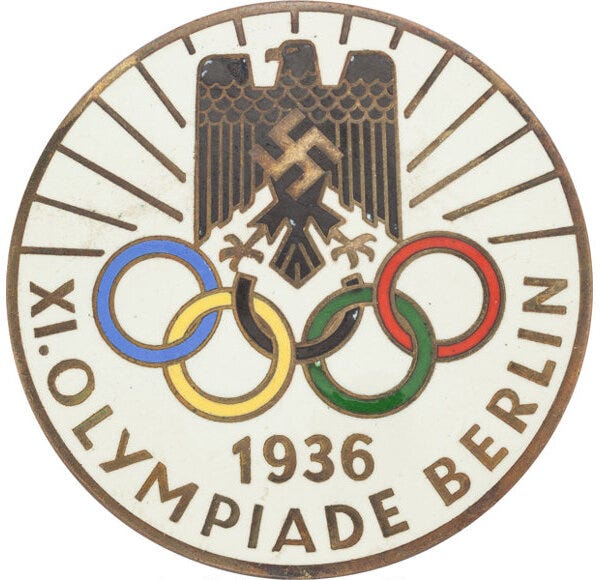
On August 1, 1936, Berlin looked as though it had been transformed into a vast theatrical stage where every flag, every parade, every word and every smile had been placed exactly where it belonged. More than 100,000 spectators waited inside the newly built Olympic Stadium, military formations moved through the avenues, thousands of young people lined the streets, and Olympic banners appeared everywhere beside swastikas.
It was the opening of the 11th Olympiad, and Nazi Germany had decided that these Games would be far more than a sporting event. They would be a demonstration of strength, discipline, organisation and civilisation to a world that already had reasons to view Adolf Hitler’s regime with unease.
For a few weeks, Germany would attempt to present a different version of itself. A peaceful, welcoming country, open to other nations and devoted to the Olympic ideal. The image was designed with extraordinary care.
The problem was that behind the scenery there was already a very different reality.
The Nuremberg Laws were already in place. Jews were being systematically excluded from public life. Sport and youth organisations were increasingly being used as tools of ideological education. Violence and authoritarianism had not disappeared.
They had simply been moved temporarily out of frame.
One of the most powerful symbols of those Games was born far from Berlin, in Ancient Olympia.
For the first time in the history of the modern Olympic Games, the Olympic flame was lit in Greece and carried by relay to the host city. The idea had been developed by German sports organiser Carl Diem and would later become one of the most recognisable rituals of the modern Olympics.
The flame was lit on July 20, 1936, and began a long journey through Greece, Bulgaria, Yugoslavia, Hungary, Austria and Czechoslovakia before reaching Germany.
The image was immensely powerful: one runner handing the flame to the next, then another, creating an imaginary line between Ancient Olympia and modern Berlin.
For the Nazi regime, that connection meant far more than a simple tribute to antiquity. Ancient Greece was used to strengthen a racial mythology in which Nazi Germany could present itself as the spiritual and racial heir of an idealised “Aryan” Greek civilisation.
History had been turned into stage design.
And the Olympic flame, innocent of everything being projected onto it, became part of that design.
From the early afternoon of August 1, Berlin echoed with marching music, the German national anthem and cheers for Hitler. Tens of thousands of members of German youth organisations gathered at the Lustgarten, while leading figures of the regime, among them Propaganda Minister Joseph Goebbels, helped set the tone of the day.
One of the greetings to the athletes ended with a single word that, knowing what would follow, sounds almost chilling now: “Peace.”
The word was not accidental. It was precisely the message the regime wanted to send abroad.
Hitler himself, welcoming members of the International Olympic Committee, presented the Games as a continuation of the ancient Greek Olympics and as a means of bringing nations closer together. He spoke of the “noble traditions” of the classical Games, of understanding between peoples and of the sacred origins of the Olympic ideal.
He also announced the resumption of German archaeological excavations at Ancient Olympia, another project that allowed the regime to present itself as the guardian of a great European cultural inheritance.
The stage was almost perfect. A dictator who had already built a racist state was speaking before the world about peace, international understanding and the sacred principles of the Olympic Games.
And much of the world listened.
Within this carefully constructed ceremony, the Greek delegation held a special place. Leading it was Spyridon Louis, winner of the marathon at the first modern Olympic Games in Athens in 1896.
Forty years after his victory, Louis appeared once again at an Olympiad, this time not as an athlete but as a living link between Athens in 1896 and Berlin in 1936.
His presence carried enormous symbolic value for the organisers. The regime wanted to present the Games as part of an unbroken historical line beginning in ancient Greece and arriving in modern Germany.
There was, however, one problem no ceremony could completely control.
Once the opening ended, the competition began.
And inside the stadium appeared a young Black American athlete who did not fit the racial mythology at all.
Jesse Owens was born in 1913 in Oakville, Alabama, and grew up in an America where racial segregation was not an abstract theory but an everyday fact. He was one of eleven children, and later moved to Ohio, where his extraordinary athletic talent became impossible to ignore.
A year before the Berlin Games, on May 25, 1935, he produced one of the greatest performances in the history of track and field. In less than an hour, he broke or equalled a series of world records, making it clear that he would arrive in Berlin as far more than another member of the American team.
He would become the face of the Games.
Owens won four gold medals: in the 100 metres, the 200 metres, the long jump and the 4×100-metre relay.
Inside a stadium covered in the symbols of a regime that had built an entire ideology around the hierarchy of races, a Black American athlete demonstrated before tens of thousands of spectators that the human body had no interest whatsoever in Nazi racial theory.
He needed no political speech.
He ran, jumped and won.
And every time he crossed the finish line first, the image spoke more loudly than any propaganda leaflet.
If there is one story from those Games that has endured almost as powerfully as Owens’s four gold medals, it is his relationship with the German long jumper Luz Long.
The two men were rivals in the long jump. Long was German, white, tall, and exactly the kind of athlete who could easily fit the image the regime wanted to display.
Owens was everything that image rejected.
And yet Long helped him during the qualifying round when the American was in danger of elimination. In the final, Owens won, and the two athletes appeared together before the crowd, their relationship becoming one of the most human stories of the Games.
The sight of a white German and a Black American standing together inside a stadium filled with swastikas expressed the true Olympic ideal far more convincingly than all the official speeches about brotherhood between nations.
That is one of the great ironies of Berlin.
The regime organised the Games in order to control the image.
The people inside the Games created images it could not control.
The Olympic Games ended on August 16, 1936. Germany won the largest number of medals, while the organisation, facilities and hospitality impressed many foreign visitors and much of the international press.
That was exactly what the regime wanted.
The streets were clean, the organisation efficient, the stadiums imposing and the ceremonies spectacular. For several weeks, Nazi Germany had succeeded in showing the world a carefully filtered version of itself.
Propaganda does not always work because it convinces people of one enormous lie. Sometimes it is enough to offer them an image beautiful enough to postpone the question of what they are not seeing.
In the summer of 1936, the world saw stadiums, flags, athletes, flames, music and a country speaking constantly about peace.
But the laws, the exclusions, the propaganda machine, the military apparatus and an ideology that had never truly hidden its ambitions were already there.
One only had to look behind the flags.
Only a few days after the Games began, on August 4, 1936, Ioannis Metaxas established a dictatorship in Greece. Europe was already moving toward something much darker, even while stadiums remained full of applause.
Three years later, on September 1, 1939, Germany invaded Poland and the Second World War began in Europe.
Suddenly, the words spoken in Berlin in 1936 about peace, understanding and brotherhood between nations acquired a very different weight.
The Olympic flame that travelled from Ancient Olympia to Berlin survived as a ritual and became one of the most recognisable symbols in world sport. But the 1936 Games also remained one of the clearest examples of how even the most beautiful symbols can be appropriated by a regime determined to present itself as something different from what it really is.
The regime staged a celebration intended to display its strength and supposed superiority. Yet inside that celebration, a Black athlete won four gold medals, while one of his German rivals stood beside him as a friend.
Perhaps that is the image most worth remembering from Berlin in 1936. Not the flame arriving before Hitler, and not the thousands of flags placed carefully for the cameras, but two athletes who, for a few moments, did inside the stadium exactly what the regime surrounding them refused to do.
They saw each other simply as human beings.
Comments
Nothing yet. Say the first thing.
Sign in to join the conversation.