
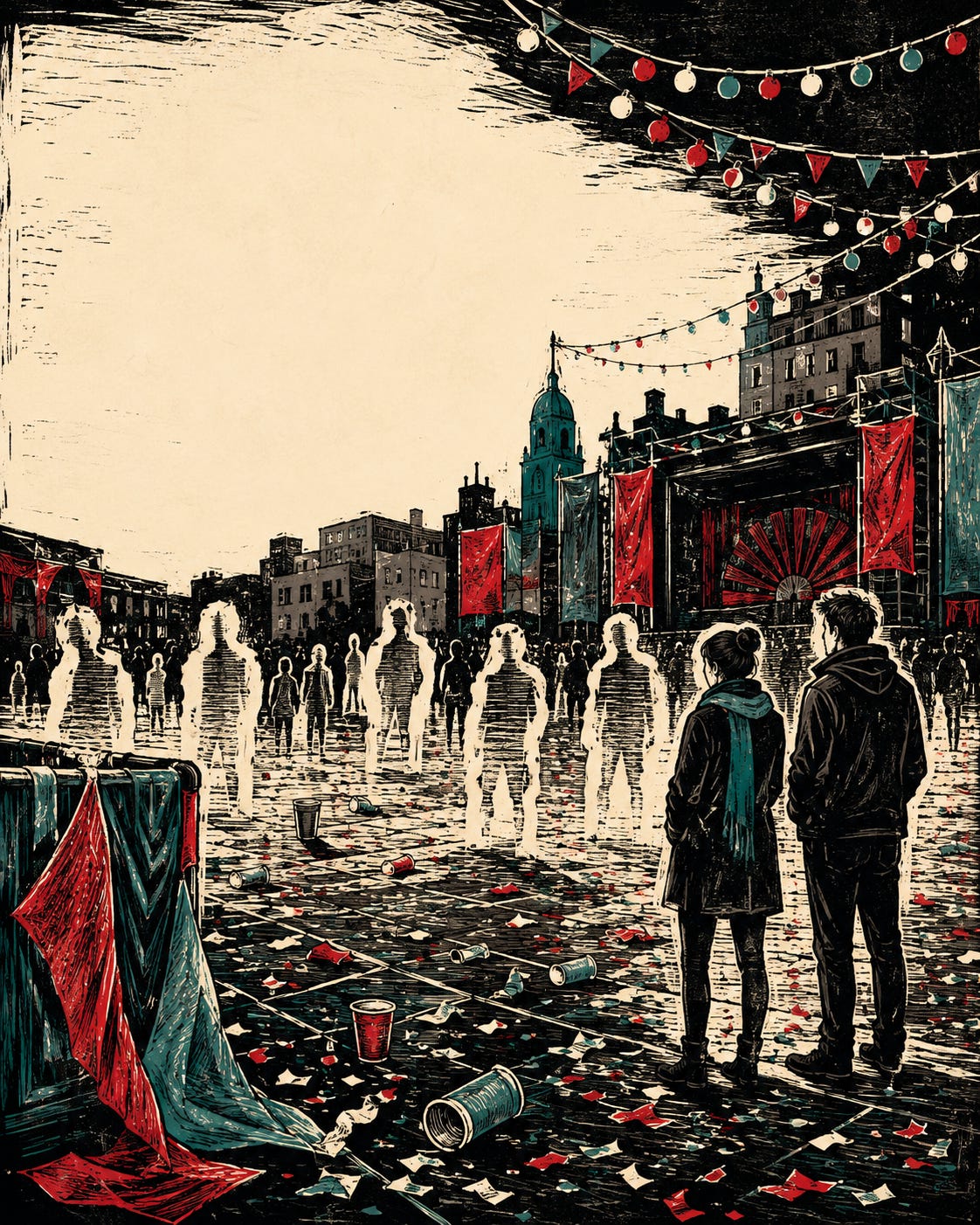
The celebration went beautifully, if you ignore the people who were missing. The lights came on exactly when they were supposed to, the stands filled, phones rose into the air, and for a few hours the city managed to do what cities do very well: look happy when someone is taking a picture.
There was still glitter on the streets from the night before. It clung to pavements, shoes and drains. Some of it would remain for days, tiny evidence that at some point we had enjoyed ourselves. The people cleaning the square collected plastic cups, broken bottles and food wrappers. Nobody had been assigned to collect the absences.
Absence is harder to clean up.
It does not always leave an empty chair. Sometimes it leaves a phone nobody calls anymore, a room that has been given another purpose, a name friends avoid mentioning because it changes the mood. Sometimes it leaves a mother who still cooks too much food and remembers why only after she has finished.
Some people never made it to the celebration. Some drowned in a sea that always looks impossibly blue in tourist photographs. Some disappeared into wars we watched intensely for a few weeks before something newer arrived on our screens. Some worked so hard just to survive that, somewhere along the way, survival swallowed the rest of their lives.
And there were others who were still alive but had learned how to disappear.
The man who no longer answers the phone because every conversation begins with, “Any luck finding something?” The woman who smiles when friends suggest a trip and says the dates do not work for her because that is easier than saying the money does not work. The child who learns far too early that certain things should not be asked for at home.
We have become very good at recognising these people.
So good that we have learned not to see them.
It may be one of our great social achievements. We can walk past someone collapsing and conclude that they probably failed to manage their life properly. We can look at an exhausted worker and recommend better time management. We can tell a young person to dream, provided the dream does not require changing anything that makes the rest of us comfortable.
We tell them to study, work, try harder, stay flexible, stop complaining, control their anger and, above all, not disturb the celebration. Once, we told young people to change the world. Now we tell them to make sure they survive it.
We decided to call the difference maturity.
Meanwhile, we have become excellent at mourning. The moment something happens, we know exactly what to do. We find the right photograph, write the right sentence, add the appropriate symbol and, for a few hours, feel slightly better about ourselves.
Then the next thing arrives.
It is not always hypocrisy. Many of us are genuinely hurt. But we have discovered an extremely convenient way to turn pain into ritual without consequence. We grieve, become angry, post, move on. Repetition has made the process almost flawless.
Sometimes we light candles too.
Candles are wonderful because they ask nothing from us after they go out.
The harder question would be why we needed them in the first place.
Perhaps that is why the people who actually keep others standing rarely appear in the big photographs. The neighbour who leaves a bag of groceries outside a door without ringing the bell. The woman who lends her car so someone can get to a job interview. The friend who pays a bill and never mentions it again. The person who sits beside someone when there is nothing clever left to say.
Nobody gives them awards.
Probably for the best.
Because perhaps something we have forgotten how to call politics begins there: not in the grand words, but in the moment you decide you will not allow another person to disappear simply because their disappearance would be convenient for everyone else.
The celebration, of course, must continue. It always does. There will be new stages, new speeches, new slogans and better lighting. The people asking us not to look too carefully will probably have cleaner hands this time.
But the old trick remains.
When people who are suffering begin to look at one another, point toward somebody weaker and tell them that person is responsible. The foreigner. The poorer one. The desperate one. The person who arrived later. The person who prays differently. The person who loves differently.
Give two drowning people one piece of wood and explain that only one of them can hold on.
Then watch them fight over it and call the result human nature.
Perhaps it is not.
Because behind all of this, another instinct still exists, quieter and far less spectacular. The instinct that makes one person share bread, time, money, a car, a room, information, an opportunity. The instinct that says, “Come here,” instead of, “Not my problem.”
It will not save the world by itself.
But no world worth saving can exist without it.
Someday, when the next celebration ends, the streets will be cleaned again. We will collect the cups, take down the banners and switch off the lights. A few photographs will remain, some videos, and perhaps that glitter that stubbornly refuses to leave the cracks in the pavement.
Before we start talking about what a wonderful time we had, it might be worth looking around.
To see who is missing.
And this time, before lighting another candle for them, perhaps we should ask whether there was something we could have done while they were still here.
Otherwise, we will keep celebrating with the same faces missing from the photograph and keep calling the habit “life.”
Until one day we open our mouths to laugh and discover they are full of sand.
Comments
Nothing yet. Say the first thing.
Sign in to join the conversation.