
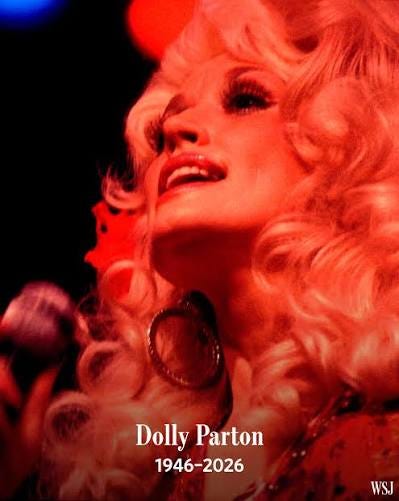
Dolly Parton spent almost her entire life turning the things that might have limited her into material for moving forward: poverty into songs, an extravagant image into a signature, success into independence, and money into a way of giving something back to the place where she began. Today, August 25, 2026, Dolly Parton died at the age of 80, leaving behind far more than an extraordinary recording career.
Her story contained everything America loves to turn into mythology: a child from a poor Appalachian family, twelve children in a small home, very little money, music from an early age, Nashville, records, movies, businesses and millions of albums sold.
But Dolly Parton never waited for someone else to write her myth.
She wrote it herself.
Dolly Rebecca Parton was born on January 19, 1946, in East Tennessee, the fourth of twelve children born to Robert Lee Parton and Avie Lee Owens.
The family was poor in a way she never tried to romanticize later. The house was small, the children were many and money was scarce. Her father worked relentlessly but had never learned to read or write. Her mother filled the home with songs, stories and the kind of practical imagination that often develops when there are not many material things available.
Dolly began inventing rhymes almost as soon as she could form words. At six, she wrote her first little song, Little Tiny Tassletop, inspired by a doll her mother had made for her from a corncob.
She would return to those childhood years again and again.
Coat of Many Colors became perhaps her clearest autobiographical statement. Her mother had sewn her a coat from scraps of fabric. Young Dolly went proudly to school wearing it and was mocked by other children for being poor.
Years later, instead of burying the memory, she turned it into a song.
That became one of the secrets of her songwriting. She never tried to prove that she had escaped the mountain girl she once was. She carried her along.
In 1964, immediately after graduating from high school, Parton left for Nashville.
She did not go there merely to “try her luck.” She went there to become a professional songwriter and singer. The distinction says something about her.
Very early, she understood what many musicians discover only after it is too late: a song is not merely art. It is also property.
In 1966, together with her uncle Bill Owens, she established Owe-Par Publishing, retaining control over an important part of her songwriting catalogue. She was not yet the global star she would become. She was a 20-year-old woman in a male-dominated business who already understood that ownership of a song might one day be worth more than the applause following its first performance.
Around the same time, Carl Dean entered her life.
She met him on her first day in Nashville outside a laundromat. They married in 1966 and remained together until his death in March 2025.
It became one of show business’s strangest marriages precisely because it looked so little like show business. She was everywhere; he was almost nowhere. Dean avoided cameras, premieres and public life, and Dolly protected that choice for nearly six decades.
Her breakthrough came when she joined The Porter Wagoner Show in 1967. The two became a hugely successful country duo, and the partnership opened the doors of the industry to her.
But it was also a difficult relationship.
Wagoner had helped make her famous, yet struggled to accept that his protégé was beginning to outgrow the boundaries of their partnership. Parton later described those years almost as a marriage, full of affection, conflict, anger and possessiveness.
When she finally decided to leave, she found a better way to explain what ordinary conversation could not.
She wrote a song.
I Will Always Love You was not originally a romantic declaration. It was her farewell to Wagoner. Love without submission, gratitude without a promise to stay.
The song became a hit in 1974 and again in 1982. Nearly twenty years later, Whitney Houston would transform it into one of the most famous ballads in popular music.
But before Whitney, there was another story that revealed just as much about Dolly Parton.
Elvis Presley wanted to record it. Colonel Tom Parker demanded half of the publishing rights as part of the deal.
Dolly refused.
She later said she cried because she loved Elvis and desperately wanted to hear him sing her song. But she did not sign away the rights.
Years later, when Houston’s recording became a worldwide phenomenon, that refusal looked like one of the most important business decisions of Parton’s life.
She was not simply good at writing songs.
She knew who should own them.
The year 1974 also brought Jolene, perhaps the song that travelled most effortlessly from one generation to another.
Parton never wrote complicated songs merely to prove she was a serious songwriter. She wrote simple songs that were extremely difficult to write well.
Jealousy, fear, work, marriage, sex, faith, family, female independence, people without much money but with plenty of stories: this was her territory.
By the late 1970s, she had moved decisively toward pop with Here You Come Again and gained an audience far beyond country music.
Hollywood followed.
In 9 to 5 in 1980, alongside Jane Fonda and Lily Tomlin, she proved she could act while also writing the film’s title song. The percussive sound at the beginning was created by clicking her acrylic fingernails together like the keys of a typewriter.
9 to 5 became an anthem for working women and earned Parton an Academy Award nomination for Best Original Song.
Films including The Best Little Whorehouse in Texas and Steel Magnolias followed, along with numerous television appearances.
But Dolly Parton was already beginning to build something larger than a career.
In 1986, Dollywood opened in Tennessee.
It could easily have become an enormous monument to its famous owner. Instead, the park was closely tied to Smoky Mountain culture and grew into one of the region’s major employers.
Parton possessed a rare kind of commercial intelligence. She understood that her image was a product without ever appearing embarrassed by that fact.
The enormous hair, rhinestones, nails, bright clothes and glorious excess were not things imposed on her by a manager.
They were her creation.
She made the joke about herself before anyone else could, removing much of its power to hurt her. Behind the image, however, was a woman who read contracts, protected copyrights and understood exactly what her name was worth.
Perhaps the most important thing she built was neither a song nor a theme park.
In 1995, Parton created the Imagination Library.
The inspiration was personal. Her father, a highly intelligent and hardworking man, had never learned to read or write. Dolly wanted to create a program that would send free books to young children before they even entered school.
It began in her home county.
It became international.
By the end of 2025, more than 300 million books had been distributed.
If anyone wanted another measure of Dolly Parton’s success, they did not need to look at the charts. They could look at a child opening a book that the family might otherwise have been unable to afford.
She repeatedly returned something to the region where her own life had begun. After devastating wildfires struck the Smoky Mountains in 2016, she created the My People Fund to provide direct financial assistance to families who had lost their homes.
In 2020, she donated $1 million to Vanderbilt University Medical Center for COVID-19 research, some of which was connected to research behind the Moderna vaccine.
She did many of these things in much the same way she did almost everything else, without turning them into lectures about what a good person she was.
During the 1980s, Parton joined Linda Ronstadt and Emmylou Harris for Trio. Later she returned to her bluegrass roots with albums including The Grass Is Blue and Little Sparrow.
She entered the Country Music Hall of Fame in 1999.
In 2005, she wrote Travelin’ Thru for Transamerica, provoking criticism from part of her conservative country audience but refusing to retreat from the choice.
Then, in 2022, she was elected to the Rock & Roll Hall of Fame and initially tried to withdraw because she did not believe she had done enough rock music to deserve the honour.
Her response was wonderfully characteristic.
Once inducted, she decided she had better make a rock album.
The result was Rockstar in 2023, featuring Paul McCartney, Ringo Starr, Elton John, Stevie Nicks, Debbie Harry, Sting, Pink, Brandi Carlile and many others.
At 77, she was not trying to prove that she was young.
She was simply still curious.
Carl Dean’s death in March 2025 ended a marriage that had lasted almost sixty years. Parton later acknowledged that while caring for him she had neglected some of her own health problems.
Only days before her own death, she was still talking about the things she wanted to create.
That may be the most appropriate detail with which to remember a woman who never behaved as though she had finished.
Dolly Parton wrote thousands of songs, recorded dozens of albums, sold more than 100 million records, won Grammys, appeared in movies, built businesses and became one of those rare figures in American culture who could be loved by people who agreed on almost nothing else.
But numbers never fully explained her.
Behind all the glitter there remained something remarkably simple: a girl from the Smoky Mountains who understood early that she could not choose where she began, but she could decide what to do with everything she carried from there.
She carried almost all of it with her: the poverty, her mother’s songs, her father who could not read, the coat made from scraps, the mountains, the faith, the humour, the excess and the determination.
She turned those things into songs.
And once she had enough, she began sending books to the children coming after her.
Dolly Parton died today, August 25, 2026, at the age of 80, only months after the death of Carl Dean, the man with whom she had shared almost six decades of her life. Her family announced her death, and as of today no official cause has been publicly confirmed.
She leaves behind far more than country music. She became part of the cultural memory of America, a voice that travelled from one generation to the next without ever surrendering the identity that created it.
Dolly Parton did not leave behind only songs.
She left behind an entire world that can still be heard.
Comments
Nothing yet. Say the first thing.
Sign in to join the conversation.