
As part of my research for this newsletter, I took a course called Ancient Animals and People at the University of Wisconsin that was taught by zooarcheologist Dr. Jason Miszaniec. The course description said that it “provides an introduction to human and animal relationships from prehistory to the present.” It was a revelation to me that there is an entire field of study devoted to this topic called Ethnozoology.
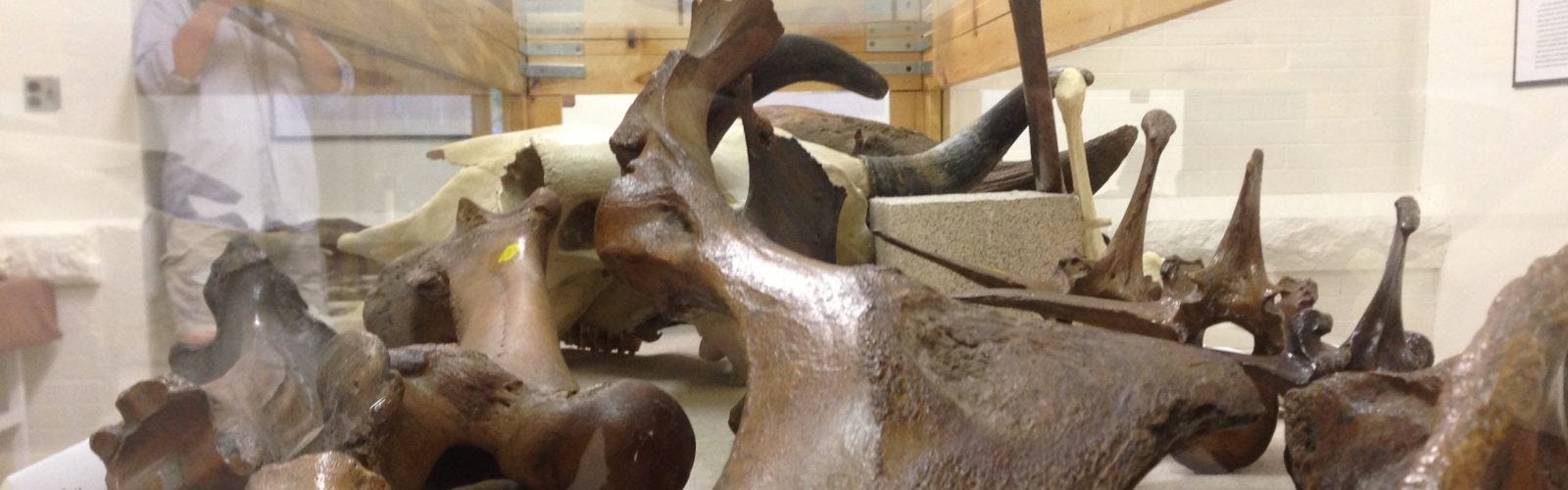
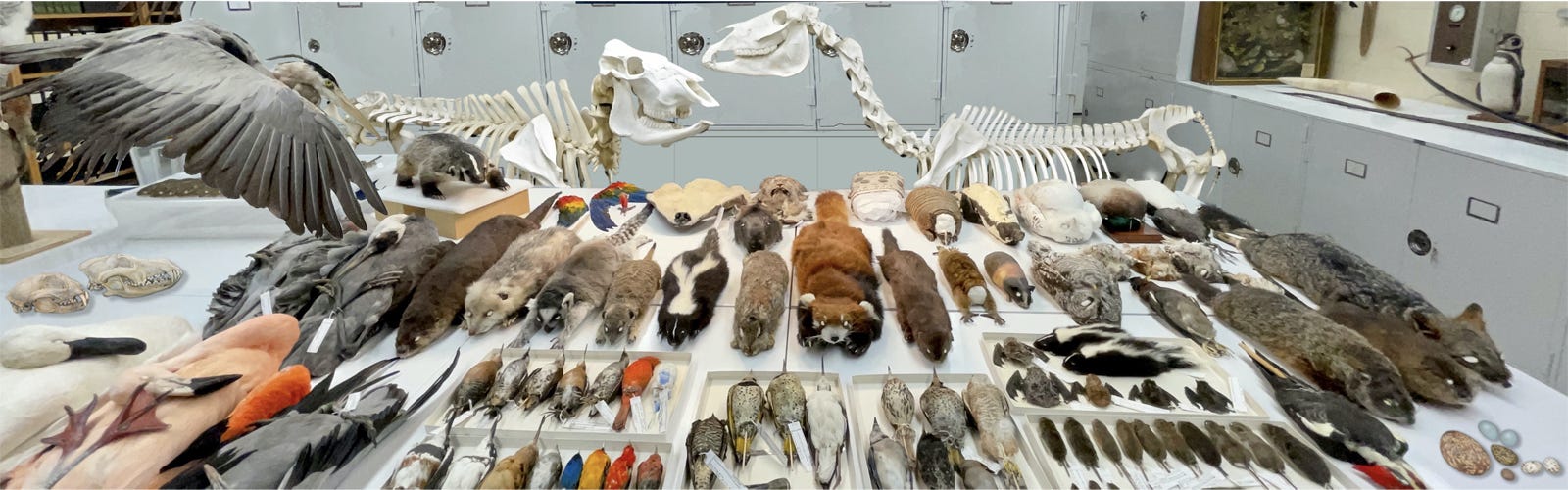
The most shocking revelation though was the Library of Dead Animals1 located in the bowels of the Noland Zoological building and not open to the public. The library owns a colony of flesh-eating beetles to clean animal carcasses to the bone. (They are housed in a Dermestarium in a different campus building to prevent them from destroying the collection should they escape.) The collection includes nearly 750,000 specimens of skeletal remains, pelts, dead birds and fish in shallow flat drawers as well as taxidermied animals, including a giant condor hanging from the ceiling. Our instructor checked out eight skulls of medium-sized woodland animals for us to use in lab. Hands-on research was not the kind of knowledge that I was seeking.
I knew that domestication of animals was one of the defining features of the Neolithic period and that actually turned out to be the focus of the course. Domestication conjures up a simple image of Neolithic humans herding sheep and cattle with a dog to assist them—a misleading notch on the timeline of human civilization. Domestication was a slow process and each animal has its own place on the timeline.
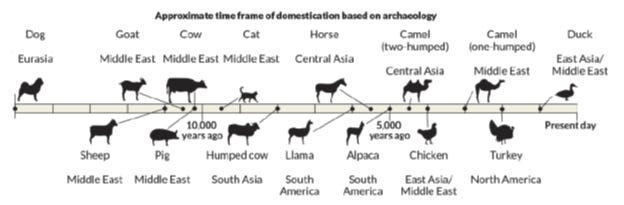
Dogs were the first domesticated animal and the only species to be domesticated before agriculture. So technically, domestication began before the Neolithic period.
Domestication is a relationship where humans are involved in the reproduction and care of animals. This results in behavioral and genetic changes in the animals, such that the domesticated species must rely on humans and can no longer do well in the wild.
Rearing animals in an adequate environment for the species is not domestication. Bees, for example, are semi-domesticated.
Domestication involves breeding (including isolation from wild counterparts), care (shelter, protection from predators, and medical treatment), and feeding.
Taming is the behavioral modification of a wild-born animal so that its natural avoidance of humans is reduced and it accepts the presence of humans. Taming is the learned behavior of an individual animal. In that sense, taming precedes domestication.
In terms of numbers of animals on the planet, domestic animals (the ultimate in protected species) greatly outnumber wild animals. This masks the surprising fact that humans have only domesticated 14 out of 148 non-carnivorous animal species weighing over 45 kilos. Only 10 of around 10,000 bird species have been domesticated. As it turns out, most animals do not have qualities that are favorable to domestication.
They live in families rather than large gregarious social groups
They have territorial rather than hierarchical dominance structures
Males live in separate groups at certain times in the lifecycle
They have monogamous mating systems
They have seasonal or annual cycles of birth
The female dominates the male in sexual behavior
They have extravagant courtship rituals
They rely on chemical marking for sexual signals rather than movement or posture
They have long lives and slow generational turnover
They have late sexual maturity
They have high parental investment
The newborns are underdeveloped and require the aid of parents to mature
They have a specialist diet rather than being an omnivore or herbivore
They have a narrow environmental tolerance
They are shelter-seeking
They have extreme wariness and long flight distance
They have a high stress response
They are easily disturbed by humans or a sudden change in environment
They are independent and avoid attention
They are difficult to habituate.
One major change resulting from domestication is a reduction in brain size between domesticated animals and their wild ancestors, which is mainly in the limbic system. This results in a decrease of aggression, fear, and flight as well as a lower stress response. The larger the brain size, the greater percentage of reduction:
33% in pigs
30% in dogs
24% in sheep.
Domesticated animals were initially smaller than their wild counterparts. But that trend has reversed as humans seek to increase the amounts of food that the domestic animal can provide.
Domestication results in some loss of agency for the animal involved. By agency, I mean the ability to make choices and exhibit behaviors that serve their interests or express their preferences. This reduction in agency makes it easier to control and use the animals. There is a continuum of agency in domestic animals. Factory-farmed domestics have practically no agency, sheep and goats have grazing preferences (e.g., sheep in a pasture will choose to eat yarrow first), and domestic pets have the most agency though still confined to the households where they reside.
Domestication is the most significant relationship that we have with animals and the one that has had the most impact on the planet.
Thank you for reading Under the Magnifying Glass: Nature, Animals, Humans. This post is public so feel free to share it.
The original 1848 name of the library was Natural History Cabinet. Its official name today is University of Wisconsin Zoological Museum.
Comments
Nothing yet. Say the first thing.
Sign in to join the conversation.