
If you had been 30 years old at the time Chastleton House was completed in 1612, you would remember the final famine in the south of England (1594–97) and Queen Elizabeth I’s death (1603). You could have seen A Winter’s Tale or The Tempest performed at the Globe Theater in 1611 before it burned down in 1613. But you would need to set out for London four days in advance because the farthest distance you could travel in a day would be 20 miles on foot or 25 miles by horse. You could read the first edition of the King James Bible published in 1611, if you were among the 20% of the men or 10% of the women who could read. You might try a new food called tomatoes but potatoes were used only for fodder, and the pharmaceutical called chocolate was not available in England. Most of what you owned was either grown or made locally.1
This is the context for the “Inspired by Nature” exhibit at Chastleton House.2 It showcases one item in each room that has taken inspiration from the natural world, specifically floral motifs. The following four items are among the earliest on display and were made locally.
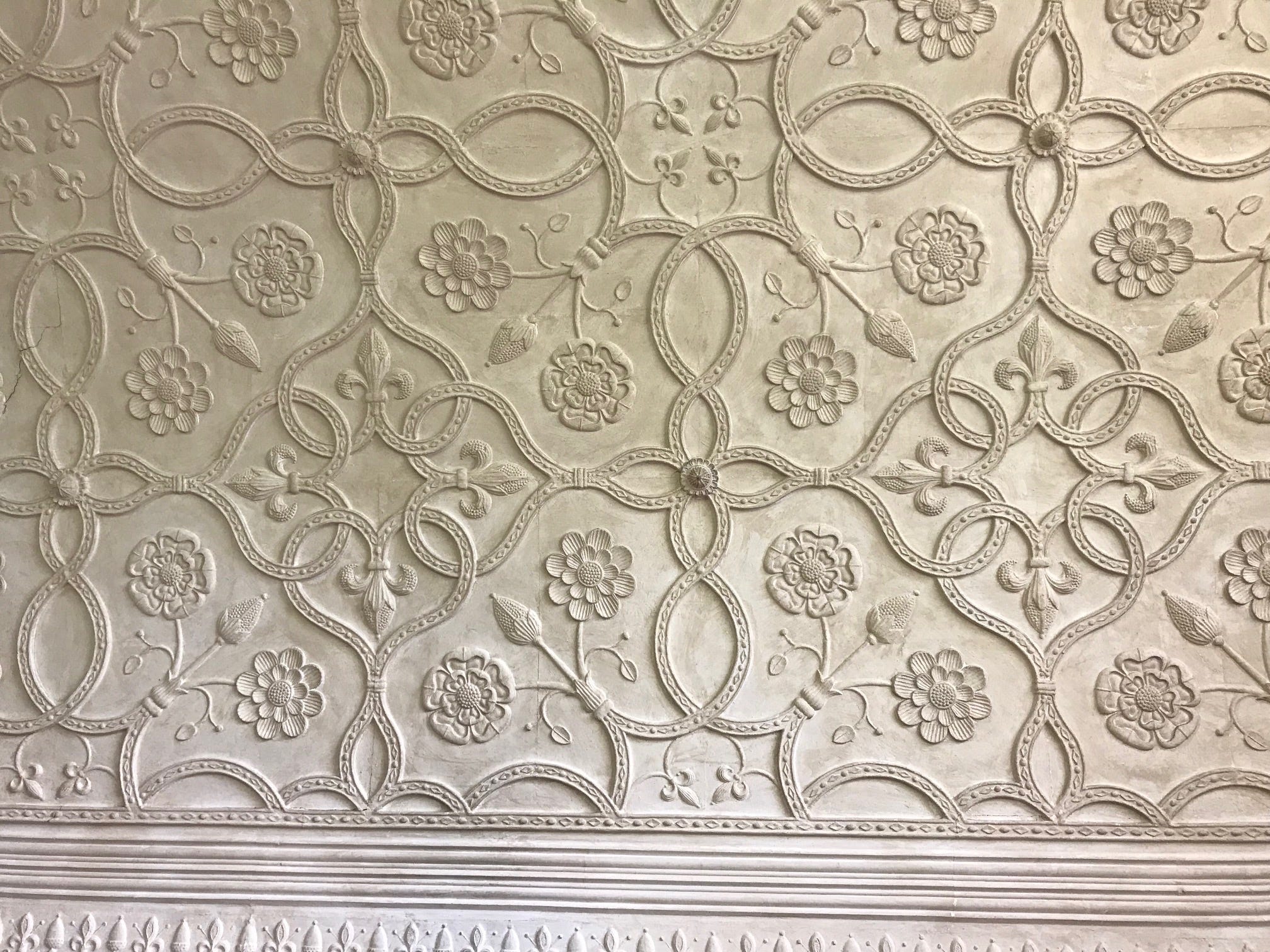
The Long Gallery on the top floor runs the full width of the house. It was used for indoor exercise. The walls are clad in wood paneling,
and a barrel-vaulted plaster ceiling covers the full length (72 ft) of this cavernous room.
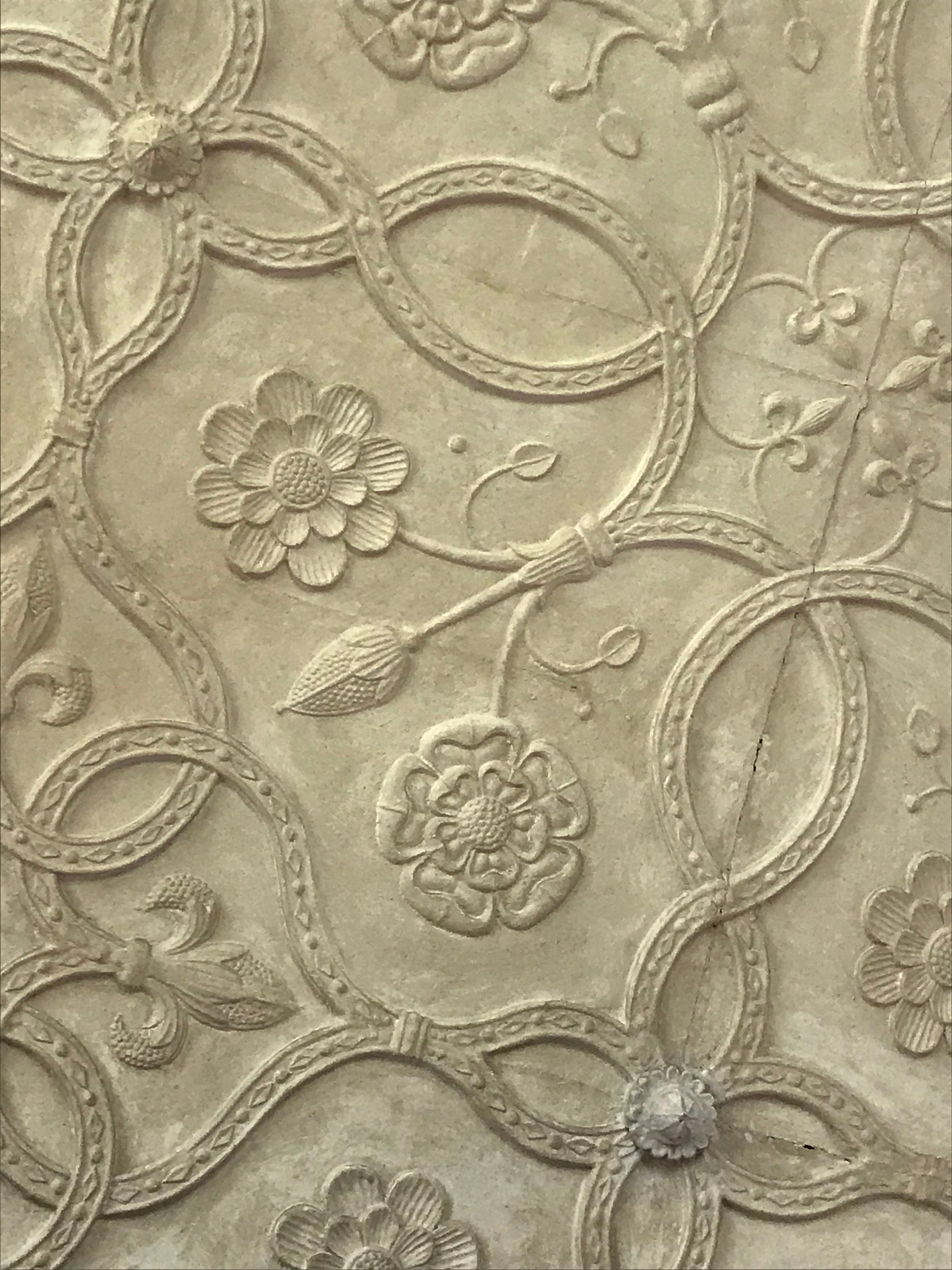
As shown above, the ceiling has a repeated pattern of fleur-de-lys, daisies, acorns, and Tudor roses. It took me nearly a half hour to isolate the exact square that is rotated clockwise to create the pattern. You can see where the four squares meet in this photo.
This woven panel is a fragment of the wall hangings that decorated several rooms, as an alternative to the expensive wood paneling and tapestries that are used elsewhere. It is a mixture of wool and linen, which provided some insulation. (The owner of Chastleton House was a prosperous wool merchant.)
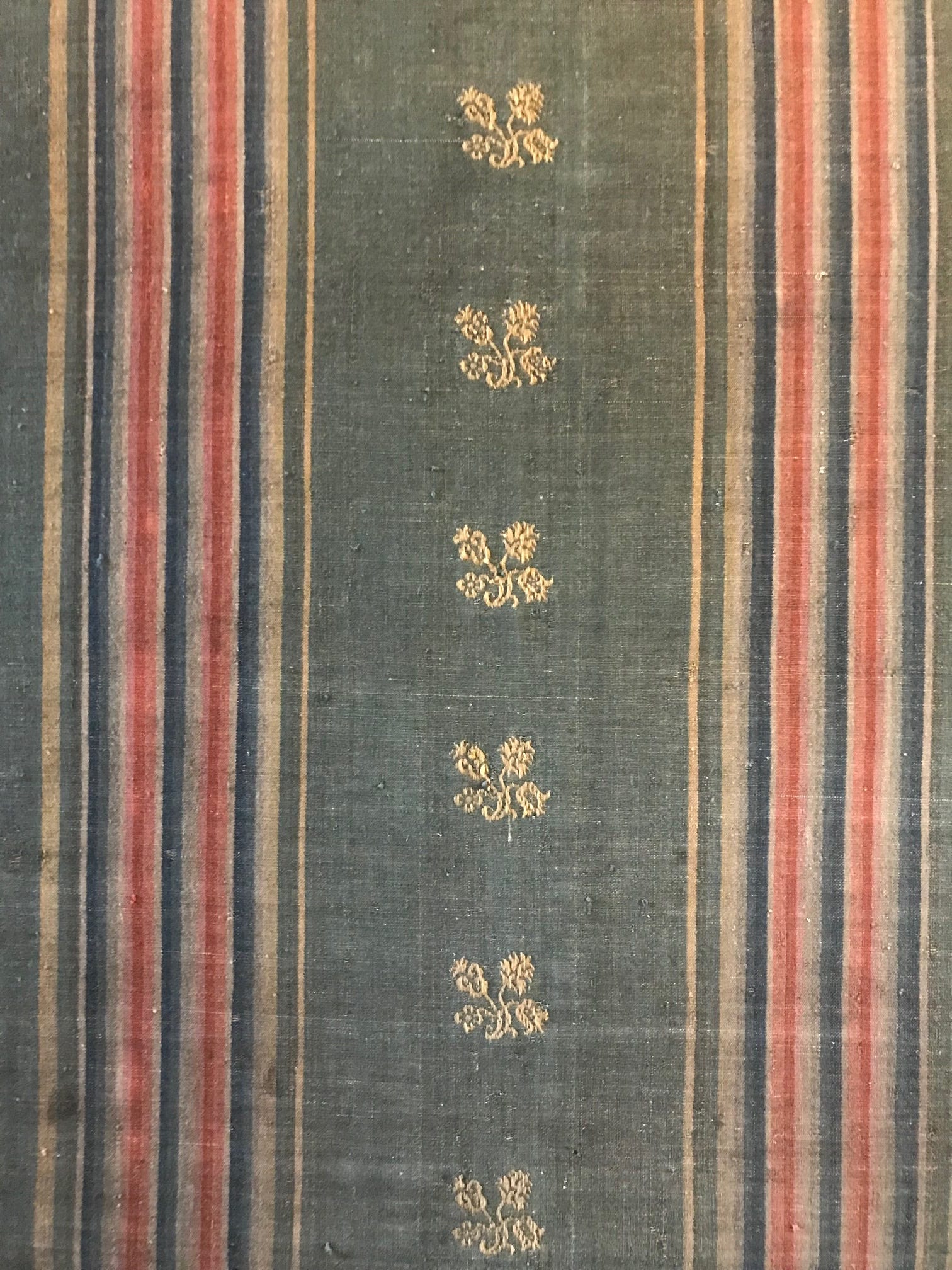
The fabric, originally more vivid, has colorful narrow stripes interspersed with a row of yellow floral sprigs.
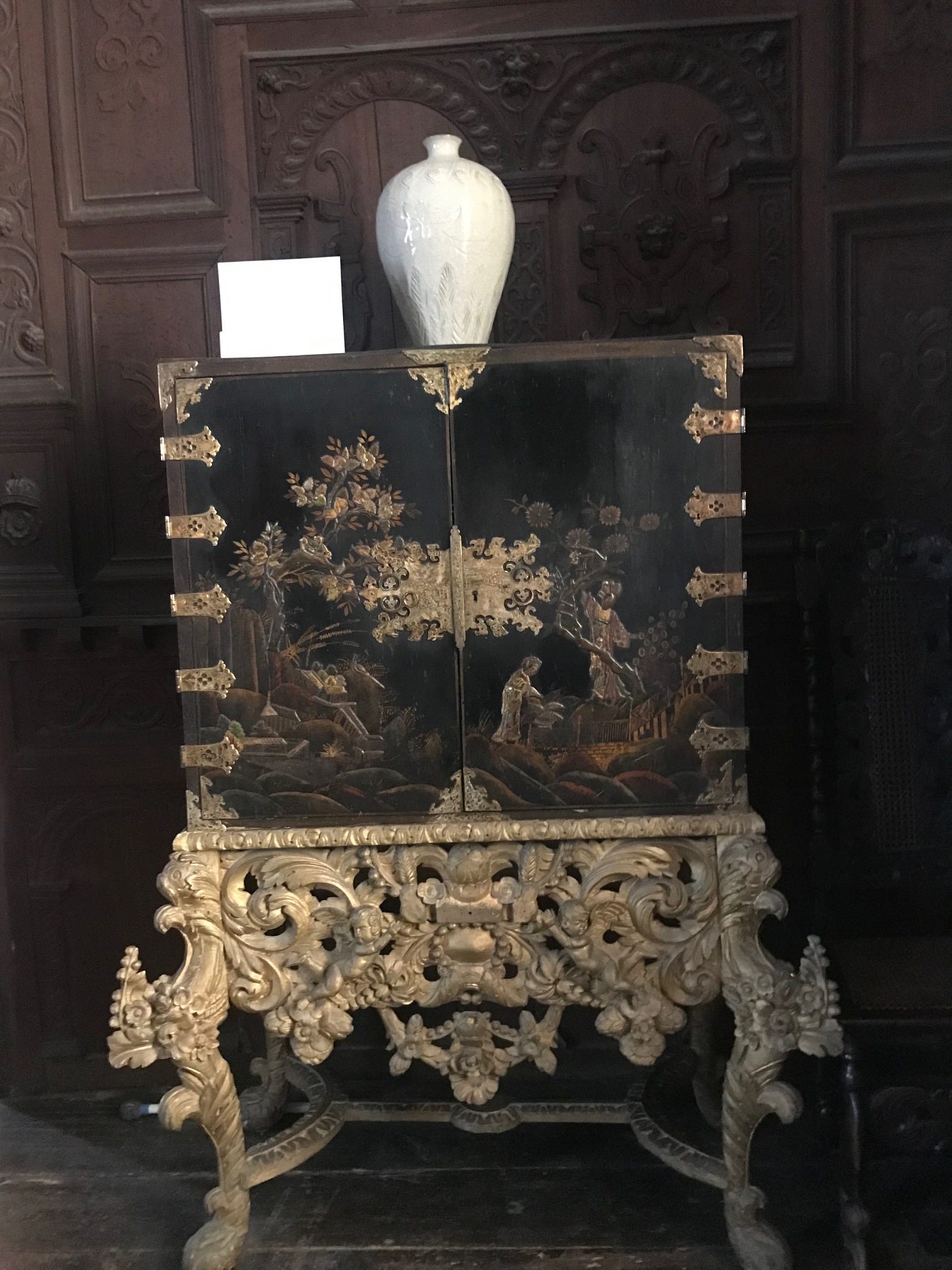
Although at first glance this looks like Japanese black lacquer, the cabinet was actually made and decorated by English artisans. The placement and size of the hardware is relatively accurate, but the scenery is fanciful without much regard for authenticity.
Depictions of flowers, plants, and trees on genuine Japanese lacquer cabinets were representations of actual, natural specimens that had symbolic meaning. Whereas, this English version shows an imagined Japanese landscape with fantastical oversized flowers.
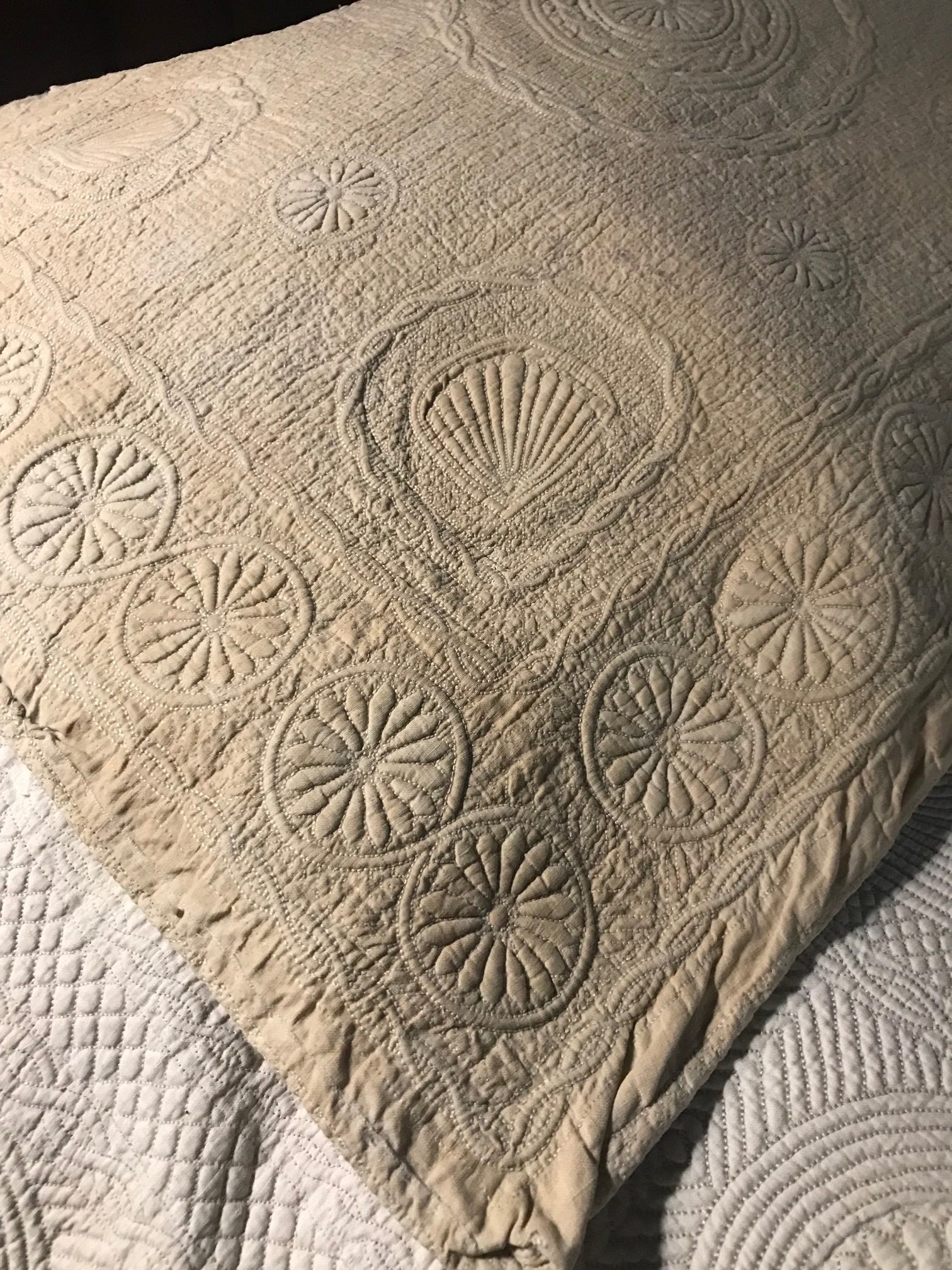
Anne Whitmore, one of the family members, spent 15 years quilting this linen bedspread with matching pillow covers. In her will, she stated, “One stitched Quilt and Pillows to the first of my daughters as are married and have a child.” As neither daughter had children, these remained at Chastleton House.
Daisies and sea shells comprise the natural motifs. A zoomed-in look at the seashell reveals 22 stitches in one line or about 264 stitches in the whole shell.
The other items in the exhibit include a portrait (c. 1680–90), book of recipes and remedies (c. 1725), porcelain tea set (1830), hand-colored print (1835), wedding waistcoat (c. 1850), and still life painting (c. 20th century).
While the use of natural imagery on ceilings, wall coverings, bed linens, furniture, dishes, and clothing is a helpful overview of our domestic decorative relationship with nature, this is just a simple example of the relationship between humans and nature that I want to highlight in this post.
“Inspired by Nature” is a theme that gives the curators an organizing principle to highlight 10 unrelated objects in a collection.
Nature can be used as an organizing principle for people as well, for example, the World Wildlife Foundation, Rainforest Alliance, and Nature Conservancy. In a broader sense, nature is the organizing principle of the environmental movement and climate change initiatives.
The key idea for today is: Humans use nature as an organizing principle.
Thank you for reading today’s post. This is a new direction for my writing, and I hope that it will be an interesting exploration and provide inspiration for your creative work.
The information in this paragraph is from Ian Mortimer’s Medieval Horizons: Why the Middle Ages Matter (2023). This is a very readable book that seems to be something of a rebuttal of Yuval Harari’s comment in Sapiens that if a peasant in 1,000 AD fell asleep for 500 years and woke up in 1500 that the world would have seemed quite familiar.
Chastleton House is a National Trust property near the Four Shires stone, where Gloucestershire, Warwickshire, and Oxfordshire come together.
Comments
Nothing yet. Say the first thing.
Sign in to join the conversation.