
Source: Teomancimit - Own work, CC BY-SA 3.0, https://commons.wikimedia.org/w/index.php?curid=17377542
On the early part of our journey to explore the relationship of humans to nature, we will be relying on archeological studies of specific sites—so, this will somewhat define where we are going. Later, I will supplement the artifacts with stories from written sources, which we must assume are interpretations of experience—and not necessarily the truth or at best partial truths. This is not a problem. What we are exploring is every possible relationship (real or imagined) that could exist between humans and nature.
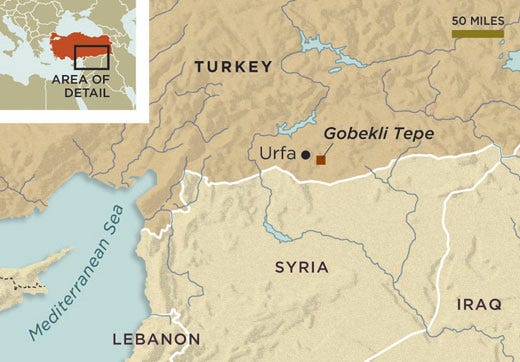
The title “Under the Magnifying Glass” refers to the fact that I am using two lenses to look at the world (as opposed to a Big Picture overview). One lens is: What does this tell us about the relationship between humans and nature? The other lens is: What does this tell us about the relationship between humans and animals? There are more than one hundred Neolithic sites around the world (a quarter of which are in East Asia). If the magnifying glasses show nothing (e.g., a Neolithic site with plain pottery), I move on. As a result of my preliminary research, I have selected two Neolithic sites: Göbekli Tepe (9,000 BCE) and Çatalhöyük (6500 BCE). They are both in modern-day Turkey, or Anatolia (as it was known in ancient times).
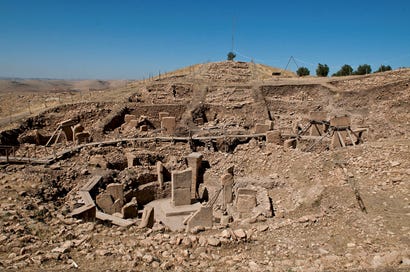
Göbekli Tepe (9,000 BCE) is one of the oldest Neolithic sites.
Source: By US gov - US gov, Public Domain, https://commons.wikimedia.org/w/index.php?curid=7029743
Humans lived on the planet for thousands of years before they began to create settlements. If we start at the point where humans first create communal areas of living, we are at the place where humans begin to differentiate themselves from their natural surroundings. Or to put it another way: there was a time when humans were at one with nature just as wildlife is today.
It now appears that the reason humans gave up their hunter-gatherer lives was because of a religious idea. The story goes like this:
Certain geographical locations were seen as holy sites.
In 9000 BCE, a few Neolithic hunter-gatherers had the idea to build some round Stonehenge-like temples on the holy site at Göbekli Tepe.
These humans had to live near the temple while building it.
Other migratory hunter-gatherer groups wandering by saw what was happening and decided to join the party so to speak.
After the temple was built, they wanted to remain there because it was actually pretty fun hanging out with other humans, sitting around a fire in the middle of a stone circle.
But they needed to figure out a way to supply themselves with snacks that were not scattered around in a twenty-mile radius; so, they developed agriculture and domesticated animals.
That’s where things become more complicated because nature (or some aspect of it) was most likely the god or gods for whom they built the temples. So, you might say that the separation of humans from nature starts at the point where humans begin to view the natural world as divine. Göbekli Tepe marks the beginning of a very long period where nature is viewed as divine. This is a relationship with nature that we will be tracking through the Bronze Age and across civilizations.
Very recognizable images of animals appear as stone carvings on the pillars at Göbekli Tepe. They include images of tusked boars, wild cattle, foxes, leopards, cranes, waterbirds, scorpions, spiders, snakes, and a strange fanged creature that cannot be identified. Particularly striking is an image of a large vulture. There seems to be some intention behind these carvings, as one animal is more prominent than the others on each pillar. The prominent animal may be a way of identifying the people who built that part of the temple or it may indicate a sanctuary for a particular animal deity (e.g., the vulture god). In any case, we have evidence at Göbekli Tepe that Neolithic humans chose to make representations of a selected group of animals and insects. Why these animals and not others? I don’t know . . . perhaps that will be revealed over time. We can also assume that the Neolithic sculptors had actually seen the animals that they carved because (aside from one) we recognize them today.
A second thing to note about the stone carvings, especially on Pillar 56 (follow link to see the image), is the density of the animals. Fifty-five animals are closely packed together on that one pillar. This raises some questions: Was the Earth teeming with animals in the Neolithic period? Were animals so dominant, plentiful, or frightening that plants and other natural phenomena were not noticed? The strangeness of Pillar 56 becomes evident when you juxtapose it with the present. Can you think of any modern-day images that contain fifty-five animals (Graeme Base’s Animalia, perhaps) or how often do you see a diverse range of wild animals and insects depicted in modern architecture or on household goods?
Aside from stone carvings, something else is going on. Archeologists have found large quantities of animal bones at the site. These are not the bones of domesticated animals. It appears that either a great number of animals were sacrificed for religious purposes, or alternatively, they were used for consumption by the people who built the site. I don’t think that we can escape the fact that humans have been killing animals as far back as 9000 BCE (and likely before that).
We should be heading out now. Our next destination is 220 miles west of here and 2,500 years in the future.
Comments
Nothing yet. Say the first thing.
Sign in to join the conversation.