
Source: Omar Hoftun, CC BY-SA 3.0 <https://creativecommons.org/licenses/by-sa/3.0>, via Wikimedia Commons
One thing I learned while researching Çatalhöyük (in modern-day Turkey) is that encyclopedias, textbooks, and lectures on Neolithic archeology are not helpful for the question I am asking. For example, this is what they will tell you:
We don’t know the actual name of Çatalhöyük because this settlement was abandoned before writing existed.
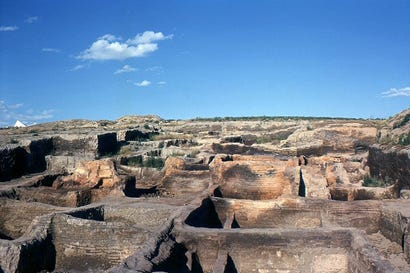
At the site, there are 160 houses, which are separated by spaces so small that you cannot walk between them. (In fact, the spaces in-between houses were filled with “midden”—a nice word for garbage.) There are no streets or alleys between the houses (see the picture above).
The walls are made of mud brick and timber, which was plastered on the inside and decorated with murals.
Removing the core of a tomato does not tell you much about a tomato. But a close examination of the core might reveal deeper truths about life and connection.
To answer my question, I need to put a specific detail about Çatalhöyük under the magnifying glass: NONE OF THE HOUSES HAS DOORS OR WINDOWS. They were entered through a hole in the roof.
Humans need shelter from nature: from cold, heat, wind, rain, insects, and animals. Nature is a potential source of physical discomfort or even death. So, for 8,600 years, we have been building shelters for ourselves. The need for protection is perhaps the most fundamental relationship we have with nature.
Humans are afraid of wild animals. A shelter that is only accessible from the roof would be safe from wild animals, and the inhabitants could walk around on the roofs to visit neighbors and carry out communal activities without fear.
Aside from the lack of windows and doors, what other evidence do we have that humans were afraid of wild animals? The archeologist James Mellaart examined a half-dozen protuberances sticking out of the interior walls of a house at Çatalhöyük. When he dislodged them, he discovered that they were the tusks and lower jaws of wild boars that had been stuck into the wall and plastered over. I can imagine a proud homeowner bragging to his neighbor as he gestures toward the tusks sticking out of the wall: “See, I told you the walls were strong. Not even a herd of wild boars can get through it!” As well as the tusks of wild boars, Mellaart found vulture skulls and bear claws protruding out of walls, as well as the teeth of foxes, weasels, and mice (who must have been trying to gnaw their way in). I am sorry I don’t have a picture of this.
The main theme of wall paintings at Çatalhöyük is wild animals. In the table below, the first column shows the percentage of each type of animal found in the wall paintings, the second column shows the percentage of animals that appear in reliefs (i.e., plaster-sculpted figures attached to the wall and often painted), and the third column shows the percentage of each type of animal found in actual bone fragments. At the time this table was made, 24,190 bones from the site had been analyzed.
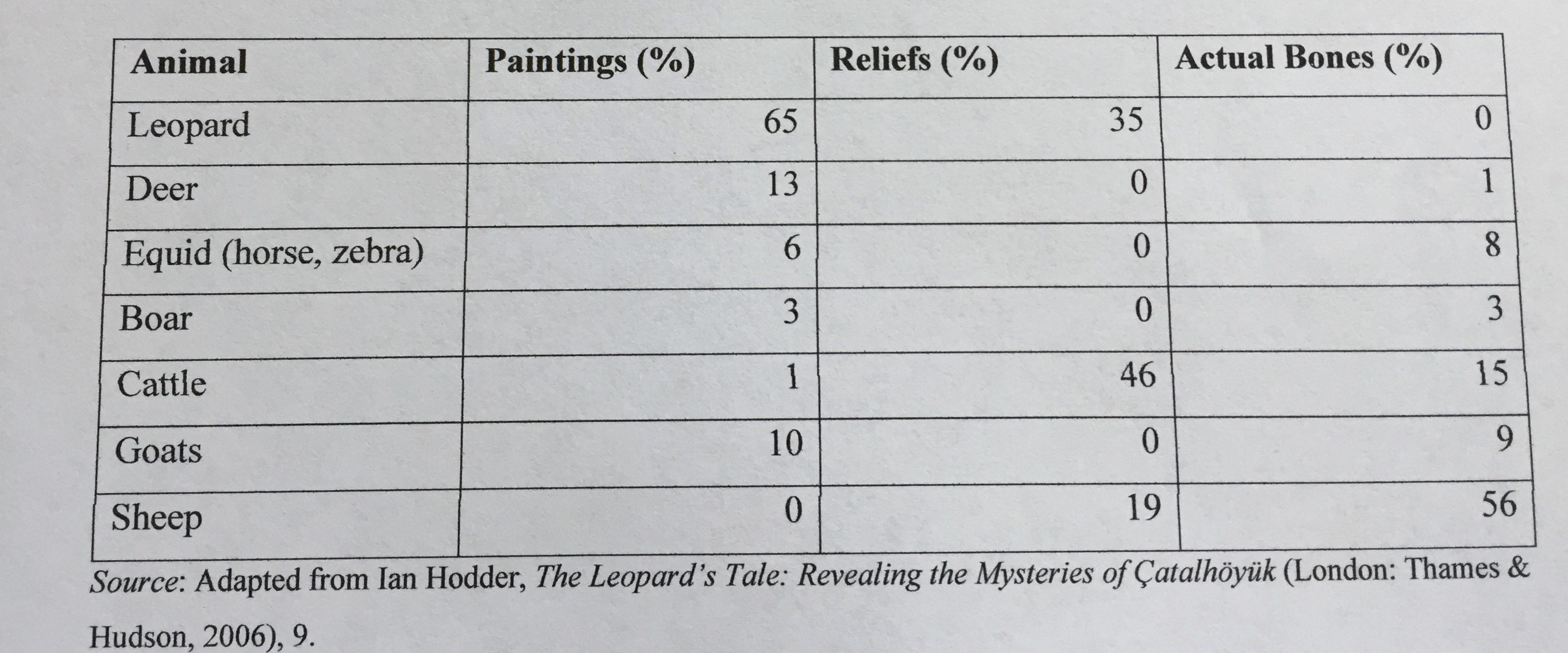
The sharp contrast between paintings of wild animals (but few or no bones) and plentiful bones from sheep and goats (with few or no images) places Çatalhöyük in the midst of the process of animal domestication. The wild animals are shown in paintings and the domestic ones are not. The animal that they are trying to domesticate seems to be cattle.
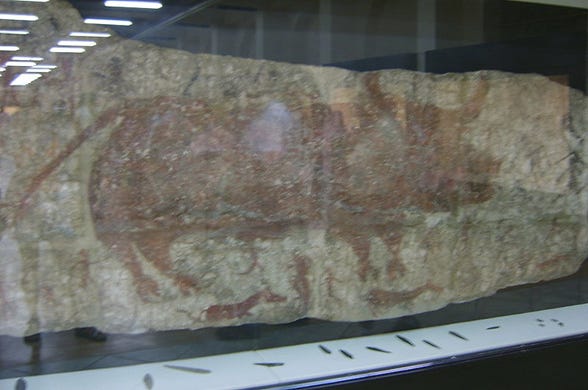
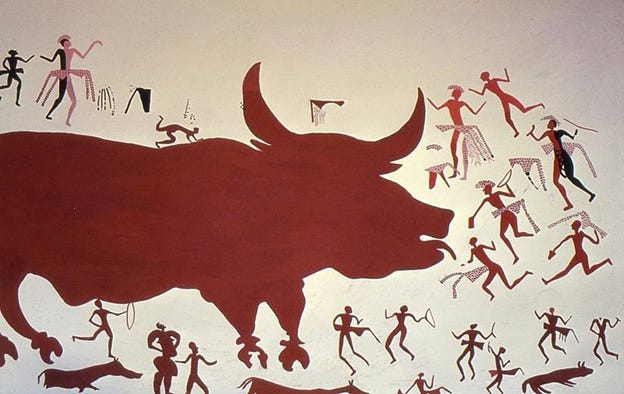
Analysis of the chemical isotopes in human bones from Çatalhöyük shows that cattle were not a major part of their diet. The cattle also do not show up in the paintings (with one exception that I will discuss shortly). However, you will notice in the middle column that cattle make up the largest percentage of the reliefs, and they also appear in decorative installations (image of cattle decoration). The semi-domesticated status of cattle is best depicted in this wall painting.
Source: Stipich Béla, CC BY-SA 3.0 <http://creativecommons.org/licenses/by-sa/3.0/>, via Wikimedia Commons
Source: Omar Hoftun, CC BY-SA 3.0 <https://creativecommons.org/licenses/by-sa/3.0>, via Wikimedia Commons
The central figure is a large auroch, standing calmly with its tongue stuck out. Just below the auroch are two figures standing between two horse-like animals. The larger female figure with her hands on her hips (possibly a mother figure) provides the scale for the rest of the figures in the painting. These are not small men attacking a giant auroch—they are children or young adults playing with it. One child touches its back leg, another touches the tail; one is even riding the auroch. They are leaping and dancing around so fast that their leopard-skin loincloths are standing straight out or even falling off (something like taking off your shirt and waving it around your head when your team wins). Their arms are raised above their heads, cheering as if to say “Yes!” The wild auroch has been tamed.
The Neolithic world is becoming a safer place. But what does domestication mean for animals? We will take this up next week when we enter the Bronze Age. The territory ahead has five main areas that will become the wellsprings of civilization: China, the Indus Valley, Egypt, Greece, and the Near East (also known as Mesopotamia). The invention of writing adds to our source material, but the insane complexity of the tribal groups in the Bronze Age may take a while to untangle.
Comments
Nothing yet. Say the first thing.
Sign in to join the conversation.