
In a previous post, I wrote a largely tongue in cheek critique of the Build Now Act. This post is the easy synopsis for those looking for highlights. This post represents my personal views, and my personal view, succinctly, is that no reasonable person can possibly vote for the Build Now Act as it stands.
I want more housing built. I want more urban housing built. I want housing supply restrictions removed. But the Build Now Act accomplishes none of these things, even as it implements an unjust and bizarre transfer scheme.
The map below represents the main point I want to make. This map is, to the best of my knowledge, the actual, correct map of how much money each state can expect to gain or lose if the Build Now Act becomes law. The raw input data for it was produced by Salim Furth, then I applied the benefit calculations as they exist under present law, and applied the disaster-area exclusion rule Salim had not considered. Any errors in the below are mine and mine alone. I have no idea if Salim agrees with my views here or not. But you should trust this map as being relatively credible, because the people who made the data for it both have extensive track records working on housing policy, and there is not any more accurate map currently available.
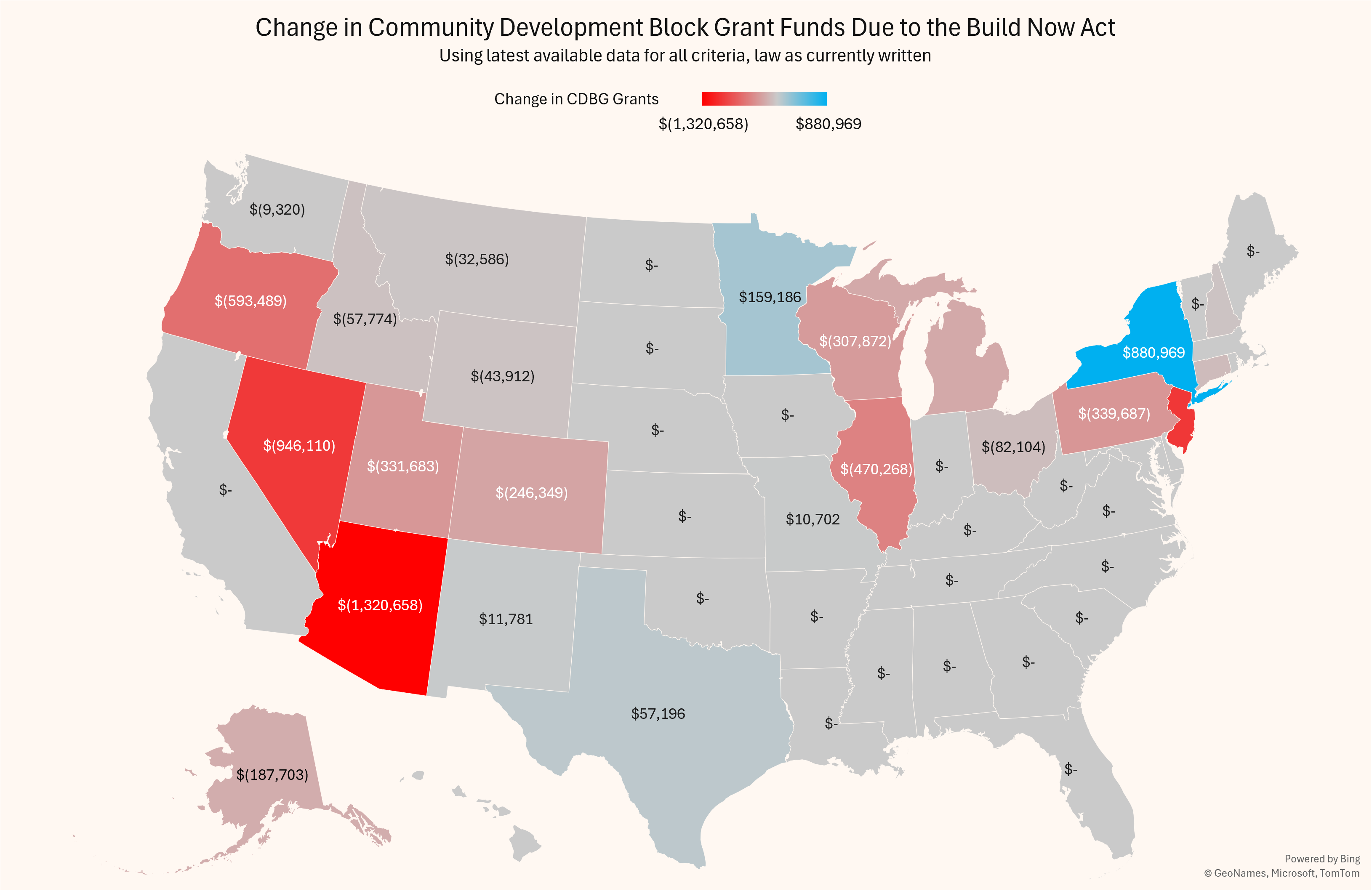
Of the $2.3 billion in CDBG grants covered by the relevant overarching program, a paltry $7.5 million will be reallocated. However, some cities will experience large changes.
These 65 cities will all lose 10% of their CDBG entitlement funding:
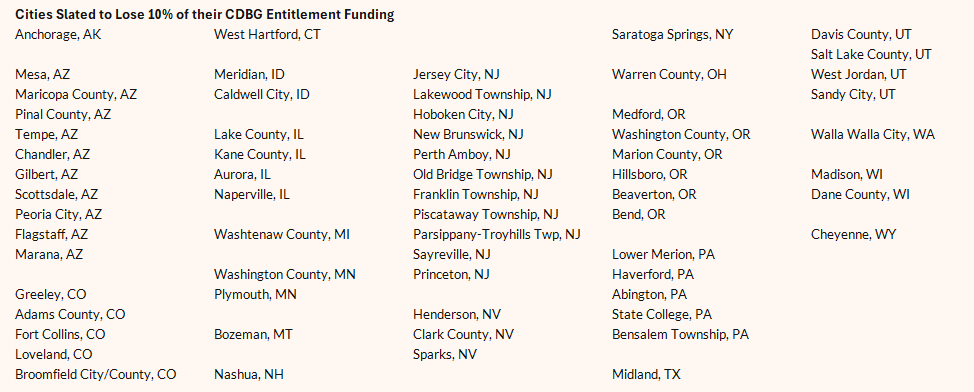
As you can see from the map and the list, Arizona, Colorado, Illinois, New Jersey, Oregon, and Pennsylvania are all rather hard hit.
Why does Build Now have this effect?
The reasons are several:
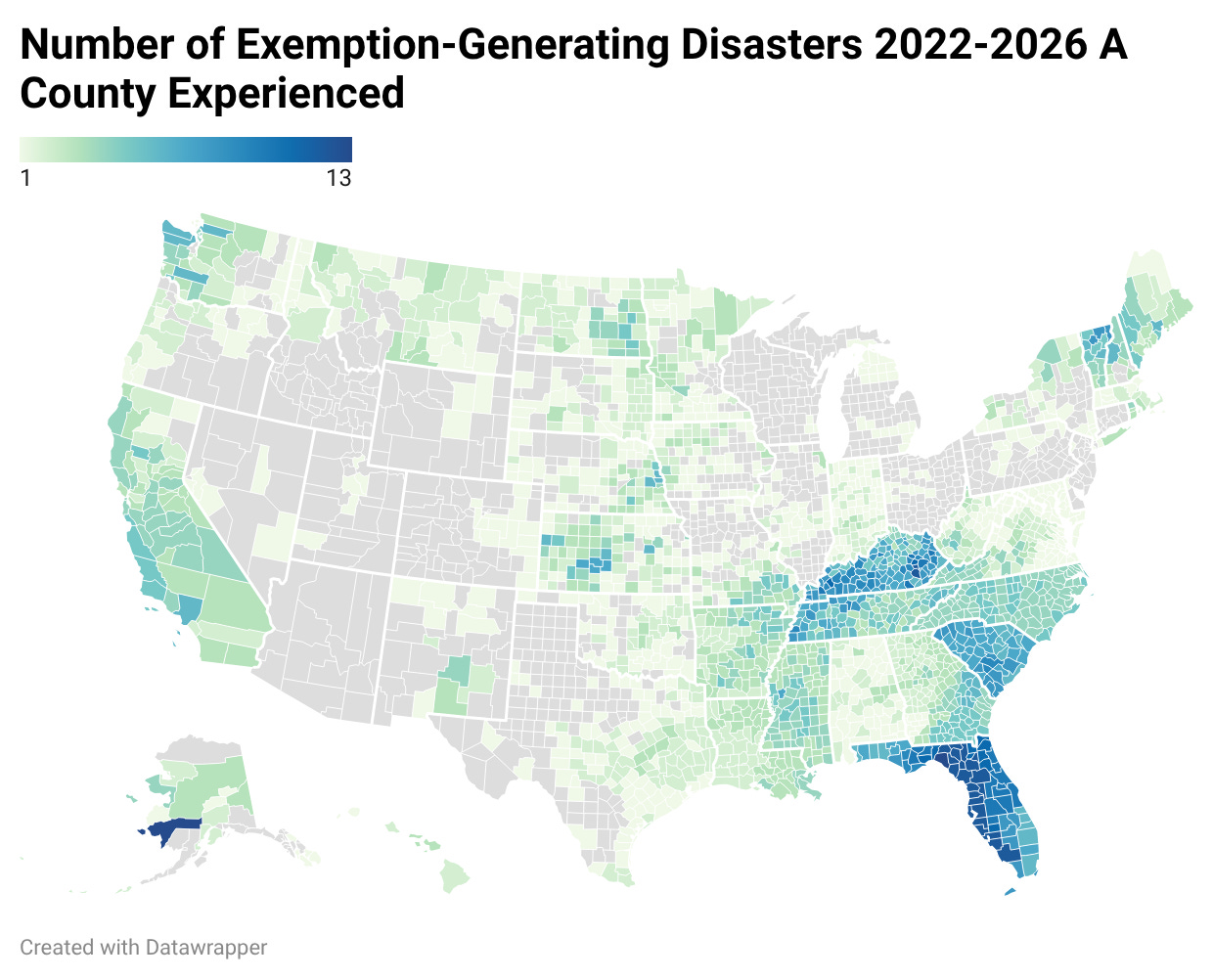
All counties with any section 401 or 501 disasters in the last 5 years are exempted. Here is a map of counties with 401/501 disasters in the last five years. As you can see, this rule exempts the entire southeast, most of Tornado Alley, much of the northeast, and virtually the entire west coast.
Penalties for harmed localities are capped. No municipality will ever owe over 10% or over $1 million. This means that municipalities with very bad housing supply don’t actually face big nudges to do better. Meanwhile, bonuses are not allocated on the basis of housing construction! Bonuses are given to localities based on raw number of houses in the locality instead of actual houses added! This gives an enormous advantage to larger municipalities like New York City.
Counties are exempted if their rental vacancy rates are high. That means that expensive vacation destinations are exempted, since seasonal-use is included as a kind of vacancy. Ski resort towns are often exempted for exactly this reason, despite having extremely high housing costs and constrained supply. It is unclear what policy goal is served by protecting block grants for ski resorts.
Additionally, counties are exempted if their housing costs are low. This is a strange feature of the law: if a city actually succeeds at lowering housing costs, they are kicked out of the program and no longer eligible for bonus funding. Bonus funding only goes to cities that add houses, but aren’t actually affordable. States that are genuinely affordable simply are not even considered. This does protect those states from losing funding, but cheap places would, if included, mostly receive bonuses; the net effect of excluding affordable places from inclusion is to harm states with low housing costs.
These four features combine to create the absurd map I showed above. I should note that the single largest bonus payout, $910,000, goes to New York City. Only 8 places have bonuses over $50,000. They are: NYC; Phoenix, AZ ($163k); Fort Worth, TX ($97k); Denver, CO ($86k); Du Page County, IL ($78k); Las Vegas, NV ($70k); Hennepin County, MN ($68k); Minneapolis, MN ($53k). On net, even though Phoenix gets money, Arizona loses, because many Phoenix suburbs lose money.
The bill has many other problems. Its formula for identifying eligible jurisdictions using a change-in-change quotient is needlessly complex, and often takes money away from cities that are adding housing and gives it to cities that aren’t adding housing. Some of the data inputs are not currently available at the legal entity level and must be inferred from ZIP-code approximations. Historic data in particular is problematic and must be guessed at. The sums of money involved are paltry, yet the mechanism implemented is seriously concerning, especially if it were ever scaled up.
My personal view is that based on this information, Congress should make major revisions to the Build Now Act before passage, or write an entirely new act. In particular, Senators and Representatives whose districts include penalized areas should consider whether this bill is actually in the interests of their constituents. Are your constituents helped by sending a million dollars to New York City? Do you really believe penalizing a suburb to the tune of $6,500 is going to accomplish housing reform? Does it really make sense to exempt the entire state of California and the entire southeast?
Before voting, legislators should seriously consider these issues.
No posts
Comments
Nothing yet. Say the first thing.
Sign in to join the conversation.