
UPDATE: Some friends and colleagues found some errors in this! I love colleagues who do this! You rock! I have put responses and fixes in italics but have retained my errors for posterity, that all may know that Lyman is sometimes a dumdum. The core thrust of the piece is correct, however. Also, a quick note, I worry some readers will not get the joke on this piece, so I refer you to my classic piece explaining Why I Am So Mean. Public discourse is professional wrestling, and somebody has to play the villain.
Congress has been debating a housing bill for a while. The bill has a lot of good stuff in it, such as an incredibly long-overdue fix to regulations for manufactured housing.
But it has within it a paradigmatic example of how the cognitive abilities of America’s elite are in steady decline, and that is the Build Now Act (pages 55-63), a bill so inane and stupid it boggles the mind that anybody wrote it.
In this post I have attempted to do the math to show you how stupid this bill is, but the math is actually such an impressive combination of stupid, complicated, and dependent on nonexistent data, that I actually cannot even show you how bad the bill really is. It’s likely that if passed, HUD will end up failing to actually enact the law, since it depends on a configuration of data which does not exist.
I hate this law for two reasons.
I loathe incompetence in general
It is actually an extremely good idea somebody just mangled into a horrible nonsense bill. I feel about Build Now the way the Valar must have felt when they saw what Morgoth had done to twist elves into orcs. I feel the way Obi-wan felt right before slicing off Anakin’s little legs. I feel like Caesar to Brutus. Mais je vais être frénétique et fulminant ! Il me faut une armée entière à déconfire ! J’ai dix cœurs; j’ai vingt bras; il ne peut me suffire de pourfendre des nains… Il me faut des géants !
Build Now is built around one very good, simple idea: the Federal government can in principle incentivize jurisdictions to compete on housing supply and deregulation by simply reallocating Community Development Block Grant funding away from cities that are, well, not developing, towards cities that are developing. Modestly reduce funding for cities not adding housing, give it to cities adding housing. Easy, peasy!
This is a really good idea. I love this idea. I want this idea to be law. Scholars of American land use have been batting around versions of this idea for decades, though usually in a very hypothetical “what if we could…” kind of way.
So let me be clear. The reason I gag and spit when I hear the Build Now Act mentioned is not because I’m ideologically opposed to it. Nor is it, on the other hand, that I am an extremist who thinks it “doesn’t go far enough.” The reason I would like to see the bill repurposed as Congressional toilet paper is because I think it is, technically, substantively, in terms of process and implementation, idiotic, deceptive, and incompetent. That’s it, just that.
Slam the share button on that line.
Suppose you wanted to reward cities for building houses using CDBG money. How would you do this?
Simple: cut general CDBG funding by ~5% or ~10%, and take that amount and put it in a fund called the “Please Just Build Houses You Sickos” fund. For every housing unit completion a municipality reports in the Census Bureau’s/HUD’s relatively complete data of housing completions, you’d give the municipality some share of the set-aside funds. So if America build 3,000,000 houses that year, and your town built 500 of those houses, you’d get 500/3,000,000 of those dollars.
That would be a super simple way to reward municipalities for allowing housing.
That is not what Build Now actually does. You need to realize that something like the above is the concept on which Build Now is constantly trading and claiming credibility. But that is not what it does. Oh no. It does something nuts.
The first step is in covered status.
See, Build Now does not apply to all places. Cities with fewer than 50,000 people are excluded entirely. So are all areas that aren’t cities. Of the ~340 million people who live in America, only ~135 million live in places that are even covered at all by Build Now. So right off the bat, we’ve excluded the vast majority of American land, population, and jurisdictions from being included at all in a plan to increase housing. Ultimately, we are only considering highly urban locations. Build Now exists exclusively to promote urban housing projects; and when I say urban I don’t even mean like “metro area,” no I mean central cities and large municipalities.
UPDATE: I was incorrect here in the details, but in practice more-or-less correct. The law says metropolitan cities and urban counties then refers to a federal register notice about metropolitan cities. I missed the “and urban counties” bit. However, the vast majority of counties are not “urban counties,” since urban counties must 1) be in a metro area, 2) have over 200,000 people excluding people who live in municipalities. This is a kind of eccentric category; being in an MSA, with 200k people living outside of otherwise covered municipalities, is a pretty narrow slice. As a result, a piddling 17% of all CDBG funds go to the “urban counties,” and as you’ll see below, urban counties are basically yeeted out of the program through other gimmicks. So, technically, I was wrong— but in terms of actual dollar bills and final program rules, I was like 94% correct, which means I get an A, and the haters and losers can sit down.
But… it actually gets crazier!
Once we have defined the “Covered Recipients” as above (metropolitan cities >50k), we then have to subset those into “Eligible Recipients”. Some cities are “Covered” but not “Eligible” for the program.
What makes a city “Eligible”? They must pass five different criteria:
The city must have “Small Area Fair Market Rents” above the 60th percentile observed among Covered Recipients. Basically this means the Build Now Act only applies in urban areas in the top 40% of housing costs.
The median home value must also be above the median for the United States. In practice this requirement is pretty much duplicative with #1; same basic story here: only expensive places.
The annual vacancy rate must be lower than the national average: so if a bunch of units are vacant, no dice. I want to mention here, “vacancy rate” is a bizarre term to throw out here. “Vacancy Rate” is not defined in the actual text of the law.
The city must not have any recent disaster designations applied to it.
The city cannot have restrictions on its ability to zone and issue building permits.
Briefly, I’m going to point out some big problems in these eligibility rules, before getting to the true craziness.
Criteria #5 is a wild stalking horse.
If a state pre-empts local zoning and established zoning rules by state law, a sufficiently trollish administration could say that renders the municipality ineligible.
If a municipality doesn’t have zoning, an administration could argue that this renders the municipality ineligible.
Imagine YIMBYs take over Connecticut and remove all zoning authorities from municipalities. Suddenly, all Connecticut municipalities would be entirely exempted from any penalties for not producing housing! They would no longer be eligible for inclusion because they aren’t zoning authorities!
The question is how much state pre-emption would be enough to trigger this condition. I don’t know the answer to that, the law doesn’t spell out an answer to that, ultimately it will depend on if a future President wants to screw around with YIMBY state-pre-emption or not. If a future president decides YIMBY state pre-emption laws are stupid attacks on exurban McMansions, a future president could just blanket exclude all states with pre-emption laws from this program, which would tend to hurt YIMBY places because YIMBY places may anticipate having higher housing growth.
So this “zoning eligible” rule is funky.
Also, you may be saying to yourself, “I wonder where I can find a list of legal entities in the U.S. able to promulgate zoning rules and/or issue building permits.” The answer is, you cannot. The Census Bureau’s building permit survey catalogues 19,000 permit-issuing entities around the country— but many of them are not cities of the kind included in the Build Now Act! They are townships, counties, or other entities! And crucially, that source doesn’t have anything about zoning authority. The National Zoning Atlas catalogues 33,000 entities that engage in some kind of zoning or land use regulation. I suppose a very clever person could probably merge those lists, but this law lowkey orders HUD to produce a new dataset of “authorities which both issue permits and have zoning rules.” Such a dataset doesn’t presently exist, and if it did, the question of “Is Houston eligible?” would be statutorily vague, since Houston doesn’t have zoning. Whoever wrote this section just didn’t think about what they were writing. (Fun sidenote: by my calculations below, Houston is not eligible for Build Now, because Houston has affordable houses, and places with affordable houses cannot get benefits from Build Now. Moreover, Houston has had natural disaster emergency declarations applied to it many times in the last 5 years, which would also exempt it, if I read the law correctly).
UPDATE: I want to emphasize how this rule is a massive question mark. Above when I flagged urban counties being included— many such counties have no zoning authority! Many counties in New England and Texas just have no zoning authority, so despite between CDBG urban counties, they would seem to be booted out of the program. I checked a couple KY counties in metro areas and several do now have zoning and planning authority; but they also don’t even have 200,000 non-city residents, so whatever. But the point is, even a lot of counties that do meet the urban county requirement may get booted by this rule.
UPDATE: This section is my biggest error, and my only excuse is I am a demented fool. The law clearly says “rental vacancy rates.” I just misread it, because I am a dumdum. So the whole section on “what if people just stopped being homeowners” is answered with “that wouldn’t matter, it’s only rental vacancies.” HOWEVER my arguments about seasonal-use vacancy are correct. Seasonal use vacancies ARE counted as part of rental vacancies. So I was totally wrong on the renter-homeowner issue, but still correct the vacancy rate stipulated is the wrong indicator.
The law says “vacancy rates.” Only places with below-average “vacancy rates” are included, “as published by the Bureau of the Census.”
Okay, what does the Census Bureau publish?
Spoiler, they don’t publish “vacancy rates” by municipality. They publish “Homeowner Vacancy” and “Rental Vacancy” rates, not a singular vacancy rate.
But in the ACS we can use microdata from the 5-year files to calculate homeowner-and-renter vacancy rates combined for all municipalities! Problem solved, right? Just order HUD to do this?
Well, no, not solved. Because first of all, rental vacancies average 7 times as high as homeowner vacancies. Places with lots of rental units will always show up as “higher vacancy” than places with lots of homeowner units. Thus, many big cities with more renters will have too high of vacancy to participate! Bonkers, right? If you make home prices expensive enough, you could shift enough of the population into renting that your overall vacancy rates rise above average and thus you are exempted from the Build Now competitive transfer program! Simple As!
Moreover, not all vacancies are actually vacant. The Census Bureau “vacancy rate” counts a unit as vacant if the usual resident is not home. This means a house that “has a usual resident, but the resident isn’t home” is vacant, it means “house does not have a usual resident, and nobody is home” is vacant, and it means “house does not have a usual resident, but somebody is home” is vacant.
“Usual residency” is where a person usually resides. Thus, for example, my wife’s family has a teeny tiny cottage up in northern Michigan. We are not usually resident there. It is “vacant.” It has always been vacant. At no point since its construction in the 1950s has it ever had a “usual resident.” But it is a property very much in active use! The whole extended family takes turns vacationing there!
Consider a city with huge vacation appeal. Maybe a beach city or something. If AirBnB purchased every single apartment and made the whole city a vacation destination, the vacancy rate would rise, because there would be no usual residents. All houses would be secondary homes and seasonal use homes. As a result, the vacancy rate would approach 100%.
This municipality would be exempted from the Build Now Act, and thus face absolutely no incentive to add homes, even though all the residents had to leave due to lack of homes after the AirBnB buying spree. Effectively, Build Now exempts places with lots of tourism from having to build houses, even though tourism often pushes home demand and prices upwards!
The Build Now Act erroneously treats “vacancy rates” as an intrinsic sign of market tightness, when in fact only certain kinds of vacancy rates are a sign of market tightness. If a town has high vacancy because lots of homes are sitting on the market with no buyer or renter, then high vacancy indicates low demand. But if a town has high vacancy because lots of homes are owned as vacation property, then high vacancy indicates high demand: that place is in such massive demand people will pay money to own houses they don’t even stay in. The vacancy rates in Vail and Aspen and Breckenridge are extremely high! Those are not low-demand municipalities!
Fundamentally, Build Now was written by somebody who just didn’t know what they were actually saying when they wrote vacancy rates into the law, and it shows.
This section is new, added in my May-15 morning update.
Notice in the law that counties hit by a disaster in the last 5 years are exempt.
Here’s a map of every county which qualifies for an exemption under the disaster rule as of today:
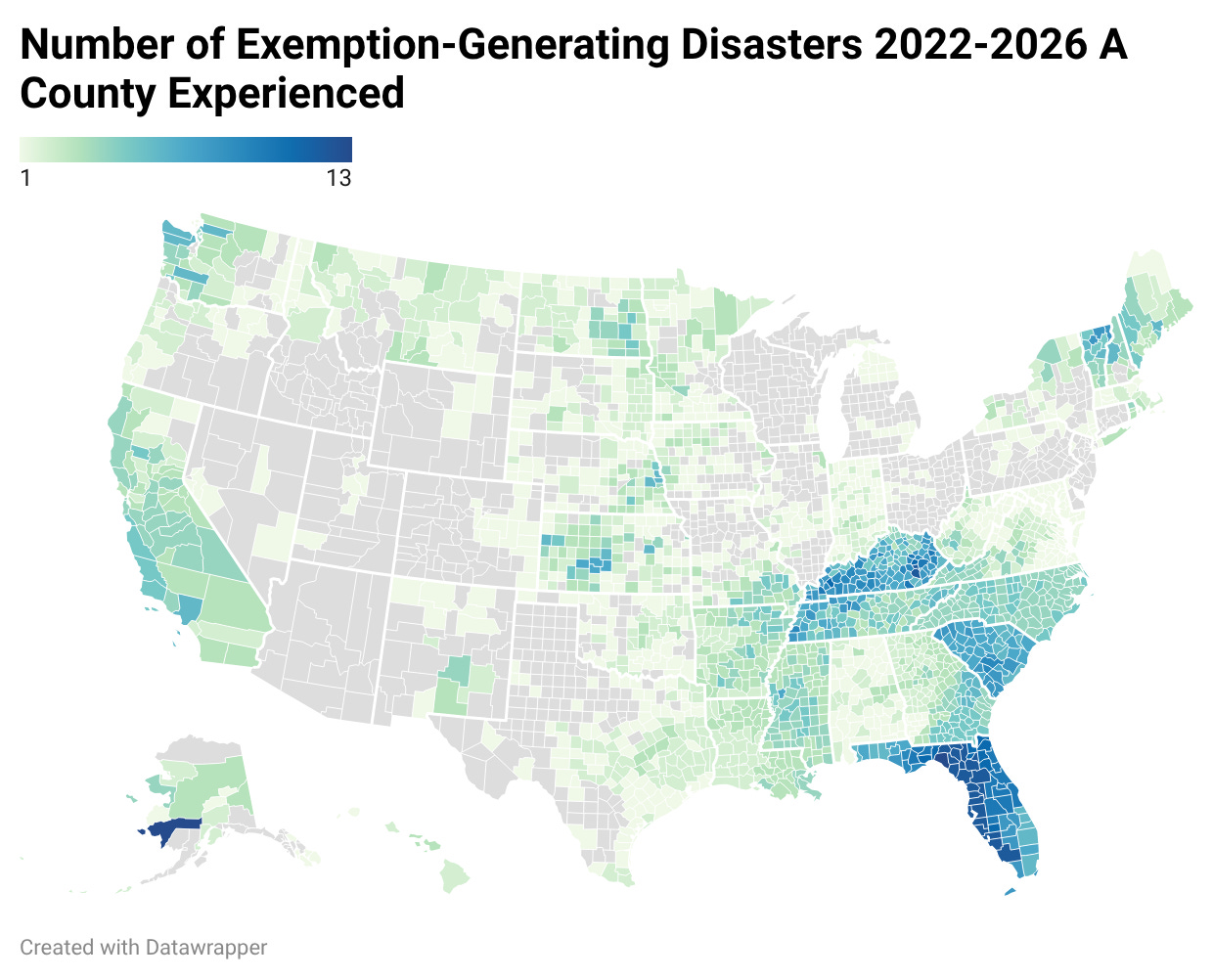
As you can see… it’s most of the country, including the entire state of California!!! Had a drought recently? LOL, you don’t need to build houses! Did a wildfire burn down a neighborhood? NO PRESSURE TO BUILD HOUSES! Tornado destroy a town? You’re in luck, we won’t ever ask you to build any houses!
I mean look at that map! Ask yourself, what expensive cities aren’t covered?
The answer is New Jersey. That’s it. This is a law which will reshuffle funds around Pennsylvania, Connecticut, New Jersey, and Delaware.
The thing to realize is the existence of CDBG-Disaster Relief supplemental funding already gave states extra motivation to lobby for disaster treatment. Making the basic CDBG program itself also disaster-contingent is just idiotic.
And at the end I’ll reveal that I have a way to solve this to help cities that actually lose houses in disasters, without punishing non-disaster zones.
Never let scholars write laws. It’s always a mistake. Only lawyers should write laws. I’m not even joking about this. Scholars just don’t have an adversarial enough approach to realize how bad the laws they right are. Not that I’m suggesting one specific highly esteemed housing scholar may have been deeply personally involved in Build Now. I wouldn’t be suggesting that. Someone else might, but I wouldn’t.
Okay, let’s ignore criteria 3-5 and set them aside; they’re tricky to get an analytic grip on and have weird definitional problems, so we’re going to ignore them. And since 1) and 2) are going to be very highly correlated, for simplicity, let’s go with just 1).
The Census Bureau tracks 19,152 muncipalities in the United States, which in 2024 were home to 214,000,000 people.
Of those, only 816 have over 50,000 residents, and thus are in our “covered sample.” Those 816 cities had 133,000,000 people in 2024.
How many of those 816 cities are eligible just based on the 1st criteria of fair market rents being over the 60th percentile?
The answer is a mere 299 cities, home to 52 million people.
The Build Now Act, then, only apples at all to 299 municipalities. Far from actually encouraging more housing around the country, it is literally only encouraging housing in 299 cities, and it does so only by reshuffling money between those cities.
Here I should mention that, using county data, the counties containing those 299 municipalities in 2024 gave Kamala Harris approximately 60-70% of their combined votes. What we are discussing here is a bill that basically asks, “How can we take money from some highly regulated blue cities and give it to other highly regulated blue cities?”
But still. So far, while there’s plenty of bad writing and weird statutory choices, you can kind of see how our original concept (“just pay municipalities to build houses”) might be working. We simply excluded all the poor, low-demand, high-vacancy, disaster-hit areas, and encouraged the expensive places to compete with each other. Sure, the method of doing those exclusions was sloppy and hackish, but in principle setting some guardrails about included jurisdictions isn’t totally crazy.
And if that is what this bill did I would still vomit a bit when I read all the drafting issues, but I would try to choke it back in the name of MOAR HOUSING.
But that’s not all it does. Honestly, it hardly encourages housing at all.
Remember our simple model? “Just give money for each new house”? Yeah, that isn’t what Build Now does.
Once we have limited to our Eligible Recipient sample of 299 cities, now the real fun begins.
First, we use the complete Master Address File to count how many postal addresses a city has today, 6 years ago, and 12 years ago. From 6 years back to today, we calculate an average annualized change in address counts. So if a city in 2026 had 50,000 addresses, and in 2020 it had 40,0000 addresses, that’s 25% growth, which annualizes out to 3.7% growth a year. Why did the drafters choose 6 years? Beats me! Do we even have this data from 6 years ago? No, not publicly! The Address Count File only goes back to 2023 on the public census website, with a supplemental file for 2020! Of course the MAF goes back further, but it’s very much not public. So we’re using a benchmark here where before passing the bill outside stakeholders have no way of knowing the central question of all legislation: cui bono. It would be nice to know in advance something like, “Wait, how many cities are actually going to get bonuses? How big will those bonuses be? Does our math actually correctly identify high-growth cities, or did we make a horrible fucking mistake and we’re going to subsidize really bad policy?” Below, I’m going to make a rough guess at cui bono, but it will be very rough due to data limitations.
Okay, anyways, so step one is the “Current Annual Growth Rate” or “CAGR,” from the prior 6 years.
Then you do the same thing again for “Prior Annual Growth Rate,” calculated from 12 years ago to 6 years ago. Of course, again, there’s not a public database you can use to check “What would this calculation look like for my municipality?” so anyone’s guess what this actually looks like in the real world.
But let’s keep our example of a city where CAGR=3.7% . Suppose the PAGR was 2.1%. So the rate at which housing was added sped up.
Well, that’s good for us, because next we calculate the HGIR: Housing Growth Improvement Rate. The HGIR is a fun bit of bureaucratic math.
HGIR=( CAGR-PAGR ) / (|CAGR|+|PAGR|)
In our example, that’s:
( 3.7%-2.1% ) / (3.7% + 2.1%) =27.6%
Cool, huh?
But what if our numbers were a bit weirder. Here’s how HGIR shakes out for any of a range of possible CAGR-PAGR pairs:
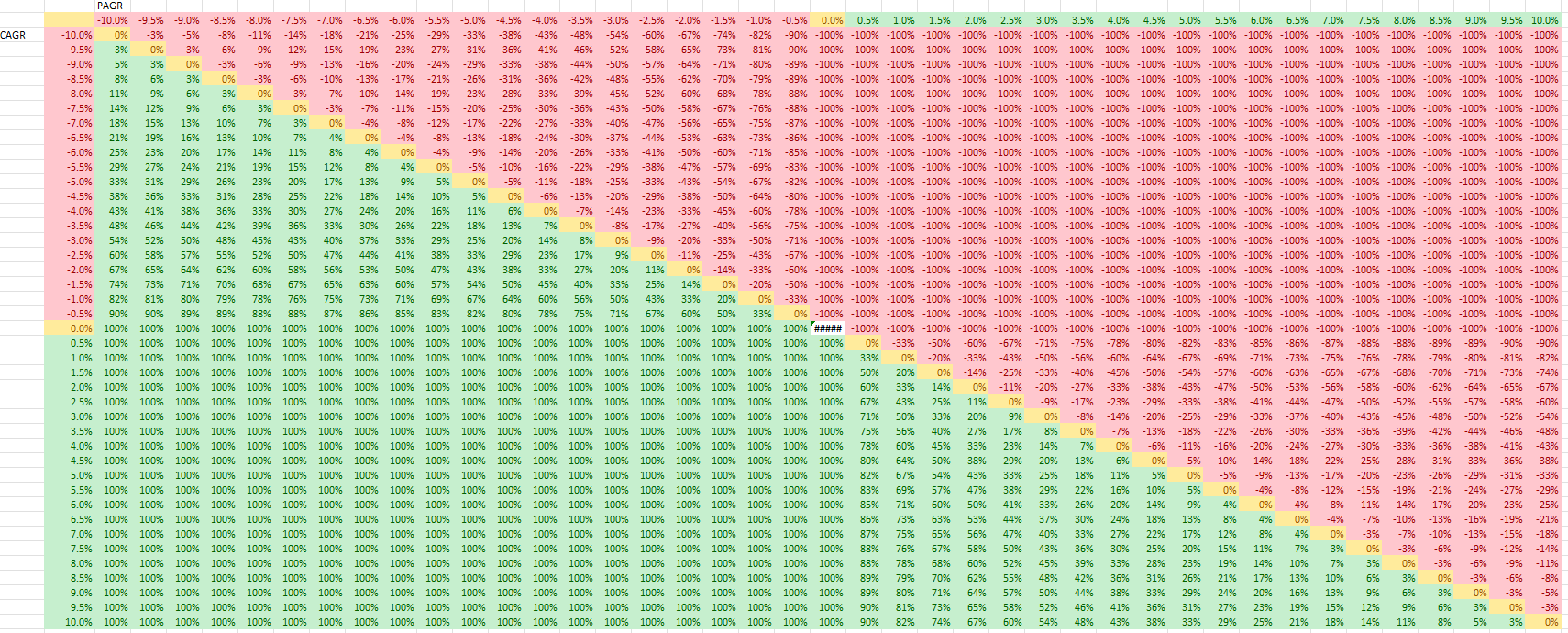
What you can see is basically this formula rewards you for improving your trajectory, but it does so even if you are literally bulldozing homes, just at a slower rate. Look in the top left. You can have a CAGR of -3%: you destroyed 17% of the houses in your town! but if your PAGR was -5% (destroyed 27% of the houses in your town), you have a HGIR of 25%, pretty good!
In fact… as I will show below a HGIR of 25% is very good. A city with an HGIR of 25% would get a big cash bonus. You can be a cash-prize-winning city while on net destroying housing, as long as you destroy houses slightly slower than the mayor before you did.
(As an aside: it’s often good for a city do bulldoze houses! If a whole street is abandoned and the buildings are decrepit, they often pose fire or crime risks and legacy utility costs. Destroying them is often wise. But doing so can cause them to drop out of the address file. The Build Now Act would incentivize cities to keep decrepit houses around for longer)
Okay, but what is HGIR for?
Cities with CAGR>4% are set aside as “high growth rate cities.” For the remaining cities, we find the MEDIAN HGIR; so basically we’re taking the median HGIR of a negatively selected group, giving high-growth cities an automatic pass and reducing the median threshold for the remainder.
Once we find the median HGIR, we check for every Eligible Recipient if they’re above/below. HGIR above median? Cool, you get a bonus! HGIR below median? Sorry, you lose either 10% of your Community Development Block Grant funding OR $1,000,000, whichever is less.
Sidenote: The $1 million cap on the penalty is hilarious. It’s basically a “Protect the Big Cities From Real Competition” rule. As you will see below, there is no limit on how much money this program will give to big cities. But there’s a limit on how much we will take from them, because this program is just a subsidy to pour more money into big cities.
But what if your HGIR is above the median?
Here, you probably think you know what happens. “If you’re above median, you get a share of the money taken from below-median cities, probably allocated based on how many houses you added.”
In a sane world, that’s what would happen.
Unfortunately, you live in clown word, that’s not what happens.
The funds yanked from the low-HGIR cities are put into a pool. They are doled out to above-median HGIR cities based on the total housing stock of those cities. Not the added housing stock. The total housing stock.
You get it?
Imagine that both Los Angeles and Austin manage to get above-median HGIRs, and both add 10,000 housing units. You might imagine that Los Angeles and Austin both adding 10,000 housing units would then both receive similar amounts of bonus money, but it is not so! Bonus money is not allocated based on houses you add but based on houses you have. Los Angeles has 1.5 million houses, Austin has 483,000. So even though Los Angeles and Austin had the same net addition to housing, Los Angeles receives 300% more money, because it is bigger to begin with. Money is given to cities because they are big, not because they added lots of houses.
In general, this means that bigger municipalities get more money. This means a simple way to get more money is to just fold more municipalities together into one entity; you can get more cash simply by redrawing some lines on the map.
Now, I’ve done this all hypothetically.
Let’s do it for real now.
UPDATE: I have kept this old section, but a vastly improved section is added below, thanks to Salim Furth.
I don’t have the Master Address File but the ACS 5-year files can give us a very good approximation from which to calculate CAGR and PAGR for 2016-2022 and 2010-2016, respectively. What we’re going to calculate is basically, “If Build Now had been in effect in 2023, what would have happened to CDBG funding?”
So, just for example, using that data, here’s California. The red means “This municipality pays a penalty,” the blue means “this municipality gets a big payout,” dark gray means “excluded from the program”, and light gray means “it’s not even a municipality so who cares, real Americans only live in city limits, county dwellers can get wrecked because nobody cares about those freaks.” I swear, that’s actually written in the law.
Now, remember, in the real world, California is 100% exempted from this law, because the entire state of California is, legally speaking, a disaster zone. It’s not me saying this. It’s the law!
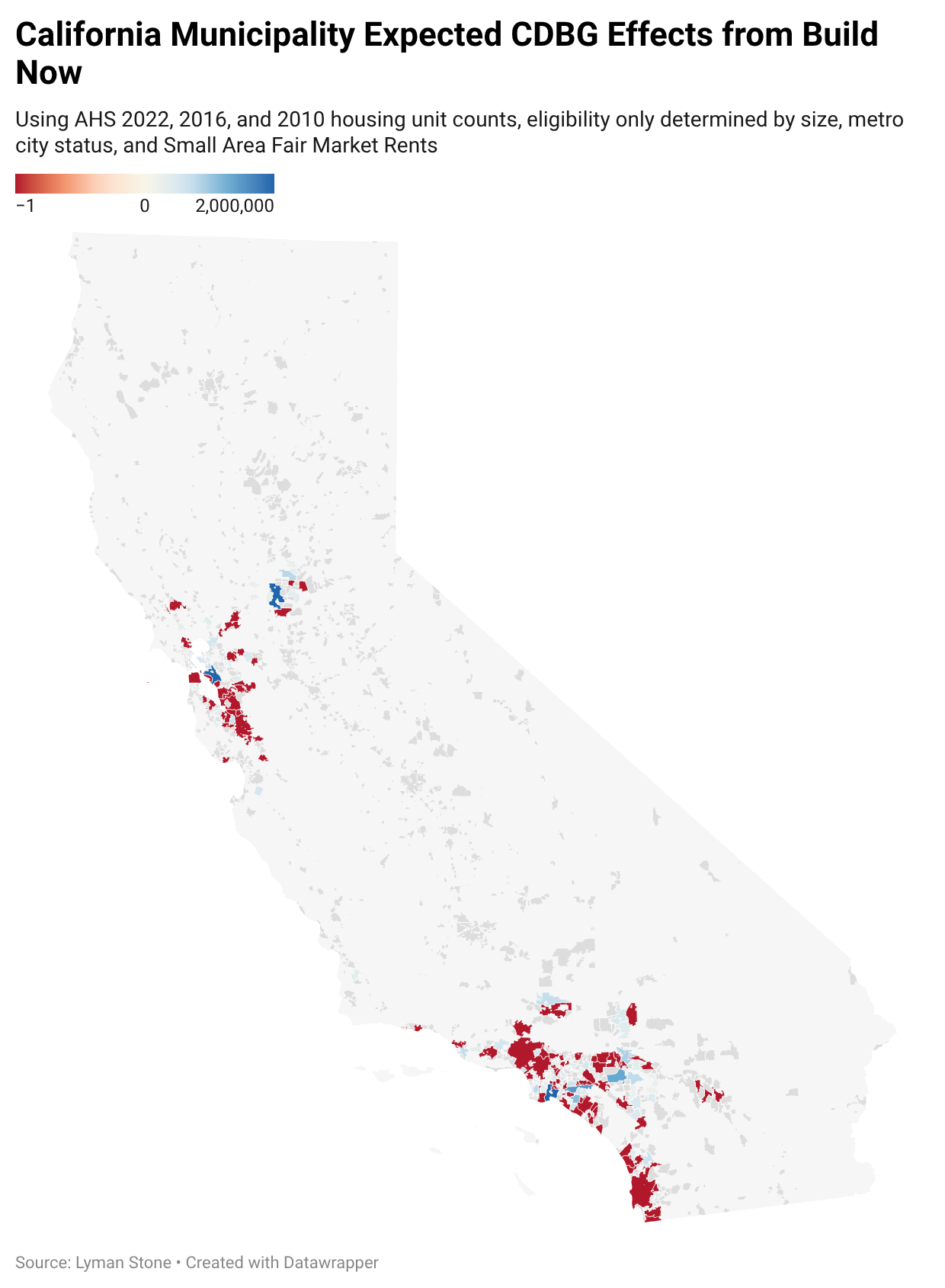
You can see that tons of the San Francisco suburbs are just plainly exempted. Too small of municipalities. San Francisco itself is penalized of course as is much of the bay area, and much of LA and San Diego too. Some areas are rewarded.
But the standout fact is the the vast majority of the developable land in California just isn’t covered at all. The Build Now Act will never add many houses because all it does is encourage a small number of large municipalities to internally add houses— but 6/7 Americans don’t live in those municipalities!!
If we add up all of this by states here’s what we get:
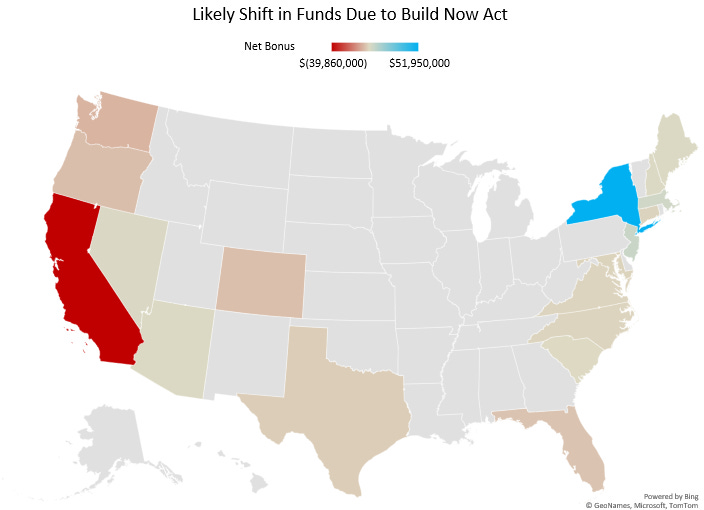
Okay, cool. We took a bunch of money from the west coast and gave it to New York. I’m… I’m so glad. Wow. We did a big thing here. So YIMBY!
Assuming all losing-municipalities are docked $1 million as a simple heuristic, it turns out only four states end up gaining more than $1 million:
New York, District of Columbia, New Jersey, and Massachusetts. Arizona, Maine, Nevada, New Hampshire, and South Carolina also come out very modestly ahead.
States adding tons of housing like Texas, Virginia, or North Carolina actually lose money! Because they’re adding housing in suburban and exurban contexts! This bill literally takes money away from states adding housing, and sends it to New York!
How? Well, NYC’s PAGR from 2010-2016 was 0.5%. Then 2016-2022, the CAGR was 1%. So their HGIR was (1%-0.5%)/(1%+0.5%)=0.5%/1.5%=33%
Was that above the median HGIR in the covered sample? Yes it was! Among eligible municipalities with below 4% CAGR, the median HGIR was 20%! So despite being notoriously restrictive about adding housing, despite eking out just 1% CAGR, New York gets a $50 million dollar bonus!
If the money were allocated among bonus-cities based on number of houses added, NYC would still get a lot of money: $33 million, instead of $50 million.
Of course, if we just gave every city a fixed sum per house they built, NYC’s share of overall benefits from this program would fall even more. Every step of this program resulted in NYC capturing more and more of the benefits.
Maybe the drafters intended this, or maybe they never looked at the math, but if you think that New York City is a champion of housing supply and the kind of regime YIMBYs want to reward then you’re on powerful, powerful, powerful drugs.
We can also ask, “Okay, if we take all the municipality benefits… how much are cities with bonuses being paid per house they add?
By sheer coincidence, totally just by luck of the draw, for reasons we can’t explain, here’s the map of which places are getting paid the most to add houses:
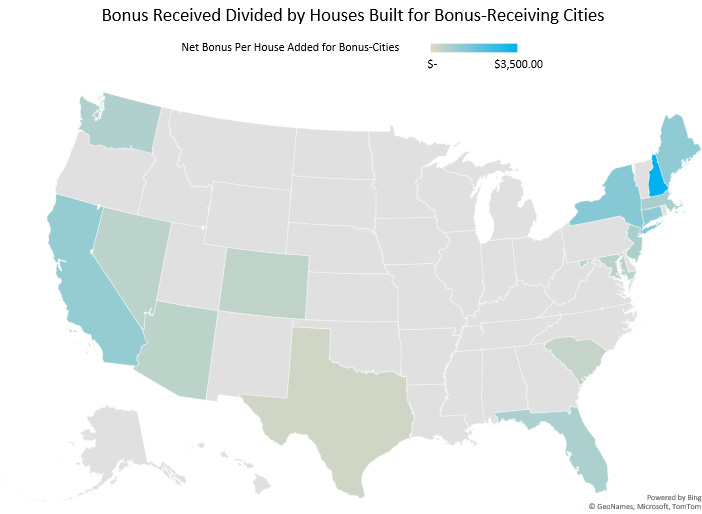
I’m noticing a trend for how this law treats Texas. Are you noticing that trend? Adding a house in Texas in a bonus-receiving city landed you, on average, $215. Doing it in New England somewhere could get you a minimum of $833 in Massachusetts, but up to $3675 in New Hampshire.
I have no idea why the Build Now Act is being so aggressively advanced by Senators Kennedy and Scott (GOP-LA, and GOP-SC, respectively). It’s a crazy bill that makes no sense, whose whole actual function appears to be to just shuffle money to cities in the northeast.
Oh by the way, see this table again???
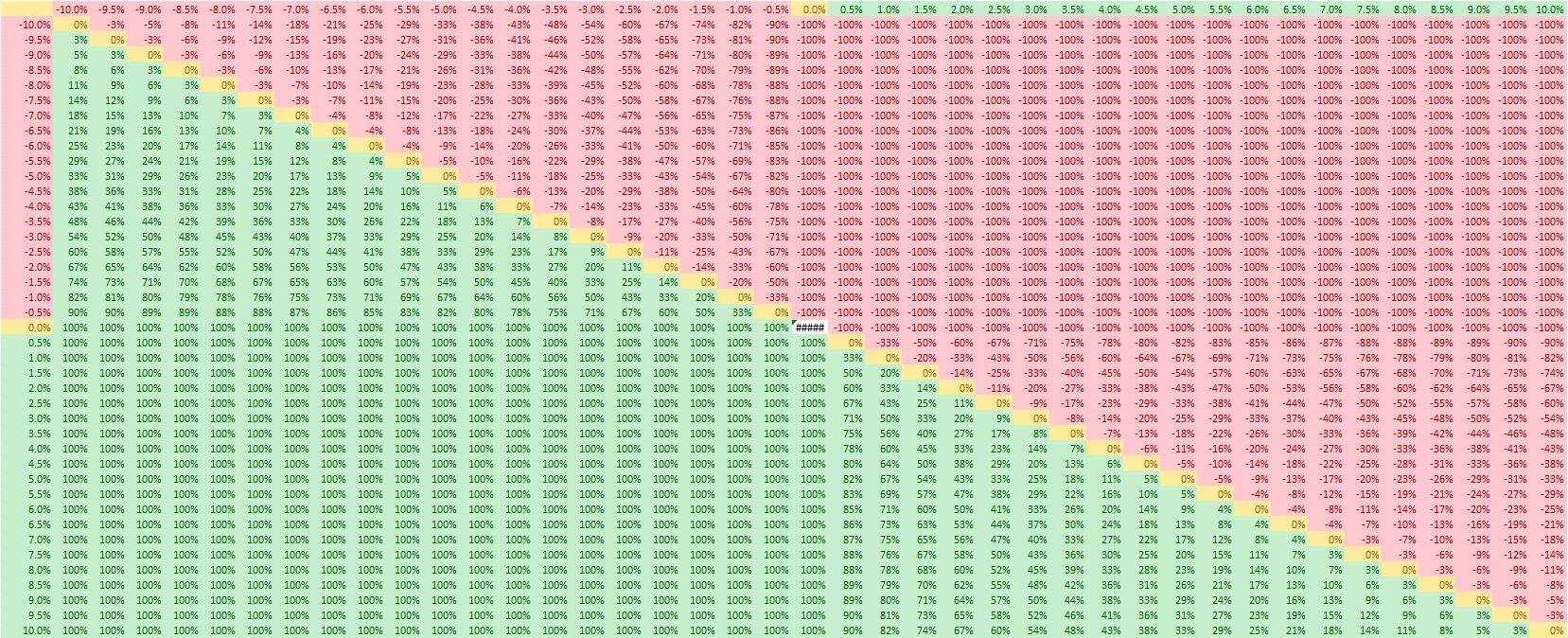
See the weird white cell in the middle?
That’s because, remember, you have a division problem in it.
If a municipality has no change in housing in either analytic period, it’s a divide-by-zero condition and you just have an irrational math problem that can’t be resolved.
The bill is based on a good principle. But its implementation is riddled with absurd rules and coverage limits and eligibility quirks and bizarre formulas, such that the only conclusion is that the drafters were intoxicated while writing it.
There are other issues with Build Now. For example, it counts housing based on addresses.
Logical, right? Well… maybe not.
Imagine you have a 3-story rowhome in a city with 5 bedrooms. It’s one house. You sell it to a developer. They subdivide it into 3 1-bedroom apartments (since each apartment now needs its own kitchen and bathroom).
This results in 2 extra “addresses” (units 2 and 3). But it resulted in 2 fewer bedrooms!
Cities vary in how they handle addresses. Sometimes, ADUs get their own addresses. Sometimes, they don’t. I lived in a townhouse with friends where the downstairs was a “unit” and the upstairs was a “unit” but the “units”… were not actually fully separated? We could absolutely access each other? Maybe we should have put a door on the next flight of stairs and “added another unit”!
My point is, the incentives to game this system are large and easy. Just bureaucratically relabel addresses. Keep derelict buildings around as long as possible. “Discover” that detached garages need their own addresses as potential ADUs. USPS/HUD/Census/DOT collectively maintain the relevant database in various forms, but localities have enormous influence in the data generating process, and with money on the line they will influence it. And since USPS nowadays is backing away from delivery at home and is instead installing neighborhood mailboxes, the modern USPS has absolutely no means to verify the truth of addresses. A clever town would just install 20 extra mailboxes on top of each neighborhood mailbox, without building any houses to go with them.
Would it be fraud? Yes. Will that stop a town that really wants those CDBG dollars? No.
There’s additional weirdness around annexation and border changes; but by now hopefully I’ve convinced you this bill is just not doing stuff the right way.
So what’s the right way?
The best way to encourage housing is simple: cash for bedrooms. The Census Bureau and HUD can easily get this data. The Building Permit Survey is a near total census of permitting in America, yet it takes the average reporting agency less than 10 minutes to complete their monthly form. All Census has to do is modify form C-404 to have a bedroom count number. Adding this field would increase time burden on permitting offices, but if you’re also paying them per bedroom they permit, well gee, I rather suspect they would report permitting bedrooms. There would be issues with this, but Census/HUD already operate a longitudinal Survey of Construction which randomly selects permits from the Building Permit Survey universe and follows up with them. The SoC already asks about bedrooms. So Census/HUD literally already conduct a randomized audit on BPS data every single year! Let’s just give a real financial incentive to permitting authorities to report bedrooms! Change one field in one Census form and create one simple payment system, and suddenly you’ve made a clean, simple, transparent way to get more housing.
The reason to do bedrooms is to avoid the unit-conversion issue, and to avoid rewarding spamming of micro-homes people may not really want. Houses with more bedrooms house more people, and our goal should be housing people rather than building houses per se.
So to do this right, just set up a fund that gives municipalities a certain sum of money for every permitted new bedroom, and use the SoC as an audit to make sure there aren’t anomalous failure-to-complete rates. Don’t do any of this nonsense about mailing addresses, no special formulas for relative growth rates, no covered and uncovered areas. Counties, cities, whatever the agency is that’s issuing the permit under the Building Permit Survey, just pay that agency. It doesn’t matter if they have zoning authority or not; public money is fungible. If the county issues permits but doesn’t control zoning, the county will issue whatever permits it can and pressure will build to change zoning, and the zoning authority will eventually buckle once the local politicians realize that the permitting authority is a cash cow.
We don’t need any of this too-clever crap. Simply make a nationwide rule: for every bedroom, the agency which issued the permit gets $100. This would cost about $450 million in 2024. Community Development Block Grants funding is about $6-$8 billion every year. For the small price of 5-10% of the CDBG funding stream, we could create a simple, flat, uniform policy that clearly incentivizes adding bedrooms everywhere in America.
We should do it, instead of this Frankenhousing bill.
This section is a new update!
See, I didn’t know anybody had done the math on CDBG before me. But one intrepid scholar (who I don’t think was a primary bill author? but if he was, well, sucks for him!) actually has done the math (kinda)! In turns out my longtime friend Salim Furth has done the math and also caught my errors on rental vacancy and missing urban counties. It’s good to have friends who send you late night texts like “You totally misread the bill, you oafish and offensive slob.” I love friends like that. It was my birthday dinner with my wife and he’s texting me like “Dude, you cretinous slime, you hideous filth, you wretched cur, urban counties are separate from metropolitan cities.” Cool bro. These are exact quotes from Salim.
Anyways, yes, I had some errors, and also, Salim has done the math I couldn’t do-ish. His math depends on approximate averaging of ZIP code data since, as I said, the actual data does not exist. HUD does not currently have the ability to enforce this law, they’ll have to rejigger their data products to actually cover these areas instead of ZIP-based approximations.
Even so! Salim kindly sent me his file, which is the think-tanker version of a massive dunk, “Lyman, I see you can’t actually do math. Here, let me show you, u widdle biddy housing powicy baby.” Fair.
But, Salim’s math (which he’s circulated to others in the space as well) is based on an assumed corrected bill, one where the allocations are not based on total housing but based on added housing. Salim is, apparently, not an absolute wackadoodle, and understands the insanity of the total housing stock allocation rule.
I’m going to compare Salim’s “fixed” data, to the “if passed as written” version… but also Salim ignored the disaster condition!! So I will then also show a “if passed as written and we don’t ignore the disaster rule” part.
To start with, disasters bump cities out of the eligible pool. How big is that effect?
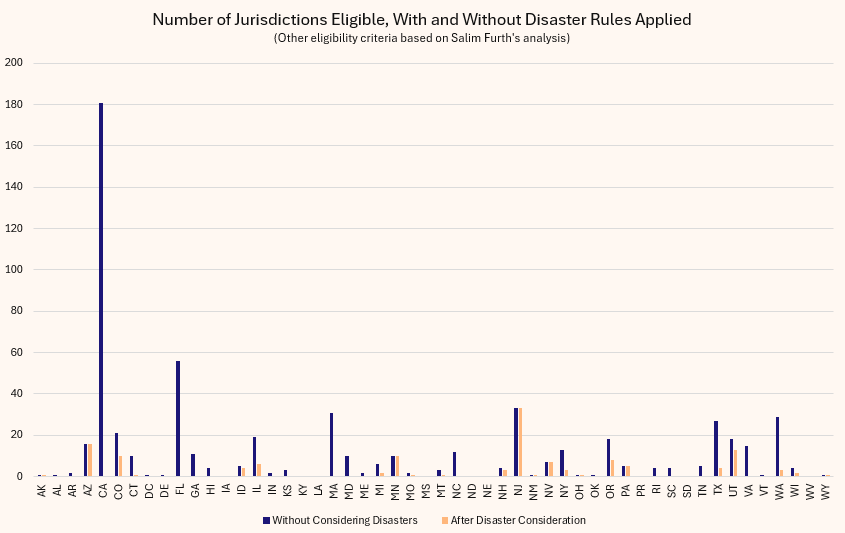
As you can see, California and Florida have TONS of cities that SHOULD be included in Build Now. So do Texas and Washington and Massachusetts.
But once we exempt places that have had disasters… literally zero cities in those states are included. None! Total carveout!
Here’s a map of states color-coded by what share of houses in that state would actually be in areas eligible for inclusion in Build Now:
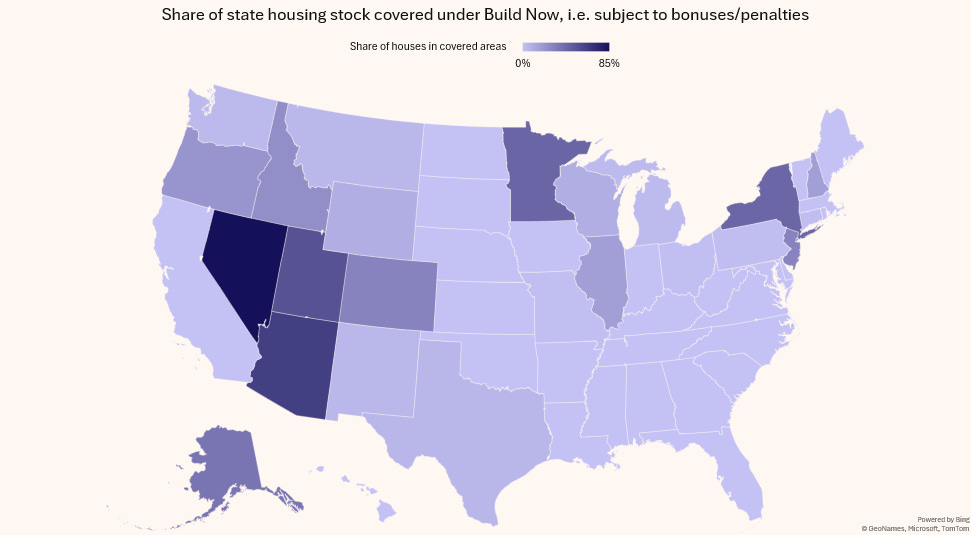
It’s wild to me a “we need to build more housing!” bill is targeting Alaska more than it targets California. Is it really true that the solution to the American housing crisis rests in locking Nevada, Utah, and Arizona municipalities into a housing construction race against each other? Does Atlanta not matter? Do we not care about Florida?
This is clearly nuts. To see how nuts it is, here’s “Share of houses covered by Build Now” plotted against “Average home price”:
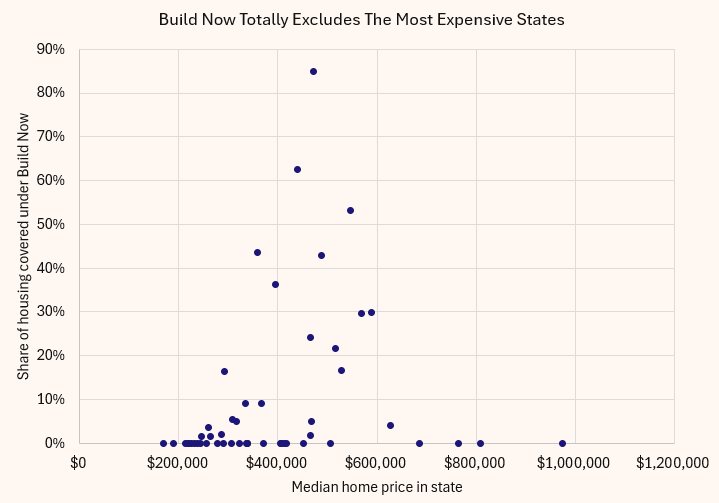
Pardon my French but what the fuck are we even doing here?!?!
Apparently we are super worried about insufficient housing supply in Wisconsin and Wyoming, but relatively chill and relaxed about Hawaii, California. District of Columbia, Massachusetts, and Washington, the actual most expensive states.
Okay, so, we’ve established that the disaster rule is nutso.
Now, what happens when we fix the allocation rule to reward extra houses instead of total housing stock?
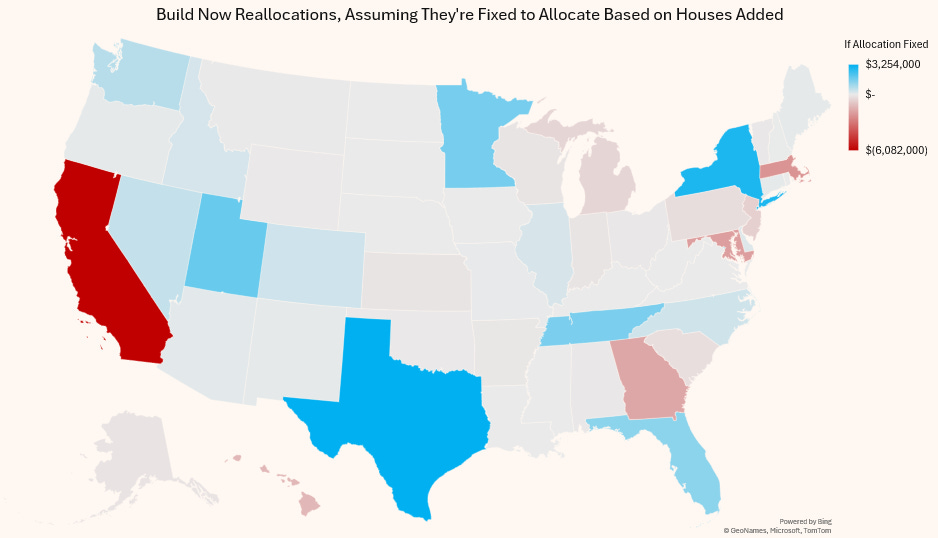
As you can see, if we fixed it to allocate based on “houses added,” but we ignore the disaster rules, the result is that California loses money, Texas and New York gain it. Georgia, Maryland, Massachusetts, New Jersey, Pennsylvania, Hawaii, and Michigan lose money as well, while UT, TN, FL, and MN are meaningful gainers.
Credit where it’s due, Salim’s map doesn’t strike me as totally nuts. This probably kind of sort of is a decent proxy for housing increases except lolololol New York is still a net winner here?!?!?
Fundamentally, I still think the “We improved on prior trend” is a dumb mechanism. Just reward for adding houses. Doesn’t matter the prior trend. If you build you get paid.
But what would it look like if, instead of Salim’s wishful-thinking mechanism where Congress isn’t a senile organization and makes rational fixes, we use the actual text of the law?
Here you go, now using Salim’s better data than mine, but using my more correct reflection of the actual rules in the law:
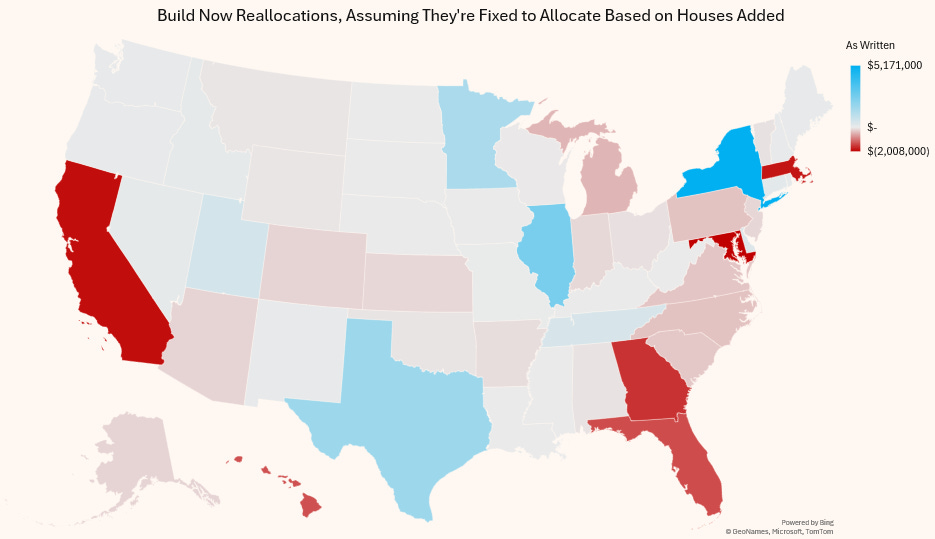
Now, New York comes out way more ahead. Basically, the whole east coast throws money at New York under the current rules. Texas still gets some housing, but now Chicago shows up as a really big winner. Also, California’s losses are cut by 60%+, and now are similar to the eastern loser-states.
This is clearly a dumber map. Do we seriously think North Carolina or Florida should be punished for not adding enough housing so they can subsidize New York even though New York adds less housing???
It makes no sense!
Okay, now, what if we incorporate disaster rules? So we exclude all the disaster-hit places.
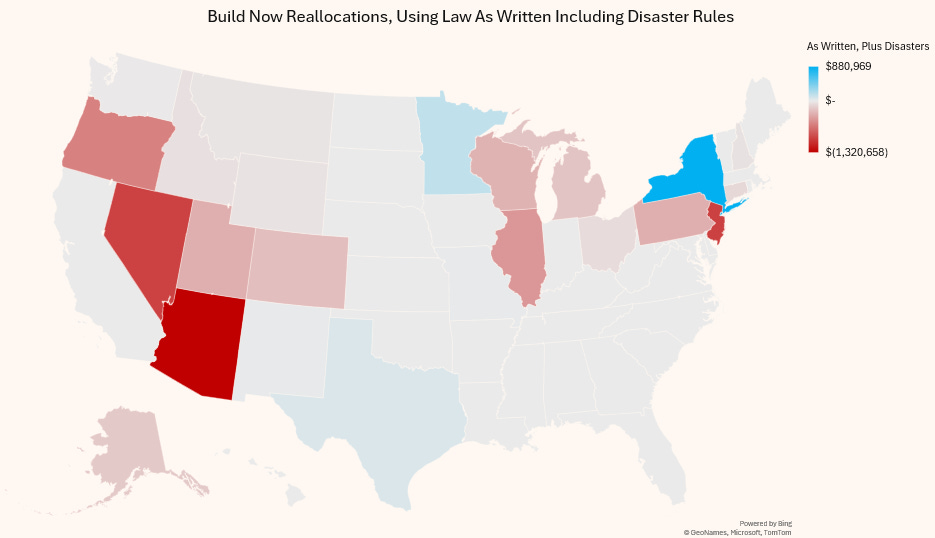
IT’S JUST A NEW YORK CITY SUBSIDY.
We are pillaging the CDBG grants of western and midwestern states in order to subsidize New York City and Minneapolis.
And folks, those are cities YIMBYs really like! I don’t think we need to pretend this is an accident. I think it’s obvious that there’s a third player in this math. Somebody besides me and Salim has sat down and looked at the math and wrote a law that did precisely one thing: took money from “water scarce” cities that urbanists dislike for aesthetic and environmental reasons, as well as rust belt cities full of working class whites, as well as New Jersey because New Yorkers hate Jersey, and designed a program to transfer that money to NYC (urbanists celebrate!) and Minneapolis (YIMBYs celebrate!). It’s hard to imagine how you arrive at this configuration by accident.
It’s a bad law and I hate it.
No posts
Comments
Nothing yet. Say the first thing.
Sign in to join the conversation.