
In a recent Wall Street Journal op-ed, Louise Perry said:

Among the other beef I have with the article, I feel it’s important to hammer the Turkish point, because Turkey’s sudden massive fall in fertility has caused generalized interest and consternation in many quarters. I am going to show what’s going on with Turkey and, in the process, demonstrate that 1) It’s not a big mystery why fertility is declining and 2) it’s the damn internet. I am going to show you actual data on adoption of new digital technologies, show actual decompositions of fertility behaviors into contracepting and non-contracepting components, and demonstrate that Turkish fertility decline is utterly mundane and easy to explain. After the paywall I warn you about the impending extinction of an entire personality type.
After the fall of the Byzantine empire— oh, crap, this is supposed to be a punchy rebuttal to a bad public op-ed, not a deep digression into the origins of the early modern world! Okay, so, let’s just start with 1950. To start with, here’s the four fertility indicators for Turkey you should keep in mind: the total fertility rate, the mortality-adjusted total fertility rate, the cohort completed fertility rate, and all extant survey data on Turkish women’s desired family sizes.
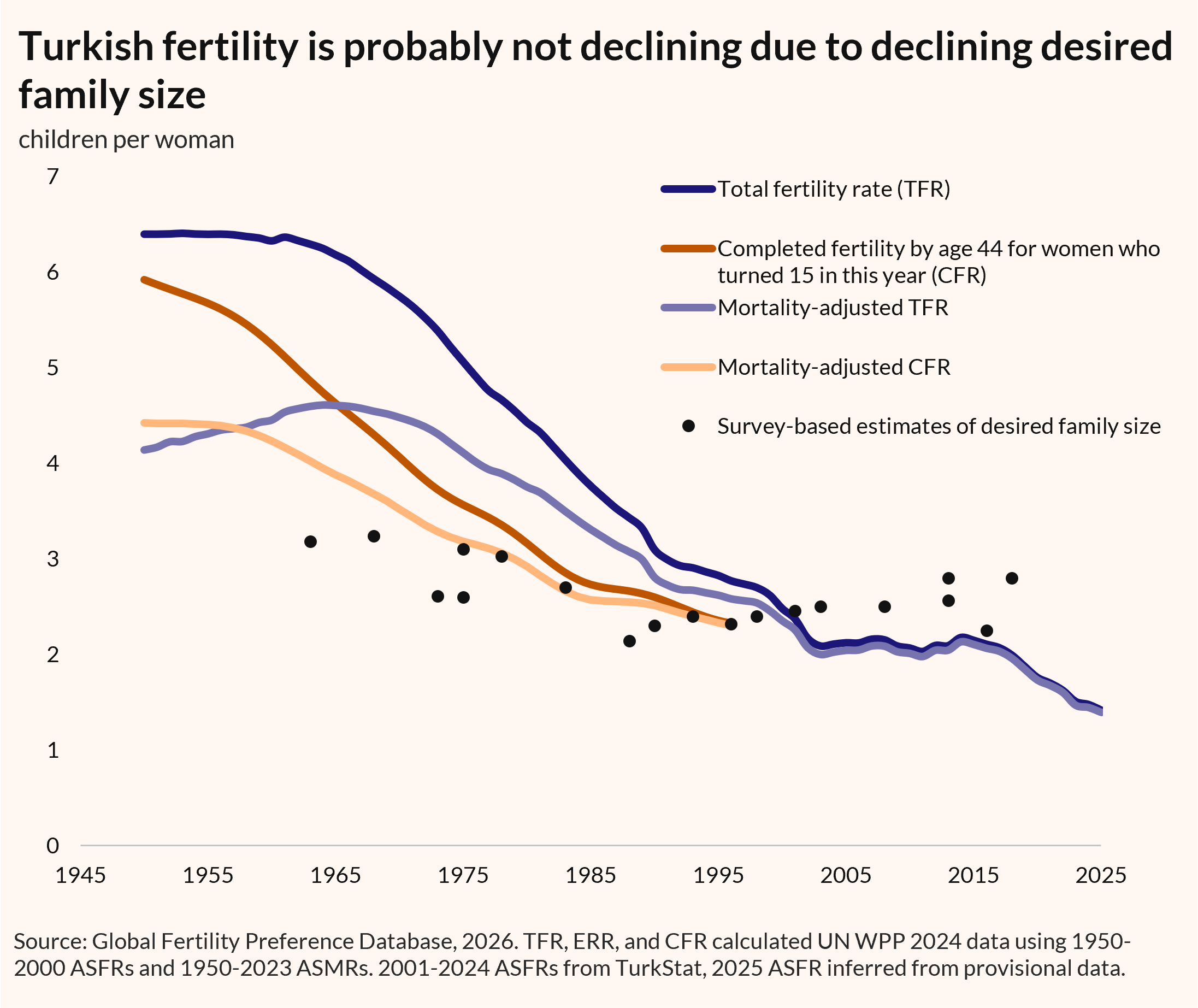
The dark blue line is the classic “total fertility rate,” which is just a blunt sum of the age-specific birth rates in a given year. The lighter blue line is the same, but adjusts for the mortality-rates then prevalent, basically telling us “Based on mortality rates at that time, about how many children might the average woman have expected to actually raise?” This is a vastly superior measure of de facto family size targets.
You can see that this mortality-adjusted measure actually rose between 1950 and 1965 since mortality was falling but fertility was stable, before declining appreciably 1965-2000. Then there’s a period of stability 2000-2013, and then a sharp decline to the present. That sharp decline is what is currently raising lots of eyebrows, and what Louise Perry is pointing to as poorly-explained by marriage.
The browish line shows completed number of life births. This is basically calculated by summing up live births for women of a given birth cohort across their whole lifespan; so the cohort of women who were 15 in 1950 have a number representing the sum of ASFRs of 15-year-olds in 1950, 16-year-olds in 1951, 17-year-olds in 1952, and so on. This measure does not adjust for mortality. You can see it was high at first, then fell precipitously. We can’t calculate it for the most recent cohorts, because they’re not done having kids.
The lighter orange line shows the same completed fertility metric, but adjusted for child mortality in the birth years, i.e. accounting for the fact that women were not actually raising the number of children implied by live births.
Finally, the black dots capture various cases where surveys were administered in Turkey and asked people about desired family size.
Please notice that mortality-adjusted CFR converges to survey-reported desired family size in 1975, and that the evening-out of mortality-adjusted CFR is coincident with an evening-out of desired family size.
Thus, it turns out, we can explain a lot of Turkish fertility history with just two factors: child mortality (helping us see the “true family size being targeted” instead of the optical illusion caused by live births which subsequently died) and desired family size. The last fertility survey in Turkey I have on hand was done in 2018 so I’m limited in what I can say with high confidence, but from 1985-1985 to 2018, desired family size actually rose rather than decline (and that one recent low value is a small privately-conducted survey without published metadata, so pretty low reliability).
It’s possible after 2018 fertility preferences took a nosedive, but since that is after the TFR took a nosedive, we’d be better off assuming that falling TFR caused falling preferences than that falling preferences caused falling TFR.
As such, we have a conundrum. Two variables we have good reason to think should be deeply and intrinsically related to fertility (mortality rates and desired family size) are, and explain essentially 100% of fertility changes… until 2014. Then something else happens. Fertility goes into a dramatic decline without a decline in preferences. What gives?
If the above discussion was hard for you to follow and too technical, then in general this post is probably not for you. Just stop here; the TL;DR is Turkey’s fertility decline is caused by the digital revolution wrecking marriage.
To see just how odd this all is, we can do a neat exercise. We will look at three different counterfactuals. In one, age-specific mortality-adjusted birth rates are held constant at 2013 levels out to the 2060s. In another, the observed decline to 2025 happened, but we assume the decline is over in 2025, and birth rates observed in 2025 continue to 2060. In the third, we assume the pace of decline we’ve observed 2015-2025 continues 2025-2035, then 2035 rates are stable to 2060. What do these projections imply for completed fertility?
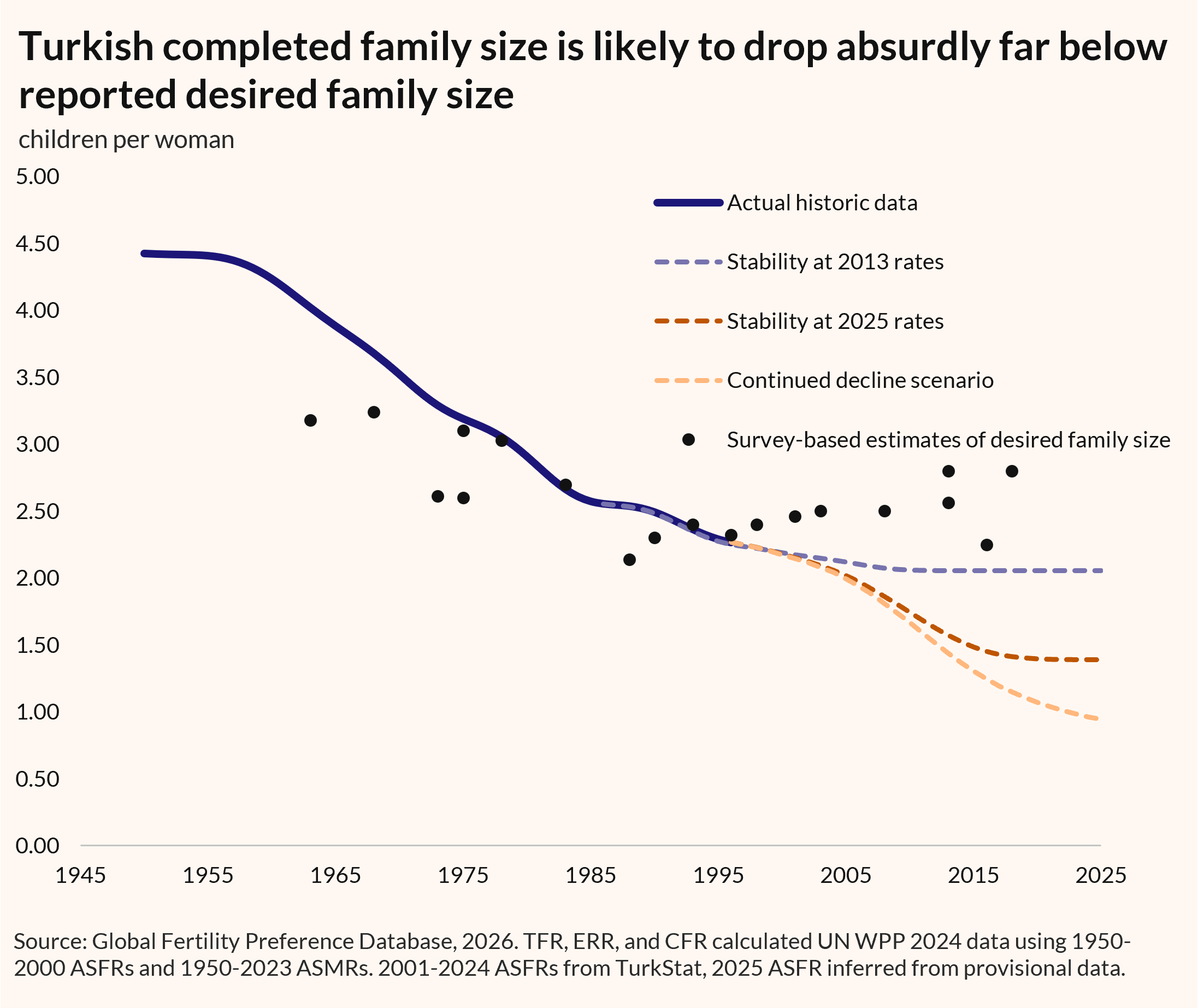
As you can see, women who were answering surveys about fertility desires in the 2000s and 2010s reported wanting about 2.5 kids each, but are likely to end up having, if continued decline goes on perhaps as little as 1 for the later cohorts, but very plausibly under 2 (after accounting for child mortality, which nowadays is very low but not zero). Even if rates had been stable at 2013 levels, there would have been undershooting vs. desires, but much more modestly.
The gaps we are talking about here are huge. The mismatch between Turkish women’s desires and their outcomes for those born in 2020-2025 will plausibly be bigger than it was for women born 1950-1960— and those women had exceedingly little access to contraception! The scale of missing kids will be socially as big or bigger than the scale of births women wanted to prevent before birth control was widely available.
This drives home a key point: something is happening to push fertility extremely low. What is it?
Demography studies are always taught a simple rule: if a theory cannot explain why one of the proximate determinants of fertility would change in response to some proposed cause of fertility change, then that cause can be ruled out. Any theory must operate via proximate determinants. The classic proximate determinants are:
Odds of infanticide or abortion conditional on non-miscarried conception
Odds of miscarriage or stillbirth conditional on conception
Odds of conception conditional on non-contracepting sex and/or odds of conception conditional on contracepting sex (i.e. contraceptive failure)
Odds of contracepting conditional on sex
Odds of sex conditional on coupling
Odds of coupling conditional on being reproductive age female
Within that, we often also add amenorrhea due to pregnancy itself and breastfeeding, which can be thought of as a subset of #4. Likewise, non-procreative sexual activities can be considered a subset of #4.
This also means we can in practice, if we had enough data, decompose fertility change into these elements. In practice, we almost never have data on 2, data on 3 tends to come from very specific narrow-case studies, data on 1 is spotty and contested. Data on 5 is also very shoddy and rare. Thus, in practice, we often focus on parameters 4 and 6: prevention behaviors conditional on sex, and coupling conditional on reproductive age.
So, what has happened? Let’s look at contraception first.
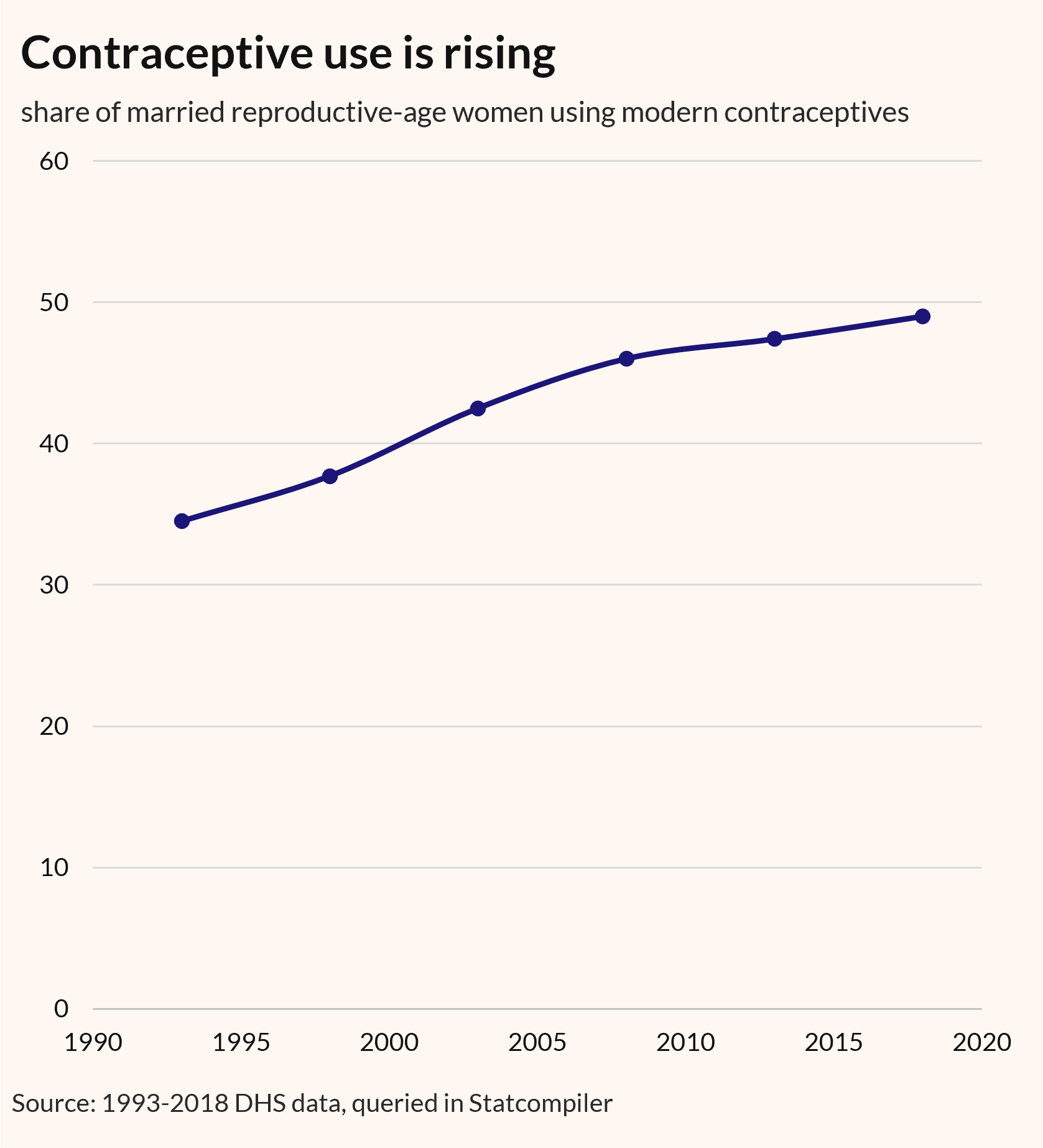
As you can see, it rose through 2018 (the latest data— 2024 data should come out any time now, however!)… but the increase actually slowed down in recent periods. It would be weird if fertility decline was accelerating while coupled women were using less contraception (remember: 95%+ of births in Turkey are to married women). So while we can’t rule out contraceptive behavior, we can see it’s a not-super-persuasive candidate for the recent fertility decline.
What about marriage itself? Here, we have more recent data:
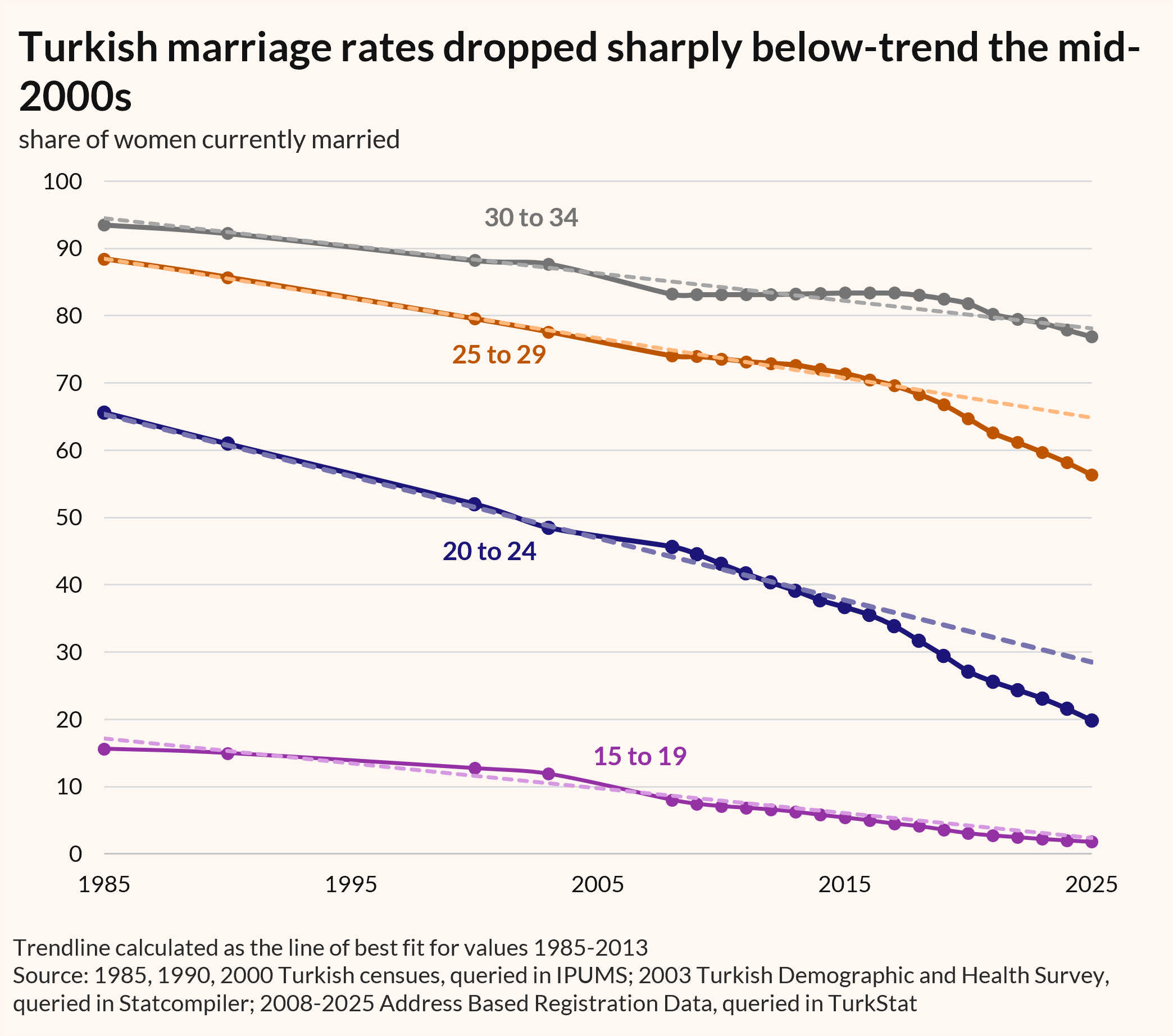
As you can see, the share of women who were married dropped precipitously below the pre-2014 trend in recent years. For 25-to-29-year-olds you could take the break as recently as 2016, and for 15-to-19-year-olds there’s not a clear break, nor for 30-to-34 (though one may be emerging since 2017 or so). But for 20-29 year olds there’s clearly a trend break in exposure to marriage.
Could this explain decline?
Well, we can ask, simply, “If every non-contracepting married woman was trying to conceive at the biologically typical rate for women who are non-contracepting and trying to conceive, what would Turkey’s fertility rate be?” and we can compare that to the actual data.
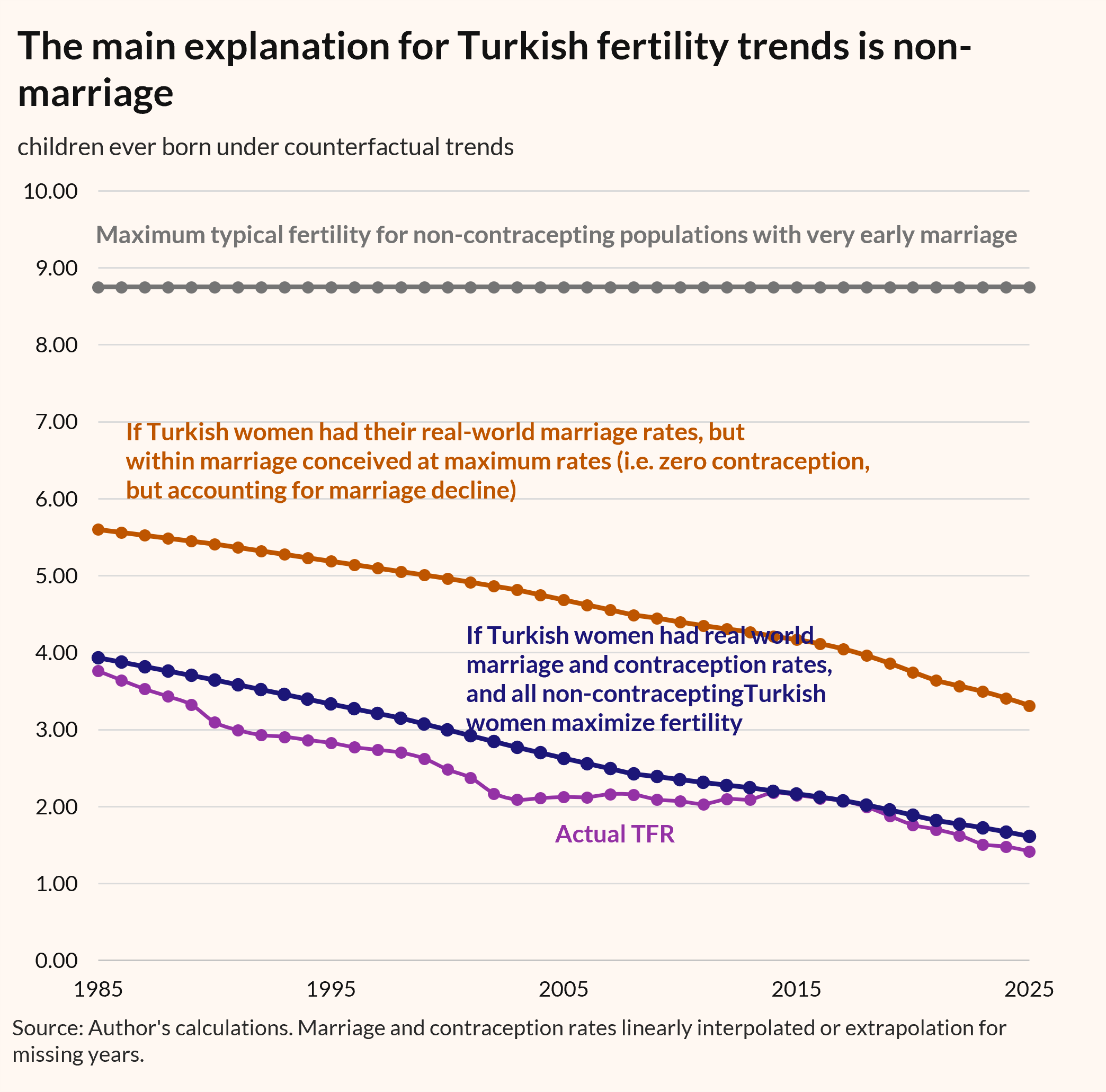
As you can see, the brown line, which is basically “Maximum Turkish fertility if every Turkish woman is crankin’ babies like the very conservative Amish sects, but unmarried women have zero babies” is in steady decline. If every Turkish married woman was babymaxxing, Turkish fertility would not be 9 or 7 or 5 or even 4. It would be 3.2. High! But waaaaaay below historic highs!
Contraception further reduces birth rates. If every single married, non-contracepting Turkish woman today made babies as fast as possible and no unmarried Turkish women did so, Turkish TFR would be 1.61— it’s actually 1.42. You can actually see that the real fertility rate is generally quite close to the “Assume babymaxxing, except unmarried and contraceptors” line.
From those lines we can get decomposed parts. The gap between the gray and brown lines just is the compositional effect of proximate determinant #6. The gap between brown and blow, likewise, more-or-less is #4. The gap between blue and purple is various kinds of other residuals. We will chain those decomposed effects to their 2013 values, and see how they’ve changed:
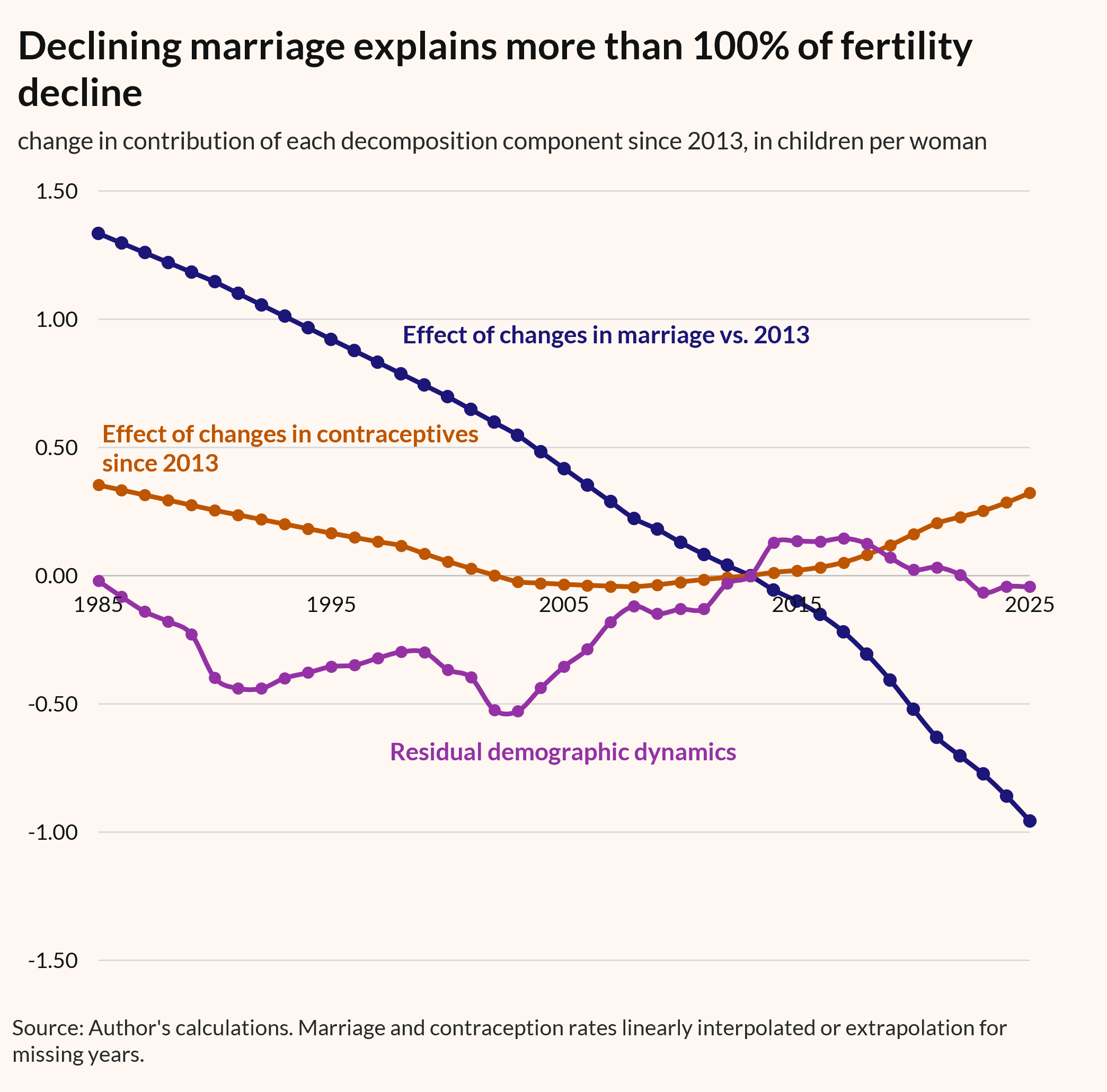
Sorry Louise Perry — there’s no mystery here. The reality is that the decline in marriage is so big at such high fertility ages that the implied contraceptive change among marrieds is actually positive: that is, married people must be using contraception somewhat less at their peak fertility ages! Residual changes don’t really explain very much either all things compared.
It just is marriage. Turkish fertility started falling super fast after 2013 because Turkish marriage rates started falling super fast after 2013.
Comments
Nothing yet. Say the first thing.
Sign in to join the conversation.