
The way we usually measure maternal mortality is to define some subset of deaths we consider “maternal,” then to divide them by some denominator for exposure (births, pregnancies, whatever).
The issue with this approach is that it assumes that those deaths would not have happened but for the pregnancy. But obviously, it’s possible that some women may simply have died anyways. A woman who dies in childbirth might have been hit by a car if she was not pregnant. This may seem like a spurious way of thinking, but this is the fundamental logic of “excess mortality.”
The issue is we don’t usually have longitudinal data on pregnancy and mortality, so we don’t have a way to calculate the “excess mortality burden of pregnancy.”
But actually… we do! In the National Health Interview Survey’s mortality-linkage dataset, we can look at how millions of people who were surveyed from the 1980s to 2004 survived through 2019. If anybody surveyed in NHIS before 2005 died as of 2019, we have data on when and how they died.
This, in turn, means that we can ask, “Did being pregnant at the time of the NHIS survey predict higher odds of subsequently dying?”
Answer: kinda yes, kinda now. Being pregnant did predict higher odds of dying in the next 24 months after the survey, but it did not predict higher odds of dying in the next 5 years or 15 years; conditional on underlying age and health, pregnant women may actually have had lower mortality than non-pregnant women. This doesn’t mean maternal mortality can be brushed off— but it means that we should think of maternal mortality as nonspecific to maternity. Some people, unfortunately, are sicker, or more exposed to violence, or have other morbidities, and as a result are more likely to die. Sometimes these people get pregnant. Sometimes, when pregnant, they die. The evidence they would have lived much longer without pregnancy is surprisingly weak. While I cannot fully untangle causality, the associational evidence shown below is consistent with the idea that short-run maternal mortality is indeed in the range the CDC reports, but that large shares of that mortality is simply mortality harvesting. The counterfactual lifespan of the statistical marginal case of maternal mortality is quite short, maybe less than 5 years.
You might not be familiar with the NHIS. It’s a huge survey that has surveyed over 6 million Americans since it began in the 1970s about, well, health stuff. Because health stuff is interesting to compare to mortality, the data was linked to mortality using the National Death Index. As such, any individual in the sample who died before 2020 has their death “linked” to their survey responses. So we can see if, say, a 43 year old married pregnant women who said her health was “fair” is dead or not and, if she is, how she died (cancer? suicide? car crash? heart attack?).
Here’s our ultimate sample size of pregnant and nonpregnant women:
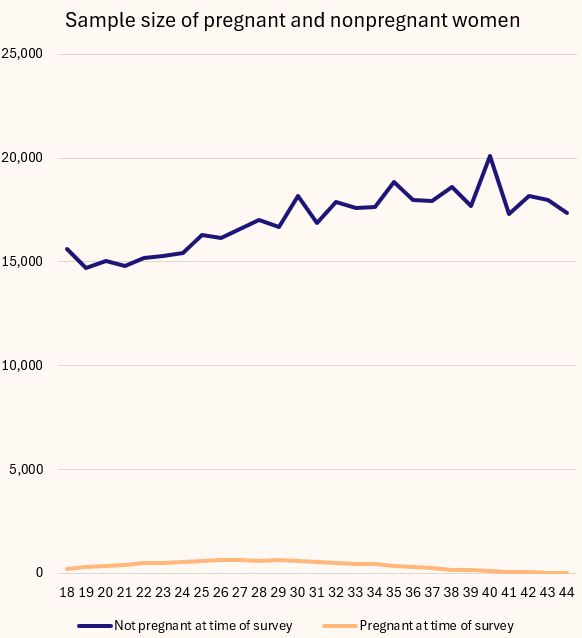
You can see only a small fraction of our female respondents were pregnant at the time of the survey. This is as we would expect. Over those 10,000 or so, just under 8,000 are in survey waves for which we have linked mortality data. Meanwhile, we have over 330,000 such linkages for women who were not pregnant at survey time.
What we want to do here is simple: just ask if otherwise-similar pregnant vs. nonpregnant women have different odds of being dead by 2020.
But alas, we have a problem.
The mortality linkages stretch all the way back to the 1980s. Obviously, a respondent who is 33 and sampled in 1985 has way higher odds of being dead before 2020 than a respondent who is 33 and sampled in 1995, and they have higher odds than one sampled in 2004. Simple time exposure means the individuals sampled further back in time have more years of exposure to mortality hazard post-survey, and those years are older. The right way to handle this is a Kaplan-Meijer type survival function benchmarked to the year of survey. Here’s how that looks:
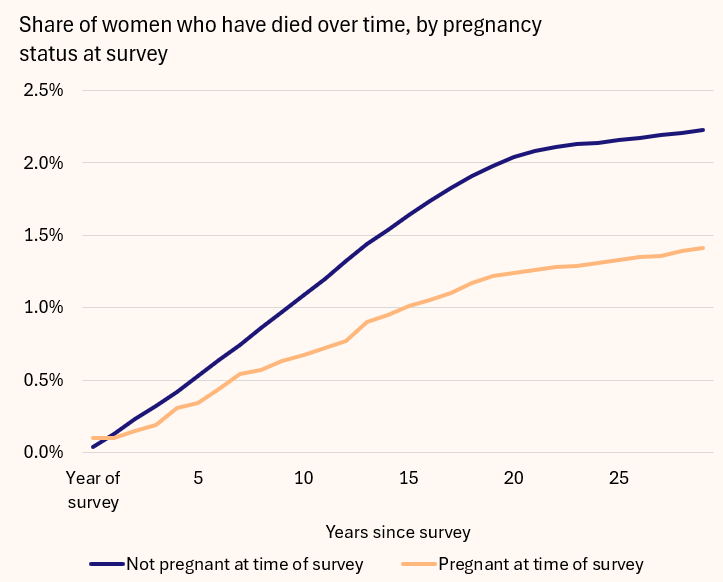
The first jump-out fact is that in the long run women pregnant at survey time have much lower death odds than other women, but of course, that might be because they tend to be younger!
Now, in the short run, i.e. the year of survey and the next year, death odds are higher for pregnant women! That suggests there may indeed be some significant mortality! Past the paywall, we will untangle what’s going on there!
And yet… long run, mortality is lower!
What’s going on here? Well, one intuitive thing to do would be to look at the age splits. To get a handle on this, we are going to limit to just deaths occurring with 15 years of the survey, since all survey waves have at least 15 years of coverage. Here’s odds of any death within 15 years of survey by women’s age at survey and pregnancy status.
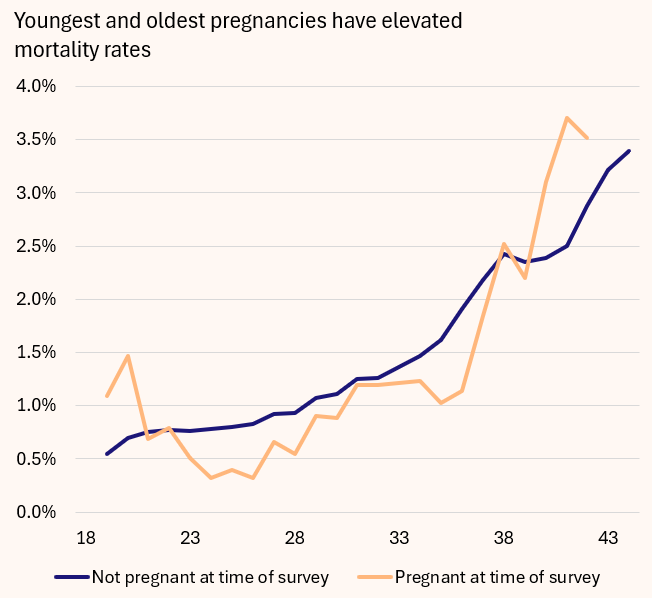
Here, you can see that mortality rates are extremely similar across groups, with perhaps two notable exceptions: women under 21, and women over 40. This tells us that most of the effect we saw above of lower mortality for pregnant women was a product of the age difference between pregnant and nonpregnant women— but not all of it!
Now, just to throw some extra confusion in here, let’s look at just the 5 years after survey.
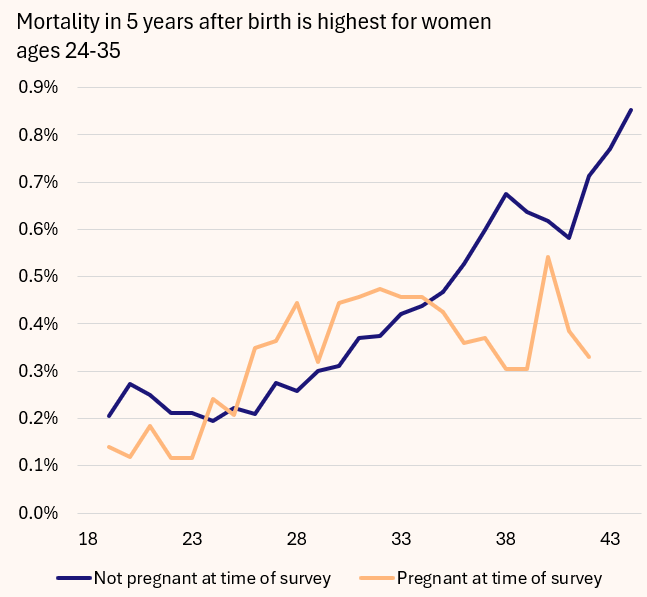
Crazy, right? Now it looks like pregnancy-related mortality rates are highest for women ages 24-35, at least compared to other women their age.
What’s going on here?
Well… let’s look at this one more way.
NHIS respondents gave a subjective rating of their own health. We can interact that with their age and check mortality across fixed time windows to get a sense of if pregnancy is associated with higher death odds conditional on two major mortality predictors: age and generalized health.
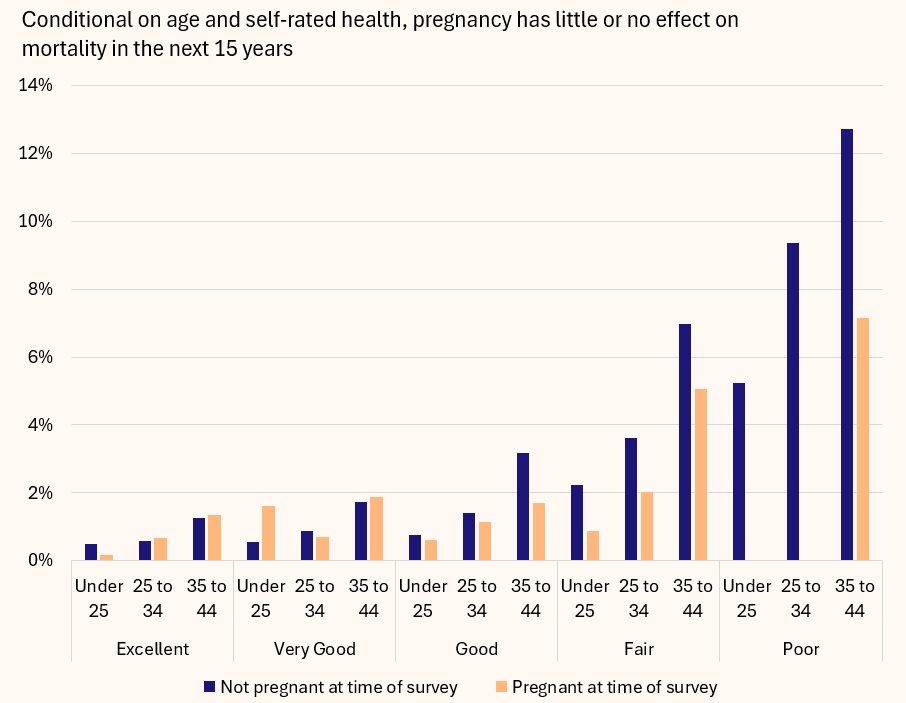
You can see mortality rates are very low for women in excellent health regardless of pregnancy status. The same is true for women in very good health. For women in self-rated “good” or “fair” health, pregnant women have much lower mortality rates; Estimates for women in “poor” health are not very reliable due to small sample sizes, but are also consistent with much lower mortality rates for pregnant women.
In general, I would not read too much into this— for example, I would not interpret this to mean pregnancy is actually net beneficial to women’s health. It theoretically could be, but I don’t think this evidence is strong enough to make that claim.
But this evidence certainly is strong enough to say that there is exceedingly little evidence that being pregnant increases mortality within reproductive years. While there may be some mortality immediately during pregnancy and delivery, virtually all “statistical women” who die in that period in this sample would counterfactually have died of some cause or other within 15 years.
Of course, 15 years is a long time. “Would you rather die 15 years sooner or later?” has an easy answer.
What about 5 years?
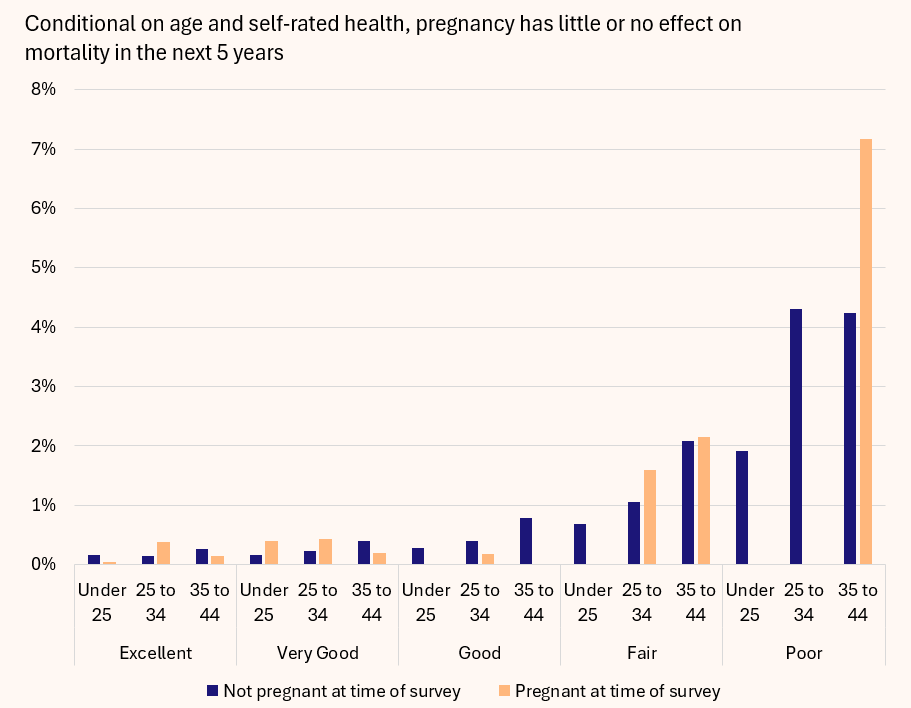
Again, effects here seem very small. In the “excellent” health group there’s an increase in mortality in the next 5 years for 25-34 year olds, but a decrease for the other two age groups. For the “Very good” group there’s an increase at all ages under 34, but a decrease from 35 to 44. For the “Good” group, it’s decreases across the board. For the fair and poor groups, again, smallish samples of mortality make inference tricky. Some age groups zero out for a major reduction, some show an increase, some a decrease.
On the whole, this seems consistent with a story where pregnancy has an extremely small effect on women’s mortality rates.
Comments
Nothing yet. Say the first thing.
Sign in to join the conversation.