

On June 10th, Chicago hosted up-and-coming leaders in tech policy for a debate on whether we should have a global pause on the development of frontier AI models. The crowd gathered on the 9th floor of a high-rise in the West Loop. Outside, a rainstorm had come — quick and destructive — and the dark, ominous clouds were blowing away, giving way to an orange sunset. Under that dramatic sky were cranes, still raised from the construction of new apartments that had been taking place earlier that day.
One of my best friends, Autumn Dorsey of the Heritage Foundation, was arguing against the proposed pause. When it came time for her opening statement, she started by speaking about something few would expect: her father’s death.
He died of cancer, she explained, one of many diseases that scientists hope AI will help not only detect earlier and more accurately, but eventually cure. That sort of vision will require AI capable of more complex analysis and of bridging different fields of knowledge.
The cost of a pause, she argued, can be measured in what we forgo by not building toward that future: human lives lost, inequality entrenched, and the persistence of a status quo that some people cannot afford to wait out.
Autumn’s argument reminded me of Magnifica Humanitas, because she — like Pope Leo XIV — refuses to separate the question of whether to build from the question of who and what we are building for. Pope Leo XIV writes: “We are called to reflect on the great ‘construction sites’ of our era and ask: What are we building?”
I believe that call applies to any construction site we find ourselves in, technical or otherwise.
The mere act of building is, in itself, neither good nor evil. A crane is just a crane. Steel and brick are just raw materials. It is the goal underlying the construction that gives the act its moral weight. And to make this concrete, the Pope juxtaposes two biblical building projects: the Tower of Babel and the rebuilt wall of Jerusalem:
“The story of Babel appears in the Book of Genesis, at the origins of humanity, immediately after the genealogies of Noah’s sons. After settling in a plain in the land of Shinar, the people decided to build a city and a tower ‘with its top in the heavens’ (Gen 11:4). Fearing being scattered across the earth, they sought to guarantee stability and power for themselves, and above all to ‘make a name’ for themselves… It was a project conceived without reference to God… When a city is built on pride and the claim to self-sufficiency, communication breaks down, languages are confused and people no longer understand each other. The result is not unity, but dispersion. Babel thus reveals the limits of any effort that, however grandiose, arises from self-affirmation, sacrifices human dignity for efficiency and aspires to reach heaven without God’s blessing.
…The Book of Nehemiah, in turn, opens at a time of great vulnerability in the history of ancient Israel. After the Babylonian exile, a portion of the people returned to Jerusalem, but the city was still in ruins, the walls collapsed and the gates burned (cf. Neh 1–2). Nehemiah, a Jew in the service of the Persian King Artaxerxes, received news of the disastrous state of his ancestral city. Before taking action, he fasted, prayed and interceded for the people… He convened the families, assigned each of them a section of the wall to rebuild, listened to their concerns, coordinated their efforts and addressed any opposition. The narrative shows how the city is reborn, not through the initiative of one man, but through the shared responsibility of all: men, women, priests, artisans, heads of households and young people all play a part. It is an undertaking with God at the center, which rebuilds relationships before rebuilding with stones. Thus, ancient Jerusalem rediscovers a common language — not one of uniformity, but one of communion, namely the harmony that arises when all persons assume their own role and recognize that their strength comes from the Lord.”
Both projects are successful in terms of their engineering. Babel’s builders are competent, but their orientation is entirely self-important. A tower stretching toward heaven does nothing for the people on the ground. It only makes a name for those who oversee its construction. Jerusalem was the opposite. Nehemiah wept for a city without walls to shelter his people, and with prayer and community engagement sought to build something that would serve those around him.
I believe we each face similar choices in our day-to-day lives. In the image of God, the ultimate Creator, we were each made to create. In a sense, you could think of your own life as a construction project. You could build a tower for your own selfish ambitions, isolated from community and context, or you could build something that contributes to the larger wall; something that encourages others and helps provide shelter from the attacks of our age.
What each person builds will look different in scale. Leo XIV is careful to say we do not all hold the same power to make a difference. But he also acknowledges that “no one is without responsibility… no one is so weak that they cannot play their part… All are given their own section of the wall.”
Within our own realms of influence — whatever their size — we are each capable of great evil or great good. We can build with pride, seeking independence from community and God. Or we can build with love, caring for those around us and for our family of faith, leaving the world a little better than we found it. As the Pope puts it:
“We all have our own areas for action, and it is precisely there — and nowhere else — that we must choose whether to fuel the mentality of force (even if only through indifference, cynicism, lies or hatred), or to persevere the mindset of peace (with truth, moderation, closeness, and care).”
To the delight of many Lord of the Rings readers, he then reaches for Tolkien, by way of Gandalf:
“It is not our part to master all the tides of the world, but to do what is in us for the succor of those years wherein we are set, uprooting the evil in the fields that we know, so that those who live after may have clear earth to till.”
The problems of our day — injustice, poverty, disconnect — are too big for any one person to fix on their own. But we each do what we can. Build our section of the wall. Clear the fields that we know. It is simultaneously all we can do and what we must do.
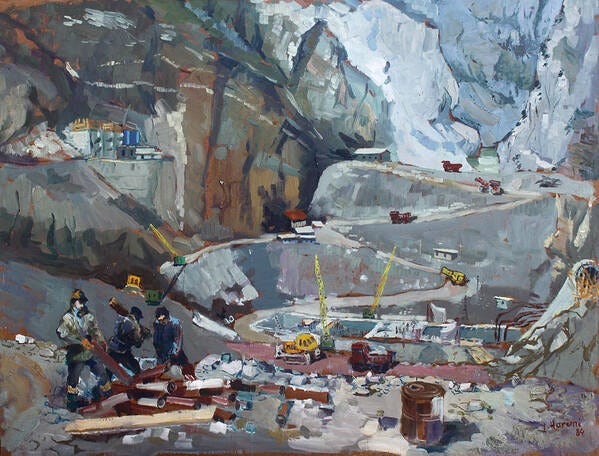
“For a Christian,” he writes (and I’d actually apply the following to anyone committed to living a life of purpose), “going beyond the narrow confines of one’s own interests and committing oneself, within the limits of one’s ability, to the common good is a non-negotiable value, as in the promotion of life.”
This is the very consideration Autumn challenged the audience to consider at the debate. Perhaps, in light of our nature as human beings to create, develop, and expand the realm of possibility, it would be better to consider — not whether or not we will build — but what we will build and what it is for. That’s the reframe at the heart of what Pope Leo XIV is arguing.
“The creative intelligence of humanity is a gift that can alleviate suffering and open up new possibilities, but it must remain ordered toward the common good, justice, the care of the vulnerable, and creation. In this sense, the true alternative is not between enthusiasm and fear, but between two paths of development: a progress that serves individuals and peoples, or a progress that subjects them to the mentality of power.”
I return to the vision outside that 9th-story window as the debate began. In this life, there are periods of darkness and destruction that come and go, but in between, construction. The cranes that will continue moving after the storm passes can, with the same motions, build a tower of Babel or a wall of Jerusalem. Our hands, our minds, and our daily efforts can build either option as well.
“The civilization of love,” Leo XIV says, “will not arise from a single or spectacular gesture, but from the sum total of small and steadfast acts of fidelity that serve as a bulwark against dehumanization.”
Last week, I asked how human you were willing to become. This week, the question I leave you with is this:
What are you using your magnificent, human life to build?
No posts
Comments
Nothing yet. Say the first thing.
Sign in to join the conversation.