
I’m a big fan of Lincoln’s speechwriting.
I recently posted a video of myself reading the Gettysburg Address — one of my favorite speeches in American history — on social media in honor of America’s 250th, and it blew up. People who remembered having to memorize it in school, people who had never paused to reflect on the words until then, and everything in between.
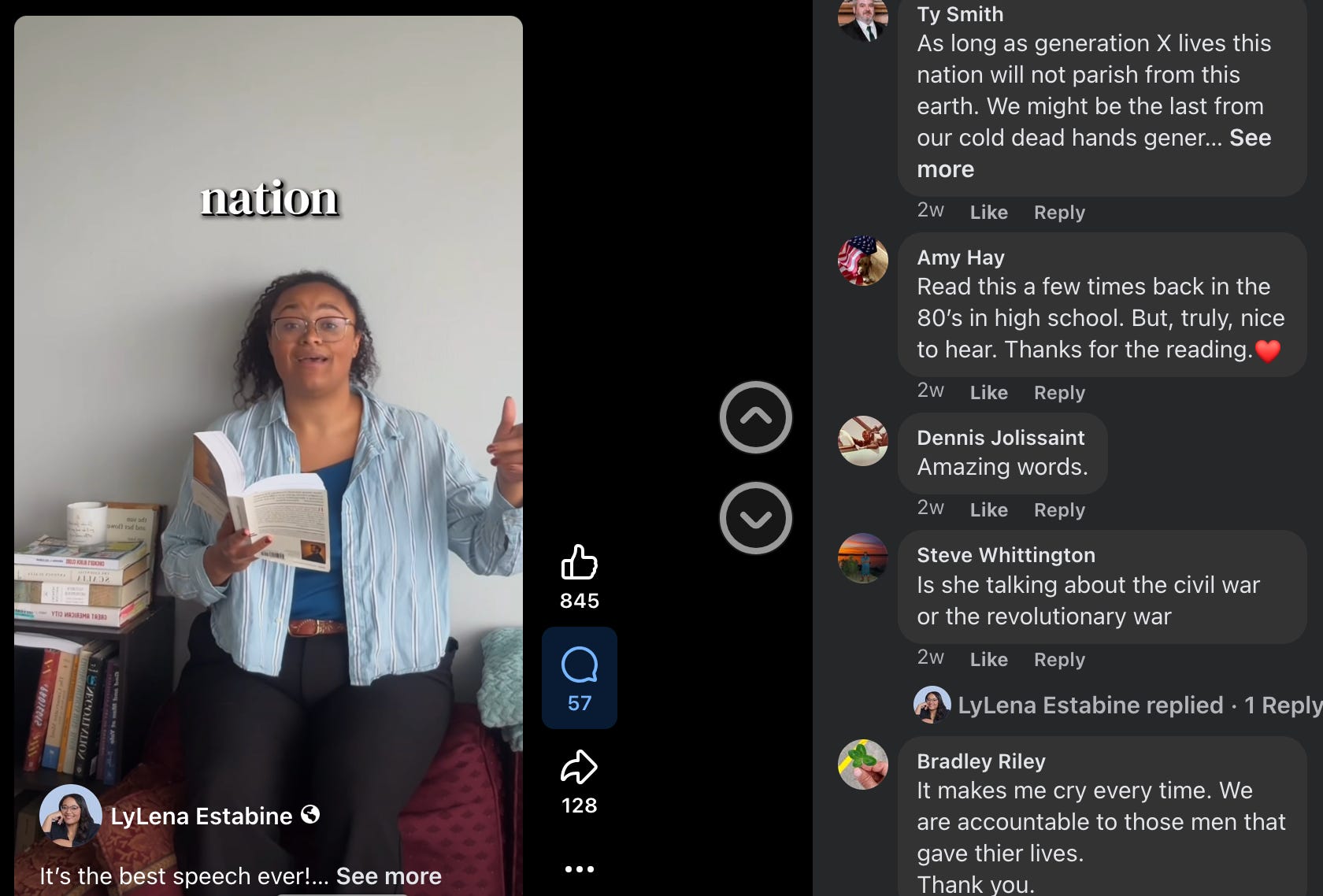
But when I taught the passage, along with other writings from Lincoln, to a group of Gen Z interns, they expressed more cynicism than the older generations on Facebook who rallied around pro-America sentiment.
It’s not that younger generations are losing faith in the promise of America made at the founding, or even in the nation’s rediscovery of that promise during Lincoln’s time. Rather, they’re questioning whether the systems they’re due to inherit are really a government, as Lincoln says, “of the people, by the people, for the people.” They cited gerrymandering, campaign financing that produces an oligarchy of rotating candidates, and political violence — all as evidence that it might not be.
The data says they’re not alone. The Spring 2026 Harvard Youth Poll found that only 13% of Americans under 30 believe the country is headed in the right direction. Just 33% — a third — trust that this year’s midterm elections will be conducted fairly. Only 15% trust the federal government “to do the right thing all or most of the time,” the lowest level recorded in the poll’s 26-year history. And half now agree that “people like me don’t have any say about what the government does” — up 15 points from 2017. This is not a generation that hates America. It’s a generation that isn’t sure America is still listening.
My interns aren’t wrong about the problems. Gerrymandered maps do let politicians choose their voters. Money does distort whose voice gets heard. Their doubts raise a harder question, one I’ve been turning over lately: where does a nation’s unraveling actually begin?
Lincoln answered that question in 1838, in his address to the Young Men’s Lyceum of Springfield. He was twenty-eight years old — speaking, in other words, to the Gen Z of his day. He warned about the mob rule that was sparking across the country, saying that those who hang gamblers and burn murderers today will, “by the very same mistake,” hang and burn the innocent tomorrow, until “all the walls erected for the defense of the persons and property of individuals, are trodden down, and disregarded.”
But Lincoln explains that the mob itself isn’t what actually destroys a republic:
But all this even, is not the full extent of the evil… good men, men who love tranquility, who desire to abide by the laws, and enjoy their benefits, who would gladly spill their blood in the defense of their country; seeing their property destroyed; their families insulted, and their lives endangered; their persons injured; and seeing nothing in prospect that forebodes a change for the better; become tired of, and disgusted with, a Government that offers them no protection; and are not much averse to a change in which they imagine they have nothing to lose. Thus, then, by the operation of this mobocratic spirit… the strongest bulwark of any Government, and particularly of those constituted like ours, may effectually be broken down and destroyed — I mean the attachment of the People.
Read that again. It is a description of a twenty-four-year-old who has reasonably concluded, from the evidence before them, that their vote doesn’t matter and their government isn’t listening — and who quietly withdraws. Lincoln’s insight is that the republic doesn’t die when the mob storms the courthouse. It dies when good people, watching the courthouse burn and seeing nothing that “forebodes a change for the better,” decide they have nothing left to lose by walking away.
The mob and the withdrawal feed each other until no one knows where it started; or rather, everyone has a different answer. Did it start when they stormed the Capitol? Or was it when the protestors broke windows and ransacked stores? Or was it when they killed that man in the middle of the street? Or was it when Trump, when Biden, when Obama, when Bush, and on and on and on?
A politics organized around grievance has no real beginning, which means it also has no real end.
Lincoln watched that spiral consume his own country — and you can hear it change him. In 1838, he sounds confident. The experiment is complete; our task is merely to preserve what the founders gave us through reverence for the law. By his First Inaugural in 1861, with the nation cracking apart, he sounds less certain — pleading, even: “We are not enemies, but friends. We must not be enemies.” And at Gettysburg in 1863, he no longer takes survival for granted. The war, he says, is “testing whether that nation, or any nation so conceived and so dedicated, can long endure.” His answer is not a promise but an assignment: “It is for us the living, rather, to be dedicated here to the unfinished work” — to resolve “that these dead shall not have died in vain,” and “that government of the people, by the people, for the people, shall not perish from the earth.”
Gettysburg came 87 years after the founding. We now stand 250 years from it, and the tensions are familiar. Jokes are made of removing a state like California from the union. In Lincoln’s own Illinois, 33 counties have passed referendums since 2020 exploring separation from the state over corruption and fiscal mismanagement — and Indiana’s House Speaker has offered to take them. I understand the frustration behind those votes better than most; I’ve spent years documenting the failures that produced it.
But the instinct to get away from the people on the other side of the problem rather than fixing it is one we must resist. It’s the same instinct Lincoln diagnosed — the disgusted good man deciding he has nothing to lose by leaving. Separation is not reform. It’s running from the problem, and begets even worse ones.
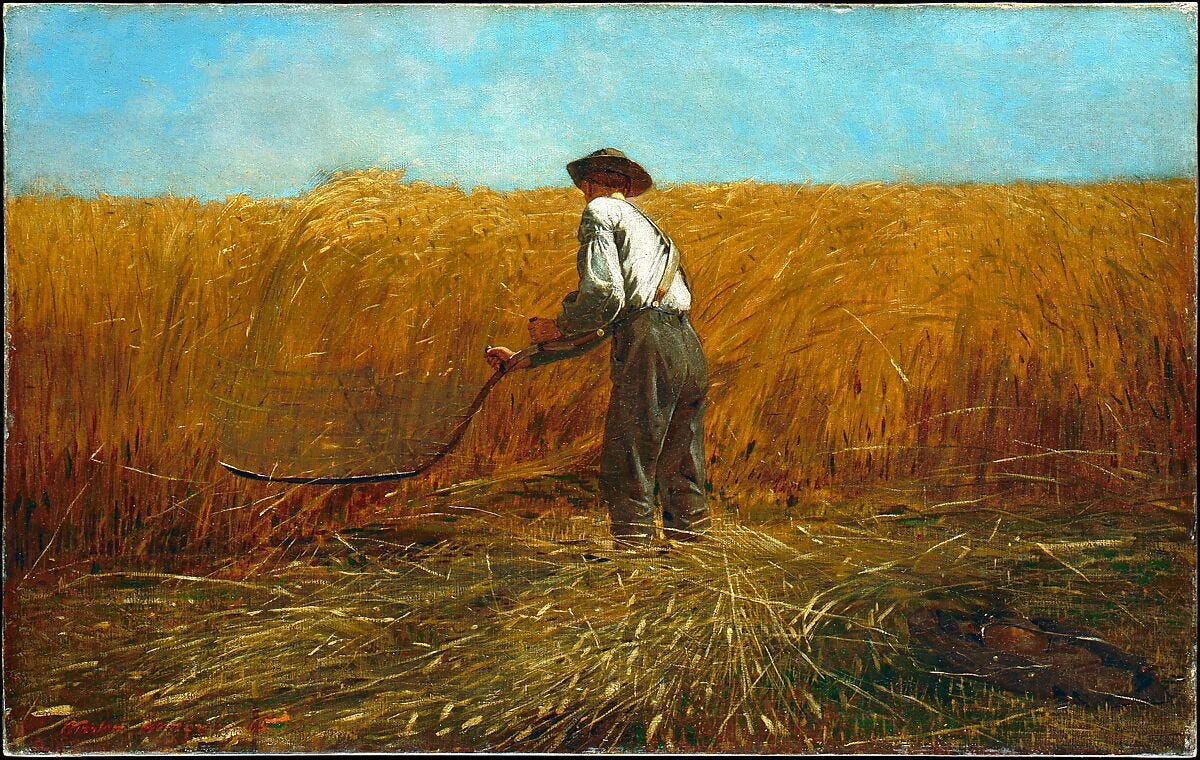
In 1865, months after Lee’s surrender and Lincoln’s assassination, Winslow Homer painted The Veteran in a New Field. A lone farmer cuts through a stand of wheat taller than his waist; a Union Army jacket and canteen lie discarded in the corner of the canvas. The “new field” of the title recalls his old one — the battlefield — and his return to peaceful work echoes Isaiah’s promise that “they shall beat their swords into plowshares.” After the work of war comes the work of cultivation. It is ambitious work, perhaps even overwhelming, given how tall the grass is and how far we have to go, but it is work we must take on nonetheless.
We are the farmers in that field now. To the young people who are doubtful of the land that we have inherited, I would tell them that their skepticism is not the problem. The problem is what comes after skepticism. Withdrawal is the one response that guarantees the systems you distrust will never answer to you, because a government of the people cannot survive the people’s exit. Rededication is not nostalgia, and it is not a demand that you pretend the machinery works. It is the decision that the machine is beautiful and worth the upkeep sweat. It means arguing ideas and believing the best intentions of those with whom we disagree. It means calling out injustice, even and especially when it comes from our own “side.” It means teaching our nation’s history with honesty and reverence — devotion to who she has been and a strong belief in who she has yet to become.
We’ve made it 250 years; the next 250 aren’t guaranteed. We must decide together to be a nation of people who refuse to leave the field. “The better angels of our nature,” as Lincoln wrote in his 1861 plea for the nation's unity, could still be called upon.
It’s our choice whether or not to reach for them.
No posts
Comments
Nothing yet. Say the first thing.
Sign in to join the conversation.