
Note: This story was updated at 10:45 a.m. Wednesday, July 29, 2026, to include information about a major operation to arrest criminal fugitives in Iowa who are immigrants.
Steve Nuessle noticed a car last January in the parking lot at the Bloomington, Minnesota, church where he is pastor. It did not have ordinary visitors.
Nuessle — who lives in St. Paul but is pastor at Portland Avenue United Methodist Church, five minutes west of the Mall of America in Bloomington — had dropped his kids, ages 9 and 12, off at school and had done a stint as a parent-school monitor before going to work at the church building.
These monitors volunteered during drop-off and pick-up times to watch for Immigration and Customs Enforcement (ICE) agents at the English-Spanish dual-language public school where the children of he and his wife, Krista Nuessle, attend. “Kind of the vulnerable times when there were a lot of people, when ICE would potentially be able to park and then snatch someone,” Nuessle, 46, said about his shift as monitor.
The monitors, parents of children at the school, had cameras to shoot video of ICE agents if any showed up and a chat app on their phones to warn other parents and school officials. It was an ad hoc effort by parents, but school officials also were concerned about child safety and the safety of school employees because, being a Spanish immersion school, it had Spanish-speaking workers.
“I want to remind people, at that point they weren’t just picking up people who were not here legally, right?” Nuessle said. “They were just taking anyone who wasn’t white and snatching them up, and so that’s what we were really concerned about with our school staff members.”
So, about that car.
“I pulled up into my church parking lot. There was a car there … it was kind of sitting there getting ready. I was like, I wonder what this is. But then it kind of pulled behind me, and it was two ICE agents,” Nuessle said.
“One of them rolled down his window, pulled out his phone and started snapping pictures of my car, and then they drove off. So, I don’t know if they were tracking me, or marking me, or trying to intimidate me, or what it was.”
His is one of thousands of stories of ICE intimidation at the least and, at the most, people shot dead amid the palpable fear and stress that existed in Minnesota’s Twin Cities area last winter.
It left a powerful, lasting impression.
Recovery from ICE occupation of some of the United States’ largest cities will take a long time. ICE agents arrested an average of 1,264 people daily in Minneapolis, Chicago, Portland, New Orleans and Charlotte in December through January, the American Immigration Council reported in April.
Not only is that an increase north of 300% from the year before. Two out of every three people arrested in these cities last winter had no criminal record. Only 17% had a prior criminal conviction, the Council reported, and only ICE classified only one-third of them as the most serious offenders.
“In other words, the idea that ICE was out in the streets of Chicago and Minneapolis to round up ‘the worst of the worst’ is provably false,” the Council's reported stated. “For every one ICE ‘at-large’ arrest in December through January that involved someone with a prior criminal conviction classified as the most serious threat risk, there were 12 arrests of people with no criminal record at all,” the report stated in bold letters.
The full brunt of the ICE crackdown clearly has been on anyone who looked like an immigrant, and it was severe. We easily could see in real time that ICE tactics were not aimed at the worst of the worst criminals.
“They would pull over anyone,” Nuessle said. “They’d just pull them over, grab them, and they would arrest them, and they would detain them for several hours. … It wasn’t even like a catch-and-release type of deal. It’s like they were taking them, they were arresting them, they were throwing them in their car. They were leaving.”
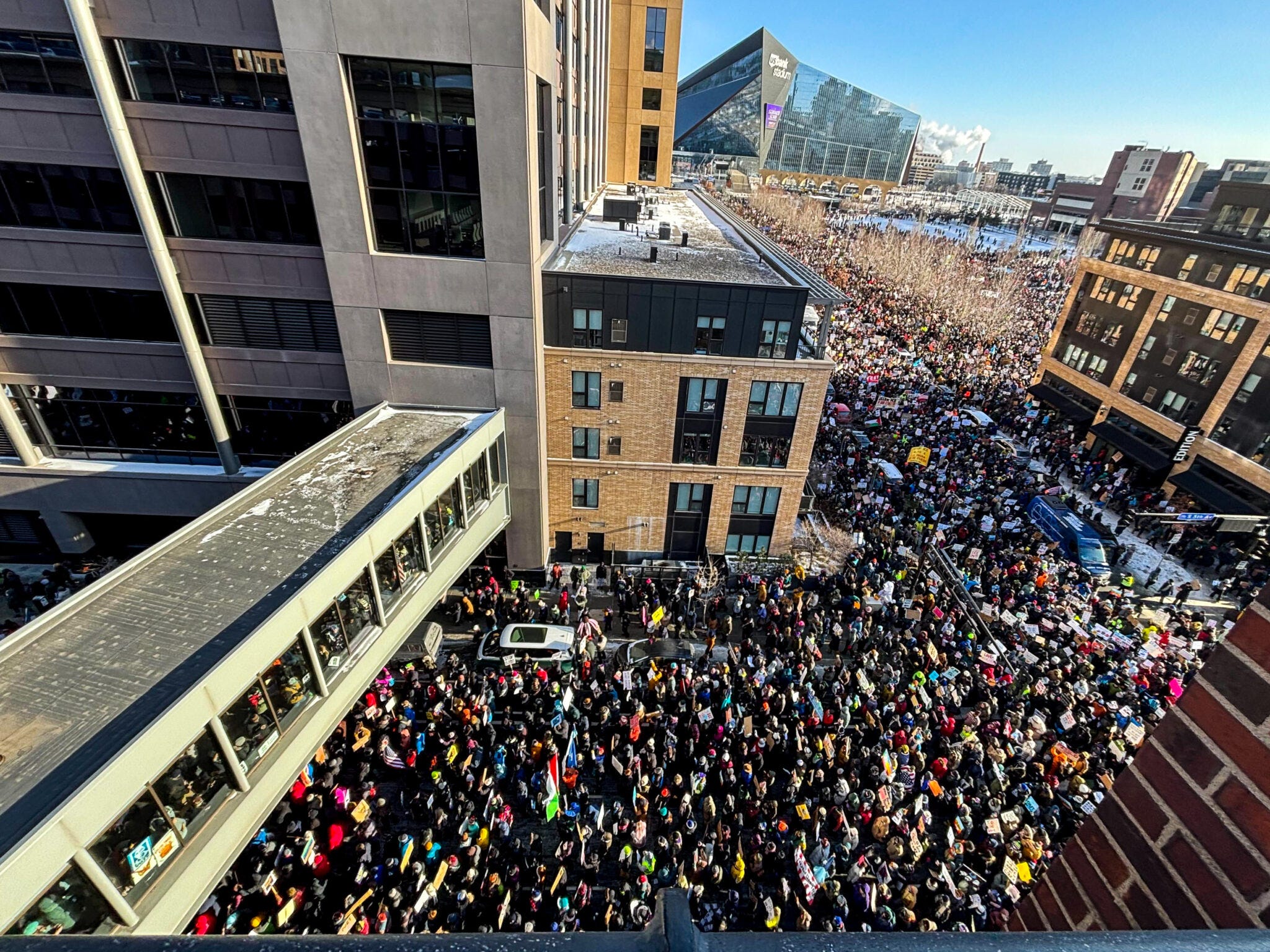
Nuessle said he had been to a few Minneapolis demonstrations against the ICE occupation, including a clergy vigil for ICE shooting victims Renee Nicole Good and Alex Pretti and two huge protest marches, such as a massive downtown Minneapolis demonstration Jan. 23. He led a few neighbor vigils but was more into helping provide food for people who needed it and organizing school patrols.

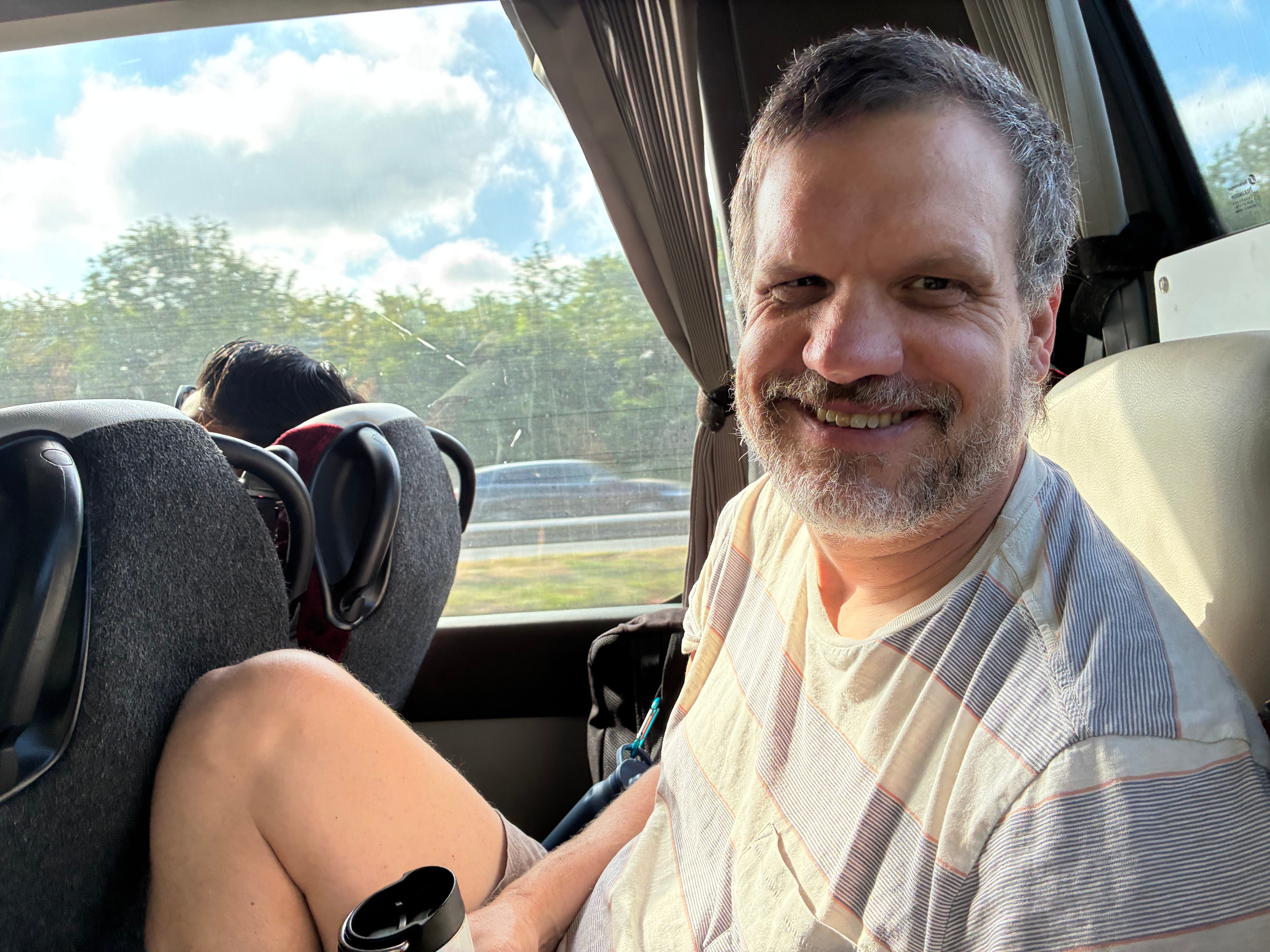
He shared his experiences in conversations he had with me during a pilgrimage we took in early July to places in England where founders of the Methodist movement, John and Charles Wesley, lived and worked.
The setting for our conversations was appropriate. The Wesleys preached love as the way to get closer to and be like Jesus. Nuessle sees his work supporting immigrants as following that call.
“I’m a white dude. I’m a middle-aged white dude. I’m a citizen. Like, I was not especially worried for myself in that sense,” Nuessle said. A reminder: Alex Pretti and Renee Nicole Good were white, too, and they are dead.
One case that got a lot of attention was 56-year-old Chongly Scott Thao’s forced removal from his St. Paul home by ICE agents. Agents broke his door down without a warrant and dragged him in his underwear and a blanket into the cold, January air. Thao said agents drove him to a place he did not know, interrogated him and returned him home.
RELATED: ELDERLY HMONG U.S. CITIZEN DRAGGED OUTSIDE UNDRESSED DURING ICE RAID, by Sharad Swaney, Centered America director
RELATED: ICE JUST EXECUTED A MAN IN MINNESOTA, by Gabrielle Blair
RELATED: MISOGYNY, MURDER AND RENEE NICOLE GOOD(E), by Broadwaybabyto, The Disabled Ginger
“There’s stories of like cars like still rolling down the street that they yank the person out of there, and then they cause accidents,” Nuessle said.
Fact check: It happened at least once, drawing the ire of Minneapolis Mayor Jacob Frey.
Nuessle described his church in Bloomington as older and “a pretty typical Methodist church” with about 50 people for Sunday worship. He said it is divided 75/25 to 80/20 when it comes to people outraged over ICE tactics and people leaning toward supporting ICE efforts.
Even so, it provided food for up to 10 families in churches for Central Americans that stopped meeting for fear of being arrested. “People even who might have been somewhat supportive of ICE, they were still willing to contribute food and supplies and money as well.”
Share Lyle Muller Doesn't Have a Fancy Column Title
In St. Paul, “I was able to do things outside of my church that were meaningful, including my kids’ schools,” Nuessle said. “I live in an area that was very impacted. My kids’ schools were very impacted, and then the other congregations that met in my church were very impacted as well.”
Schools offered virtual learning, for example. “We had set up networks to provide food for those families, to provide rides for the kids, for those who didn’t feel safe sitting at bus stops and things like that. So, it was a massive disruption — not the high-profile things that probably got the news like the Minneapolis situations, but it was not all that different,” he said about St. Paul.
One high-profile incident in St. Paul happened Jan. 18 when protesters disrupted worship at Cities Church. Thirty-nine people were charged with conspiracy against the right of religious freedom at place of worship and injure, intimidate, and interfere with exercise of the right of religious freedom at a place of worship.
Several notable people, including journalist Don Lemon, were arrested at Cities Church but the charges were dropped in June. Those invading the church service aimed their protest at the Rev. David Easterwood, a church pastor who served as a field office director for Minnesota.
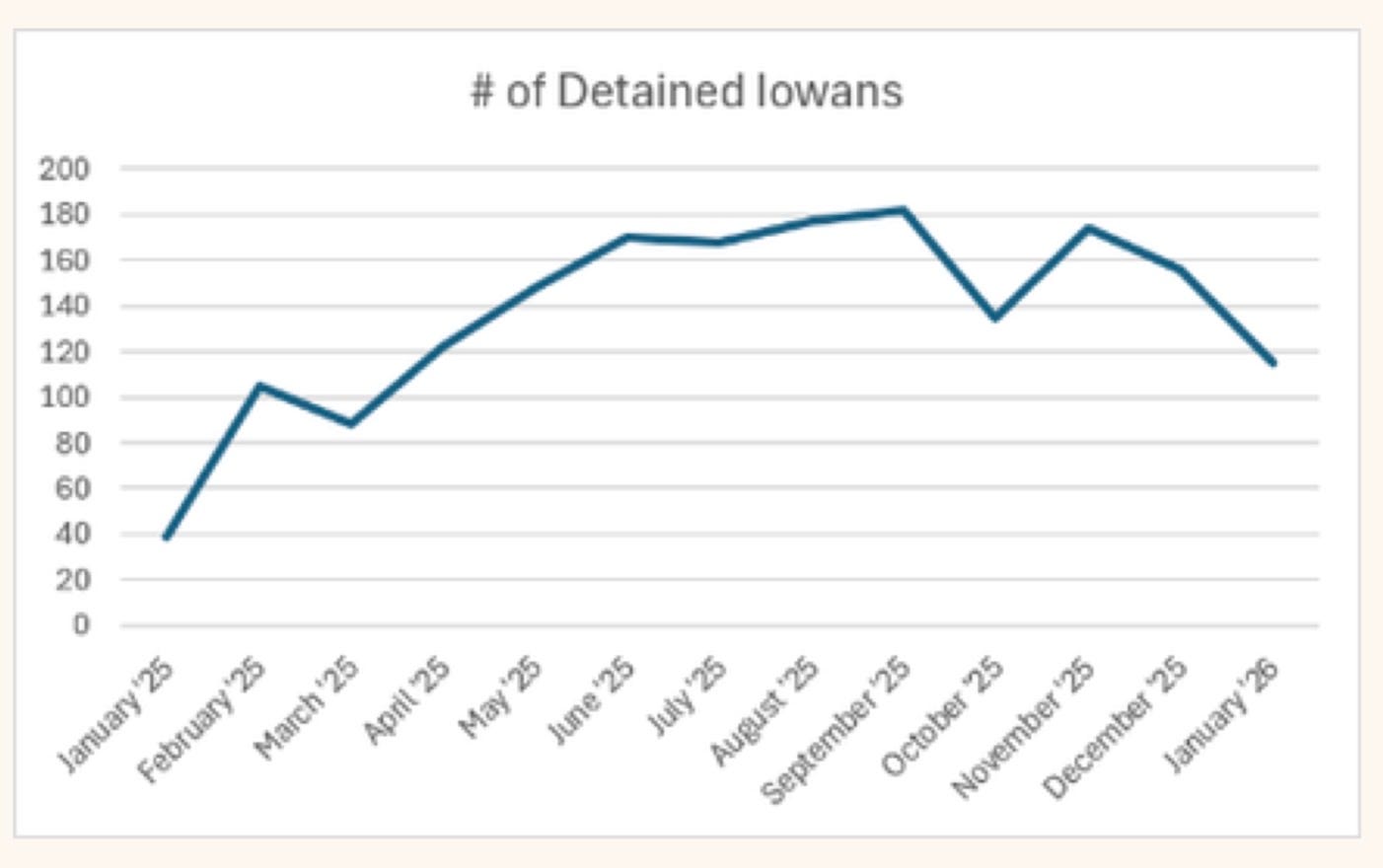
The week after Nuessle and I spoke, Iowa Migrant Movement for Justice released data that showed ICE detained at least 1,779 people in Iowa in 2025 after Donald Trump brought his flaming anti-immigrant, deport-first policy to the presidency.
Almost all of them — 1,170 — were men.
“Overwhelmingly, Iowa MMJ receives calls from mothers, wives, girlfriends, and entire networks of female family members desperately seeking help for their fathers, husbands, and sons,” the report states. The ratio of men to women detained was 25-to-1. “This sharp ratio has given way to a phrase being told in communities across the state, ‘They (ICE) are taking our fathers.’”
Arrests increased steadily each month into September but still outpaced the previous year, the data showed. Most ICE arrests are made when a motorist is jailed after an arrest by local police. This includes minor traffic stops, the data showed.
Ages of the those ICE detains ranged from 18 to 72, with an average age of 34, the report stated.
“It is important to remember that the data represents Iowans. Every number represents an Iowan who was seeking safety, opportunity, and the chance to build a life for themselves and their families,” Migrant Movement for Justice leaders wrote in the report.
“The data confirms what our communities know to be true: the Trump administration’s mass deportation agenda is actively happening in Iowa through close collaboration between the federal immigration agency and local law enforcement. Differentiating ICE agents from local law enforcement can be impossible because masked men in unmarked cars wear bulletproof vests labeled ‘police,’ stopping community members on the street with guns.
“Separating ICE agents from local law enforcement has turned into an impossible task. For vulnerable communities, these realities represent real terror that haunts them daily.”
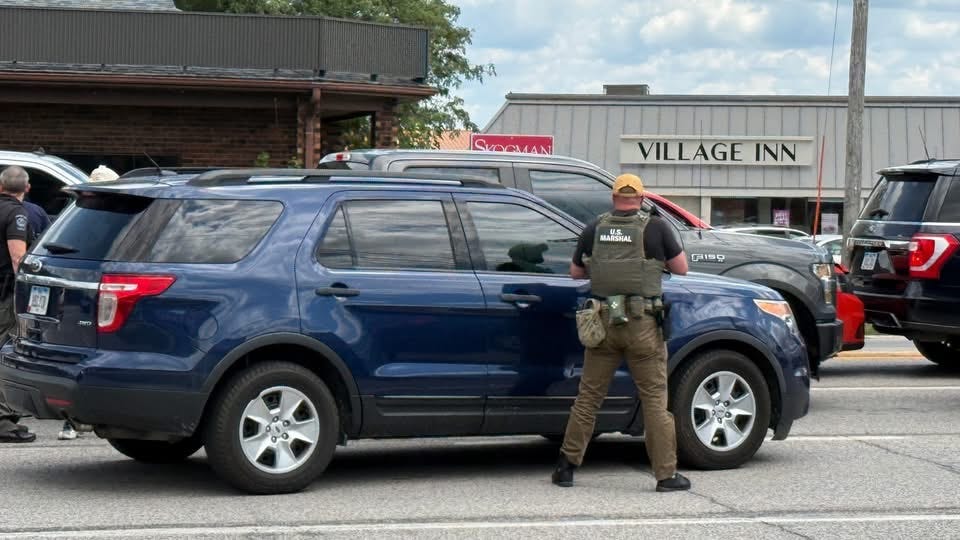
The U.S. Marshals Service’s Southern Iowa Fugitive Task Force enlisted several local law enforcement agencies for a crackdown called Operation Heatwave on July 21-24, in its words, “with the goal of removing dangerous fugitives from the communities of central Iowa.”
Sixty-one people were arrested and 97 warrants were cleared, the U.S. Marshals Service reported.
A news release said the target was violent offenders and gang members; it listed five bad actors arrested in Des Moines whom the task force called notable. Their crimes included sexual assault on a minor female, distribution of methamphetamine and fentanyl and possession of a firearm.
Helping the task force, and officers from the U.S. Department of Homeland Homeland Security, Bureau of Alcohol Tobacco and Firearms and USDA Office of Inspector General, were the Iowa State Patrol, Iowa Division of Criminal Investigation, Des Moines Police Department, Ames Police Department, Ottumwa Police Department, Coralville Police Department and Dallas County Sheriff’s Office.
“Locating and arresting the most dangerous offenders remains one of the highest priorities of the U.S. Marshals Service,” U.S. Marshal Ted Kamatchus, of the Southern District of Iowa, was quoted as saying in the press release. The enforcement coalition began planning the aggressive four-day crackdown June 29, the news release said.
Officers targeted those “wanted for crimes including homicide, robbery, sexual assault, aggravated assault, weapons offenses and other serious felony offenses,” the release stated.
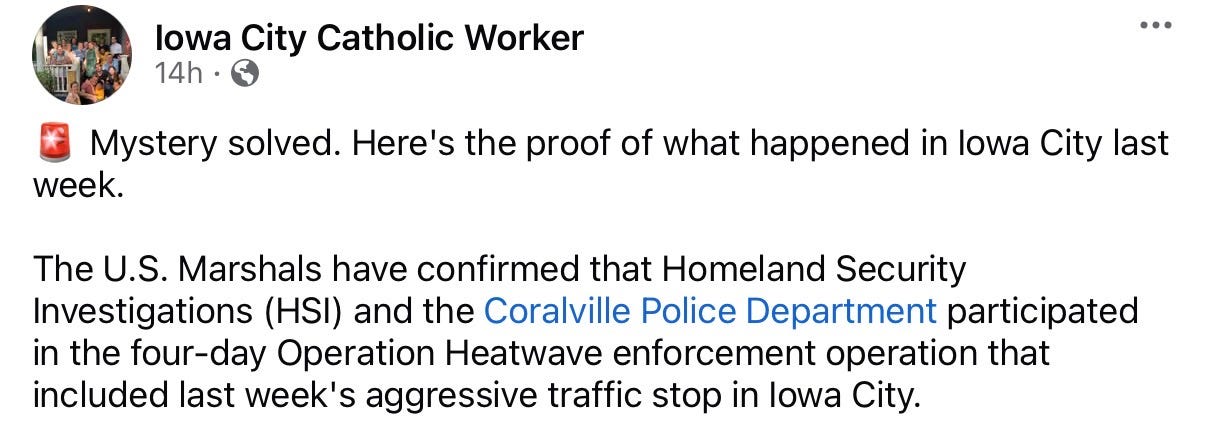
Catholic Worker House in Iowa City posted on Facebook: “Despite the public messaging spin, only 12 of the 61 people arrested were so-called ‘violent criminal offenders.’ The vast majority were arrested for other alleged offenses.” The organization had posted last week photos of big traffic stops in Iowa City by Coralville police and U.S. marshals,
Getting 12 bad guys off the street and in jail sounds A-OK. The concern, here, is public trust.
“The public deserves transparency about why heavily armed, high-risk traffic stops like this are being carried out in our communities - and whether these dangerous tactics make us safer or simply put the public at greater risk.” Catholic Worker House wrote on Facebook.
Immigrant supporters in Eastern Iowa are planning to be at ICE’s Cedar Rapids headquarters, 3351 Square Dr. SW, to accompany outside the building immigrant Iowan check-ins on Tuesday, Aug 4, and Wednesday, Aug. 5, starting at 7:30 a.m. each day. Anyone interested in joining may RSVP here.
At last report, organizers Escucha Mi Voz Iowa and Iowa City Catholic Worker House knew of at least 13 families who were to check in during those days. That can change between now and then.
Video and photos from the Twin Cities last winter were jarring and data like that produced in its neighbor to the south, Iowa, are noteworthy. But Charlie Cook, founder of the nonpartisan Cook Political Report, says immigration likely will not move the needle when it comes to independent voters in the upcoming midterm elections.
“I think you have plenty of people that feel very passionately about the immigration issue, some on each side,” Cook said in a July 20 Zoom session with the Iowa Writers’ Collaborative, “and most of them are not swing voters.”
Cook said: “You show me people that are militantly against ICE, and I’ll show you somebody that probably hasn’t voted for a Republican in a while. You show someone who is absolutely livid about what was happening along the border during the Biden administration, and I’ll show you somebody that probably hasn’t voted for a Democrat in a long time.”
Cook is a polling expert, but something disheartening exists in his assessment. Are independent swing voters incapable of being an effective group to oppose mistreatment of American citizens by their government that includes killing innocent people?
Earlier this month, an ICE agent fatally shot Johan Sebastián Durán Guerrero, 25, of Colombia, in Biddeford, Maine. The Department of Homeland Security’s stated reason was the vague: concern for public safety.
In Florida, Juan Jairo Coronilla Durán, a 28-year-old Mexican vacationing in the United States, died July 14, when he ran into traffic and was struck by a truck while running away from ICE agents. Think about this: you are in a foreign country on vacation and masked men try to grab you. You run.
In another ICE shooting, Lorenzo Salgado Araujo, of Mexican, was shot in Houston while backing up his vehicle and ramming an unmarked ICE vehicle that was following him. Homeland Security officials said he was trying to hit an ICE agent partially in the vehicle or just outside it, who fired in self-defense.

US Attorney SDTX@USAO_SDTX
Statement from @USAttyReitz on the shooting and death of Lorenzo Salgado. Video below. Written statement here: justice.gov/usao-sdtx/pr/u… @USAttorneys
10:15 PM · Jul 16, 2026 · 299K Views
241 Replies · 212 Reposts · 907 Likes
Nuessle said the effects of last winter’s ICE occupation in the Twin Cities will stay with him a long time. “You can’t be 100% on edge from the moment you wake up to the moment you— you won’t last. You’re going to burn out, and bad things are going to happen. So, I try to think of it as a rhythm. It was a tense rhythm,” he said.
Nuessle said he worries about the effect last winter’s ICE presence where his family lives will have on his children. “I wanted them to try to live about as normal life as possible, not get too caught up in it,” he said.
“I just don’t know how it’s going to impact my kids because they saw it in their schools every day. They had friends who had to stop coming to the school. They had neighbors who had different circumstances, and they sponge up more than I realize, I think.”
Looking back, he said: “I didn’t feel it was too much of a risk to stand up and do something. But I was also very heartened, I would say, by my neighbors and people who took the mantle themselves, and really seeing the different people stand up and do this work in different ways.”
“It really made me appreciate those around me,” he said. “However. However, it has really shook my belief in this country in a way that I did not think was possible.”
The first months of 2026 have given Nuessle plenty to think about now that summer gives him time to reflect. “It’s just been bad. It’s unnecessary. It’s terrible,” he said.
“It did a lot of damage to a lot of people. I see people, and I know that they are crushed by this and have not recovered well. And there’s just going to be years and years of work to get to a place where people are back to some semblance of normal.”
Lyle Muller is a proud member of the Iowa Writers’ Collaborative. Check out some of the collaborative’s most recent reporting in this week’s summary. He has spent the last few years researching United Methodist history. He has a book, which you may order here.

No posts
Comments
Nothing yet. Say the first thing.
Sign in to join the conversation.