
I try not to share too much about my kids' personal lives. When Mario entered elementary school something shifted in me. The older he got the clearer it became: this kid who shows up fully himself in every room he walks into is not really "my kid" to share. He is just his own person and I don’t want things I share publicly to interfere with who he is becoming. Every year that passes I feel less and less like I have the authority to air his business online. Today I am breaking that rule. Not to expose him but to open a conversation. And for what it's worth, I am fairly confident none of his Portland school parents are subscribed to this little newsletter, so we should be safe. Thanks for reading with care and humility. xx LL
On our first day back in town last week I was in the garage looking for Felix’s helmet. Mario joyfully rediscovered his bike and was in front of the house doing laps in the street. It was a warm evening and we had landed a few hours prior from Rome. I saw a kid in a ball cap passing across the street and saw Mario approach him from behind. I heard him use a silly voice and say ‘hey where do you think you are going?’ in a mock authoritarian voice. An invitation to start a conversation or in the least a ‘hi’. The ball cap boy barely flinched, didn’t acknowledge Mario and just kept lunging down the street. I watched as my son playfully put himself out there to a kid he had been in school with since kindergarten. A kid who was hot and cold with Mario. Some days telling him he couldn’t sit by him on the bus and other days Mario would come home from the bus stop and proudly tell us “Stan* let me sit by him today and told me I am his friend”. *The kids name is not really Stan but I am not going to share his name for obvious reasons.
I vaguely recognized the kid in the cap but when he ignored Mario it cemented who this kid was. It stung. I immediately caught myself telling Mario what a bummer it was that the kid acted that way. I led with my near constant refrain of "maybe his cat just died," the joke we use in our family when someone is rude or gruff with us. And then I called him a jerk anyway.
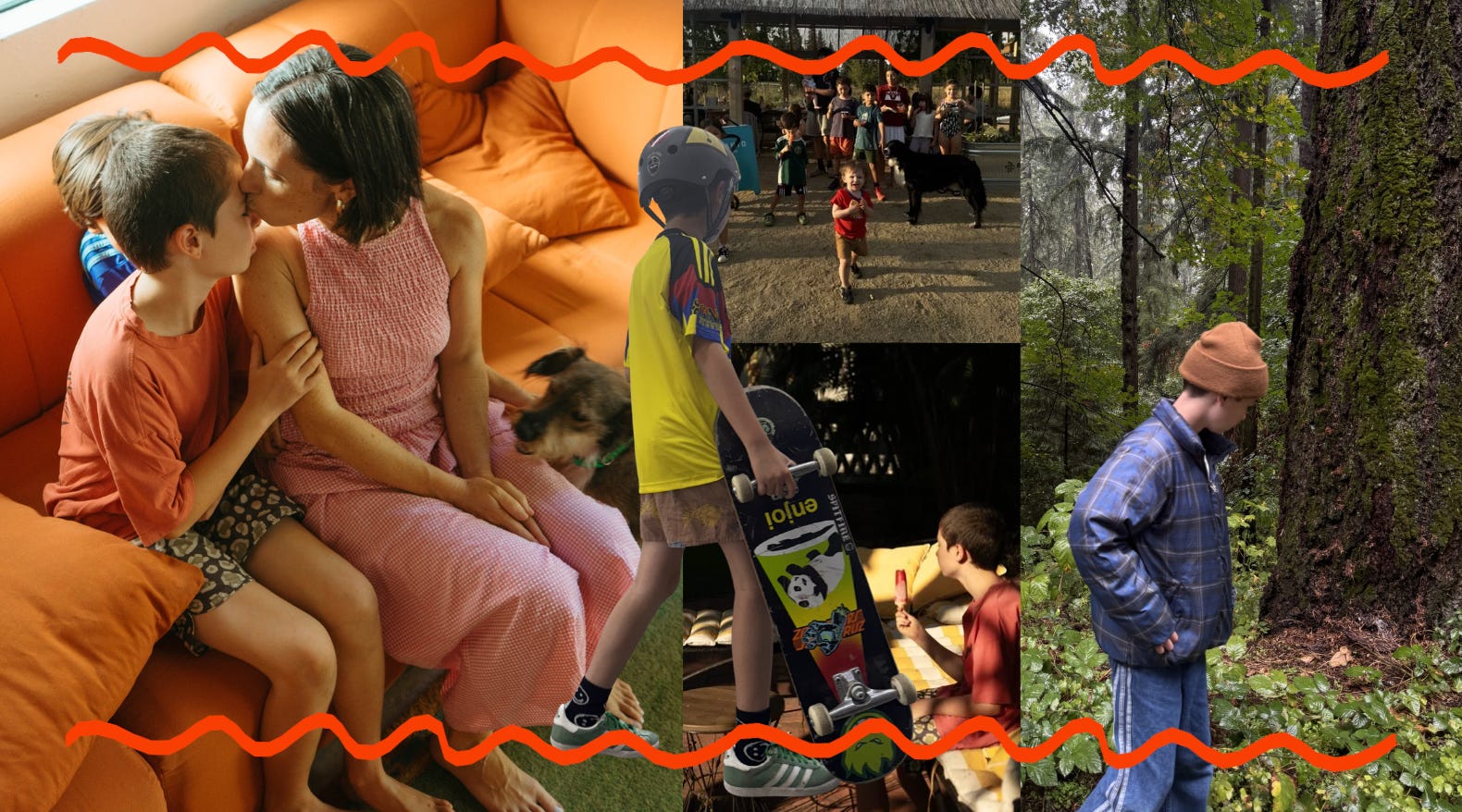
I wrote about my feelings around raising a boy in 2017 for Mother Mag, when Mario was almost three and I was still figuring out what it meant to raise a little white boy as a Mexicana- Americana. How I wanted him to be aware of his privilege and connected to his Mexican roots. Proud of where he comes from on both sides. At that time I was afraid of what my son would become. I saw his white privilege as a defining character trait. The things I feared were American patriarchal archetypes. A frat boy, a jock, a jerk.
Before I go any further, I must also confess that Mario is not a saint. He is equal parts fun and challenging but guess what, he can actually be a jerk sometimes too. Uniquely to his brother. Six and a half years his junior.
Now as a rising sixth grader I am not worried about those things. We continue to talk about privilege openly. And I see a kid who genuinely wants to be everyone’s friend. I observe an innocence and zero ‘cool kid’ posturing. I would like to believe that the conversations around privilege and culture and identity have produced this in him. I am proud of that.
We are in the awkward years for sure and he is transforming in front of me so my question now becomes what kind of man is he becoming and what is my role in that? What I wrote all those years ago was abstract. But now I am watching it all happen in front of me, in real time. The social dynamics, the kids who won’t include him. The way he still tries anyway, reaching for approval from kids who aren’t ready to give it.
I see in this pre-teen a sense of innocence, wonder, curiosity and energy that I want to protect. Hold onto as long as possible. In the fall of his fourth grade year I mentioned to Mario's teacher his feeling of being on the outs with some of the cool kids. I wanted to see if she observed anything in class that could help him, or help us. She told me he had checked out a book from the library about dinosaurs and was really into it, sharing new facts with his classmates daily. She noted that some kids had moved beyond dinosaurs by fourth grade. More into video games, TV shows, soccer. But then she said: "Hold onto that as long as you can." She was a mom of two grown boys. I felt that in my bones and knew we were going to be alright.
In Mexico it is different. The school is small. He has been in class with the same kids since kindergarten. We know every family. Birthday parties include the whole class, parents and siblings in tow. These are kids who have grown up alongside him, who move between Spanish and English depending on the day, many of whom also know what it feels like to live between two places and occasionally feel like an outsider. Our small community fosters a kind of innocence and openness that I have come to depend on. Sometimes all the kids running wild on the beach at sunset feels a little Lord of the Flies. But that's part of growing up in the jungle. The belonging there has never been something we had to think about or engineer.
I sometimes wonder if our lifestyle of living between two places has not allowed him to fully integrate here in Portland. If that not integrating is costing him something. How living in two very different communities with two very different cultures is damaging to his potential for a solid crew, a pack, somewhere to belong. I question the benefits of consistency versus the perceived gift of resilience. I struggle with this guilt. Am I making things harder than they need to be? Would this same struggle still happen if we were just living in one place instead of two? If the clique problem is not geography but just this stage of adolescence.
And then I start thinking about the myth we are told. The myth that your neighborhood school or any school becomes your social world, your village, your people. I see friends living this dream. I see moms at our Portland school who appear to be living it too. And I won’t pretend I don’t feel a pang of something watching that. But then I remind myself: it was never my reality, not even as a kid.
I went to alternative schools outside my neighborhood so the built-in social world never existed for me either. My network has always been rooted in family. A large gang of cousins and my lifelong friend Emily, who I have known since I was one year old. To this day that holds. We share a nanny with my cousin Anni, rotate family dinners between backyards all summer long.
I remind Mario of this. That at his age and well into HS, to this day even, I straddle multiple friend groups. I was voted ‘most outgoing’ in HS. And that my closest and most valuable relationships were with my cousins and my neighborhood friend, Emily again, who was a year older than me and not at my school. As it turns out his cousins here in town are his best playmates and his best friend in Portland is our across the street neighbor a couple years older and not at his school. They have been going back and forth from house to house playing and now ‘hanging out’ and growing up together. We adore their family and look forward to hosting them in San Pancho next spring.
The boy I feared, the frat boy, the jock, the jerk. Is not at all who he has become.
His teachers in both countries tell us he is a helper. That he is friends with the girls and the boys equally- somehow worth mentioning. He started a comic book club in Portland. In Mexico he scripted a short film and spent multiple recesses casting and filming it with his classmates.
I don’t know if any of what we are doing is right but I would like to believe that the life we are choosing has something to do with his nimbleness. The two languages, the two countries, the skateboarding, dinosaurs, the cousins, the neighbor across the street. Maybe that is just what consistency looks like for him.
Culturally we spend a lot of time talking about mean girls. The cultural narrative around adolescence and cruelty is almost entirely focused on them. The movies, the books, the cautionary tales. Can we blame this on the patriarchy? Nobody really warned me about the boys. The quiet ones who won’t let your kid sit on the bus. The ones who just keep walking.
I want to hear from you. How do you talk to your kids about belonging when you can't fix it for them? Do you call the other kid a jerk too or do you hold it together better than I do? Are you living the neighborhood school dream or did that myth miss you too? Please share it in the comments. I am genuinely asking.
xx LL
No posts
Comments
Nothing yet. Say the first thing.
Sign in to join the conversation.