
August 5, 2026 · AR & Analyst Industry Watch #59
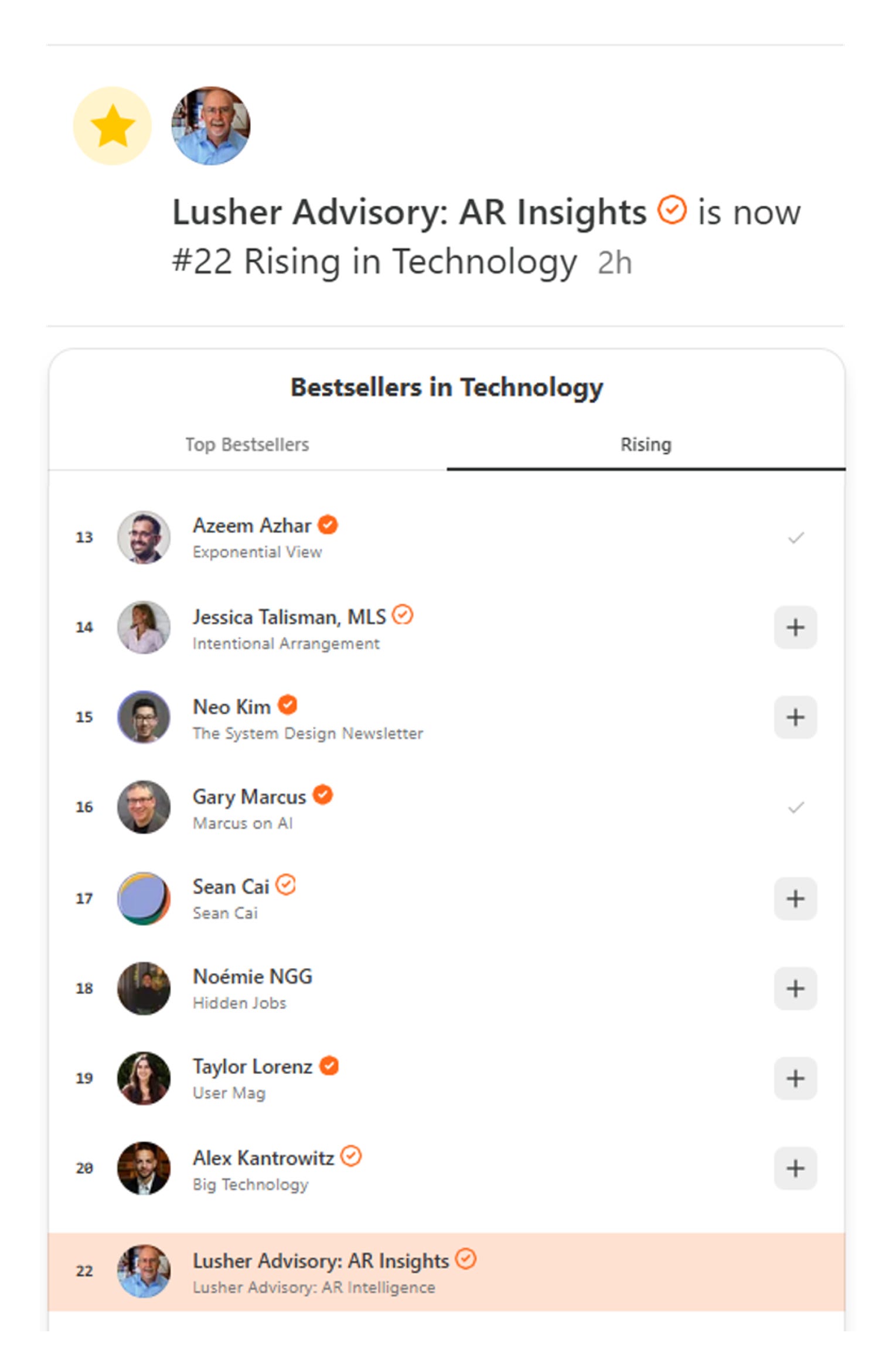
A pleasant surprise arrived just after I wrapped this month’s AR Intelligence: Quick Shots webinar. Substack notified me that Lusher Advisory: AR Intelligence had entered its Rising in Technology bestseller list, debuting at #22.
At first glance, that’s a little surprising. I don’t write about AI model releases, venture funding, or consumer gadgets. I write about Gartner, Forrester, IDC, analyst relations, and the competitive dynamics of an industry that many people assume is simply too niche to matter.
Yet the audience keeps growing.
I don’t think that’s because more people suddenly became fascinated by analyst firms. I think it’s because the analyst industry has become a useful lens for understanding a much bigger story.
The more I’ve researched analyst firms, the more I’ve come to see them as part of a broader information system. Technology vendors invest millions trying to influence analyst opinion. Enterprise buyers rely on analyst research to reduce risk. Investors listen for signal in earnings calls. Increasingly, AI systems are consuming all of that content too.
Analyst firms don’t simply publish research — they shape how information moves through the enterprise technology market. Once you look through that lens, the audience expands well beyond analyst relations professionals.
When generative AI arrived, the obvious prediction was that analyst firms would become obsolete. My reporting has pointed in a different direction: the firms making the most progress aren’t trying to compete with AI directly. They’re rebuilding around the assets AI can’t easily manufacture — proprietary data, trusted methodologies, human judgment, long-term client relationships.
Verdantix’s Voyager and IDC’s Quanta both point that way, designed to augment and scale analyst expertise rather than simply automate report generation. Gartner is taking a different route. My 2Q26 earnings analysis found the company doubling down on a walled-garden strategy — keeping its research and AI tooling tightly closed rather than opening it to broader consumption. Different bets, same underlying question: what unique information assets become more valuable once AI makes synthesis essentially free?
That question is also the thread running through what I call the Three Waves of Analyst AI Adoption. The first wave was about productivity. The second is about new client experiences. The third — and the most strategically important — is about redesigning the analyst firm’s operating model around AI itself. We’re only beginning that third wave.
The bestseller ranking was a pleasant surprise. The more interesting signal is that conversations about analyst firms are no longer confined to analyst relations teams — they’re increasingly conversations about AI, trust, and how enterprise knowledge gets created and distributed. Those are much bigger topics, and I suspect they’re only going to matter more.
Thanks for being part of that conversation — for reading, arguing with me in the comments, and treating a “niche” topic as the window into bigger things it actually is.
Onward.
Comments
Nothing yet. Say the first thing.
Sign in to join the conversation.