
August 5, 2026 · AR & Analyst Industry Watch #59
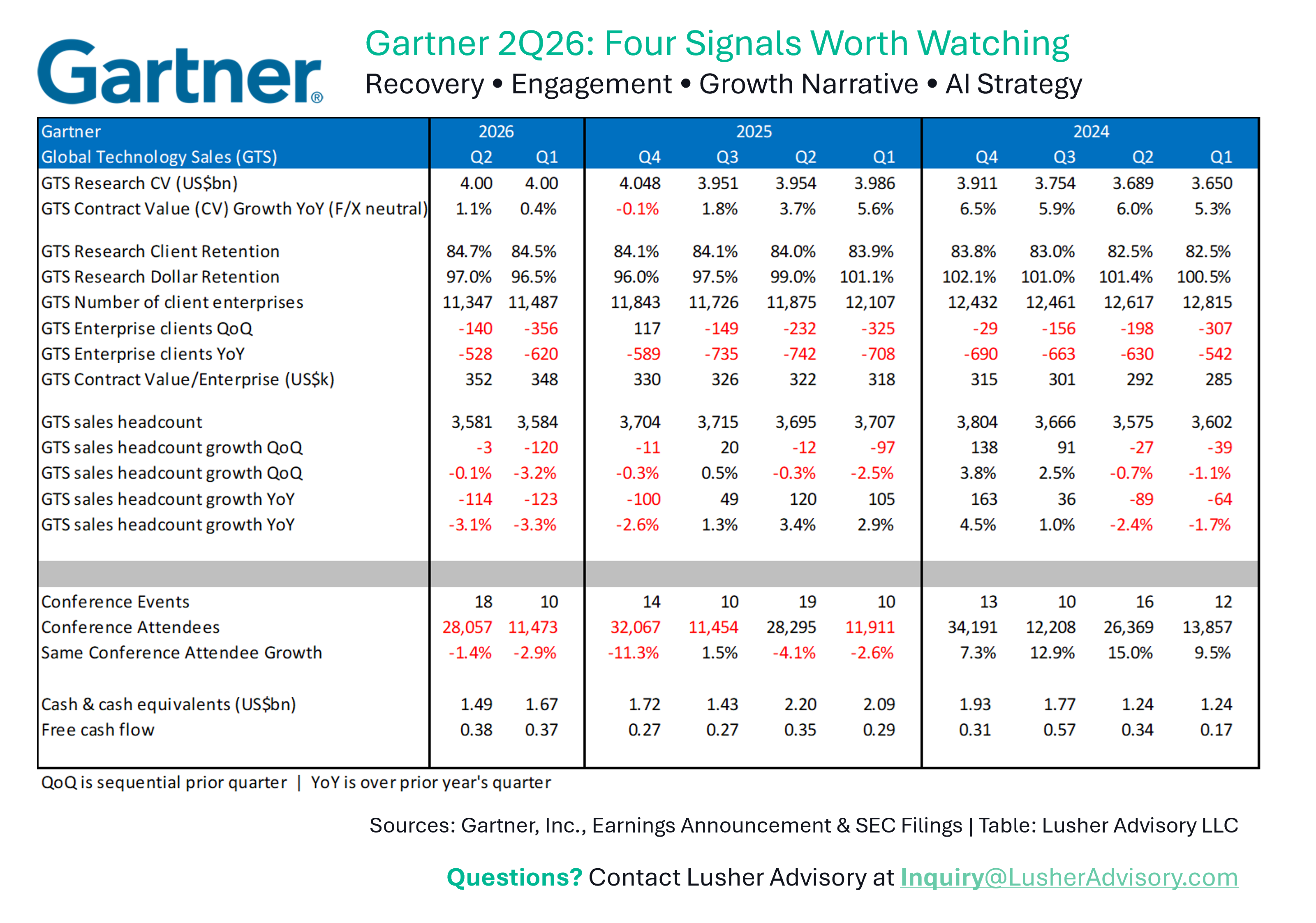
One of the more revealing aspects of Gartner’s 2Q26 earnings call wasn’t what Chairman and Chief Executive Officer Gene Hall said — it was what he chose to emphasize. Rather than spending much of his prepared remarks on Gartner’s quarterly operating performance, Hall devoted most of his time to reinforcing Gartner’s value proposition: helping enterprise leaders navigate unprecedented change through proprietary research, expert guidance, and the ongoing Business & Technology Insights (BTI) transformation. Detailed business metrics were largely left to Chief Financial Officer Craig Safian. That messaging set the tone for the quarter. Gartner wasn’t simply reporting better financial results — it was explaining why management believes its competitive advantage becomes more valuable in the age of AI.
On the BTI transformation, Hall said in his prepared remarks:
“…the heart of this change is our Business and Technology Insight (BTI) transformation. We continue to make progress on this transformation in four key areas: volume, impact, timeliness, and user experience. … documents in our Insights library are up 18% … higher-impact documents up double digits. …insights we produce immediately after important events are up significantly. …we continue to enhance the Gartner digital experience…”
In his prepared remarks, Chief Financial Officer Craig Safian said:
“Client engagement continues to improve meaningfully, increasing 140 basis points versus last year across both digital and human interactions… Digital engagement improved by more than 110 basis points year over year. Human interactions increased more than 150 basis points year over year…”
Taken together, the two executives framed the quarter less around what Gartner earned and more around how Gartner creates value. That distinction matters. Across the earnings call and the company’s evolving investor presentations, management is increasingly asking investors to evaluate Gartner not only through traditional financial metrics such as contract value and retention, but also through operational leading indicators tied to engagement, research production, and the BTI transformation.
Dig Deeper:
Is Gartner’s influence on technology buying recovering — or merely stabilizing?
Are Gartner’s new client engagement metrics becoming meaningful leading indicators?
Why is “productivity before hiring” become Gartner’s growth strategy?
Why did Gartner quietly replace “double-digit” growth with “durable” growth?
Is Gartner doubling down on a “walled garden” for AI while competitors embrace workflow integration?
Additional reading: Lusher Advisory: Research on Gartner. This directory brings together Lusher Advisory’s independent research on Gartner – including news, earnings, business model analysis, predictions, webinars, and more – in one place.
Comments
Nothing yet. Say the first thing.
Sign in to join the conversation.