
Poor Ophelia. Innocent, white-dressed Ophelia, the most beautiful & waifish maiden in the land. She remains, even in her grieving madness, the ‘pretty lady’ (iv.v.41), ‘Pretty Ophelia—’ (iv.v.56).
Dear Ophelia, beloved for the loveliness of her corpse. She fulfilled that coveted feat of remaining so perfectly female, so utterly romantic, even as she drowned. Her flesh will never bulge or distend as waterlogged bodies must; she made a wonderful role model for L’Inconnue de la Seine.
The death of a beautiful woman is, unquestionably, the most poetical topic in the world.
— Edgar Allen Poe, ‘The Philosophy of Composition’
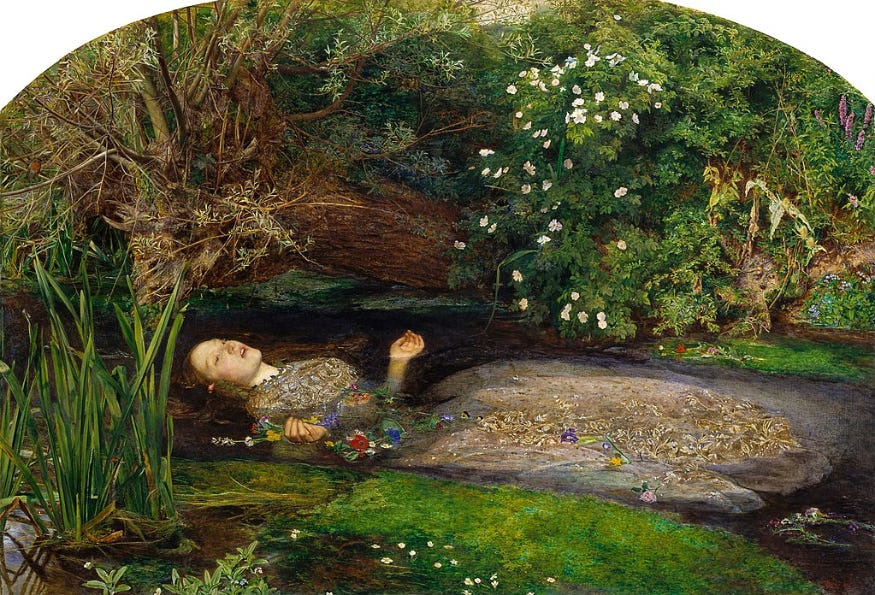
This is the cult of Ophelia — a veneration not so much of the blooded, living character as she is staged in Shakespeare’s Hamlet,1 but of her iconography, specifically that of her death-scene. I know this because I, admittedly, would (and still) go on regular pilgrimage to pay homage to John Everett Millais’ Ophelia. I too have dreamed of a watery grave. This, more than anything, seems to be the modern inheritance of ‘Ophelia’; not her life or love story, as Elaine Showalter writes, but the ‘history of her representation’.
It is this that has sanctioned the latest invocation of the object-Ophelia: Taylor Swift’s song ‘The Fate of Ophelia’ in her album The Life of a Showgirl.
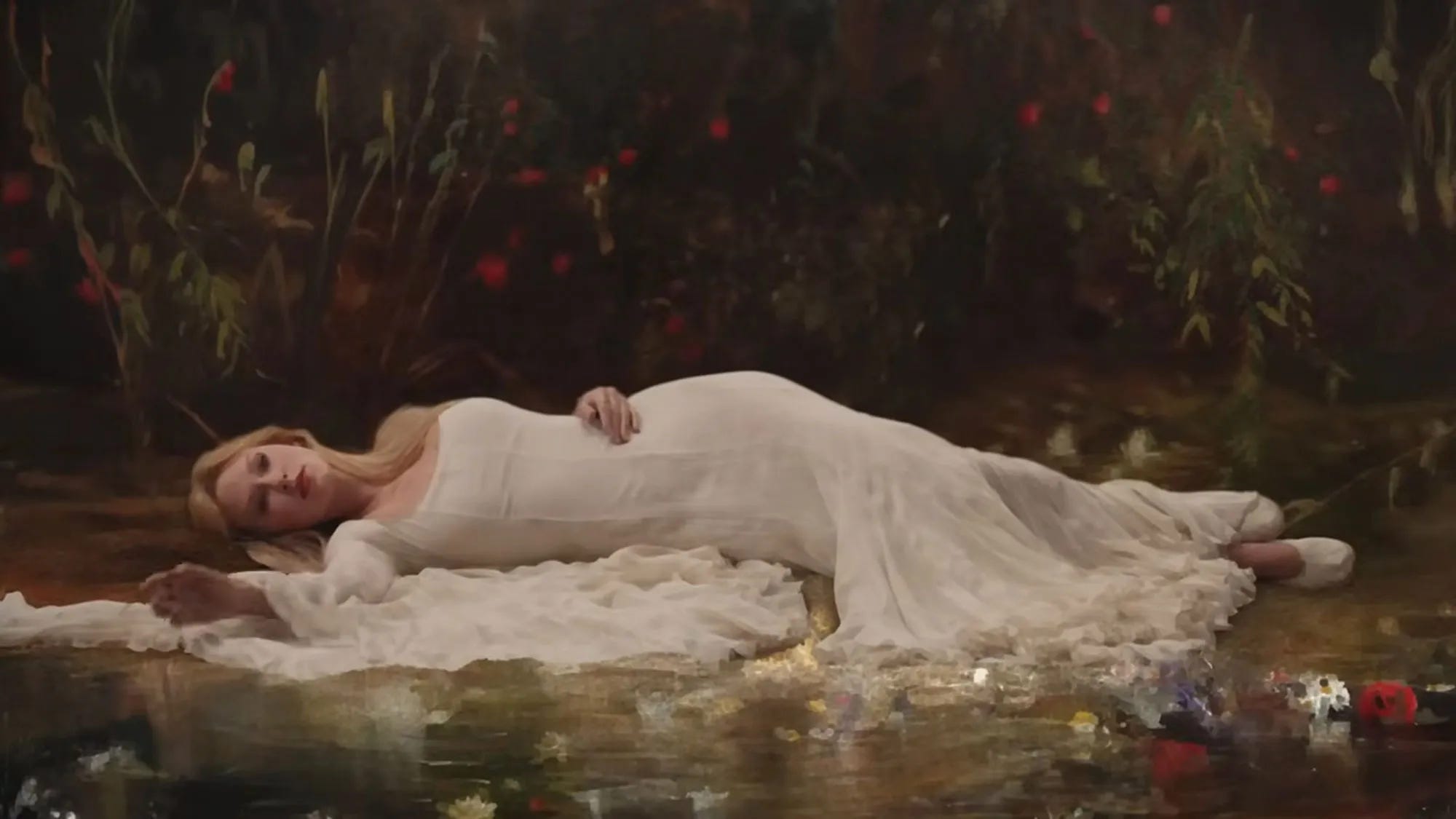
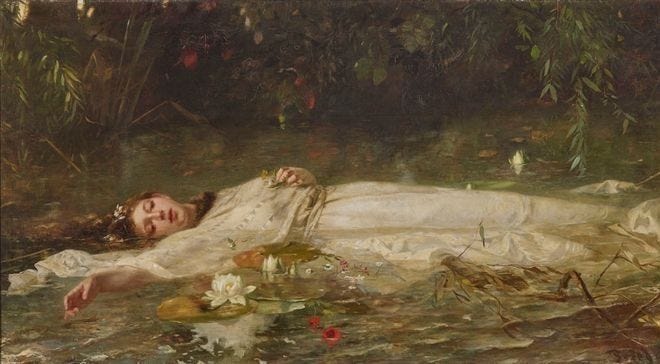
The dislocation of the Ophelia-figure from her source text to her extra-theatrical representations is not, however, necessarily an injustice to or misinterpretation of the interior workings of the play. Ophelia’s legacy as the image is foretold and encoded within the script; the reverence of the iconographic Ophelia is a perpetuation of the play’s own rhetoric. This would always have been her fate.
𓇢𓆸
Ophelia asks to be remembered: ‘There’s rosemary: that’s for remembrance. Pray you, love, remember.’ (iv.v.169-71). She dictates much of her own symbolism that is preserved in her representations: her strewing of flowers, her setting of the river. What has been lost, or deliberately eroded, however, is her speech — and the art of her song.
We do remember Ophelia: her wish, in part, has come true. But it is not by her own words that we do so.
Ophelia’s ‘mad-scene’ is the only plausible point of the play where she appears to wield a kind of agency, abandoning constraints of court etiquette. Her song has a keen intelligence, disguising revelation through the guise of the ballad.
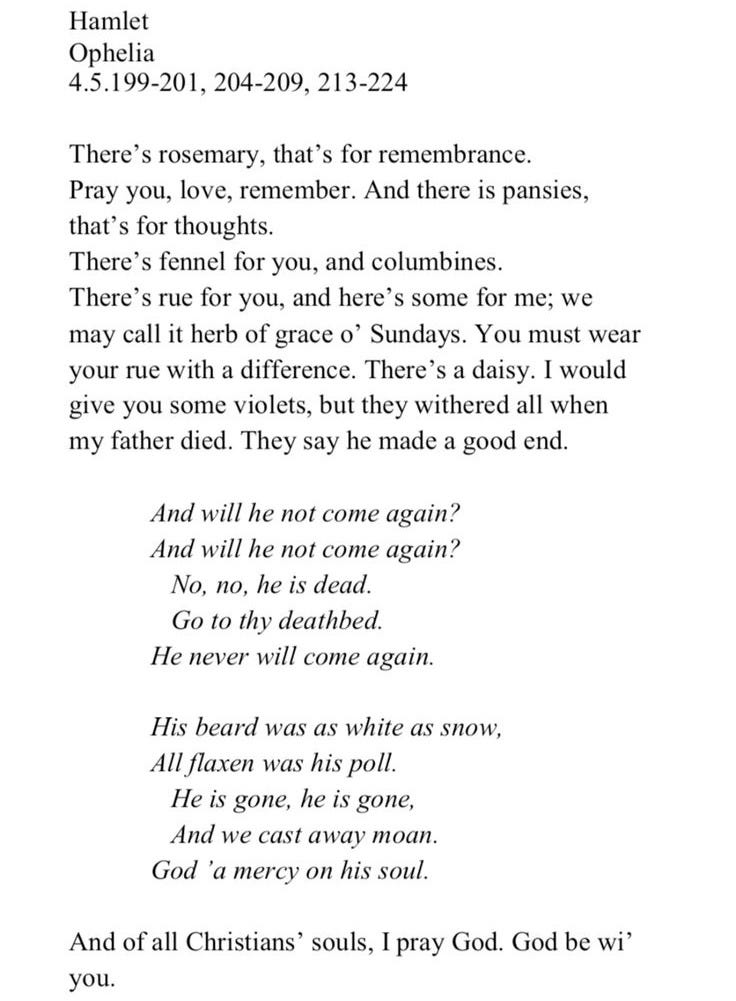
She reappropriates the imagery that has belittled her through the play: Hamlet’s charge for Ophelia to be ‘as chaste as ice, as pure as snow’ (iii.i.135) in a thinly veiled vilification of her sexuality reemerges in ‘White his shroud as the mountain snow’ (iv.v.36). Laertes’ warning that she should hold Hamlet’s favour as a ‘A violet in the youth of primy nature,/Forward, not permanent, sweet, not lasting’ (i.iii.7-8), finds an echo in ‘Larded all with sweet flowers;/Which bewept to the ground did not go’.
Contrary to the claim that Ophelia’s ‘speech is nothing’ (iv.v.7), the uneasy slipping between imagery of sex and death forms an implicit accusation of Hamlet — his sexual exploitation of Ophelia, as implied by the ‘Valentine’s day’ song, and his murder of her father, Polonius.
𓇢𓆸
Why does no one remember Ophelia’s song, then? Perhaps, because of the play’s contrived efforts to displace Ophelia’s speech in place of her appearance; to usurp song with painting.
Claudius, the King, declares: ‘poor Ophelia/Divided from herself and her fair judgement,/Without the which we are pictures or mere beasts’ (iv.v.84-6); in her madness, Ophelia is supposed to amount to merely the artifice of the ‘picture’. She is dispossessed of a self. She is lack, an empty shell, the lovely cadaver with its absent soul.
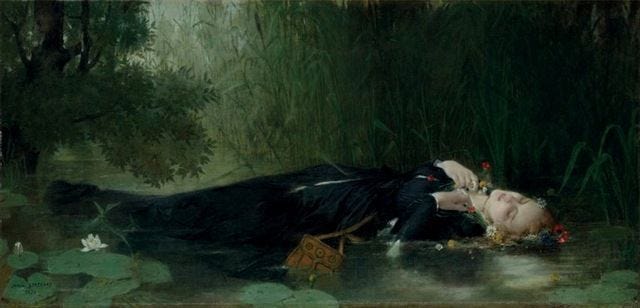
The painted subject is, indeed, a creature that cannot speak nor move, that can only be looked upon, that is, functionally, a dead thing. In a discomfiting literalisation of the metaphor, Elizabeth Siddal famously contracted pneumonia while modelling in a cold bath for Millais’ Ophelia and almost died. This is the vampiric artist of Christina Rossetti’s ‘In an Artist’s Studio’, who ‘feeds upon’ his anonymous female muses. This is the myth of the vacant female self.
The statement that Ophelia’s ‘speech is nothing’ heralds psychoanalyst R.D. Laing’s conclusion that ‘She is not a person […] Incomprehensible statements are said by nothing. She has already died’.2 (italics my own.)
Ophelia is thus subjected to a pre-emptive symbolic death — the revelation of Ophelia’s corporeal death is merely its natural conclusion.
𓇢𓆸
Gertrude’s relation of Ophelia’s death is ekphrastic — as if describing a work of art, peculiar for its coolness and specificity, the precise references to ‘crowflowers, nettles, daisies and long purple’ (iv.vii.167). Gertrude reports that Ophelia ‘chanted snatches of old lauds’, and is pulled from ‘her melodious lay’. But against the precision of all other details, we are not told what exactly Ophelia sings.3
So this music is superseded by the visual. In the shift from ‘chanted snatches’ to ‘melodious lay’, Ophelia’s song is diffused into the environment and coherency ceases; her voice is dissolved and reduced into the pictorial mode.
At this point, Ophelia is no longer human. She is ‘mermaid-like’, a ‘creature’. Her self is undone, executed entirely into the ‘painting’.
The violence of the picture against voice is encoded also in Shakespeare’s The Rape of Lucrece, Lucrece recognises her own suffering in the painted Hecuba, swearing that the painter ‘did her wrong,/To give her so much grief and not a tongue’ (1462-3). Voice and painting are fundamentally irreconcilable — to reconcile the two would make the painter a ‘god’.
To kill Ophelia into the painting is to ensure her silence.
𓇢𓆸
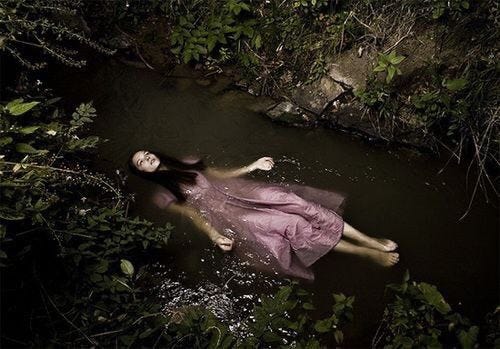
Strangely, then, Taylor Swift’s new song ‘The Fate of Ophelia’ is a rather appropriate reading of Hamlet. Taylor would do well as Gertrude, perhaps — possessing not the wit or wordplay of Hamlet, nor his violence, nevertheless a complicit agent in Ophelia’s dehumanisation in her own feeble, pallid way. Ophelia is once more rendered as aesthetic artefact, the Frailty of the empty signifier.
The song celebrates Taylor’s salvation from tragedy through the love of a man. And, as well tread as scholarship on Shakespeare’s Ophelia is, this is certainly a new line of critical thought — if only Ophelia ‘alone’ in her ‘tower’ (i.e. tormented by her lover who then murdered her father) had found true love, everything would have been just fine.
This is the modern inheritance of Ophelia; even when apparently liberated from her painting by transposition into song, Ophelia has been effectively emptied out into a shorthand for beautiful & tragic damsel. A citation, little more, masquerading as meaning.
In the interest of offering a balanced perspective, there is something potentially subversive about the playfulness of this new context for Ophelia, a gleam of feminist interest in the madwoman as a product of patriarchy. This is, however, not the case here.
The few lines that gesture to any detail of Ophelia’s life are bizarre and misleading:
The eldest daughter of a nobleman
Ophelia lived in fantasy
But love was a cold bed full of scorpions
The venom stole her sanity
Ophelia is the ‘eldest daughter’ only on a technicality — she is the only daughter of Polonius, and younger sister to Laertes. The claim of a ‘fantasy’ life occludes Ophelia’s characterization & social reality as a girl whose perceived moral value is bound up in chastity and obedience, surveilled by the men of her life. She bears no autonomy, no freedom, no voice beyond the veiled speech of her lunacy.
Above all, this is Taylor’s most distasteful misappropriation of Ophelia. Incredibly, Taylor’s salvation from the ‘fate of Ophelia’ is, apparently, salvation from independence: Taylor’s assertion that ‘I swore my loyalty to me, myself and I’, is apparently symptomatic of her lingering in ‘purgatory’, ‘my grave’, ‘drowning’ in ‘melancholy’. Now that ‘you came for me’, she no longer swears fealty to herself but ‘pledge[s] allegiance to your hands/Your team, your vibes’.
‘The Fate of Ophelia’ lifts Ophelia’s story out of the tragic genre and resituates it in a pale version of a Shakespearean comedy: no matter what suffering the characters endure, the marriage at the end resolves all. In the music video, almost every scene is this same act of reversal. Taylor, posing as Ophelia (resembling Heyser’s painting more than Millais’), moves away to reveal it as a set. The perils of the sea are neutralised by transfiguring into a swimming pool.
Finally, Ophelia’s drowning in the river is redeemed as Taylor lounging in the bath, the shot which becomes the album’s cover art.
This is the fate of Ophelia then, the painted Ophelia, the mimetic Ophelia, the gaping nothing within the ‘O’:
Deprived of thought, sexuality, language, Ophelia’s story becomes the Story of O--the zero, the empty circle or mystery of feminine difference
— Elaine Showalter, ‘Representing Ophelia: Women, Madness, and the Responsibilities of Feminist Criticism’
Poor, innocent Ophelia. You did not deserve your fate.
𓇢𓆸
𝔴𝔦𝔱𝔥 𝔩𝔬𝔳𝔢,
𝔄𝔫𝔫𝔞 𝔊𝔦𝔰𝔢𝔩𝔩𝔢 𝔡𝔢 𝔚𝔞𝔞𝔩
PS. please note this is a very selective & somewhat shabby reading of Hamlet’s Ophelia, absent of many details & theoretical readings… there is much more to be interpreted…
@anna.c.dewaal & @lunulae.archive
as far as we can accept that dramatic figures have a kind of imagined interiority or ‘life’ as part of the audience contract with the play…
‘nothing’ repeats in the play as an accusation of female lack. Hamlet appropriates Ophelia’s innocent use of ‘nothing’ in her statement, ‘I think nothing, my lord’, to play on the slang ‘Nothing’, meaning female genitalia:
Hamlet: That’s a fair thought to lie between maids’ legs.
Ophelia: What is, my lord?
Hamlet: Nothing.
(iii.ii.117-19)
This raises also the threat of active misrepresentation: the word ‘lauds’, hymns, has been commented to be at odds with the act of suicide and the coarse ballads of two scenes prior. Elze prints lauds but complains that ‘Ophelia does not sing lauds, which are entirely foreign to her form of mental disease, but love ditties and songs of mourning’, preferring the alternative ‘tunes’ in Q1/F.
To accept the sanitised ‘lauds’, however, is to question whether Gertrude’s relation of the event can be trusted, especially considering the problematic implications of her presence at the drowning—why didn’t she prevent Ophelia’s death…?
Comments
Nothing yet. Say the first thing.
Sign in to join the conversation.