
A few summers ago, Sarah, a librarian in her mid 40s, came into clinic very short of breath. Her asthma had been controlled for months. Same inhaler, same dose, nothing new.
Then the wildfire smoke rolled in. Not from anywhere near us. The fires were burning in Canada, 500 miles north, and the haze settled over the area for the better part of a week.
She was trying to get more active that summer. Evening walks with the dog. Windows open at home for the fresh air. She noticed her breathing getting worse over a few days and started reaching for her rescue inhaler more than she had in months. By the third day she was using it every few hours and it wasn’t working. By the time she came into clinic that afternoon, she could barely finish a sentence.
She did everything she thought she was supposed to do. Sometimes that is not enough.
The numbers behind a bad-air day:
2026 has started fast. In the US, 2.4 million acres had already burned by late May. That’s about 195% of the 10-year average, and forecasters are calling for above-normal fire potential across much of the western US through September.
In Europe, fire-weather danger across France, Spain, and Italy is rated extreme right now, in mid-June.
The summer of 2025 was one of Europe’s worst wildfire seasons on record by area burned. More than 2 million hectares lost. Dozens of deaths across the Mediterranean.
At the peak of the June 2023 Canadian smoke event, asthma emergency visits in New York climbed by as much as ~40%. Across the full season, the national rise near 17% above expected.
Here's the part that surprises some. Inhalers treat asthma. They do nothing about what can set it off- like the air you're breathing.
A wildfire, a dust storm, a layer of agricultural haze. Different events, different parts of the world, different seasons. What they share is fine particulate matter, the small stuff that gets deep into the lungs. I wrote about the biology and the health effects of air pollution here.
This piece is about acute exposures. A wildfire smoke day, or a dust storm, where the air turns bad fast. A bad air day is a dose problem. And the dose is something you can lower.
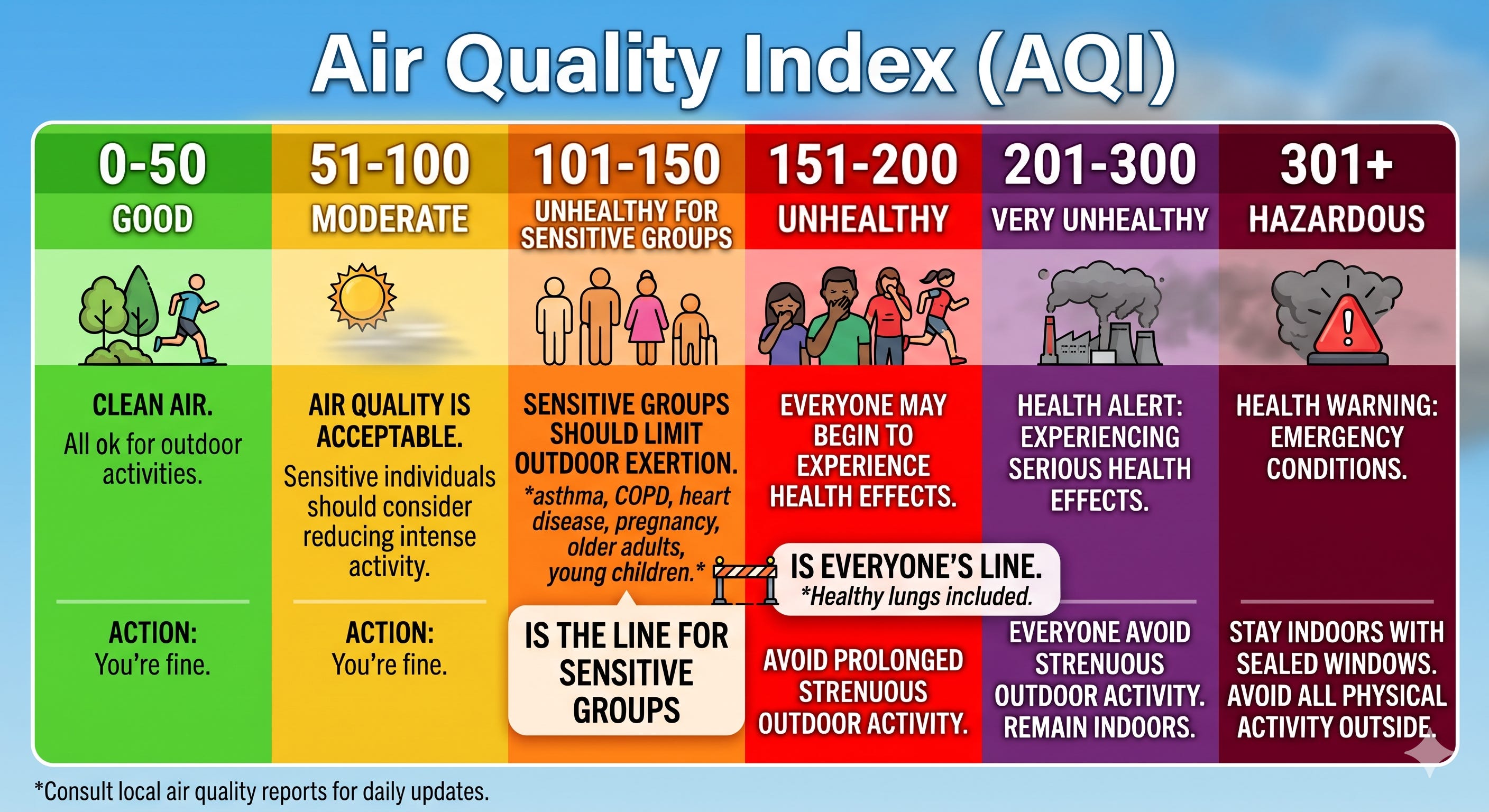
The Air Quality Index (AQI) runs on a color scale from 0 to 500, measuring the concentration of pollutants in the air you're breathing. Lower numbers mean cleaner air. Higher numbers mean more health risk.
Green and yellow ranges are fine.
Orange, from 101 to 150, is the threshold for sensitive groups- people with asthma, COPD, or heart disease, pregnant women, older adults, and young children.
Red, 151 and up, is the threshold for everyone else.
One caveat. The AQI was built for everyday pollution, not wildfires. It doesn't detect the toxic gas-phase pollutants (VOCs, formaldehyde, acrolein) released when plastics and metals burn, so on a smoke day the AQI number understates the actual health risk. If you can see haze or smell smoke, treat the air as worse than the AQI number.
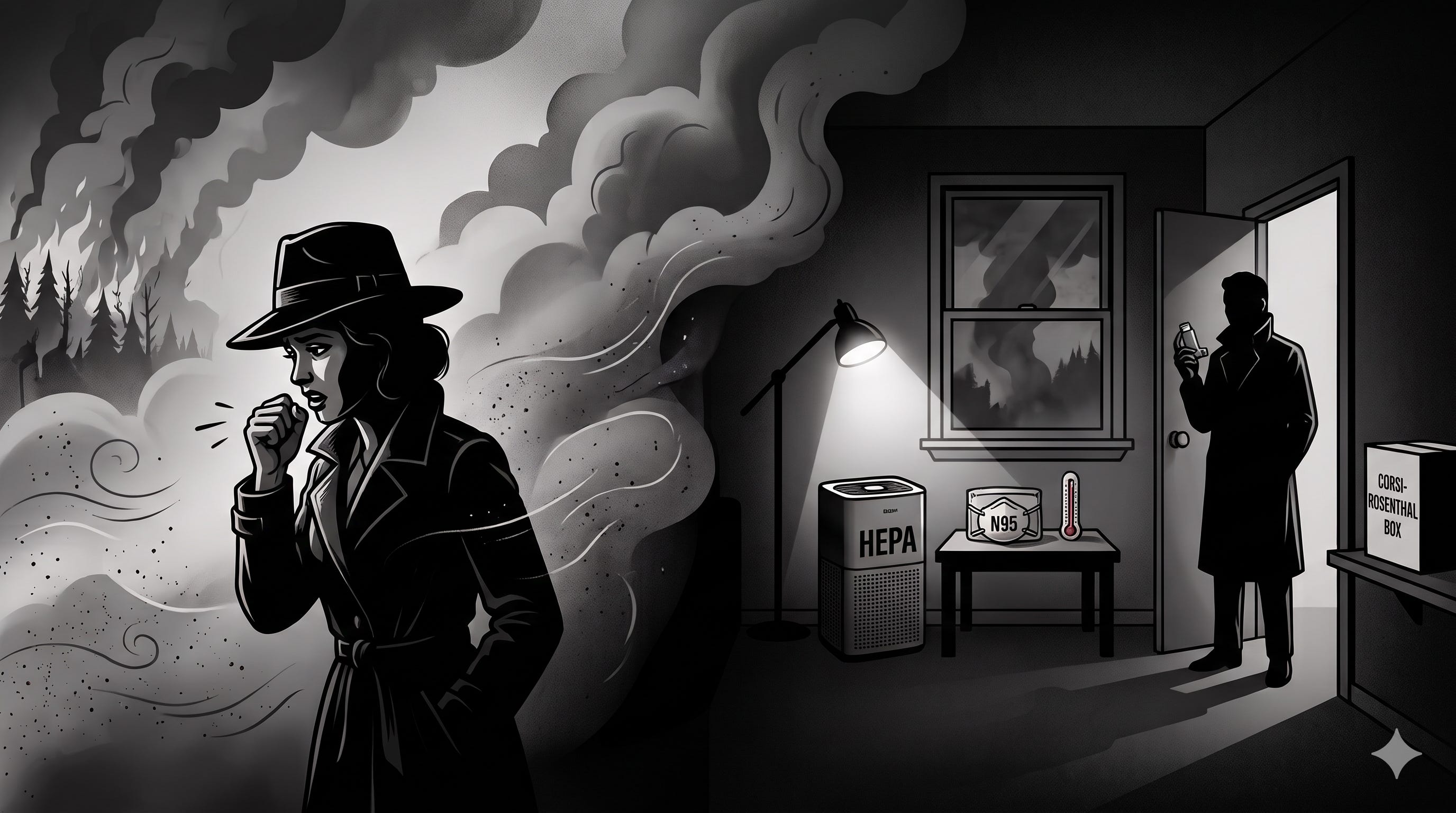
Get inside, close the windows, set the AC to recirculate. That’s the floor.
Run a HEPA air purifier in one room. This is the one I’d put first. It’s the best studied step you can take indoors, and in a single sealed room it can cut the particulate there by as much as 80%. You don’t need to filter the whole house. You need one clean room.
If you have central HVAC, upgrade the filter and run the fan. A standard fiberglass furnace filter does almost nothing for wildfire smoke. Swap it for one rated MERV 13 or higher (which can actually catch fine particles). Then switch the thermostat fan from “auto” to “on,” so the system keeps pulling air through that filter instead of only running during heating or cooling.
If air purifiers are sold out, build a Corsi-Rosenthal box. When a regional smoke event hits, the stores empty fast. You can build a high-volume air filter in about 10 minutes. Tape four MERV 13 furnace filters into a cube, seal the bottom with cardboard, and tape a 20-inch box fan on top blowing up and out. In testing, these can match or beat commercial HEPA units on clean air delivery rate, basically how fast they actually clear a room, because of the sheer filter surface area.
Make a buffer at the door. Every time an exterior door opens, a plume of dirty air rushes in. If you have a mudroom, foyer, or attached garage, use it as an airlock. Close the outside door fully before you open the inside one. It can meaningfully cut how much smoke you let into the living space.
Cut the indoor sources. A closed house traps whatever you generate inside, and on a smoke day that matters more than usual. Skip frying, searing, and broiling, especially on a gas range without a vented hood. No candles, no incense, no wood fires. And don’t vacuum unless yours has a sealed HEPA exhaust, because a standard vacuum throws settled fine dust back into the air you’re breathing.
If you go out, consider wearing a well-fitted N95 or FFP2 mask. A cloth or surgical mask doesn’t seal well, and it doesn’t filter fine particles reliably.
Yes. Some groups more than others.
Children. They breathe faster, spend more time outside, and take in more air per pound of body weight than adults. Oregon updated its guidance for kids’ outdoor activity in June 2026, citing evidence that smoke affects children at lower exposure than we used to think.
Pregnancy. Wildfire particulate in pregnancy has been linked to higher rates of gestational hypertension, preterm birth, and low birth weight.
Older adults and people with heart disease. The same higher-risk tier, which is why they share the orange line with people with asthma and COPD.
Outdoor workers. If you work outdoors, the levers you’ve got are timing the heaviest work to the cleaner part of the day, taking breaks somewhere filtered when you can, and a properly fitted N95. And here a valved N95 helps, since it’s easier to breathe through.
If you’re in the western US, Mediterranean Europe, or downwind of Canada, your bad air days may be related to wildfire smoke.
If you’re in the Middle East, dust storms there have pushed cities deep into the hazardous range with no fire in sight.
If you’re in Southeast Asia, your worst stretch may be the dry-season agricultural haze (triggered by large-scale agricultural burning), roughly January through April, fading with the rains.
It’s getting worse.
The number of fires hasn’t climbed much. The size has. Area burned in the US has roughly doubled since the 1990s, and the western US fire season runs longer than it did a generation ago.
Here’s the part that surprised me. For decades the air was getting cleaner, year over year, mostly because of the Clean Air Act. That progress has stalled or reversed in 35 US states since 2016, and wildfire smoke is one of the reasons.
Why are fires getting bigger? A hotter, drier atmosphere strips moisture from the landscape, so fuels ignite more easily and burn more intensely. Layer on a century of suppressing every small fire, and there's vastly more fuel waiting when one finally breaks through.
A bad air day can tip into something that needs more than a clean room. Use this as rough triage.
Call emergency services now if there’s severe breathlessness, you can’t speak in full sentences, your lips or fingertips look blue or gray, or the rescue inhaler isn’t working at all.
Get same-day or urgent care if your rescue inhaler is wearing off faster than usual, your peak flow is dropping, or your symptoms are worse than a typical flare.
Manage at home, and call your regular doctor, if you’re stable, the rescue inhaler is working, and you’re just more symptomatic on the smoky days. Stay in your clean room, keep taking your controller, and don’t wait days to call if it isn’t getting better.
Does a regular face mask help during wildfire smoke? Not reliably. Cloth and surgical masks don’t seal well, and their filtration of fine particles is variable at best. A well-fitted N95, KN95, or FFP2 work much better.
Can I exercise outdoors on a moderate air quality day? If you have healthy lungs and the index is yellow, usually yes. Orange is the line for asthma, COPD, and other sensitive groups. Red is the line where the general public faces health risks. Exercise pulls more air (and more poor quality air) deep into the lungs.
Do air purifiers actually work for smoke? A true HEPA purifier lowers indoor particulate in the room it’s running in, by a wide margin when the unit is matched to the room size.
Is indoor air automatically safe during a smoke event? No. Indoor air tracks outdoor air unless you’ve closed up and filtered. Open windows and a fan pulling outside air in will bring the smoke with it.
I felt fine during the smoke but coughed for two weeks after. Is that normal? A lingering cough and irritated airways after an exposure are common. If it isn’t improving, or you’re short of breath, that’s worth a visit to your doctor.
What’s the difference between an N95, a KN95, and an FFP2? All three filter fine particles when they fit well. The label matters less than the seal. If air leaks around the edges, the rating on the box doesn’t help you.
My patient Sarah didn’t need a lecture. She needed to know the air had been the trigger, not her asthma quietly getting worse.
So we talked through it. A HEPA unit in the bedroom. Windows shut and the AC on recirculate when the AQI climbs. Checking the AQI before the evening walk, and skipping it on the bad days. A fitted N95 for the times she had to be out.
None of that is complicated. The hard part is that nobody had told her any of it before the smoke arrived. She’d done what she thought she was supposed to do. She just didn’t know a fire 500 miles away could land her in my clinic.
The patient described in this article is a composite based on real clinical experience. Identifying details have been changed to protect privacy. This article is for general educational purposes only and does not constitute medical advice, diagnosis, or treatment. Reading it does not establish a physician-patient relationship. Treatment decisions should be made in consultation with your own physician based on your individual history and circumstances. References to guidelines, study findings, and publicly available data reflect information at the time of publication and may change. The views expressed are my own and do not represent the views of my employer or any institution with which I am affiliated. If you are experiencing severe shortness of breath or any acute respiratory distress, call 911 or seek immediate emergency care.
McArdle CE, Dowling TC, Carey K, et al. Asthma-Associated Emergency Department Visits During the Canadian Wildfire Smoke Episodes, United States, April–August 2023. MMWR Morb Mortal Wkly Rep. 2023;72(34):926-932. doi:10.15585/mmwr.mm7234a5.
He H, Canty TP, Dickerson RR, et al. Assessing PM2.5 Pollution in the Northeastern United States From the 2023 Canadian Wildfire Smoke: An Episodic Study Integrating Air Quality and Health Impact Modeling. Environ Res Lett. 2025;20(11):114042. doi:10.1088/1748-9326/ae10c9.
European Commission Joint Research Centre. European Forest Fire Information System (EFFIS): current wildfire situation in Europe. 2026. https://joint-research-centre.ec.europa.eu/projects-and-activities/natural-and-man-made-hazards/forest-fires/current-wildfire-situation-europe_en
Copernicus Atmosphere Monitoring Service. Highest wildfire emissions in at least 23 years for Europe after a hectic summer. 2025. https://atmosphere.copernicus.eu/highest-wildfire-emissions-least-23-years-europe-after-hectic-summer
Rajagopalan S, Brauer M, Bhatnagar A, et al. Personal-Level Protective Actions Against Particulate Matter Air Pollution Exposure: A Scientific Statement From the American Heart Association. Circulation. 2020;142(23):e411-e431. doi:10.1161/CIR.0000000000000931.
Rice MB, Henderson SB, Lambert AA, et al. Respiratory Impacts of Wildland Fire Smoke: Future Challenges and Policy Opportunities. An Official American Thoracic Society Workshop Report. Ann Am Thorac Soc. 2021;18(6):921-930. doi:10.1513/AnnalsATS.202102-148ST.
Xu R, Yu P, Abramson MJ, et al. Wildfires, Global Climate Change, and Human Health. N Engl J Med. 2020;383(22):2173-2181. doi:10.1056/NEJMsr2028985.
Crocker ME, Cogen JD. Wildfire Smoke and Pediatric Lung Health: What the Clinician Needs to Know. Pediatr Pulmonol. 2026;61(2):e71484. doi:10.1002/ppul.71484.
Oregon Health Authority. Protecting children’s health during wildfire smoke: updated air quality guidance. June 2026. https://oregonhealthnews.oregon.gov/protecting-childrens-health-during-wildfire-smoke-ohas-updated-air-quality-guidance/
Zhang T, Ren AX, Tong M, et al. Gestational Exposure to Wildfire PM2.5 and Its Specific Components and the Risk of Gestational Hypertension and Eclampsia in the Southwestern United States. Sci Total Environ. 2024;951:175781. doi:10.1016/j.scitotenv.2024.175781.
IQAir. How recent dust storms affect air quality in the Middle East. 2025. https://www.aqi.in/blog/us/dust-storms-affects-air-quality-across-the-middle-east/
NASA Earth Observatory. Grappling with Thailand’s seasonal haze. 2026. https://earthobservatory.nasa.gov/images/152616/grappling-with-thailands-seasonal-haze
IQAir. Perth air quality and Australia air pollution. 2026. https://www.iqair.com/au/australia/western-australia/perth
National Interagency Fire Center. National Significant Wildland Fire Potential Outlook, June through September. Issued June 1, 2026. https://www.nifc.gov/nicc-files/predictive/outlooks/monthly_seasonal_outlook.pdf
Burke M, Childs ML, Qiu M, et al. The contribution of wildfire to PM2.5 trends in the USA. Nature. 2023. Summary: Stanford Report, September 2023. https://news.stanford.edu/stories/2023/09/wildfire-smokes-toxic-influence
National Oceanic and Atmospheric Administration. Wildfire climate connection. https://www.noaa.gov/noaa-wildfire/wildfire-climate-connection
Falk J, Banta D, Dralyuk I. Air Quality Index falls short in gauging wildfire smoke risks, pulmonologists say (Cedars-Sinai). Respiratory Therapy. January 2025. https://respiratory-therapy.com/public-health/healthcare-policy/environmental-news/air-quality-index-falls-short-gauging-wildfire-smoke-risks-pulmonologists-say/
No posts
Comments
Nothing yet. Say the first thing.
Sign in to join the conversation.