
At her follow-up visit, she asked me what I thought about mouth taping. She'd already been diagnosed with sleep apnea and we had discussed CPAP treatment at her first visit.
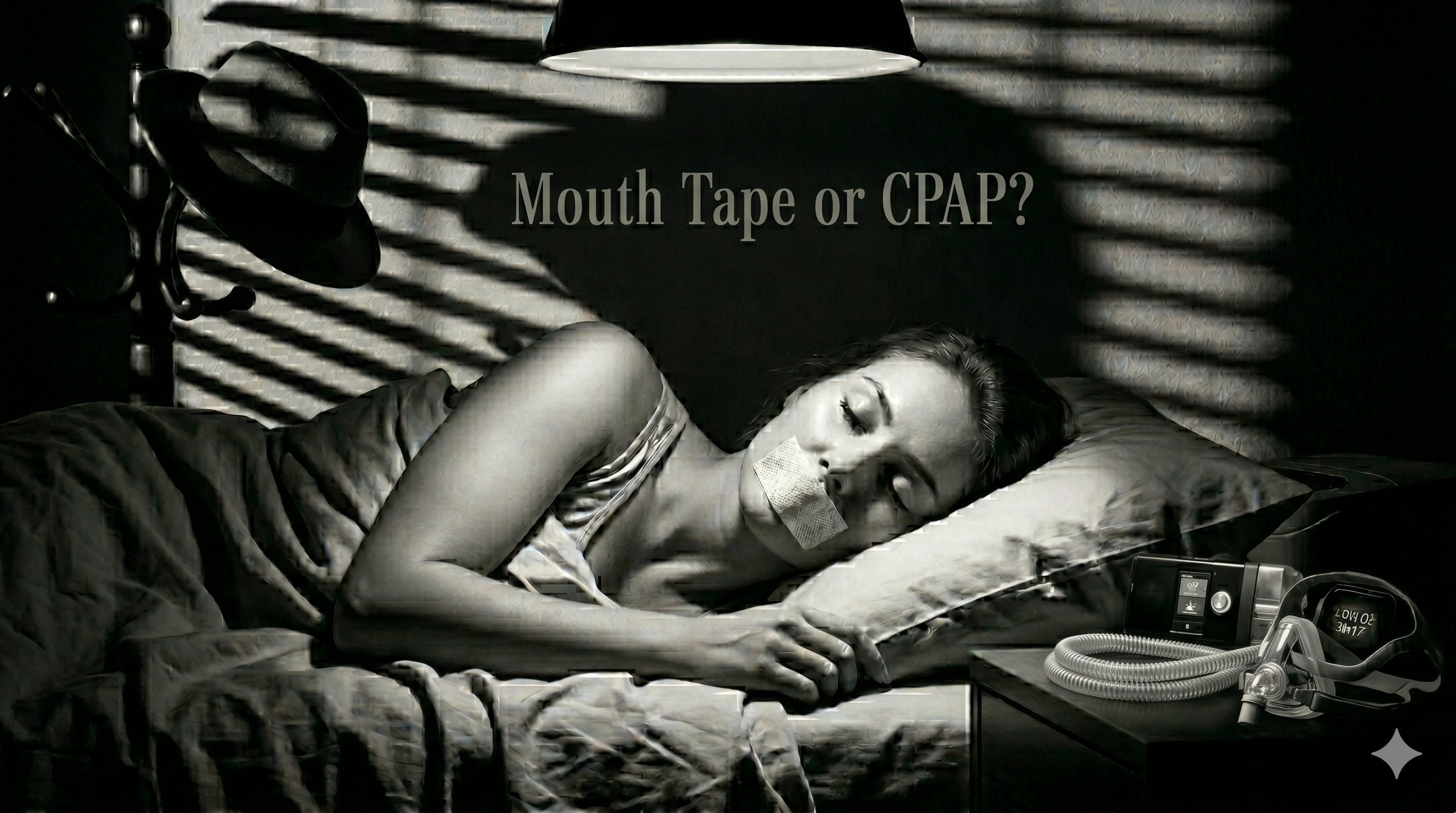
Maria, a lawyer in her mid-40s, came in a few weeks earlier because her smartwatch had been flagging poor sleep, low oxygen, irregular breathing. Tired by 2 PM. Foggy in meetings. I sent her for a sleep apnea test. It confirmed what the watch had been picking up. She had obstructive sleep apnea (OSA), and the daytime symptoms tracked with the severity.
We talked through all the treatment options. CPAP (positive airways pressure). Oral appliances. Hypoglossal nerve stimulation (Inspire). Airway surgery. Weight loss. The whole conversation. She listened. She nodded. She said she'd think about it.
Now she was back, and she wanted to know about mouth taping.
Two groups buy mouth tape. The ones who don’t know they have OSA, and the ones who do and don’t want CPAP. The internet sells them the same answer.
The first group gets most of the coverage. People see mouth taping on TikTok or Instagram, try it, and either feel a little better, feel worse, or stay the same. Many of them never get a sleep apnea test. Some do, often when the experiment fails or a partner’s complaints escalate. But for the population that quietly experiments and feels modest improvement, the actual diagnosis never happens.
A 2019 Lancet Respiratory Medicine analysis estimated nearly one billion adults globally have OSA, and the majority are undiagnosed. An estimated ~80% of patients with significant OSA are undiagnosed. Across most reported cohorts, the delay from first symptoms to a diagnosis runs into years, not months.
That’s a lot of undiagnosed OSA, and a lot of people self-treating a condition they don’t know they have. And self-treatment is not completely benign. There is emerging evidence that mouth taping can make things worse in OSA patients.
Mouth taping is exactly what it sounds like. A piece of tape, usually a porous medical-grade strip or a silicone patch, placed over the lips at bedtime to encourage nasal breathing. The wellness pitch is that nasal breathing humidifies, filters, and warms the air, produces nitric oxide, and reduces snoring and sleep-disordered breathing.
Most of that physiology is real. Nasal breathing is better than mouth breathing, all else equal. However, self-treating symptoms with mouth taping is not completely benign.
A 2025 PLOS One systematic review pulled together 10 studies covering 213 patients. Two studies showed statistically significant improvement in apnea-hypopnea index (which measures severity of sleep apnea) or oxygen desaturation. The rest showed no benefit. Several studies flagged potential risks including asphyxiation in the presence of nasal obstruction. And most studies excluded anyone with nasal obstruction. The people most drawn to taping, the chronic mouth breathers with allergies or deviated septums, were not even included in these studies.
Another 2025 review in the American Journal of Otolaryngology reached a similar conclusion. The evidence remains thin, the studies small, and the populations don’t match the people actually trying this at home.
But the most important paper isn’t either of those.
In 2024 JAMA Otolaryngology–Head & Neck Surgery published a clinical trial that measured what actually happens when OSA patients close their mouths during sleep.
In 54 patients, mouth closure on average improved inspiratory airflow by 27.8%.
In 22% of patients, airflow actually got worse.
The patients who got worse were the ones with the highest baseline oral airflow. They were mouth-breathing the most because they were compensating- bypassing an obstruction in the airway at the soft palate. Velopharyngeal obstruction predicted unfavorable response to mouth closure with 77% accuracy.
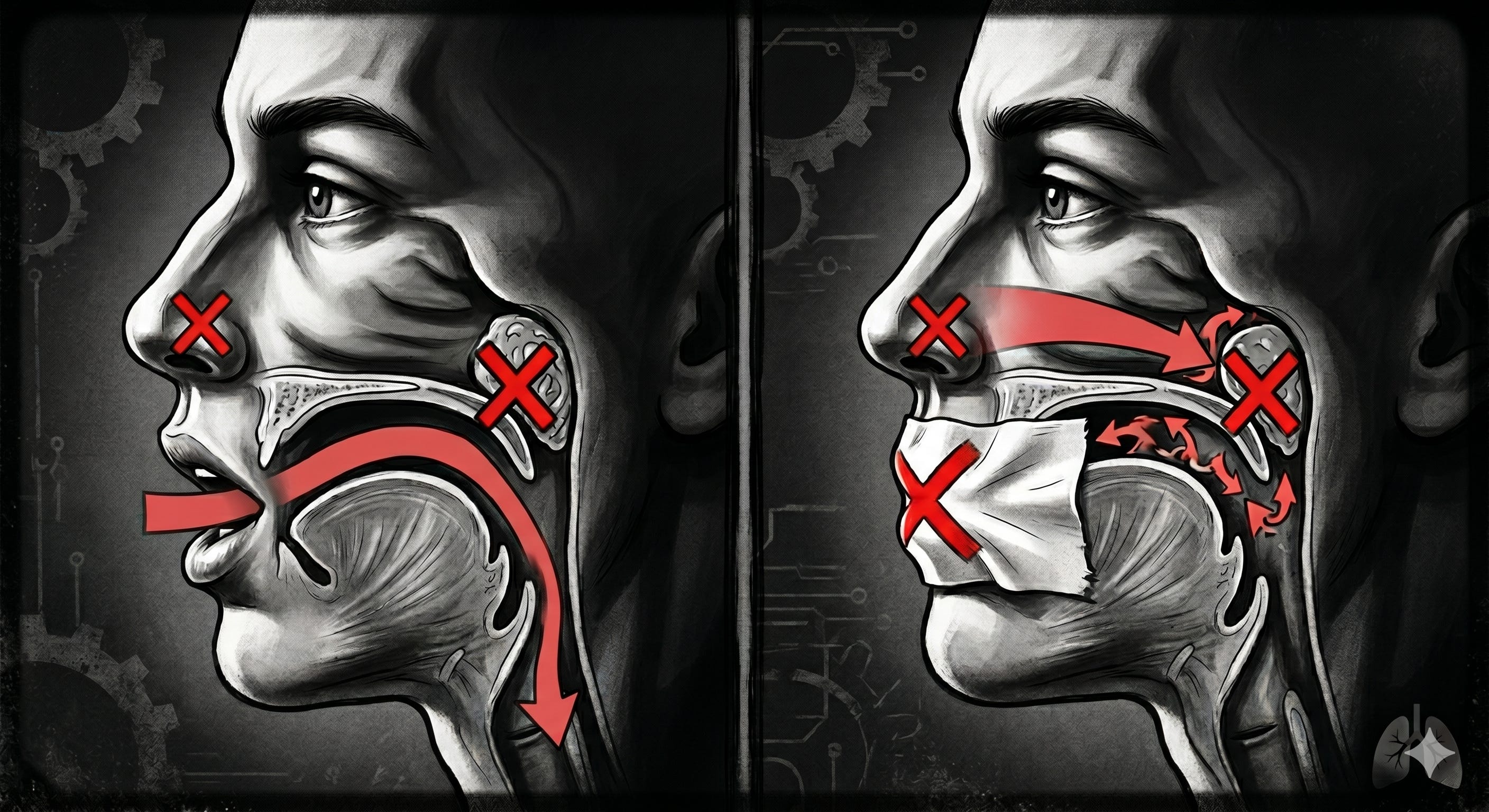
Individuals who mouth-breathe the most may often be the ones in whom taping makes airflow worse. They are also the ones most motivated to try it as a quick fix.
There is one population in which mouth taping has positive randomized data, and it isn’t the population that’s trying it.
A 2025 randomized crossover trial in the Journal of Clinical Sleep Medicine enrolled 62 OSA patients already using CPAP. The study showed that mouth taping led to longer nightly CPAP use, more frequent use, better daytime sleepiness scores, less snoring, and less mouth and throat dryness.
That’s a real finding. Mouth tape works as a CPAP adherence tool, for diagnosed and treated OSA patients who leak air through their mouths and lose pressure.
That’s a different intervention than what most people are doing. It’s tape with the OSA diagnosis and with the CPAP treatment, not tape instead of either. No one is selling silicone strips on Instagram with the caption “for use with your prescribed CPAP machine.”
Some patients will hear all of this and still want to try the mouth tape. Mild OSA. Frustrated with CPAP.
Here is what nobody is saying about that patient.
When we fit a patient with a oral appliance for mild-to-moderate OSA, we don’t just hand it to them and say good luck. Most clinical practice guidelines recommend a follow-up sleep study with the device in place to confirm it actually works.
Why would mouth tape be any different.
The 2024 JAMA Otolaryngology trial showed 22% of OSA patients had worse airflow with their mouths closed during sleep. Velopharyngeal obstruction predicted that response with 77% accuracy. There is no clinical exam that reliably identifies which patient is which. The only way to know whether tape is helping or hurting a specific patient is to test them with the tape on.
The analogy of course isn’t perfect. Oral appliances physically modify airway anatomy. Tape modifies behavior with mechanical consequences. But the principle is the same. When response is variable and unpredictable from clinical exam, you should do objective testing.
So if a patient with diagnosed mild OSA wants to try mouth tape as primary therapy, the structurally honest answer is the same one we apply to oral appliances. Repeat the sleep study with the tape in place. If the AHI drops to a clinically acceptable range and oxygen saturation looks adequate, the tape is doing what we hoped. If it doesn’t, we know. If it makes things worse, we know that too.
This is the protocol the Taiwan group used in 2022 when they published the only positive sleep test data on mouth taping in mild OSA. It was a small study with only 20 patients. They did a baseline test, then a repeat one a week later with tape on. They reported AHI dropping from 8.3 to 4.7. Strong responders in 65% of patients.
Now I have to be honest. This is not guidelines based nor commonly recommended by sleep doctors. We have one small study that proves the concept. And most payers will not cover the cost of a repeat sleep study, so you’d have to pay for it yourself.
When a patient asks me about mouth taping, the conversation almost never ends up being about tape.
We first screen for OSA. I use the STOP-BANG questionnaire. It asks about snoring, tiredness, observed apneas, blood pressure, BMI, age, neck circumference, gender. Sensitivity for moderate-to-severe OSA is around 90%.
If the STOP-BANG score warrants it, the next step is ordering a sleep study.
For most adults with clinical signs of OSA, both the American Academy of Sleep Medicine and the European Respiratory Society guidelines support home sleep apnea testing as a first-line option. A Type 3 home sleep test captures airflow, oxygen, heart rate, and respiratory effort, and for the patient with simple obstructive disease and high pretest probability, it works well most of the time.
For a selective group of patients, we do an in-lab sleep test (polysomnography) because we need more sensors to get more accurate and detailed data.
Patients with significant cardiac or respiratory disease
Patients with possible respiratory muscle weakness from neuromuscular conditions
Patients with awake hypoventilation or suspicion of sleep-related hypoventilation
Patients on chronic opioid therapy
Patients with a history of stroke
Important to note that the home sleep test is not perfect. In some patients, particularly those whose events produce cortical arousals without significant oxygen desaturation, the home test can underestimate the severity of OSA and be falsely negative. So if the home test comes back normal, you may still need a follow-up in lab sleep test to confirm that you truly do not have sleep apnea.
There are also real barriers to sleep apnea diagnosis and care. In many areas, an appointment maybe months away, in the US insurance can deny testing or the out of pocket costs may be too much. In some areas the sleep testing infrastructure itself maybe limited.
But mouth taping is not the answer to these barriers.
Maria came back with the tape question and I didn’t lecture her. The tape wasn’t the issue. It was actually about CPAP.
When we’d first talked about treatment options, she’d told me her dad had been on CPAP for years and hated it. It was a loud older machine. His masks never fit well. And he would often take it off midway through the night.
The reality I explained to Maria is we’ve come a long way over the past decade in terms of CPAP equipment. The modern auto-titrating CPAP machines run quieter and weigh less. Mask designs have improved, making it easier to find the right fit. Most suppliers offer a trial period (usually around 30 days) so patients can return equipment that doesn't work for them. The data the machine collects tells us whether it's actually helping and to troubleshoot issues. Many pair with companion apps that coach patients through acclimation and consistent use.
If CPAP truly doesn’t work out, there are oral appliances, positional therapy, hypoglossal nerve simulation and surgical options for the right anatomy. Weight loss, especially with GLP1 medications can also help. Mouth taping does not replace any of these options.
For some, CPAP is not the right option. Documented claustrophobia or facial trauma history that makes a mask genuinely intolerable. Specific OSA phenotypes, supine-only, REM-predominant, or positional, where other therapies may be first-line.
As I discussed Maria’s concerns, I realized her tape question wasn’t really a tape question. It was actually a CPAP question. Her feeling that the standard treatment would be unbearable isn't crazy. It’s the most common reason patients with OSA stop using their CPAP. But also the internet has gotten very good at offering alternatives that are sold as easier fixes.
Related articles:
Wellness content sells the same answer to everyone. Real medical care doesn’t work that way. If you're reading this and wondering whether to try mouth taping for snoring or mouth breathing, here's how to approach it.
Talk to your family doctor about a sleep evaluation if you have:
Witnessed apneas. Someone has seen you stop breathing in your sleep.
Loud snoring with daytime sleepiness severe enough to nod off driving, in a waiting room or in meetings.
Morning headaches
A wearable consistently flagging poor sleep or low oxygen
A first-degree relative with OSA plus any of the above
Worth tracking on your own first:
Isolated mouth breathing without snoring, fatigue, or wearable flags.
Occasional poor nights without a clear pattern.
A trial of nasal saline, allergy treatment, or improving sleep hygiene before any clinical workup.
If roughly 80% of clinically significant OSA is undiagnosed worldwide, and diagnosis takes months to years, the wellness market for sleep aids isn't filling a gap. It's filling a vacuum the system created. Mouth taping is a symptom of how hard it is to get diagnosed and treated for OSA.
For patients who haven’t been worked up, taping risks worsening a condition they don’t know they have.
For patients who have been worked up, taping risks becoming a suboptimal substitute for the treatment they’re not yet ready to accept.
Maria left her second visit without a CPAP order. She wanted to think about it. I told her she could call the office anytime, and we’d start whenever she was ready.
Is mouth taping safe?
It depends entirely on who’s doing it. For an adult with completely normal nasal breathing, no nasal obstruction, no underlying sleep disorder, mouth tape is a low-stakes wellness intervention with a plausible mechanism. The safety case in that population is reasonable. For everyone else, the risk is real. The 2025 PLOS One systematic review flagged asphyxiation risk as a recurring concern across multiple studies, particularly for patients with nasal obstruction. The patients usually drawn to mouth taping are chronic mouth breathers. They’re also the ones most likely to have an underlying reason their bodies are bypassing nasal breathing and an underlying obstruction. If you have allergies, a deviated nasal septum, chronic congestion, or signs of sleep apnea, taping can take away the only backup airway you have. The honest answer to “is it safe” is: it depends what category you’re actually in, and most people don’t know which they’re in until something goes wrong.
Can mouth taping treat sleep apnea?
The data is very limited. There is no high-quality evidence that mouth taping treats obstructive sleep apnea as a primary therapy. The 2025 systematic review found benefit in only 2 of 10 studies, and most of those studies excluded patients with nasal obstruction. The 2024 JAMA Otolaryngology clinical trial showed 22% of OSA patients had worse airflow when their mouths were closed during sleep. The patients who got worse were the ones bypassing a higher airway obstruction. CPAP, oral appliances, hypoglossal nerve stimulation, weight loss, and positional therapy are the evidence-based treatments. Tape is not a substitute for any of them.
Does mouth taping help with snoring?
Sometimes. Some snoring is mouth-driven and may improve with nasal breathing. But snoring is often a symptom of something else, most commonly undiagnosed OSA. If you snore loudly enough that someone else has noticed, the right next step is probably a sleep evaluation, not a roll of tape.
My Apple Watch (or Oura, or Whoop) is flagging my sleep. Should I tape my mouth?
No. A wearable flagging poor sleep, low oxygen levels, or irregular breathing is doing the job of a screening tool. Wearables can suggest there is a problem. They cannot diagnose what kind. Mouth taping can delay the OSA diagnosis the watch was warning about.
What about mouth taping while using CPAP. Does that work?
Yes, in the right patient. A 2025 randomized crossover trial in the Journal of Clinical Sleep Medicine found that OSA patients on CPAP who used mouth tape during therapy had longer nightly CPAP use, less mouth dryness, and better daytime sleepiness scores. This is tape with the OSA diagnosis and with CPAP, not tape instead of either. If you have OSA, are on CPAP, and are losing pressure through the mouth, talk to your doctor about adding tape to your existing therapy.
How do I know if mouth breathing during sleep is actually a problem for me?
Mouth breathing alone isn’t the diagnosis. The questions that matter: Are you waking up tired despite a full night in bed? Does your partner notice snoring, gasping, or pauses in your breathing? Do you have morning headaches, or fall asleep during the day? Any of those, plus the mouth breathing, possibly warrants a sleep evaluation. Without those, isolated mouth breathing is rarely the urgent issue the internet makes it out to be.
Can mouth taping cause harm in someone without sleep apnea?
Yes, in specific scenarios. Anyone with nasal obstruction, severe allergies, or active congestion risks reduced airflow when the mouth is closed. People who are at risk of vomiting during sleep, including patients with reflux or those who drink alcohol close to bed, face an aspiration risk. Children should not use mouth taping outside of medical supervision. And anyone with undiagnosed OSA risks worsening the condition they don’t yet know they have.
The patient described in this article is a composite based on real clinical experience. Identifying details have been changed to protect privacy. This article is for general educational purposes only and does not constitute medical advice, diagnosis, or treatment. Reading this article does not establish a physician-patient relationship. Treatment decisions should be made in consultation with your own physician based on your individual medical history and circumstances. References to clinical guidelines, study findings, and publicly available data reflect information at the time of publication and may change. The views expressed are my own and do not represent the views of my employer or any institution with which I am affiliated. If you are experiencing severe shortness of breath, gasping, or any acute respiratory distress, call 911 or seek immediate emergency care.
Yeghiazarians Y, Jneid H, Tietjens JR, et al. Obstructive Sleep Apnea and Cardiovascular Disease: A Scientific Statement From the American Heart Association. Circulation. 2021;144(3):e56-e67.
Mukherjee S, Patel SR, Kales SN, et al. An Official American Thoracic Society Statement: The Importance of Healthy Sleep. Am J Respir Crit Care Med. 2015;191(12):1450-8.
Benjafield AV, Ayas NT, Eastwood PR, et al. Estimation of the Global Prevalence and Burden of Obstructive Sleep Apnoea: A Literature-Based Analysis. Lancet Respir Med. 2019;7(8):687-698.
Rhee J, Iansavitchene A, Mannala S, Graham ME, Rotenberg B. Breaking Social Media Fads and Uncovering the Safety and Efficacy of Mouth Taping in Patients With Mouth Breathing, Sleep Disordered Breathing, or Obstructive Sleep Apnea: A Systematic Review. PLOS One. 2025;20(5):e0323643.
Fangmeyer SK, Badger CD, Thakkar PG. Nocturnal Mouth-Taping and Social Media: A Scoping Review of the Evidence. Am J Otolaryngol. 2025;46(1):104545.
Yang H, Huyett P, Wang TY, et al. Mouth Closure and Airflow in Patients With Obstructive Sleep Apnea: A Nonrandomized Clinical Trial. JAMA Otolaryngol Head Neck Surg. 2024;150(11):1012-1019.
Meksukree A, Pitipanyakul S, Laohavinij W, et al. The Role of Mouth Tape for CPAP Use in Mouth Breathing Patients With OSA. J Clin Sleep Med. 2025.
Ramar K, Dort LC, Katz SG, et al. Clinical Practice Guideline for the Treatment of Obstructive Sleep Apnea and Snoring with Oral Appliance Therapy: An Update for 2015. J Clin Sleep Med. 2015;11(7):773-827.
American Academy of Sleep Medicine and American Academy of Dental Sleep Medicine. Joint Clinical Practice Guideline for Oral Appliance Therapy. AASM/AADSM, 2024.
Lee YC, Lu CT, Cheng WN, Li HY. The Impact of Mouth-Taping in Mouth-Breathers with Mild Obstructive Sleep Apnea: A Preliminary Study. Healthcare (Basel). 2022;10(9):1755.
Randerath W, Bassetti CL, Bonsignore MR, et al. Challenges and Perspectives in Obstructive Sleep Apnoea: Report by an Ad Hoc Working Group of the Sleep Disordered Breathing Group of the European Respiratory Society and the European Sleep Research Society. Eur Respir J. 2018;52(3):1702616.
Gottlieb DJ, Punjabi NM. Diagnosis and Management of Obstructive Sleep Apnea: A Review. JAMA. 2020;323(14):1389-1400.
Kapur VK, Auckley DH, Chowdhuri S, et al. Clinical Practice Guideline for Diagnostic Testing for Adult Obstructive Sleep Apnea. J Clin Sleep Med. 2017;13(3):479-504.
No posts
Comments
Nothing yet. Say the first thing.
Sign in to join the conversation.