
Bronchitis itself is not contagious. The inflammation in your airways cannot spread to another person. But the virus that caused bronchitis (usually a cold or flu virus) was contagious during the first several days of the illness.
And the cough that’s still hanging around two or three weeks later? That’s not infection. That’s the airways healing. You’re almost certainly not spreading anything anymore.
That distinction between the infection and the inflammation it left behind is the part that often isn’t explained well enough. It’s why people quarantine for days on end unnecessarily, why coworkers treat a lingering cough like a biohazard, and why patients come back demanding antibiotics for a virus that’s already gone.
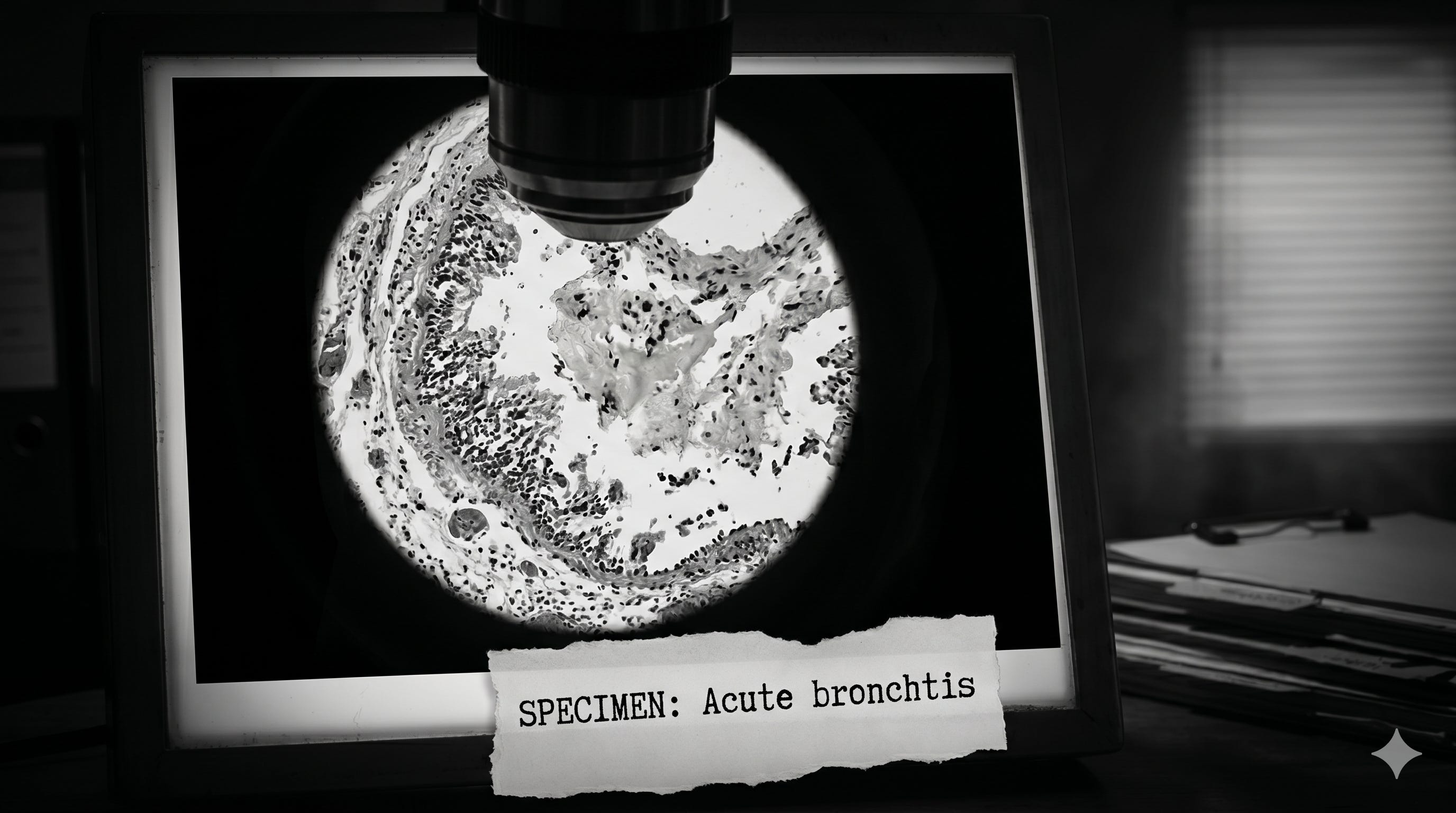
Earlier this week I wrote about what happens when “bronchitis” becomes a label that stops diagnostic thinking and leads to missed diagnoses, antibiotic overprescription, and the cough that sometimes turns out to be something much worse. This piece is the companion to that one- the straightforward clinical questions that need clear answers. What’s actually contagious. How long. And when a cough that won’t quit is telling you something that needs further evaluation.
Is Bronchitis Contagious?
The inflammation—the swelling, the mucus, the cough—is not contagious. Bronchitis is the body’s response to an irritant. If you give a coworker the virus that started your bronchitis, they might get a cold. They might get a sore throat, a runny nose. But they might not develop bronchitis at all.
What is contagious is the underlying virus. More than 90% of acute bronchitis cases are caused by viruses - influenza, RSV, rhinovirus, coronavirus, parainfluenza [1, 4]. These spread through respiratory droplets when you cough, sneeze, talk, or through contaminated surfaces.
Bacteria are identified as the primary cause in roughly 10% of cases, though they can be detected in sputum more frequently without necessarily driving the illness [4, 5]. In fact, there is no convincing evidence to support the concept of “acute bacterial bronchitis” caused by typical respiratory bacteria like Streptococcus pneumoniae or Haemophilus influenzae in adults without underlying established lung disease [4, 8, 22]. When bacterial bronchitis does occur, it typically stops being contagious about 24 hours after starting antibiotics.
How Long Are You Contagious with Bronchitis?
You’re typically contagious for the first several days of illness—sometimes beginning a day or two before symptoms start. The exact window depends on the specific virus: influenza is typically contagious one day before through five to seven days after symptom onset, while other respiratory viruses follow similar but varying patterns. For most viral infections, the contagious window is roughly a few days to one week.
But the cough can last much longer. A systematic review found the average duration of a bronchitis cough is about 18 days [6]. So there’s a gap—often a week or more—where you’re still coughing but no longer infectious.
The United States CDC’s current unified respiratory virus guidance, updated in 2024 and reaffirmed in 2025, which applies to COVID-19, influenza, and RSV- stay home until you’ve been fever-free for 24 hours without fever-reducing medication and your symptoms are improving overall, then take added precautions for the next five days—masking, distancing, hand hygiene, and cleaner air—especially around people at higher risk for severe illness [23]. Healthcare settings such has clinics and hospitals will have similar policies in place.
You do not need to wait for the cough to completely resolve before returning to work or school. A reasonable threshold: once you’ve been fever-free for at least 24 hours without medication and your acute symptoms—body aches, sore throat, malaise—are improving, you are very likely no longer contagious, even if the cough persists. The added cautionary step is to mask or distance for five days around people at higher risk. Such as those who are immunocompromised or have underlying health conditions.
The Exception: Whooping Cough (Pertussis)
There’s one important exception. Pertussis (whooping cough) is bacterial and can remain contagious for weeks if untreated. It’s most contagious during the early (catarrhal) stage - the first one to two weeks- and antibiotics eliminate contagiousness after about five days of treatment [4, 7]. It’s more common in adults than the name suggests, especially as vaccine immunity wanes. The Tdap vaccine protects against pertussis and a booster is recommended every 10 years in adults.
If your cough comes in violent episodes, you’re vomiting after coughing fits, or there’s an audible whooping sound when you inhale, it maybe a good idea to get tested. Early macrolide antibiotic therapy (eg azithromycin) both treats the infection and reduces transmission.
Why Does the Cough Last So Long After Bronchitis?
This is the section I wish every patient heard before leaving the clinic or urgent care.
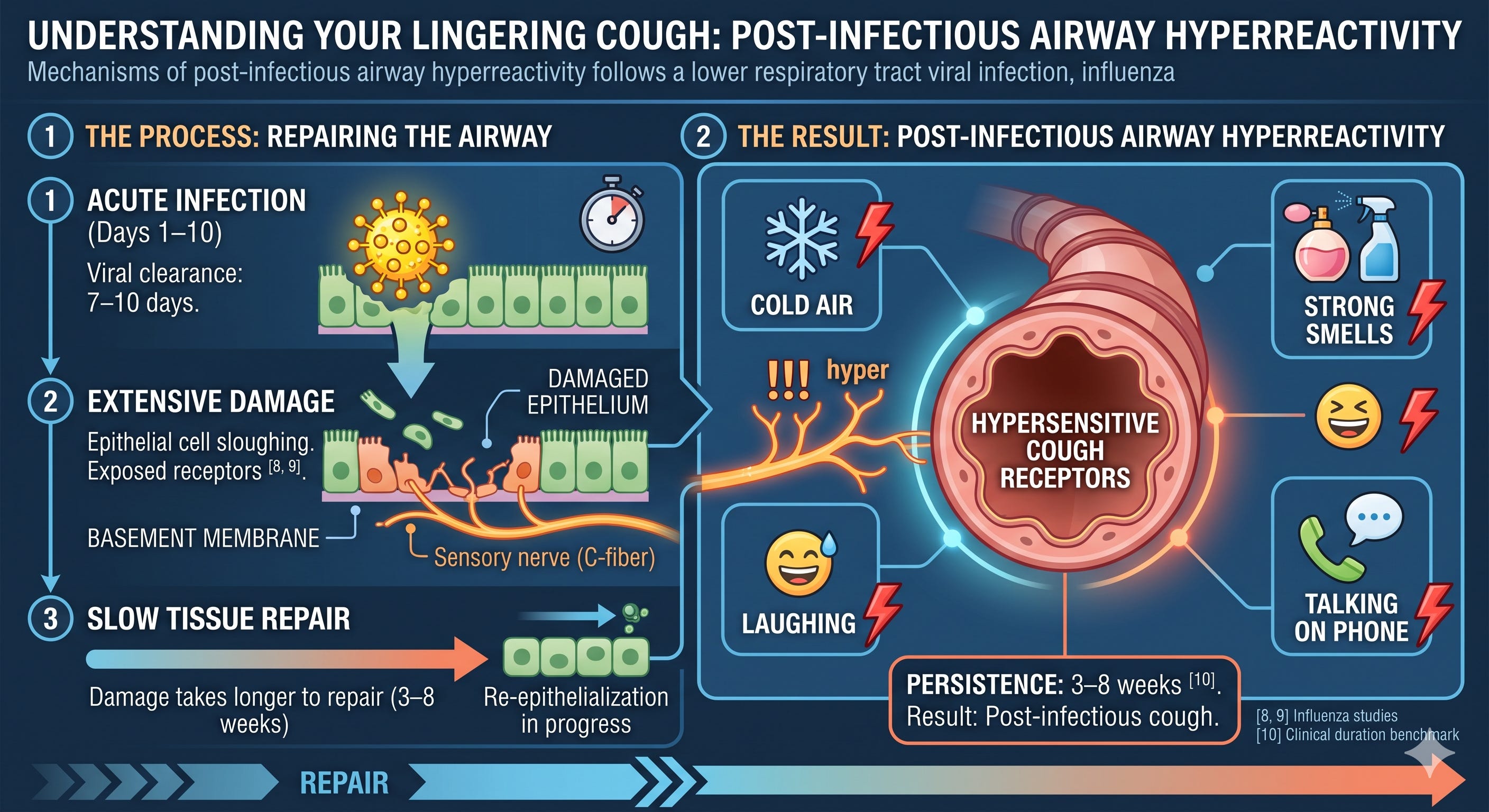
When a virus infects your lower airways, it damages the epithelial lining of the bronchial tubes. Studies on patients with influenza have shown the virus can strip airway cells all the way down to the basement membrane, with extensive desquamation of the epithelial lining [8, 9]. The infection clears in 7–10 days. The damage takes longer to repair.
What you’re left with is called post-infectious airway hyper-reactivity. The cough receptors are hypersensitive. Cold air, strong smells, laughing, talking on the phone - things that wouldn’t normally trigger a cough - now do. And this can persist for three to eight weeks [10].
Do You Need Antibiotics for Bronchitis?
Almost certainly not. The Cochrane Collaboration’s systematic review of 17 randomized controlled trials found antibiotics reduced cough duration by less than half a day, with no meaningful reduction in overall illness [11]. The American College of Chest Physicians and the ACP/CDC guidelines both recommend against routine antibiotic use for uncomplicated acute bronchitis [4, 12].
Despite this, antibiotics are prescribed at approximately 70–80% of bronchitis visits [4, 13]. Azithromycin -the “Z-pack” - is the most commonly dispensed antibiotic being handed out for a condition that is viral over 90% of the time.
In one emergency department study, physicians were 5.3 times more likely to prescribe antibiotics when they believed the patient expected them. But they correctly identified only 27% of patients who actually wanted antibiotics. And patient satisfaction was nearly identical whether antibiotics were prescribed or not—what mattered was whether the patient felt they understood their illness.
In one survey evaluating an antibiotic stewardship intervention, 38% of clinicians agreed it’s easier to write the script than explain why it won’t help. One physician in the study put it plainly: “If somebody is sick enough to come in, they’re expecting something. Doctors like to do something”.
What Actually Helps
Time. This is a self-limiting illness. Honey has modest evidence for cough relief, especially nighttime cough [14]. Over-the-counter cough suppressants help reduce cough frequency modestly. Inhaled bronchodilators are not routinely recommended unless there is wheezing. Steroids are not recommended routinely unless there is underlying asthma or COPD [12].
What helps most is knowing what to expect. If your doctor tells you the cough will likely last two to three weeks, you’re less likely to panic at week two, less likely to demand medication that won’t work, and less likely to isolate yourself when you’re no longer contagious.
When Should You See a Doctor for a Bronchitis Cough?
Most bronchitis resolves on its own. But a cough can be the presenting symptom of conditions that are not bronchitis. See a doctor if:
The cough lasts beyond three weeks. By definition, that’s no longer acute bronchitis [2, 12]. The differential shifts to include post-infectious cough, asthma, reflux, medication side effects, and other causes.
Fever returns after you’d been improving. A biphasic fever pattern suggests secondary bacterial infection or developing pneumonia.
You’re more short of breath than coughing. Shortness of breath out of proportion to the cough raises concern for other conditions such as asthma, pulmonary embolism, or heart failure.
You’re coughing up blood. That’s not bronchitis and needs urgent evaluation.
You started a new blood pressure medication recently. ACE inhibitors (eg lisinopril) cause a persistent dry cough in 5–35% of patients, depending on the study [15, 16]. According to the 2024 BTS clinical statement on chronic cough, ACE inhibitors should be discontinued in all patients with cough, regardless of temporal relationship with symptoms [17].
You’re a smoker or former smoker over 50 with a new cough that persists. Current lung cancer screening guidelines recommend low-dose CT for individuals aged 50 and older with a 20-pack-year smoking history [18, 19]. A normal chest X-ray does not always rule out cancer since some areas of the lung are poorly visualized on x-ray [20]. If the cough persists, ask about a CT scan.
You’re getting worse instead of better after 7–10 days. The natural trajectory of bronchitis is gradual improvement. If things are going the other direction, the diagnosis may be wrong.
Frequently Asked Questions
Is bronchitis contagious through kissing?
The viruses that cause acute bronchitis can be transmitted through saliva, so yes — close contact including kissing can spread the underlying infection during the first several days of illness. Once the acute symptoms have resolved, the risk drops significantly.
Can you go to work with bronchitis?
Once you’ve been fever-free for 24 hours without medication and your acute symptoms are improving, you are likely no longer contagious. You do not need to wait for the cough to fully resolve. If you’re unsure, that 24-hour fever-free benchmark is a reasonable guide.
Does green or yellow mucus mean I need antibiotics?
Not necessarily. In acute bronchitis, discolored sputum has poor predictive value for bacterial infection. Green sputum is caused by myeloperoxidase released by neutrophils—immune cells that respond to any airway irritation, including viral infections [4, 21]. The guidelines explicitly state that purulent sputum alone is not an indication for antibiotics in the setting of acute bronchitis. This does not apply if someone has underlying lung condition such as COPD or bronchiectasis.
How long does a bronchitis cough last?
The average duration is about 18 days, based on pooled data from clinical studies [6]. Some coughs persist for three to eight weeks as post-infectious airway hyperreactivity [10]. A cough lasting beyond three weeks should be re-evaluated to rule out other causes.
Can bronchitis turn into pneumonia?
Bronchitis itself doesn’t usually progress to pneumonia, but the same viral infection can sometimes lead to secondary bacterial pneumonia, especially in older adults, young children, and people with immunocompromise or underlying chronic lung disease [2, 8]. If the fever returns after improving, or you develop worsening shortness of breath, then it is a good idea to get reevaluated.
This article is for educational purposes only and does not constitute medical advice. It is not a substitute for professional medical evaluation, diagnosis, or treatment. If you have concerns about your symptoms, consult your physician. The information provided reflects current evidence and guidelines at the time of writing but may not apply to your individual situation.
Sources
1. Singh A, Avula A, Zahn E. Acute Bronchitis. StatPearls. Updated March 9, 2024.
2. Kinkade S, Long NA. Acute Bronchitis. Am Fam Physician. 2016;94(7):560-565.
3. Global Initiative for Chronic Obstructive Lung Disease (GOLD). 2026 Report.
4. Harris AM, Hicks LA, Qaseem A. Appropriate Antibiotic Use for Acute Respiratory Tract Infection in Adults. Ann Intern Med. 2016;164(6):425-434.
5. Park JY, et al. Microorganisms Causing Community-Acquired Acute Bronchitis: The Role of Bacterial Infection. PLoS One. 2016;11(10):e0165553.
6. Ebell MH, et al. Acute Cough in Outpatients: What Causes It, How Long Does It Last, and How Severe Is It? Clin Microbiol Infect. 2024;30(12):1569-1575.
7. Miller JM, et al. Guide to Utilization of the Microbiology Laboratory for Diagnosis of Infectious Diseases: 2024 Update. IDSA/ASM. Clin Infect Dis. 2024;ciae104.
8. Wenzel RP, Fowler AA. Acute Bronchitis. N Engl J Med. 2006;355(20):2125-2130.
9. Short KR, et al. Pathogenesis of Influenza-Induced Acute Respiratory Distress Syndrome. Lancet Infect Dis. 2014;14(1):57-69.
10. Braman SS. Postinfectious Cough: ACCP Evidence-Based Clinical Practice Guidelines. Chest. 2006;129(1 Suppl):138S-146S.
11. Smith SM, Fahey T, Smucny J, Becker LA. Antibiotics for Acute Bronchitis. Cochrane Database Syst Rev. 2017;6:CD000245.
12. Smith MP, et al. Acute Cough Due to Acute Bronchitis in Immunocompetent Adult Outpatients: CHEST Expert Panel Report. Chest. 2020;157(5):1256-1265.
13. Barnett ML, Linder JA. Antibiotic Prescribing for Adults with Acute Bronchitis in the United States, 1996–2010. JAMA. 2014;311(19):2020-2022.
14. Oduwole O, et al. Honey for Acute Cough in Children. Cochrane Database Syst Rev. 2018;4:CD007094.
15. Messerli FH, et al. ACE Inhibitors in Hypertension: To Use or Not to Use? J Am Coll Cardiol. 2018;71(13):1474-1482.
16. Israili ZH, Hall WD. Cough and Angioneurotic Edema Associated with ACE Inhibitor Therapy. Ann Intern Med. 1992;117(3):234-242.
17. British Thoracic Society. Clinical Statement on Chronic Cough in Adults. 2024. Summarized in Medscape, Jan 2026.
18. Mazzone PJ, et al. Screening for Lung Cancer: CHEST Guideline. Chest. 2021;160(5):e427-e494.
19. Wolf AMD, et al. Screening for Lung Cancer: 2023 Guideline Update. American Cancer Society. CA Cancer J Clin. 2024;74(1):50-81.
20. ACR Appropriateness Criteria: Chronic Cough. J Am Coll Radiol. 2021;18(11S):S305-S319.
21. Briel M, et al. Sputum Colour for Diagnosis of a Bacterial Infection in Patients with Acute Cough. Swiss study, primary care. Supports poor PPV of sputum color for bacterial infection in acute bronchitis.
22. File TM Jr. Acute Bronchitis in Adults. UpToDate. Updated Sep 5, 2025. Accessed 2026.
23. CDC. Preventing Spread of Respiratory Viruses When You’re Sick. Updated Aug 18, 2025. https://www.cdc.gov/respiratory-viruses/prevention/precautions-when-sick.html
No posts
Comments
Nothing yet. Say the first thing.
Sign in to join the conversation.