
My patient was fifty-five. Former smoker. Came in with a cough that wouldn’t quit.
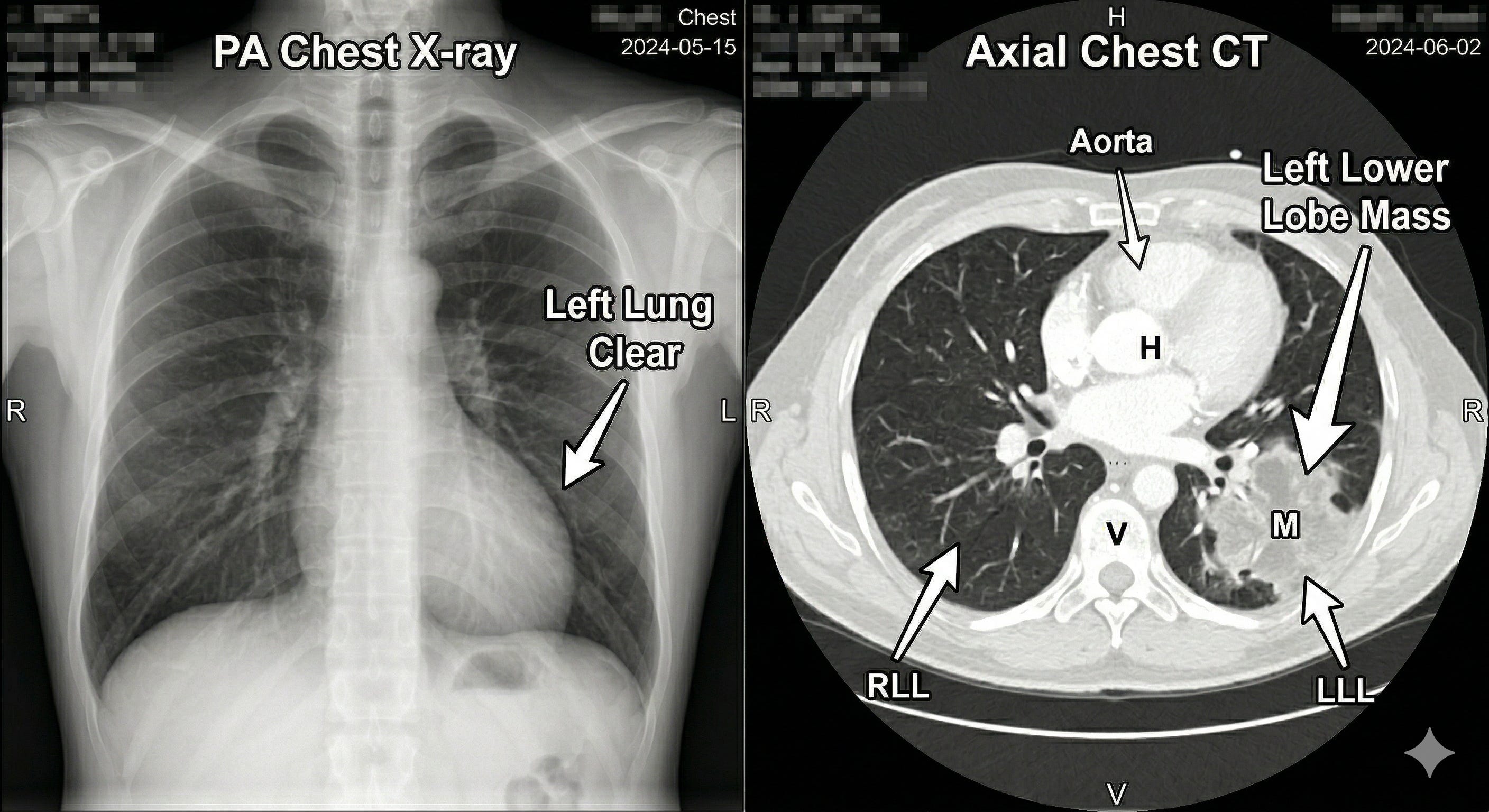
The first doctor told her it was bronchitis. Gave her a Z-pack. And steroids. She finished it. The cough came back. She went back. Got another round. Then another. Five rounds of antibiotics and steroids in three months. A chest X-ray was done somewhere in the middle of all that. It looked fine.
Nobody ordered a CT scan. Nobody asked why she kept coming back. Nobody checked whether she qualified for lung cancer screening- she did. [1, 2].
When she was finally referred to me, the CT showed a mass in the left lower lung. That’s behind the heart on a plain chest film -one of the spots where X-rays can miss things. [3] The cancer had been sitting there the whole time, hidden behind a label.
Bronchitis.
I discussed on past articles why most early lung cancer don’t have symptoms, why lung cancer screening is important, and what lung cancer biopsy, staging and treatment planning looks like.
Most of the time, bronchitis is exactly what it sounds like. It’s usually caused by a virus and the cough lasts 2-3 weeks. But I see enough cases where the label itself did the patient no favors that it’s worth examining what happens when we stop questioning the diagnosis.
A caveat before I go further- I’m a lung doctor. I see the cases that were missed. The urgent care doctor who correctly diagnosed two hundred patients with bronchitis and sent them home with reassurance doesn’t send any of those patients to me. I only see the ones where something was wrong. That’s a selection bias I want to name upfront- not to dismiss the problem, but to be honest about where I’m standing when I describe it.
Can Bronchitis Be Misdiagnosed?
Yes - and it happens more often than most patients realize.
Acute bronchitis has no confirmatory test. The 2020 CHEST Expert Panel Report defines it as an acute lower respiratory infection manifested predominantly by cough, lasting no more than three weeks, with no clinical or radiographic evidence suggesting an alternative explanation [4]. It is a diagnosis of exclusion -meaning it’s what you call the cough after you’ve ruled out everything else.
But in busy clinics and urgent cares, that ruling-out often doesn’t happen thoroughly. A patient walks in coughing. Lungs sound clear. Vitals are stable. “Acute bronchitis” goes on the chart. The label closes the visit.
What Can Be Mistaken for Bronchitis?
Pulmonary Embolism (PE)
A systematic review of PE (“blood clot” in the lungs) misdiagnosis found that approximately one-third of initially missed PEs were labeled as chest infections—pneumonia, bronchitis, COPD exacerbation [15, 16]. Smokers appear to be at significantly higher risk of misdiagnosis, because clinicians default to bronchitis as an explanation for their symptoms. Delay to correct diagnosis ranged from 5 to 14 days. PE kills when it’s missed.
Asthma and Cough-Variant Asthma
Asthma flares are frequently misdiagnosed as bronchitis. Cough-variant asthma - where cough is the dominant symptom without classic wheezing is often missed [4, 17]. It responds to inhaled steroid inhalers, whereas acute bronchitis usually does not.
Heart Failure
Fluid backs up into the lungs. The patient coughs, often worse when lying flat. In an older patient with a cardiac history, “bronchitis” can mean weeks of missed diuretic therapy [18, 19].
ACE Inhibitor Cough
Anywhere from 5 to 35% of patients on these blood pressure medications develop a dry, persistent cough [20, 21]. According to the 2024 BTS clinical statement on chronic cough, ACE inhibitors should be discontinued in all patients with cough, regardless of temporal relationship with symptoms [22]. This remains one of the more under-recognized causes of ongoing cough in primary care.
Pertussis (Whooping Cough)
More common in adults than the name suggests. Paroxysmal (sudden, uncontrolled) coughing, vomiting, inspiratory whoop. Unlike viral bronchitis, pertussis (a bacteria) is contagious for weeks and actually responds to early macrolide antibiotic therapy (such as azithromycin). It is highly contagious during the catarrhal (initial 1-2 weeks) stage, with antibiotics eliminating contagiousness after about five days of treatment [7, 8].
GERD-Related Cough
Reflux causes cough (reflux of stomach acid into the esophagus, triggers cough receptors). And vigorous coughing from bronchitis can itself trigger reflux, perpetuating a coughing cycle. The CHEST guidelines identify it as one of the most common and hardest-to-confirm causes of chronic cough [18, 19].
Lung Cancer
A new cough in a smoker or former smoker that doesn’t resolve in three to four weeks needs imaging. A normal chest X-ray is not the final word since it can miss cancer if it is small or hiding behind other organs - lung cancer in the left lower lobe hiding behind the heart. There are known blind spots on chest x-rays [3]. A CT scan sees what an X-ray can miss.
Current lung cancer screening guidelines recommend low-dose CT scan for individuals aged 50 and older with a 20-pack-year smoking history [1, 2]. And overall, lung cancer screening remains extremely underutilized [23]. As for my patient, five rounds of antibiotics got prescribed, when a CT scan could've diagnosed the cancer at even an earlier stage; but is often not ordered. In the United States, we only screen about 16% of eligible smokers for lung cancer.
Bronchitis Red Flags: When these symptoms develop, the Diagnosis Needs a Second Look
Seek Immediate Medical Attention-
Hemoptysis. Coughing up bright red blood is not bronchitis. This needs same-day ER evaluation.
Significant or worsening shortness of breath. Shortness of breath out of proportion to the cough raises concern for PE, heart failure, or severe asthma. If you’re really struggling to breathe, go to the emergency department.
Pleuritic (sharp) chest pain, especially with leg swelling. Pulmonary embolism (blood clot in the lungs) until proven otherwise—particularly in someone with risk factors: recent surgery, immobility, cancer, oral contraceptives, postpartum.
Biphasic fever. Initially getting better for a few days then getting worse suggests pneumonia or secondary bacterial infection developing. Don’t wait - get re-evaluated.
Bring Up with Your Doctor Soon-
Cough beyond three weeks. No longer acute bronchitis by definition [4]. The potential causes changes and needs a second look.
Weight loss or night sweats. Cancer. TB. Other chronic lung diseases. These warrant more workup, not watchful waiting.
Unilateral (one sided) wheeze. Bronchitis is diffuse and on both sides of the chest. A one-sided wheeze suggests focal obstruction, potentially a tumor and imaging is warranted.
New cough in a smoker over 50. Imaging. If the cough persists after a normal X-ray, ask about getting a CT scan.
Worsening after 7–10 days. Wrong trajectory. Reconsider the bronchitis diagnosis.
Worth Mentioning at Your Next PCP Visit
New blood pressure medication. ACE inhibitors cause cough in 5–35% of patients [20, 21, 22]. This isn’t an emergency, but your doctor needs to know if you have a lingering cough.
Paroxysmal coughing with vomiting. Raises concern for pertussis. Testing and early treatment matter, but this is typically managed in an clinic visit, not the ER.
Frequently Asked Questions
Can bronchitis be misdiagnosed as something else?
Yes. Common mismatches include labeling asthma, heart failure, PE, or medication-induced cough as “bronchitis.” Because there’s no confirmatory test for bronchitis, the diagnosis is only as good as the differential workup that preceded it [4].
Can a chest X-ray miss lung cancer?
Yes. Chest X-rays have known blind spots, particularly the retrocardiac space, the left lower lobe, and the costophrenic angles [3]. A normal chest X-ray does not rule out lung cancer, especially in high-risk patients (with a smoking history) with persistent cough.
Should I worry if bronchitis keeps coming back?
Recurrent “bronchitis” deserves a closer look. Conditions like asthma, GERD, immunodeficiency, bronchiectasis, and even early lung cancer can present as repeated episodes of cough labeled as bronchitis. One study found a strong association between recurrent acute bronchitis and undiagnosed asthma [26]. If you’ve been treated for bronchitis multiple times in a year, ask your doctor whether the diagnosis itself should be reconsidered.
Why did my doctor prescribe antibiotics if bronchitis is viral?
This happens frequently despite guidelines recommending against it [7]. Common reasons include diagnostic uncertainty, perceived patient expectations, and the pressure to “do something” at the end of a visit [11, 12]. Studies show patient satisfaction depends on understanding the illness - not on receiving a prescription. One of the main reasons I’m writing this article.
What is the difference between bronchitis and pneumonia?
Bronchitis inflames the large airways (bronchi). Pneumonia infects the small air sacs (alveoli) deep in the lung, though bronchopneumonia can also involve the airways. Pneumonia typically causes higher fever, more significant shortness of breath, and abnormal findings on chest X-ray [4, 24]. If your doctor suspects pneumonia, imaging and antibiotics are appropriate.
The Question That Matters
The problem with bronchitis isn’t that it doesn’t exist. Millions of people get it every year, cough for a few weeks, and recover.
The problem is what the label does in practice. It closes the visit. It creates a reason to prescribe. And sometimes it becomes the place where the thinking stops.
Most of the time, that’s fine.
But sometimes a woman comes in five times in three months with the same cough, and nobody asks the question that changes everything-
What if it isn’t bronchitis?
The content in this article is intended for general educational purposes and reflects the author’s clinical perspective as a board-certified pulmonologist. It does not constitute medical advice, establish a physician-patient relationship, or replace evaluation by your own physician. Individual symptoms vary, and only a clinician with access to your full history can make diagnostic or treatment decisions on your behalf. If you are experiencing cough, shortness of breath or other symptoms that are severe, worsening, or accompanied by chest pain, fainting, or significant distress, seek emergency care.
Sources
1. Mazzone PJ, et al. Screening for Lung Cancer: CHEST Guideline and Expert Panel Report. Chest. 2021;160(5):e427-e494.
2. Wolf AMD, et al. Screening for Lung Cancer: 2023 Guideline Update. American Cancer Society. CA Cancer J Clin. 2024;74(1):50-81.
3. ACR Appropriateness Criteria: Chronic Cough. Expert Panel on Thoracic Imaging. J Am Coll Radiol. 2021;18(11S):S305-S319.
4. Smith MP, et al. Acute Cough Due to Acute Bronchitis in Immunocompetent Adult Outpatients: CHEST Expert Panel Report. Chest. 2020;157(5):1256-1265.
5. Heintze C, et al. The Conceptualization of Acute Bronchitis in General Practice — A Fuzzy Problem with Consequences? BMC Primary Care. 2023. PMC10080804.
6. Smith SM, Fahey T, Smucny J, Becker LA. Antibiotics for Acute Bronchitis. Cochrane Database Syst Rev. 2017;6:CD000245.
7. Harris AM, Hicks LA, Qaseem A. Appropriate Antibiotic Use for Acute Respiratory Tract Infection in Adults. Ann Intern Med. 2016;164(6):425-434.
8. Wenzel RP, Fowler AA. Acute Bronchitis. N Engl J Med. 2006;355(20):2125-2130.
9. Barnett ML, Linder JA. Antibiotic Prescribing for Adults with Acute Bronchitis in the United States, 1996–2010. JAMA. 2014;311(19):2020-2022.
10. Hafeez B, et al. Patient and Provider Characteristics and Outcomes Associated with Outpatient Antibiotic Overuse in Acute Adult Bronchitis. Proc (Bayl Univ Med Cent). 2020;33(2):169-174. PMC7155999.
11. Martinez-Gonzalez NA, et al. / Linder JA. Primary Care Clinicians’ Perceptions About Antibiotic Prescribing for Acute Bronchitis: A Qualitative Study. BMC Fam Pract. 2014;15:194. PMC4275949.
12. Ong S, et al. Antibiotic Use for Emergency Department Patients with Upper Respiratory Infections: Prescribing Practices, Patient Expectations, and Patient Satisfaction. Ann Emerg Med. 2007;50(3):213-220.
13. Gonzales R, et al. One Size Does Not Fit All: Evaluating an Intervention to Reduce Antibiotic Prescribing for Acute Bronchitis. BMC Health Serv Res. 2014;14:563. PMC4228248.
14. Briel M, et al. Sputum Colour for Diagnosis of a Bacterial Infection in Patients with Acute Cough. BMC Fam Pract (Swiss primary care study). Supports poor PPV of sputum color for bacterial infection in acute bronchitis.
15. Kwok CS, et al. Misdiagnosis of Pulmonary Embolism and Missed Pulmonary Embolism: A Systematic Review of the Literature. Thrombosis Research. 2022. Pooled data from 18 studies / 2,053 patients.
16. Hendriksen JM, et al. Clinical Characteristics Associated with Diagnostic Delay of Pulmonary Embolism in Primary Care. BMJ Open. 2017;7(3):e012789.
17. Mosnaim G. Asthma in Adults. N Engl J Med. 2023;389(11):1023-1031.
18. Chung KF, Pavord ID. Prevalence, Pathogenesis, and Causes of Chronic Cough. Lancet. 2008;371(9621):1364-1374.
19. Irwin RS, Madison JM. The Diagnosis and Treatment of Cough. N Engl J Med. 2000;343(23):1715-1721.
20. Messerli FH, et al. ACE Inhibitors in Hypertension: To Use or Not to Use? J Am Coll Cardiol. 2018;71(13):1474-1482.
21. Israili ZH, Hall WD. Cough and Angioneurotic Edema Associated with ACE Inhibitor Therapy. Ann Intern Med. 1992;117(3):234-242.
22. British Thoracic Society. Clinical Statement on Chronic Cough in Adults. 2024. Summarized in Medscape, Jan 2026.
23. Zahnd WE, et al. Lung Cancer Screening Utilization: A Systematic Review. Cancer. 2020;126(15):3375-3386.
24. Kinkade S, Long NA. Acute Bronchitis. Am Fam Physician. 2016;94(7):560-565.
25. File TM Jr. Acute Bronchitis in Adults. UpToDate. Updated Sep 5, 2025. Accessed 2026.
26. Hallett JS, Jacobs RL. Recurrent Acute Bronchitis: The Association with Undiagnosed Bronchial Asthma. Ann Allergy. 1985;55:568.
No posts
Comments
Nothing yet. Say the first thing.
Sign in to join the conversation.